
Never Work Again? This Figure Changes Everything
44sThe opening hook teases a mysterious country where the same money makes you rich, immediately grabbing attention.
▶ Play Clip"Mostly delivers on its promise with real numbers, but the Telegram plug and crude asides add noise."
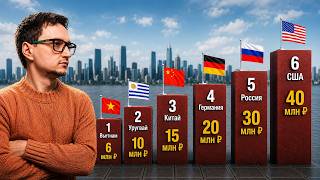
This video breaks down how much capital you need to never work again, applying the classic 4% rule to Russia (about 30 million rubles) and then comparing six countries: Vietnam, Mexico, Uruguay, Germany, and China. The presenter argues that geography and opportunities matter more than the absolute amount of money, ultimately choosing China as the best destination.
To live comfortably in Russia without ever working, the presenter calculates you need roughly 30 million rubles in capital.
Multiply your annual expenses by 25. That is the capital from which you can withdraw 4% per year indefinitely.
A normal life in Russia costs about 100,000 rubles per month. The median salary is around 74,000 rubles, so saving everything would take about 34 years — realistically twice as long.
High deposit rates like 16% are deliberately set to fight inflation. Real inflation (apartments doubled in 5 years) and ruble volatility eat returns, making ruble deposits an emotional rollercoaster.
A comfortable life in Vietnam costs about 90,000 rubles per month, needing 27 million rubles of capital — less than Russia, with ocean, summer, and an international environment.
The average local salary is about 30,000 rubles per month, so a Vietnamese person would need roughly 80 years to save for that freedom. Great for remote foreign earners, tough for locals.
A comfortable life in Mexico costs about 130,000 rubles per month, requiring 34 million rubles. It offers freedom, Caribbean Sea, and proximity to the USA, but has two-tier tourist vs. local pricing.
Comfortable life in Uruguay's capital costs 143,000 rubles per month, needing 43 million rubles. It is the safest country in Latin America, with potable tap water, digitalization, and easy residency via income proof.
Germany requires 67 million rubles for freedom at 224,000 rubles per month. However, the average net salary is 260,000 rubles per month, so a German can save enough in just 22 years.
In second-tier Chinese cities like Changzhou, Hangzhou, and Xi'an, a comfortable life costs about 115,000 rubles per month, needing 31.5 million rubles. Goods like cars and electronics cost far less than in Russia, and there are real earning opportunities.
Vietnam is a place where you mostly spend existing capital, while China lets you live cheaply and still grow your capital — the main reason the presenter picks China as the undisputed leader.
The same 30 million rubles can make you poor in one country and rich in another. Financial freedom depends more on location and opportunities than on the absolute amount you've saved.
Financial freedom is as much about geography as about money: the same capital that buys an ordinary life in Russia can fund a rich lifestyle in the right country. The presenter chooses China because it combines low costs with real earning potential.
What formula does the presenter use to calculate how much capital you need to never work?
Multiply your annual expenses by 25, allowing a 4% annual withdrawal.
00:47
How much capital is needed to live comfortably in Russia without working?
About 30 million rubles, based on 100,000 rubles per month in expenses.
00:01
Why does the presenter warn against keeping money in ruble deposits despite the 16% rate?
The high rate is designed to fight inflation; real inflation (like apartment prices doubling in 5 years) and ruble swings eat the returns.
01:44
How much monthly income and capital are needed for a comfortable life in Vietnam?
About 90,000 rubles per month and 27 million rubles of capital.
02:39
How long does a Vietnamese local need to save for financial freedom at the average local salary?
About 80 years.
03:39
Which country requires the most capital on the list, and how much?
Germany, requiring 67 million rubles for a comfortable life at about 224,000 rubles per month.
08:35
Why does Germany become the leader in accumulation speed?
The average net salary in Germany is 260,000 rubles per month, so a German can save the needed capital in about 22 years.
09:17
What are the monthly cost and capital need for a comfortable life in second-tier Chinese cities?
About 115,000 rubles per month and 31.5 million rubles of capital.
10:42
Why does the presenter choose China over Vietnam as the top destination?
In China you can live cheaply and still earn/increase capital, while Vietnam is mainly for spending existing capital.
12:06
What is the presenter's broader conclusion about financial freedom?
It depends more on geography and opportunities than the absolute amount of money; 30 million rubles can make you poor in one country and rich in another.
12:36
The 4% rule shortcut
Gives viewers a simple, actionable formula for estimating their own independence number.
00:47Why high deposit rates are a trap
Explains the gap between official and real inflation, a key insight for anyone saving in rubles.
01:44The Germany paradox
The most expensive country on the list offers the fastest path to freedom because of high salaries.
09:17Vietnam spends, China earns
Highlights the crucial difference between retiring somewhere cheap and moving somewhere with earning potential.
12:06Geography beats net worth
The core philosophical message: the same money can mean poverty or wealth depending on where you live.
12:36[00:01] never work again? I recounted six countries for the summer of '26 and came across something strange. To live comfortably in Russia and not have to work for the rest of your life, you need capital of approximately 30 million rubles. Remember this figure, 30 million
[00:18] rubles. So, there is a country where for the same 30 million rubles. You will live like a rich person. And no, this is not Africa. At the end of this video, I will tell you which country I would choose myself, and I will justify my choice with pure mathematics and numbers. Let's
[00:34] go. My name is Artem Anatolyevich Zvezn, a qualified investor, financial advisor, and a Central Bank certificate. And let's start from the very beginning. From Russia, I'll tell you how I calculated how much money it would cost to
[00:47] never work. To do this, you need to multiply all your expenses for the year by 25. This is the amount from which you can withdraw 4% per year. And in my mind, until the end of my days, it will never end. The average normal life in
[01:02] Russia is 100,000 rubles. And through simple calculations, we get exactly simple calculations, we get exactly those same 30 million rubles. Sounds pretty realistic, right? Moreover, Musk recently became the
[01:16] world’s first trillionaire. However, sausages cost 25 kopecks. The median salary in Russia is about 74,000 rubles. I would argue here, of course,
[01:28] but let it be 74,000 rubles. If you put it all aside down to the last penny, it would take If you put it all aside down to the last penny, it would take about 34 years to get these 30 million. 34. But in reality, if you are, of course, a living person, it will take twice as many years. Elvira
[01:44] Nabiullina will, of course, say: "Yes, put it on deposit at 16% and live off the interest." Stop, stop, stop. There is a nuance here. There is a reason why the 16% rate is so high . It was deliberately made tall. For what? To simply bring down
[01:58] tall. For what? To simply bring down inflation. On paper, inflation is 5.12, but in reality, apartments have doubled in price in 5 years . That is, your interest is eaten up almost often. Plus you even go into the minus. Besides this, the ruble is
[02:13] constantly fluctuating. A year ago, the dollar was worth a hundred, if you look at it in rubles. Today is 75. In short, an eternal deposit in rubles in a bank is an investment on emotional swings, as if you were living with a narcissist and a psychopath, where
[02:27] these very swings will eventually hit you on the head. 30 million is our starting point. I hope you remembered it. And now let's race around the world. Buckle
[02:39] up. Let's start with the favorite country of all my friends. This is Vietnam. First stop Vietnam. Normal, comfortable life. This will cost you approximately 90,000 rubles. per month. This is, of course, for one person and it's really
[02:54] fun. That is, it’s a separate comfortable apartment for rent, delicious food from the ocean, a beach, and some kind of spa massage, basically, some kind of entertainment in a small way. To live there comfortably according to our formula, you would
[03:07] need 27 million rubles, so as to never work there. At home in Russia, for 30 million, you get the usual default life of an ordinary Normiss, that is, an ordinary, broken Xiaomi on an installment plan. In Vietnam, for less money, you have
[03:23] the ocean, year-round summer, an international environment and complete freedom. The money is almost the same, well, even a little less. At home you would have a dull existence, but here it is a tropical paradise. But there is a spoon of decant in the Vietnamese barrel. The average
[03:39] salary of a local Vietnamese is 30,000 rubles. with our money. It seems to me that this is the same average as ours, 74,000 rubles. That is, the reality is even less. And to save up for that average life, a Vietnamese person needs
[03:56] about 80 years. For a local, that's bitter bread, but for our IT specialist working remotely and earning money somewhere abroad, it's a tropical paradise. That is, for a Vietnamese, Vietnam itself is much worse than Russia is for Russians. But since we're
[04:12] looking at this location solely from the perspective of someone who lives in from the perspective of someone who lives in Russia, Vietnam is definitely a favorite. So, Vietnam is now in first place. The table looks like this for now
[04:25] . In Russia you will need 30 million, in Vietnam 27. Let's move on. And now let's take a look at Mexico. Mexico is one of the main hubs on the planet for
[04:37] remote workers. A comfortable average life will cost you approximately 130,000 rubles. per month. With capital to subscribe to life in paradise, you'll need 34 million. For this money, you
[04:49] get freedom, the Caribbean Sea, delicious food, hot Latin American women with smelly vaginas, and, of course, tykil. Friends, to stay in touch with us and receive good analysis on financial markets and, most importantly,
[05:02] recommendations on what to buy right now , please subscribe to my Telegram channel and, God forgive me, my Max channel if Telegram is unavailable to you . You can scan these QR codes and subscribe to the
[05:16] Telegram channel or to Telegram in Max. Our channel is very different from what you see in most cases, because, firstly, we are responsible for our words, and secondly, we bear full legal and moral responsibility
[05:32] for what we say. So please scan these Telegram channels. We are not hiding from justice somewhere in Dubai. We work honestly, legally, and within the legal framework. Scan QR codes, subscribe. Mexico is
[05:46] expectedly more expensive than Vietnam. Let me remind you that in Vietnam you'll need 27 million, in Vietnam you'll need 27 million, in Mexico 34. In Russia, you'll only need 30. But Mexico has its own trump card. It's as if there are two countries here
[06:01] in terms of prices. That is, there are tourist prices for the pale-faced, roughly speaking, yes, who came for two weeks, and, basically, to throw around some money. And there are locals. And so, local targets, that is, those who go to working-class areas and
[06:15] cafes, will spend several times less than vacationers. That is, you can live quite comfortably with the same amount of money. Plus, the USA is always right next to you . For many, this is a straightforward decision: No, no, but there will still be a hole in the fence. And from
[06:30] there it’s not far to Los Angeles. So, in the ranking, Moscow loses to Vietnam in terms of price, but wins in terms of its development and capabilities. Vietnam currently holds first place in terms of money. The next place, you probably won't guess,
[06:45] is Uruguay. And let's continue the trend with South America. Uruguay is the Switzerland of Latin America . And this is not just some name that is often heard in all sorts of neronchi. In Uruguay,
[06:59] comfortable life is located in the capital. 143,000 rubles per month you will need to feel comfortable there. And in order to never work there again, you will need 43 million rubles. For this
[07:12] region it is quite expensive, more expensive than, frankly, in our neighbors. But the Tsimus of Uruguay is this. It is the safest country on the continent. Tap water is practically potable and one of the easiest paths to residency and citizenship in the world
[07:27] . I think you understand the logic. That is, in Vietnam, this is a place where you save money. Uruguay is a place where, on the contrary, they even pay you a little extra so that you can sleep peacefully and not be afraid of any kind of [ __ ].
[07:41] I don't think there's even any point in talking about the beauty of Uraguay, because the country is incredibly beautiful and colorful. High level of digitalization, the banking sector is well developed. The country also has a robust system of both free
[07:53] public and private healthcare, and healthcare, and residence permits, we usually don't talk about them here, but Uruguayan residence permits are
[08:08] easy to obtain. Simply by confirming your income of $1.00 or about 100,000 rubles. with kopecks. Uruguay is definitely a country Uruguay is definitely a country that deserves your attention. So,
[08:22] we update the table. Vietnam - 27 million, Russia - 30 million, Mexico - 34 million, million, Russia - 30 million, Mexico - 34 million, Uruguay - 43 and the leader is still Vietnam.
[08:35] Now let's do a sharp turnaround and turn ourselves into the very heart of old Europe. Let us turn to Germany. And here, of course, get ready. I think you understand perfectly well what I'm going to talk about.
[08:49] Germany is [ __ ] very expensive. A comfortable average life here starts at around 224,000 rubles. per month per person. The capital you would need to never work here is 67 million. In terms of
[09:04] cost, Germany simply flies to the last place. Let me remind you of the whole list. Vietnam - 27, Russia - 30, Mexico - 34, Uruguay - 43, Germany - 67.
[09:17] Well, this is the bottom of the ranking, of course, in terms of price, but in terms of accumulation speed, Germany suddenly becomes the leader. The average net salary in Germany is
[09:29] 260,000 rubles. per month. And a German only needs 22 years to save up for this financial freedom. That is, a Vietnamese, let me remind you, a Vietnamese will need 80. That's where the paradox lies. to live is more precious than anyone else. And in terms of
[09:44] the level of freedom, how can a German achieve this very freedom? The easiest way. That is, Germany should be viewed solely as a platform for growth and opposition to the Vietnamese model, where you come with money and
[09:59] I hope that the police won't break into my place with a bottle now. Here, most likely, your money, of course, will not be enough, but the opportunities to realize yourself, to realize your potential are much higher. On the plus side, it could be a good start to a
[10:13] new life. Well, it’s clear that Germany has everything you could dream of. High medicine, beauty. I don't think there's any point in listing them here. The downsides, as strange as it may sound, are that it is unsafe and, of course, noticeably expensive. I think for
[10:28] most people Vietnam is now the obvious leader. Yes, I think that even you won’t argue with that . But there is one last country that turns any country that turns any idea of life abroad upside down. This is
[10:42] China. And I will immediately destroy your idea. China is inexpensive. Expensive supercities like Shanghai, for example. But the real China is the second-tier cities like Changzhou, Hangzhou, and Xi'an, for example, where your
[10:56] world-class life costs, well, not that much. I would like to say pennies, but in general, a comfortable average life here starts at 115,000 rubles. per month. starts at 115,000 rubles. per month. Capital of 31.5 million rubles. You will need to
[11:10] never work there. So, formally, Vietnam is still a little cheaper, but why then is China, in my opinion, so much better and takes first place as the undisputed leader? Firstly, the same Chinese car can
[11:23] cost almost twice, three times less in China than in Russia. And this is a fact. I think if you just google it, you will be very surprised. Here, in this regard, as they say, everything is for the people, and
[11:37] any Chinese person can afford a car, even if he works as a window cleaner. So, it's exactly the same picture throughout. Equipment, phones, clothes, all of this is available for half the price of what it costs in Russia. The biggest advantage for an adult in
[11:52] China, unlike Vietnam, is that you can actually earn money not only as a remote worker. Business with the CIS countries, supplies, remote work, a bunch of people who have already moved. Well, that's basically how they live. I think you can feel the
[12:06] difference. Vietnam is where you only spend capital, and China is where you live cheaply and at the same time can also increase this very capital. That's why I'm removing Vietnam from first place, despite its low prices . And for me, China is the
[12:21] obvious leader here. What do you think about my opinion? Do you agree with this? In general, while I was counting all these countries, it dawned on me, you know, this same logic. Final freedom never rushes with the amount of money. It's
[12:37] more about geography and the opportunities that geography gives you. The same 30 million rubles. can make you poor in one country and rich in a completely different one. Same money, same financial strategy, same you. The only question is
[12:51] where in the world you are. And the funniest thing is that most people struggle all their lives to earn more. More, more, more. And in the end they still end up
[13:04] with nothing. But almost no one ever asks themselves: "Maybe, screw it, maybe I'm heading in the wrong direction? Maybe I should slow down a bit and, so to speak, move and live there, even if not super-ultra-rich."
[13:21] Nevertheless, you know, it’s as if I’ve just walked through the pains of a midlife crisis, but this is a wound that I also have. This is really worth thinking about. And in this video I chose China for myself. And
[13:34] why, now we understand why, right? And you write in the comments which country you think is the best for living and feeling comfortable. And most importantly, remember that work and social fulfillment are one of the
[13:48] social fulfillment are one of the foundations of our personal fulfillment.




⚡ Saved you 0h 13m reading this? Transcribe any YouTube video for free — no signup needed.