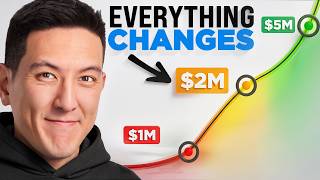

Why $1M to $2M Matters More Than $2M to $5M
44sThe counterintuitive claim that a smaller monetary gap has a bigger impact challenges common assumptions and sparks curiosity.
▶ Play Clip"Delivers on the promise with concrete numbers and clear explanations, though some sections feel padded with repetition."
This video analyzes how retirement planning changes at three key portfolio milestones: $1 million, $2 million, and $5 million. It examines income, taxes, risks, and psychological shifts at each level, concluding that the jump from $1M to $2M is more significant than from $2M to $5M due to the security it provides.
The difference between retiring with $1M vs $2M is bigger than between $2M and $5M because retirement problems change: at $1M it's a math problem, at $2M a risk problem, at $5M a purpose problem.
The 4% rule allows withdrawing 4% of your portfolio in the first year, adjusted for inflation, historically safe for 30-year retirements with a 50/50 stock/bond split. Thus $1M yields $40k/year, $2M yields $80k, $5M yields $200k.
Median retirement balance for 65+ is ~$44k, average ~$200k. Only 3-5% of retirees have $1M+. With $1M and $48k social security (household), total income ~$88k, exceeding the median working household income of $80k.
Standard deduction 2026: $16,100 single, $32,200 married, plus $3,300 if 65+, and temporary $12k household deduction. Long-term capital gains tax 0% if income < $98,900 (joint). Well-structured $1M portfolio may pay near-zero federal taxes.
Market downturns early in retirement deplete assets faster. Example: 15% decline in first two years leaves investor near depletion by year 18, while same decline in years 10-11 leaves $400k+. Mitigate with cash/short-term bonds.
At $1M, budgeting never stops; you may not feel financially free. Money is still a constraint, and market dips can cause stress.
4% of $2M is $80k, plus $48k social security = $128k gross income, placing you in top 15-20% of households. Portfolio can sustain itself.
Required Minimum Distributions (RMDs) start at 73 (75 for born 1960+). On $2M, forced withdrawals ~$70-75k/year may push you into higher tax brackets. Strategy: convert traditional IRA/401k to Roth before RMDs, saving up to high five figures.
After 40 years of accumulation, switching to spending is hard. Many retirees underspend, leaving millions unspent. Financial advisors may need to force a spending budget.
People either fear self-sabotage or move goalposts to $2.5M, $3M, $5M. Survey data shows people need roughly double what they have to feel secure, driven by identity tied to net worth.
4% of $5M is $200k, plus $48k social security = ~$250k gross income. Default outcome is dying richer than you started; requires effort to avoid.
Federal estate tax exemption is $15M per person ($30M couple) in 2026. Step-up in basis means heirs may owe little to no capital gains. Focus shifts to legacy and property taxes.
With infinite security, the biggest risk is loss of purpose. Identity shifts, stress may increase. Need to find meaning beyond work, such as helping family, hobbies, or community service.
The jump crosses the security line: at $1M, the plan works only if nothing goes wrong; at $2M, it works regardless. $2M unlocks flexibility and freedom from constant budgeting. $2M to $5M is just upgrades.
Diminishing marginal returns of wealth. If you're heading to $1M, you're ahead of most. If between $1-2M, every extra dollar is valuable; consider working one more year for peace of mind. Past $2M, the problem is purpose, not numbers.
The video concludes that the most significant financial milestone is reaching $2 million, as it provides true security and flexibility, while beyond that, wealth yields diminishing returns and the focus shifts to purpose and legacy.
What is the 4% rule?
Withdraw 4% of your portfolio in the first year of retirement, adjusted for inflation, historically safe for 30 years with a 50/50 stock/bond split.
01:22
What is the median retirement account balance for people 65 and up?
Around $44,000 according to Vanguard.
02:42
What is the standard deduction for married couples filing jointly in 2026?
$32,200, plus an additional $3,300 if over 65, and a temporary $12,000 household deduction.
04:00
What is sequence of returns risk?
The risk that market downturns early in retirement deplete assets faster, reducing future growth.
05:34
At what age do Required Minimum Distributions (RMDs) start for those born 1960 and later?
75 years old.
08:25
What is the federal estate tax exemption per person in 2026?
$15 million per person, $30 million for a couple.
13:42
What is the biggest risk at the $5 million retirement level?
Loss of purpose, as money is no longer a constraint.
14:37
Why is the jump from $1M to $2M more significant than from $2M to $5M?
Because it crosses the security line: at $2M, the plan works regardless of market conditions, while at $1M it only works if nothing goes wrong.
16:11
The 4% Rule
Provides a concrete, widely-used rule for retirement withdrawals.
01:22Ahead of the Average
Shows that $1M is already above 95-97% of retirees, countering common fears.
02:42Sequence of Returns Risk
Illustrates with a graphic how timing of market declines drastically affects portfolio longevity.
05:34Underspending Risk
Highlights a counterintuitive risk: retirees may not spend enough, leaving wealth unutilized.
09:42Security Line
Explains why $2M is a pivotal milestone for financial security.
16:11[00:01] between retiring with $1 million versus $2 million is actually bigger than the difference between retiring with two and five million dollars? It sounds like a math error because the jump from two to five million is $3 million versus the
[00:14] jump from one to two is only $1 million, but here's the thing, retirement isn't completely different problems depending on where you land and money solves each dollars, I think the core problem you have is a math problem. You're trying to
[00:29] calculate balance is going to last you at least 30 years and if not, what adjustments you might have to make. At $2 million, retirement becomes a risk problem. You probably have enough for a very comfy retirement, but managing your
[00:41] risk comes way more into question. And at $5 million, retirement becomes a purpose problem. The money isn't just a constraint at this level, but a much place. In today's video, we're going to walk through all three levels and for
[00:54] each tier, we're going to go over four variables. Number one, how much income what your tax bill might look like. Number three, the single biggest risk at which is the psychological shifts that happen at each number. And by the end,
[01:09] you will see why the jump from one to two million dollars matters much more right, so let's get into it. The standard calculation for figuring out what you can spend in retirement is all going to be based off of the 4% rule.
[01:22] might have probably already heard about it, but it was subsequently studied by researchers to answer the following question. What is the highest withdrawal rate that survives any 30-year retirement window in US stock market
[01:35] history? The answer was around 4% and since then, it's been revised to around 4.5 or 4.7%, but for most of the financial community, we still prefer 4% number. To illustrate how this works, let's say you start with a $1 million
[01:50] retirement portfolio. In your first year of retirement, you can withdraw 4% of your total balance, which is $40,000. Then the next year you would take the baseline $40,000 out and then maybe you account for some inflation of 2%. You
[02:02] might take out around $40,800 and so on and so on every single year until you retire. The assumption here was that as long as your portfolio was split evenly 50/50 between stocks and bonds, you would not run out of any money back
[02:15] of the market. So, that means with a retirement balance of a million dollars, you could withdraw $40,000 per year and at 2 million that becomes $80,000 per year and at $5 million, that's around $200,000 per year. So, most of you
[02:29] that's no surprise to me, but the raw withdrawal number that you take is maybe only 25% of the actual story. At each level of retirement today, those four variables are going to be constantly changing. Those are the same four that I
[02:42] start with the $1 million retirement portfolio level. It's at this level that you're actually ahead of the average American. In fact, the median retirement account balance for people 65 and up is around $44,000 according to Vanguard.
[02:56] And the average retirement balance is closer to $200,000 according to the Federal Reserve's Survey of Consumer Finances. Now, both of these numbers are same survey, only about 3 to 5% of retirees are going to have more than a
[03:09] million dollars in retirement or more. So, let me be clear, if you're on target for a million dollars or more by the time you retire, you're already ahead of let's say 95 to 97% of people. Now, the real math at this level is the
[03:21] number one, which is real income, you're going to be able to withdraw that $40,000 per year from your retirement account balance. In addition, the average social security payment in America is just about $2,000 a month per
[03:34] person, so that's $24,000 per year. That means if you have a household of two adults, you're going to be able to have $48,000 in that social security payments plus the 40K from your retirement account portfolio. So, that's a total of
[03:47] $88,000 per year. Consider that the median working household in the United States earns around $80,000 per year. That means with a million dollars in median working family without having to actually, well, work. And that's pretty
[04:00] nice. In terms of number two, which is the tax considerations, this is where it gets really fun. The million-dollar retiree might have the lowest tax rate of their entire adult life because the standard deduction in 2026 is $16,100
[04:14] for single filers, and for married couples filing jointly, that's actually double that, so $32,200. If you're over the age of 65, you can get an additional $3,300 combined in extra standard deduction. Also, if
[04:27] reason, there's a temporary bonus deduction of $6,000 a person or $12,000 a household, and this actually came out with the 2025 Big Beautiful Bill. So, obviously, if you're watching this video in 2029, that might be phased out, but
[04:42] still, that's 35.5k of a standard deduction without the temporary 12k deduction added. That means as of today, the $1 million dollar retiree household can already have between 35.5 to 47k of their income
[04:55] consider that social security benefits are only partially taxable to begin with, so that's an added benefit as well. If you are withdrawing $40,000 per year of gains from your taxable brokerage account, you will pay 0% in
[05:09] long-term capital gains so long as your income is less than $98,900 filing jointly. That means if you were to have a well-structured $1 million be only paying a few thousand dollars in federal taxes, and that's probably just
[05:22] some years you might actually pay nothing. So, that's really nice. It's one of the biggest benefits of retiring with this amount. Now, let's move on to category number three now, which is what is the biggest risk that we have to
[05:34] portfolio? And I think that there is no bigger risk here than the sequence of returns risk at this level. Basically, sequence of returns risk means that your matters. If you retire and then immediately, let's say you go through a
[05:49] 2008 type of drawdown where the market tanks 20 to 40%, that's going to be a into your retirement account for living expenses. You're also going to have fewer assets left because you're tapping into your retirement account when the
[06:02] market is down. So, those fewer assets will not be able to generate as much growth during future recoveries. If you take a look at this graphic from Charles and investor two, they both start with a million dollars in their portfolio.
[06:15] Investor one, however, they experience a 15% decline during the first two years by the time they hit year 18, they're close to depleting their entire balance. Investor two experiences a 15% decline
[06:27] after their 10th and 11th years of retirement, so you can see that the you experience that decline in the 10th and 11th years of retirement, investor two is still going to have over $400,000 left at the end of 18 years. So, while
[06:40] when the market dips are going to happen, the one way to mitigate some of reserve of low-risk investments like cash or perhaps short-term bonds that you can use to cover expenses in case there is a drawdown, and usually you
[06:54] expenses. I know that's not always possible for people, but I think that allocation of cash or short-term bonds, you're going to feel more comfortable with the market exposure of the rest of your retirement portfolio. Let's talk
[07:07] million level, and that's the psychological bit here, and that's the fact that I think that budgeting will never stop at this level. Because your amount, money is still going to be very
[07:20] you're still maintaining a budgeting spreadsheet, or it can mean that you there, and then if the market goes down 10% in a quarter, it actually might to consider at this level and just to be aware of, which is that you might not
[07:33] feel financially free even though you are quote retired. All right, so let's move on to the $2 million mark now because at $2 million, this is the number that's more than enough for most Americans. 4% of $2 million is 80k, and
[07:46] in retirement where your portfolio can still sustain itself. If we were to add in the same $48,000 of household social security payments, that means your total gross retirement income is around $128,000.
[08:00] million in your portfolio, that means you're going to be drawing about $11,000 per month in retirement income, and that's going to put you in the top 15 to 20% of all American households in terms of income already, regardless of if you
[08:13] work or not. Number two, let's talk about the tax picture now at the $2 million level. The first thing you need to be mindful of here are required minimum distributions. If most of your two million bucks is in a traditional
[08:25] 401k or IRA, you're going to be forced to withdraw that money and pay ordinary income taxes on that money if you're over the age of 73. If you're born 1960 and later, that's going to be changed to 75 years old. That means on your $2
[08:38] million portfolio, you could be forced to take out around 70k or maybe 75k per year in your 70s, and then on top of the social security payments you might be tax bracket that perhaps you haven't visited since your working years. Now,
[08:51] luckily, in terms of capital gains here, even if you are taking $80,000 out of a taxable brokerage account in long-term capital gains, you're still sitting need to start paying taxes on it. One strategy that people do here if they're
[09:03] worried about the RMD taxes is, let's say they retire at the age of 63 and most of their money is in a traditional IRA or 401k, they just convert chunks of that into a Roth. While they will have to pay taxes when they convert the funds
[09:16] from the traditional to the Roth versions, at least they are paying taxes very low. If they do this for the next 10 years before they're required to take out minimum distributions, it could actually save them close to high five
[09:29] right, so, moving on to category number three here, what is the biggest risk at the $2 million portfolio level? Well, I think number one, sequence of returns like in the previous section. If you
[09:42] beginning of your retirement, it's going to make you rework your entire plan. But doesn't sound like a risk, but it actually is and that is underspending. If you've gotten to a point where your portfolio or your investment account is
[09:56] at least $2 million, you've probably spent at least 40 years accumulating you're so ingrained in this behavior and habit that it's hard to flip the switch from accumulation mode to spending mode. My dad is a really great example of
[10:09] about money and accumulating it and then still fly economy class, he would eat frozen meals, and he would keep driving his 12-year-old car. Not because he couldn't afford those nicer things, but
[10:22] mindset off. And if you're watching this channel, you actually might have the for the same problem and this is something that I want to remind you guys money with you at the end of your life. One of the biggest risks for you if you
[10:36] might actually end up with three or four million dollars by the time you kick the avoid, so you're going to have to find ways to spend that money whether that's forcing someone like a financial advisor to give you a budget to spend every
[10:51] year. So, what's really going on with the psychology here at the $2 million level? First, you're really not worried about having enough at this level, at talked to people with this much money in their investment portfolios, they
[11:03] usually fall into one of two camps. The first is the type of person that thinks need to protect themselves against themselves because they're afraid that portfolio that could derail their entire retirement. The second is a person that
[11:17] has a much darker pattern which is that when they get to $2 million, the goal to that have $2 million bucks already, they want to hit that next milestone. So, $2.5 million, $3 million, $5 million, etc. And there's a lot of
[11:31] survey data that actually backs this up, which is that essentially people at roughly needing double what they currently have to feel secure. And I think I know why this happens because for 40 years of your life, or even more,
[11:44] bank account or your investment portfolio, etc. And that number is a reflection of how well you are doing at life. So, when you finally reach the time when it's time to retire and to actually draw down that balance,
[11:57] and number two, you might actually just create a new goal post for yourself and instead and continue that pattern of accumulation. So, that's definitely a problem at the $2 million level. But, what happens when you reach a number so
[12:11] big that mathematically money isn't a problem anymore? That's actually what happens at the $5 million retirement level. So, at $5 million, it's at this level where the amount you can draw from your portfolio is $200,000 per year. If
[12:24] you added the social security payments, that's another $48,000. So, you're going to have a gross income of around 250k when you consider your nest egg. Now, a real problem at this amount is that you will most likely die richer than what
[12:36] you started with. At lower tiers, the die richer outcome is possible, but it depends on flexibility, health, and luck. But, at $5 million of a portfolio, it's actually the default outcome and I think it requires a lot of effort to
[12:49] avoid that. 200k of spending money is more flexible than 40k per year like the $1 million portfolio has. So, if something bad were to happen, such as a health-related issue occurs and say you have to come out of pocket for $20,000,
[13:02] $40,000, the person with $200,000 a year is going to be able to weather that are dollar denominated and not percentage denominated, it's going to adversely affect the person with a lower portfolio much more. Another argument
[13:15] here is that a $200,000 lifestyle versus a 120k lifestyle per year is pretty similar at the end of the day. You might even have some years where you're just not spending the the 200k that you're technically allowed to spend with the $5
[13:28] to consider. Now, let's actually talk about the tax picture at the $5 million level. When you reach this echelon, it's really not about the income tax anymore. It's more about what happens to your money after you are gone. The good news
[13:42] is is that the federal estate tax exemption is $15 million per person as of 2026 and up to $30 million for a couple. There might be some state taxes in. So, what this essentially means that if you have $5 million and you're trying
[13:56] to pass it on to your kids after you're gone, they essentially will pay no taxes basis, which means that if you're passing on property with a low cost up to the value on the date of your death. That means if your kids inherit
[14:10] your property and then sell it, they might owe lower amounts of capital gains your cost basis. Of course, the trade-off here is that the recurring property tax amounts might get increased in certain states like California. But,
[14:23] questions about other people after you pass. And I'm sure after you pass, that much. But still, it just goes to show you that the more money you have, other people are going to handle it. Versus when you have a $1 million of a
[14:37] about yourself. All right, category not financial anymore. I just really want to emphasize that because you definitely have more money than you will ever need. One risk at $5 million you
[14:50] to want your money and you essentially become a target of financial products placements, REITs, alternative investments, etc. And when you're older, perhaps your sense of judgment lapses from time to time and you might actually
[15:04] financial products or maybe even financial scams. But let's move on to category number four, the psychological part, because the biggest risk is also psychological shift, which is also the risk, is a matter of purpose. Because if
[15:19] you have $5 million in retirement, you basically have infinite security. Now, were working towards your entire life for, and now that you've achieved it, you might be starting to have some newer questions. You start to experience a
[15:31] shift in identity, and then you might start to ask yourself, why am I even oftentimes our career and work does don't have a purpose anymore, your levels of stress might go up, and you
[15:43] might become less satisfied with your life. It's at this level you might have doesn't mean that you have to go do something crazy like save the world or simple as helping your kids or grandkids, mastering a new hobby, or
[15:57] doing community service. The question you might find yourself asking is, what the real thing you should be trying to solve on your way up to this portfolio successful people I know are the ones who have the answers to what is this all
[16:11] for, and have had plans for their money long before they were retired. All right, so now I want to answer why I still think the jump from one to two million. In my opinion, the jump from
[16:23] line, and that line is all about security. At one million dollars or below, you have a plan that will work only if nothing goes wrong. At two million dollars and above, you have a plan that will work regardless if things
[16:36] there's going to be more security and more flexibility at the two million dollar level, and that's when it really unlocks. You get the ability to not much. You don't have to worry about one-off expenses derailing your
[16:50] the time about budgeting. Now, don't get me wrong, the jump from two to five It's going to give you options like perhaps you can fly business class and travel way more often, and you can maybe perhaps pass down that wealth to
[17:04] kind of thing. But those are upgrades within your retirement already, and the occurred from the one to two million dollar jump. So, the takeaway here is that as you accumulate more money, it has diminishing marginal returns, and
[17:18] after you reach a good level of security, the next incremental 100k or $1 million might just be a number. So, what can you actually take away from this video? Here is my take. If you're on your way to the $1 million mark, I
[17:30] than what the internet will tell you, especially because you get social million dollars in retirement is definitely way ahead of the average American as we've proven today, and even though it's just tier one in this video,
[17:44] it's still really good. Like it's like it's amazing. I just wanted to give you insights on what you could reasonably expect on your way to the $1 million and at the $1 million level. If you're between 1 and $2 million, then hopefully
[17:57] every additional dollar you save right now is very valuable for your future. you're able to work one more year without stressing yourself out considering because it might be worth a lot of peace of mind if you're able to
[18:11] hit that $2 million and above mark. And if you're past the $2 million mark or perhaps you're on your way to $2 million with high confidence, I can say that your problem is no longer the number anymore, but it's rather a question of
[18:23] future videos, I will share some tips and strategies to get you to your first million dollars, $2 million and beyond, so make sure you are subscribed for comments what tier are you working towards? My guess is that most people
[18:36] are working towards at least $1 million, but do you have aspirations of $2 million and beyond? Let me know. If you're interested in my video on how far 250k, 500k, 750k, and $1 million take you in retirement, you should check out
[18:49] see you guys in that one or a future one on the channel. on the channel. See you later. Peace.




⚡ Saved you 0h 18m reading this? Transcribe any YouTube video for free — no signup needed.