

The Hardest Wealth Tier? $100k
43sViewers love relatable financial milestones, and the claim that $100k is the hardest tier sparks debate and self-reflection.
▶ Play Clip"Delivers exactly what the title promises — a clear, tiered breakdown of wealth levels, though it lacks depth on how to achieve them."
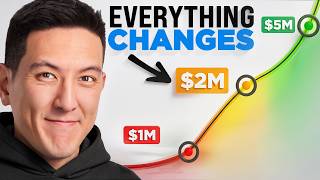
The video outlines a four-tier framework for measuring wealth, from $100k to $5 million, emphasizing the role of compounding and financial independence. It explains how each tier represents a milestone of financial security and freedom, with practical implications for retirement and lifestyle choices.
The hardest tier to reach because it requires consistent saving and discipline; it proves good financial habits and cannot be achieved by accident.
If under 45, this amount allows you to stop investing because compounding will grow it into a full retirement; you can coast at work or take a part-time job to cover bills.
Withdrawing 4% annually yields $80k per year, providing a full income without working; sufficient for 99% of people, making work optional.
Represents financial freedom for those with higher costs of living or many liabilities; reaching this tier is hard and may require additional strategies.
Reaching tier 1 makes tier 2 easier due to compounding, and then tier 3 becomes more attainable; tier 4 is significantly harder.
The video presents a motivational framework for wealth accumulation, highlighting that reaching the first tier is the hardest but sets the stage for compounding to accelerate progress toward higher tiers.
What is the first tier of wealth according to the video?
$100k
00:02
Why is reaching $100k considered the hardest tier?
Because it requires consistent saving and discipline, and cannot be achieved by accident.
00:02
What can you do if you have $500k and are under 45?
You can stop investing because compounding will grow it into a full retirement; you can coast at work or take a part-time job.
00:14
How much annual income does $1 million provide at a 4% withdrawal rate?
$80k per year
00:39
What does the $5 million tier represent?
Financial freedom for those with higher costs of living or many liabilities.
00:51
Tier 1 is the hardest
Establishes the baseline for wealth accumulation, emphasizing the importance of discipline.
00:02Compounding allows coasting
Highlights the power of compounding to make work optional at $500k.
00:144% rule for retirement
Introduces a practical rule for sustainable withdrawals in retirement.
00:39Compounding accelerates progress
Explains why reaching tier 1 makes higher tiers easier.
01:06[00:02] tier one is 100k. Now, this one is the hardest, but luckily it does get easier as you climb. 100k invested is impressive because you can't get there by accident. So, it's proof that you've got good financial habits, you have
[00:14] discipline, and that you're able to save consistently. Tier two is 500k. If you're relatively young, say under the age of 45, having 500k means that you stop investing altogether because your portfolio is already big enough that
[00:27] compounding alone will grow it into a full retirement. At that point, you can just coast at your job or you get a part-time job to cover bills. Tier three million because if you have this much,
[00:39] 4% withdrawn every single year is 80k per year in retirement, which means that you can get a full income without working. This should be enough for 99% of people and work is entirely optional at this point. Now, if you have a higher
[00:51] cost of living or many liabilities like multiple houses or kids, then maybe not, pretty much financially free. And tier four is $5 million. This is where you altogether. Now, the best part is is that if you can reach tier one, which
[01:06] two is a lot easier because of compounding and then hopefully you're on your way to tier three. Getting to tier four or $5 million though is actually quite hard and we can talk about some methods to do that in a future video,
[01:19] but let me know what tier you are on in the comments.



⚡ Saved you 0h 01m reading this? Transcribe any YouTube video for free — no signup needed.