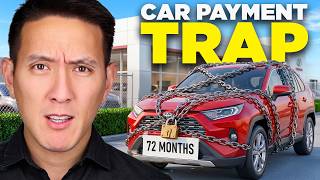

Never Tell a Dealer Your Monthly Budget
44sReveals a common mistake car buyers make that can cost them thousands, prompting viewers to rethink their approach.
▶ Play Clip"Delivers solid, actionable advice on car financing, though the title's '2026' is a bit gimmicky."
This video exposes common car dealership financing tactics that can cost buyers thousands of dollars, such as negotiating based on monthly payments, dealer interest rate markups, and hidden add-ons. It provides five actionable steps to prepare before visiting a dealership, including knowing your budget, getting pre-approved, and focusing on the total price.
Salespeople ask about your monthly budget to manipulate the deal. Revealing a range like $500-$600 allows the dealer to adjust price, loan term, interest rate, and add-ons to maximize their profit while keeping the payment within your stated range.
Dealers use a four-square worksheet with quadrants for trade-in, vehicle price, down payment, and monthly payment. They steer you to focus on the monthly payment, while the vehicle price barely changes, making it seem like you're saving money when you're not.
Dealers can mark up your interest rate for their own gain. A 2015 DOJ settlement with Honda limited dealer markup to 1.25% for loans ≤60 months and 1% for longer loans. A 1% markup on a $27,000 loan can cost $764 extra in interest.
The video outlines five steps: 1) Know your exact budget using the 24/10 rule (20% down, total car costs ≤10% of gross income), 2) Get pre-approved for a loan from a bank or credit union, 3) Refuse to discuss monthly payments and focus on total price, 4) Keep loan term to 60 months max, 5) Handle add-ons separately or decline them.
Finance managers push add-ons like extended warranties, paint protection, and gap insurance. Gap insurance can be purchased separately from an insurance company, and extended warranties can be bought later, so you don't need to decide under pressure.
By preparing with research and a clear budget, you can avoid common dealership traps and negotiate a fair deal. Focus on the total price, not the monthly payment, and you'll save thousands.
What is the 24/10 car buying rule?
Put at least 20% down, finance for no more than 4 years, and ensure total monthly car costs (payment + insurance) do not exceed 10% of gross monthly income.
05:54
What is the maximum dealer markup on interest rates for loans of 60 months or less, according to the Honda settlement?
125 basis points (1.25%).
03:50
What is the maximum dealer markup for loans greater than 60 months?
100 basis points (1%).
04:05
How much extra interest does a 1% interest rate hike cost on a $27,000 loan?
$764 over the course of the loan.
04:33
What are the four quadrants of the four-square worksheet?
Trade-in value, vehicle price, down payment, and monthly payment.
01:49
What is the recommended maximum loan term to avoid negative equity?
60 months (5 years).
08:45
Monthly Payment Trap
Reveals a common psychological tactic that costs buyers thousands.
00:01Interest Rate Markup
Documents a real DOJ settlement showing how dealers inflate rates.
03:23Five-Step Preparation
Provides a concrete, actionable framework for car buying.
05:14Countering the Budget Question
Gives a specific phrase to deflect the monthly payment question.
07:51[00:01] browsing for cars, you'll probably hear a salesperson ask you the question, "How spend?" And if you've never bought a car before or know how the car buying game you might say something like, "I'm happy if I pay between $500 to $600 a month."
[00:16] though, you've lost the game and you've actually cost yourself upwards of many ways to finance a car, but if you negotiate based on the monthly payment number, you're allowing the dealer to rearrange every variable in the deal for
[00:30] their benefit. The price, the loan term, the interest rate, and add-ons, they all looks the same at the end of the day, but on the back end, you're actually some examples of how they do this and then we're going to also discuss what to
[00:43] focus on instead when you go and buy a car. So, let's say you're in that dealership and you've already revealed that your upper limit is $600 a month. The car you're looking at retails for $27,000, so something like this Subaru
[00:55] Crosstrek, which the MSRP is $26,995. The estimated monthly payment here if you finance the entire price of the car, so no money down, is $528 a month, assuming you finance it for 5 years at a 6.5% interest rate. So, that's right in
[01:09] your budget range of $500 to $600 a month and that's actually closer to the lower bound. And the problem is is that if you don't do any research on your car can do is pretty sneaky. They might steer you towards a higher priced trim
[01:22] or perhaps add products like a dealer package with tinted windows and floor they're going to do all this to try to steer you towards a $600 a month payment you stated your upper bound was. They're not going to tell you that you were
[01:37] already under budget at the listed price initially. So, the entire sales process here is designed to keep you focused on the monthly payment instead of the total cost of the car. So, let's look at the four-square worksheet as an
[01:49] dealer might show you. It has four quadrants, the trade-in value in the top left, the vehicle price in the top right, the down payment and your monthly payment. It looks pretty straightforward and if you're looking at this from a car
[02:02] go straight to the vehicle price in the top right. And that would be pretty logical, that's pretty much all that matters, right? However, what the dealer wants you to focus on is the monthly payment number in the bottom right,
[02:14] too high. This worksheet as is looks really simple because there's only four negotiations start to progress, they might start crossing out certain numbers your loan length and your down payment in order to get you to a lower monthly
[02:29] worksheet might look like something like this. Notice in the bottom right quadrant that your monthly payment was $845 a month for 36 months, but somehow it dropped to $476 by the end of the
[02:42] vehicle price, it doesn't really move that much. It went from maybe $34,000 that much. It went from maybe $34,000 OTD or out the door to $33,980. it looks like the loan terms just got extended, but it doesn't really mean you
[02:56] saved that much money on the price of the car in reality. Now, dealerships worksheet, but they're going to have some sort of version of it. So, perhaps a deal sheet, a printout, or they turn a screen towards you and the goal is
[03:08] think about the monthly payment. It also doesn't help that this deal sheet is the dealership for already a few hours. So, that means you're already mentally home, and you're more likely to agree to something that you might not have wanted
[03:23] dealerships can use your budget against you is simply by marking up the interest financing through their dealer. In fact, this is really well documented. There for interest rate discrimination like
[03:37] this case from 2015 against Honda. The DOJ reached a settlement with Honda of discrimination against minorities when it came to auto lending rates. Now, the discrimination is one thing and obviously not very good, but if you read
[03:50] this press release, the fascinating part is just how it outlines how standard of rates are. So, I quote, "Honda has agreed to change the way it prices its loans by limiting dealer markup to 125 basis points or 1.25% for loans of 60
[04:05] months or less and to 100 basis points or about 1% for loans greater than 60 months." And if you read further on in the release, it states that Honda, like most other major auto lenders, lets the dealer change your interest rate from
[04:18] means that dealerships just have the discretion to charge you more for their own gain. So, let's say you qualify for a 6.5% interest rate on the $27,000 car might come back to you and say, "Congrats, you've been approved for a
[04:33] yourself, "Well, I think that's the going rate right now." But if you were to actually do some research and you know that by taking an extra 1% interest extra $764 in interest over the course of that loan
[04:47] and your monthly payment is now higher as well. Now, that's just a 1% interest rate hike. Some dealers can mark up your interest rates even more by up to 1.5 to 2.5 percentage points. Now, true story, I actually went to a Toyota dealership
[04:59] help my friend with her car and the financing rates that they had for cars were astronomically high. They were between 6.9 to 8.9 to even up to 9.9%. thousands of dollars of interest and you'd never know this if you didn't do
[05:14] any research ahead of time. All right, so what should you do instead? I have five actionable steps that you can take before you go and step foot into any car lot of money. The key here is that you need to spend about 30 minutes prepping
[05:27] Knowing some basics about your own financial situation as well as what a car should go for and the interest rates will save you thousands of dollars. The actually afford before you walk into the dealer. So, in our example conversation
[05:41] from the beginning of this video, I said you might walk into a dealership and say that your budget is between $500 and $600 per month. If you say a range like a signal to me that you don't know your exact number, and you should really know
[05:54] afford on a monthly basis is. A good rule of thumb to follow is the 24/10 car buying rule. That's where you put at least 20% down on a car, you finance a make sure that your total monthly car costs, that's your payment plus your
[06:09] insurance, it doesn't exceed 10% of your gross monthly income. So, if you make $84,000 a year, that's $7,000 in gross income per month. Therefore, your total car costs should be under $700 a month as an example. Some people find this
[06:22] really difficult, so they stretch the car loan to 5 years instead of 4, and However, just know that if a car doesn't fit your math on a 4 or a 5-year loan, it's probably too much of a car for you financially. Once you know what you can
[06:35] should look into financing options in terms of loans before you go into the dealership. In the real estate world, you can get pre-approved for a loan actually do the same thing in the car world as well. If you go to your bank or
[06:49] your credit union or even an online lender, you can apply for a pre-approval letter on a car loan of say $27,000. Banks will then tell you what you qualify for and what their interest rates that they can offer you on that
[07:01] you a lot of negotiating leverage because it's going to signal to the buyer. You have your baseline interest rate to compare against the dealer's financing offers. And a common misconception is that people think that
[07:14] financing options for their interest rates, but really you can go with any lender that gives you a loan. The way that this logistically works, if you're curious, is that the title of the car is going to list the lender as the lien
[07:26] the car when you buy it, but the lender has the legal claim on the car until the loan is paid off. The lien holder in this case can be the dealership that's your bank or your credit union. The other perk about getting a pre-approval
[07:39] is that it streamlines the process at the dealership. So, a good amount of dealership is going to be talking about financing. Doing any groundwork before you get to the dealer will end up saving you a lot of time as well as any
[07:51] is probably one of the most important, is that if a salesman ever asks you what what your monthly budget is, you really just want to counter them with, "I don't payment. I'm just more focused on the overall price." If you say that, that's
[08:06] going to help a lot, and if they ever try high sales pressure tactics on you, purchase today yet, and you want some time to think about it. You basically process if you feel things are moving too fast or they're trying to use
[08:19] urgency tactics against you. You can always negotiate over email or text, and just know that you don't have to commit to it right then and there. I think a dealership and expect, "Okay, I'm going to get a car today, and I just want to
[08:32] don't really want to come back to this place again." But, if you can exercise some limits for yourself and know that you can go back in any time or to any similar car that you've been looking for, it's still going to be there for
[08:45] you. Step number four is to keep your car loan to 60 months max. With the average new car loan these days being between 69 to 72 months long, dealers are going to try to get you to these longer loan terms as well. But, the
[08:57] you're going to pay, and there's a second problem, which is that on a underwater, which means that you technically owe more on the car than sell or the car gets totaled, you're paying out of pocket to cover that
[09:10] difference. And step number five is to handle add-ons separately or just say no want them being lumped in together with your total purchase price. When I personally bought a car before and the price has already been negotiated upon,
[09:23] and that's basically where they try to sell you the second list of items, which is usually extended warranties, paint protection, wheel protection, fabric else they can roll into the loan. When you get to that finance manager's
[09:36] department, you just really want to say no to almost everything that they try to gap insurance. This is basically when, let's say, you owe $20,000 on a car, but the car might be only worth $15,000 if it's totaled. That gap insurance will
[09:50] ever gets into a pretty bad accident. But even with gap insurance, you can dealership and just call different auto insurance companies and get it yourself extended warranty, I would just say don't buy it right then and there,
[10:04] with all that added pressure. That's something you can definitely wait on, you can think about it, and decide to buy it later if you really want it. All car dealership, if you've watched this video and prepared yourself, you will be
[10:17] ready to go toe-to-toe with them and get the best deal possible. Some resources as prepared as possible is to check out the edmunds.com car forums, cargurus.com, and any other websites that I will link down below in the
[10:30] thought of this video in the comments and share your car buying experiences guys in the comment section or in the next video. All right, peace.


⚡ Saved you 0h 10m reading this? Transcribe any YouTube video for free — no signup needed.