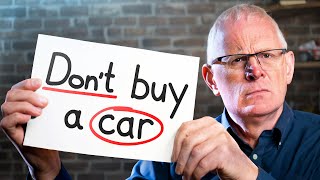

The Car Debt Explosion
59sShocking stats on skyrocketing auto loan debt and the 'car poor' trap are highly relatable and eye-opening.
▶ Play Clip"The title is a bit exaggerated but not misleading; the video explains how car expenses can lead to poor financial decisions, which is indirectly about being poor long-term."
The video argues that the biggest wealth killer isn't housing or taxes, but transportation—specifically, the hidden costs of car ownership. It breaks down how the true cost of a seemingly affordable car can be nearly double the sticker price, and how that money could instead be invested to build significant wealth. The presenter offers practical rules to avoid the 'car poor' trap.
Housing, taxes, utilities, and transportation are examined. Transportation is identified as the biggest wealth killer because cars depreciate and have many hidden costs.
Total auto loan debt has risen from $720 billion in 2005 to $1.62 trillion in 2025, indicating a growing problem.
Many people stretch their budgets so thin on car payments that they cannot build wealth—a state called 'car poor'.
In Q4 2023, nearly one in four car owners were in negative equity (owing more than the car is worth).
A $27,867 Honda Civic actually costs $46,821 over five years when including depreciation, insurance, fuel, financing, maintenance, taxes, and repairs.
Investing $780/month in an S&P 500 index fund yields $60,016 after five years (10% return), while the car owner is left with only $19,295 after selling—a difference of $40,721.
1) Buy a car 3-4 years old with 30-40k miles. 2) Keep total transport costs under 15% of income. 3) Keep the car for more than 10 years.
What is identified as the number one wealth killer in the video?
Transportation, specifically car payments, insurance, fuel, repairs, and depreciation.
00:55
What was the total auto loan debt in 2025?
$1.62 trillion.
01:54
What is the term for owing more on a car loan than the car is worth?
Negative equity.
03:33
In Q4 of 2023, what proportion of car owners were in negative equity?
Nearly one in four (or 25%).
03:39
What is the total true cost of owning a $27,867 Honda Civic over five years, according to the video?
$46,821.
08:04
If you invested $780 per month in an S&P 500 index fund with 10% annual returns, how much would you have after five years?
$60,016.
08:59
What are the three steps recommended to avoid being car poor?
Buy a car 3-4 years old with 30-40,000 miles; keep total transport costs under 15% of income; keep the car for more than 10 years.
11:48
How much can you save by buying a $35,000 car at three to four years old instead of new?
$11,000.
12:07
Three Steps to Smart Car Ownership
Provides actionable, quantitative rules (buy used, 15% income rule, keep 10+ years) that directly combat the wealth-killing effect of cars.
11:48Auto Loan Debt at All-Time High
Shows a clear trend of increasing car debt (from $720B in 2005 to $1.62T in 2025), highlighting the growing scale of the problem.
01:54True Cost vs. Sticker Price
Reveals that a $27,867 car actually costs $46,821 over five years, illustrating hidden expenses most buyers ignore.
08:04Opportunity Cost of a Car
Quantifies the wealth gap ($40,721) between buying a car vs. investing the same money, making the financial impact visceral.
09:05[00:00] If you don't want to
[00:02] then you have to avoid the
[00:04] that nobody talks about.
[00:06] Take a look at this chart,
[00:07] it shows how the average person
[00:09] spends their money each month,
[00:11] and believe it or not,
[00:12] one of these categories is
[00:15] of building wealth.
[00:15] So let's uncover it together.
[00:17] First up, housing.
[00:19] This is the biggest slice of the pie,
[00:21] so it's definitely the
[00:23] Well, although paying rent
[00:27] at least it provides you
[00:28] with a place to live.
[00:29] Next, taxes, nobody likes these.
[00:32] Well, unless your name
[00:35] but let's not get into that.
[00:36] Next, utilities and household expenses,
[00:40] they're not fun to pay,
[00:42] but you can easily get
[00:44] for the best deals.
[00:45] How about all of these?
[00:47] There are so many of
[00:49] but most of them are flexible,
[00:51] so that leaves us with one section left.
[00:53] Can you guess what it is?
[00:55] Transportation; car payments,
[00:58] insurance fuel repairs parking
[01:01] all for something that goes
[01:05] The average new car costs nearly $48,000.
[01:09] It's not an investment, it's
[01:12] and in most cases
[01:13] it's just a financial
[01:15] That's why out of all of these expenses,
[01:18] transportation, specifically your car,
[01:21] is the number one wealth killer
[01:23] and it's only getting worse.
[01:24] (eerie music)
[01:27] There's been an absolute explosion
[01:29] in the amount of money
[01:31] It's honestly getting outta control.
[01:34] Let me show you what I mean.
[01:35] In 2005, total auto loan debt
[01:41] Five years later it reached $850 billion.
[01:45] Fast forward to 2020,
[01:47] it's rocketed all the
[01:51] and in 2025 we're sat at an all time high
[01:54] of $1.62 trillion.
[01:57] This has led to more people than ever
[01:59] being what I like to call car poor.
[02:02] This is when you're making just enough
[02:04] to cover your car payments,
[02:05] but not enough to build
[02:08] It's like you're trapped on a treadmill
[02:10] that never slows down,
[02:11] but why get on this
[02:14] Well, more people than
[02:17] and driving a nice car
[02:18] is one of the quickest ways
[02:21] The car industry spends billions
[02:24] that a new car is gonna
[02:27] confidence and maybe even your love life.
[02:29] They don't show you
[02:31] on a rainy Tuesday after getting slapped
[02:33] with a $600 repair bill.
[02:35] Clever marketing makes you
[02:38] but really it's a liar being
[02:41] Look at the cyber truck
[02:43] that wasn't sold on
[02:46] It was sold on the image of power
[02:48] and looking like you're
[02:50] Social pressure fuels this too.
[02:52] Nobody claps when you drive
[02:55] and running smoothly,
[02:56] but if you roll up in a
[02:59] people tend to give you approval
[03:01] and assume you're doing
[03:03] I see so many young lads these days trying
[03:05] to look successful rather
[03:08] to be successful, especially in cultures
[03:10] where car ownership gives you credibility.
[03:13] This need to look rich, it's
[03:16] It makes people stretch
[03:19] that the car actually ends up owning them.
[03:21] This car poor trap gets
[03:24] as they borrow more than
[03:27] It sounds silly and you might be thinking,
[03:29] why would anyone do that?
[03:31] But it's actually very common
[03:33] and it's called being in negative equity
[03:35] or upside down on the loan.
[03:37] In Q4 of 2023,
[03:39] nearly one in four people
[03:42] so this could result in
[03:45] that's only worth $30,000.
[03:48] This means your $10,000
[03:51] I've actually had a lot of people email me
[03:53] after reading my free weekly newsletter
[03:55] saying it helped them
[03:58] and even make a bit of extra money
[03:59] with some of the strategies I share.
[04:01] Is something I just do for fun
[04:03] and I really enjoy reading the replies,
[04:05] so if you want me to send
[04:07] I'll drop a link in the description.
[04:09] Anyway, if you want to
[04:11] like most people,
[04:12] then you need to
[04:14] that so-called affordable
[04:17] (eerie music)
[04:20] I feel like a lot of
[04:22] that the sticker price of a
[04:26] of owning that car.
[04:27] Let me explain.
[04:28] Take a look at this Honda Civic.
[04:30] It's the most commonly purchased car
[04:32] by people aged between
[04:35] and on the surface it looks
[04:38] The sticker price is $27,867,
[04:44] which seems reasonable.
[04:45] However, let's dig into the true cost
[04:48] to own this car over five years.
[04:50] First up is depreciation,
[04:52] and on this car that's $10,999.
[04:56] This cost starts the second
[04:59] off the lot as it drops 10 to 15% in value
[05:02] before you even make it home.
[05:03] Over five years,
[05:05] you'll lose nearly $11,000
[05:08] Think about that.
[05:09] $11,000 just gone
[05:12] all because time passed
[05:15] It's like paying $2,200
[05:20] of watching your money evaporate.
[05:21] Next is insurance.
[05:24] This is nearly $12,000 over five years,
[05:27] and that's a conservative estimate.
[05:29] This figure is based on a 40-year-old
[05:31] with a perfect credit
[05:34] If you are a young guy,
[05:35] then this number is actually much worse.
[05:38] You are probably looking at double that.
[05:39] Sure, you can get this down a bit
[05:41] by calling them every
[05:44] and never staying loyal to one company,
[05:46] but it's still gonna be a high cost
[05:48] even if you do manage to get
[05:51] Then there's fuel.
[05:53] $6,415, just to keep the thing moving.
[05:57] This is actually getting so expensive.
[05:59] Now for financing.
[06:02] This is the cost of not
[06:04] $4,719 over five years
[06:08] assumes you've got a decent
[06:12] but if your credit score is bad,
[06:14] then you could be looking
[06:18] instead of the six to
[06:21] That's why I always
[06:23] of building up a good credit
[06:26] and putting small monthly expenses on it
[06:28] that you pay back in full
[06:31] This means you avoid paying any interest
[06:33] and prove that you're
[06:35] Next up is maintenance.
[06:38] $3,224 over five years
[06:42] for oil changes, brake pads,
[06:46] However, you can do this a lot cheaper
[06:48] if you learn a little bit about cars.
[06:51] I used to race in car championships
[06:52] so I know the ins and outs of
[06:56] This has saved me
[06:58] I mean, if you learn
[07:00] you'll save 30 to $50 every single time,
[07:04] and if you buy a basic OBD
[07:07] you can diagnose most problems yourself
[07:10] instead of paying the
[07:12] to plug it in and tell you what's wrong.
[07:14] Then taxes and fees.
[07:17] This is just the
[07:19] registration and inspection fees
[07:21] will come to around
[07:24] Finally, we've got repairs.
[07:27] We'll budget $1,790 for
[07:31] These surprise expenses are killers
[07:33] if you're not prepared for them.
[07:35] Even reliable vehicles
[07:37] will eventually need repairs
[07:40] This is exactly why you
[07:43] of three to five months
[07:45] Without it, a single
[07:48] your entire financial plan.
[07:50] With cars, it's not a matter
[07:53] it's when.
[07:54] So let's add all this up.
[07:57] Drum roll please.
[07:58] Your affordable $27,867 Honda Civic
[08:04] actually costs you $46,821
[08:09] over five years,
[08:10] but it gets even worse than this
[08:12] as this doesn't even
[08:15] (eerie music)
[08:17] This is where it gets really painful.
[08:19] Let's look at a five year comparison
[08:21] between someone that chooses the car
[08:23] and someone that chooses to invest.
[08:25] If you decide to choose the
[08:28] then after five years,
[08:29] you'll only be left with $19,295.
[08:35] This is, of course,
[08:37] at its current market value.
[08:39] That's assuming it's been well maintained
[08:41] with minimal damage.
[08:42] That's a loss of over
[08:45] No wonder it's such a wealth killer.
[08:47] However, if you choose to take
[08:49] that same $780 monthly payment
[08:52] and stick it into an S&P 500 index fund
[08:55] based on the historical average return
[08:57] of around 10% per year,
[08:59] after five years, you'd
[09:05] Of course, past results can't
[09:08] However, if it followed the
[09:11] then that would be gain of
[09:15] That's a price difference of $40,721.
[09:21] That means by choosing
[09:23] you could be giving up $40,000 of wealth.
[09:26] Most people repeat this
[09:29] for their entire work in lives.
[09:31] This is just one example of
[09:33] You could choose to invest
[09:36] buying a rental property,
[09:38] or even launching your
[09:40] The key is getting your
[09:42] instead of against you.
[09:43] That's not even mentioning
[09:47] although they are riskier investments.
[09:49] But to put it into perspective,
[09:50] if you'd invested that same $46,821
[09:54] in Microsoft stock five years ago
[09:57] instead of the Honda Civic,
[09:58] you'd have seen a 224% total return.
[10:02] Turning your money into
[10:06] Think about that for a second.
[10:07] The same money that bought
[10:11] could have bought you a small fortune
[10:13] in one of the world's
[10:15] The point isn't that you
[10:18] It's that every financial
[10:21] Every dollar tied up in something
[10:23] that loses value is a dollar
[10:25] that's not compounding in your favor.
[10:27] You might be thinking, "If this is true,
[10:29] then why aren't more people investing?"
[10:31] And to be honest, I think it's
[10:33] because they don't understand
[10:35] Back in my day, it used
[10:37] as you had to phone up a stockbroker.
[10:39] However, now you can use
[10:43] right from your phone.
[10:44] You can set up an account,
[10:47] and then search for S&P 500
[10:51] if you want to keep it
[10:53] As I was planning on talking
[10:57] I reached out to see
[10:59] in sponsoring this portion of the video.
[11:01] They agreed and are also
[11:04] worth up to 100 pound to
[11:12] in the promo code section of the app.
[11:14] (eerie music)
[11:16] Now, look, I get it, in many places
[11:19] not having a car means
[11:22] A study by Capital One actually
[11:26] said owning a car opened
[11:29] they wouldn't have had without a car.
[11:31] So that shows that sometimes
[11:32] there is a clear opportunity
[11:36] So I'm not against getting one,
[11:38] but if you're smart about it,
[11:40] you can still free up
[11:43] So if you want to buy a car and invest,
[11:45] then here are the three steps
[11:48] Step one, buy in the sweet spot.
[11:51] This is when you buy a car
[11:54] with 30 to 40,000 miles on the clock.
[11:57] This is great because you dodge
[11:59] the brutal first year depreciation hit,
[12:01] but still get modern safety
[12:05] and often remaining warranty coverage.
[12:07] A car that costs $35,000 new
[12:12] so that's $11,000 in instant
[12:17] Step two, follow the 15% rule.
[12:21] Your total transport costs,
[12:24] insurance, fuel, and repairs,
[12:27] should never exceed 15%
[12:30] If you earn $3,000 per month,
[12:32] that's a maximum of $450
[12:37] Push past this
[12:38] and you're getting dangerously
[12:41] Step three, keep it
[12:45] This is where you actually build wealth.
[12:47] Most people trade in their
[12:50] which is financial madness.
[12:52] Instead, buy once and maintain it
[12:54] like your financial future
[12:58] If following these steps
[13:01] compared to buying new,
[13:02] that's $3,600 every year.
[13:05] Invested at 10% annual returns,
[13:08] that becomes more than
[13:12] That could be the down payment on a house,
[13:14] all funded by making smarter car choices.
[13:17] If you want me to walk you through
[13:18] how to set up an invest in
[13:21] then I'm gonna leave that
[13:23] but don't click on it just yet.
[13:25] Make sure to subscribe if
[13:27] Okay, I'll see you over there.




⚡ Saved you 0h 13m reading this? Transcribe any YouTube video for free — no signup needed.