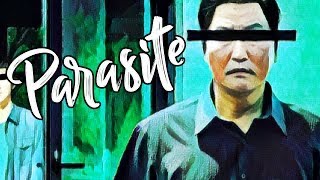

Rich People Are Nice Because They're Rich?
41sThis direct quote from Parasite challenges viewers' perceptions of class and wealth, sparking debate.
▶ Play Clip"Delivers exactly what the title promises: a deep analysis of class critique across Bong Joon-ho's filmography, with minimal fluff."
This video analyzes how director Bong Joon-ho's film 'Parasite' critiques class inequality, and contextualizes it within his broader filmography. By examining all seven of his films, the video argues that Bong consistently portrays the struggles of the lower class, exploring themes of false consciousness and class solidarity with varying conclusions. The analysis reveals that while 'Parasite' depicts the poor as lacking class solidarity due to false hope, other films like 'The Host' and 'Snowpiercer' present more united lower classes fighting against oppression.
The presenter introduces Parasite as a blunt allegory about inequality and explains the goal of analyzing it in the context of Bong Joon-ho's entire filmography.
2019 was noted as the Year of Class Warfare on Film, with movies like Knives Out, Us, Joker, and others. Bong Joon-ho has been exploring this theme for twenty years.
Bong's first film, 'Barking Dogs Never Bite' (2000), is his only not good movie, but it introduces his interest in how poverty changes people.
In Parasite, the poor mother says, 'Not 'Rich but still nice,' and the father adds, 'Hell if I had all this money, I'd be nice too.' This illustrates the smoothing effect of money on character.
Barking Dogs explores the 'creases' – the resentments and struggles that poverty creates, as seen in the main character's deteriorating relationship with his wife.
In 'Mother', the titular character considered killing herself and her child due to extreme poverty. In 'Snowpiercer', otherwise heroic characters resorted to cannibalism. All of Bong's protagonists are poor.
The section discusses how Bong's films sometimes show class solidarity and sometimes do not. In Parasite, the poor lack solidarity, which prevents substantive change.
When the former housekeeper reveals the secret basement and appeals to class solidarity, the poor mother declines. Later, when the housekeeper gets the upper hand, the mother also appeals to solidarity, but both fail to recognize their aligned interests.
In 'Mother', the have-nots claw at each other, as seen when a customer threatens the mother for a better deal, and she is violently thrown out at the school.
In the monster movie 'The Host', the working-class family shows solidarity, teaming up with a homeless man to kill the beast, while a protest movement opposes government toxic chemical use.
In 'Snowpiercer', the lower classes are trapped in the rear cars and work together to improve their situation. They have class consciousness and know they must fight together.
The poor family in Parasite suffers from false consciousness, believing they can move up in the system. The rich father constantly reminds them to 'never cross the line'.
The film uses staircases to represent class positions: the Parks live uphill in a beautiful house, the housekeeper's husband lives in a basement devoid of light, and the Kims live in a half-basement with a window, 'wanting to believe it's above ground'.
The window provides hope, but that hope deludes the Kims into continuing to try to move up inside a system where that is impossible. The son fantasizes about buying the house, but Bong says we all know he won't.
Bong's recent movies end on shots echoing ones from previous films: in Snowpiercer two people head into an uncertain future; in Okja the family is restored; in Parasite the boy stares at the camera and sighs.
In 'Memories of Murder', the coda shows the detective revisiting the crime scene and looking into the camera, searching for the culprit. Similarly, the son in Parasite looks at the camera, acknowledging the audience's knowledge of his likely failure.
Bong's films return to the problem of what the oppressed should do. Snowpiercer's revolution perpetuates hierarchy; Okja's protagonist plays by capitalist rules for a small victory; Parasite's son remains trapped in the system.
Bong's last three films offer different endings: Snowpiercer (system crashes down), Okja (leave system unchanged but with personal victory), Parasite (remain trapped within the system). No easy answers.
His movies consistently portray lower class characters, sometimes with solidarity, sometimes without, but always recognizing solidarity as needed. However, how to change systems varies.
Collectively, Bong's films feel inquisitive, digging for answers to the central unsolvable problem of social and economic stratification. They are stuffed with political messages but also wonderful characters.
Bong Joon-ho's films offer no easy solutions to class inequality but consistently confront its horrors with nuanced, conflicting perspectives. 'Parasite' serves as a powerful culmination of his career-long exploration of class consciousness and false hope.
What is the central theme of Bong Joon-ho's filmography?
Class inequality and how poverty changes people.
01:44
In 'Parasite', what does the mother say about rich people being nice?
'Not 'Rich but still nice.' Hell if I had all this money, I'd be nice too.'
01:57
What is 'false consciousness' as used in the video?
A belief that one can move up in a system where upward mobility is impossible, preventing recognition of one's true class position.
08:10
What does the stair motif represent in 'Parasite'?
The vertical positions of the classes: uphill for the rich, downhill for the poor, half-basement for the middle.
08:49
How does 'The Host' differ from 'Parasite' in terms of class solidarity?
In 'The Host', the working-class family shows solidarity and teams up with others to defeat the monster, whereas in 'Parasite' the poor lack solidarity.
06:02
What are the three different endings of Bong's last three films?
Snowpiercer: system crashes down; Okja: leave system unchanged but personal victory; Parasite: remain trapped within the system.
14:03
What does the window in the Kims' semi-basement symbolize?
Hope and the illusion of upward mobility, which leads to false consciousness.
09:19
Who is the only character in 'Snowpiercer' that realizes the system must be destroyed?
Minsoo, a character who lives on the only part of the train with windows.
12:41
Lack of class solidarity in Parasite
Illustrates how the poor turn on each other instead of uniting, a key critique of false consciousness.
03:38Vertical symbolism
Staircases and basement levels visually reinforce class hierarchy.
08:49Bong's honest ending
Bong acknowledges the audience knows the son won't buy the house, breaking the illusion of hope.
10:15No easy answers
Bong's films present conflicting solutions, reflecting the complexity of economic inequality.
14:16[00:02] Pretty good, right? Well, I’ve got a really hot take about it. I know!
[00:14] In all seriousness, Parasite is probably my favourite movie of last year. It is also a pretty blunt allegory about inequality, and I don’t think you have to do a lot of
[00:31] digging to get what director Bong Joon-ho is trying to tell you. So if the broad strokes of what Parasite is about are clear, what am I doing here? Well, I wanted to dive deeper into this movie and figure out what it was about, so I went back
[00:44] and watched all seven films that Bong Joon-ho has written and directed. And I think something really interesting happens when you look at Parasite in the context of Part One: Nice BECAUSE She’s Rich
[01:03] Many other critics have pointed out that 2019 was The Year of Class Warfare on Film. Between Knives Out, Us, Joker, Hustlers, Uncut Gems, and Ready or Not, it felt like writers
[01:15] READY OR NOT: Fucking Rich People. But Bong Joon-ho has been on this beat for twenty years.
[01:28] His first movie came out in 2000 and is… well his only not good movie… the rest of them are all classics in their genre, but Barking Dogs Never Bite is pretty stilted. It’s also very uncomfortable given that it’s main character keeps killing dogs.
[01:44] But I mention it because right from the beginning of his career, Bong Joon-ho was interested in writing stories about class and how poverty changes people. In Parasite, there’s a moment when the parents of the poor family make this observation.
[01:57] Father: She’s so naive, and so nice. Mother: Not “Rich but still nice.”
[02:09] Hell if I had all this money, I’d be nice too. Father: That’s true, your mom’s right.
[02:23] No resentments. Mother: It all gets ironed out. Those creases all get smoothed out.
[02:38] Barking Dogs is Bong Joon-ho trying to explore the creases. Much of the film centers on the main character's deteriorating relationship with his wife, Husband: Who do you think you are.
[02:50] And eat walnuts all the time. At one point in Mother we learn that the titular character once considered killing herself and her child because of their extreme poverty.
[03:07] And in Snowpiercer, otherwise heroic characters are revealed to have resorted to cannibalism In fact, all of Bong Joon-ho’s protagonists are poor. Bong Joon-ho has a topic that he is fixated on and which crops up in his movies, but what's interesting is that he
[03:24] doesn’t always portray it in the same way. Part Two: Class Solidarity But if you’re poor, it’s a dog-eat-dog world.
[03:38] It’s the reason they can’t make any actual substantive change to their situation. None of the poor characters in the film show any sense of class solidarity. There’s this moment at the center of the film where everything pivots.
[03:53] Up until this point, we’ve seen a poor family of four con their way into working for a rich The son becomes their tutor, the mother their housekeeper, ect. Doing this involves getting their existing housekeeper fired, but then the former-housekeeper
[04:05] shows up in the middle of the night and reveals that there is a secret subbasement beneath There they learn that the housekeeper’s husband had been living in secret to avoid The housekeeper begs for the mother’s help to keep him concealed and she makes a direct
[04:19] appeal to the idea that they belong to the same class and should look out for one another. But the mother declines
[04:39] Then, when the housekeeper gets the upper hand, it’s the mother's turn to beg for mercy on the grounds of solidarity, calling the housekeeper “sis.”
[04:51] Both characters ought to realize that their interests were aligned from the start. The rest of the movie involves one poor family trying to dominate the other poor family,
[05:03] while the rich family is oblivious to their life or death struggle (at least until the It’s also absent from another one of Bong Joon-ho’s films, Mother, about a poor mother
[05:15] trying to prove that her mentally disabled son isn’t guilty of killing a local girl. As the director himself has said, “in Mother, you see the have nots and needy clawing at For example, in one scene, the Mother is selling herbs to a customer, who threatens to turn
[05:30] her into the police for conducting acupuncture without a license just so she can get a better In another, when the mother goes to the school of the murdered girl, she is violently thrown We don’t really see an upper class in that movie, but the world it depicts is a harsh
[05:46] This is the case in Bong Joon-ho’s more grounded and realistic films, but in his fantastical In some sense, the idea of the lower classes showing solidarity IS fantastical.
[06:02] In the monster movie, “The Host,” the main characters are a family who run a small They are working class and, even though they begin the film a dysfunctional family, as Bong says, “you see the solidarity between them, they save each other and they gather
[06:15] At the end of the movie, the family teams up with a homeless man to kill the beast. At the same time, a protest movement forms to oppose the government’s use of toxic So class solidarity exists in spades in The Host and it is what allows them to defeat the monster.
[06:31] It also exists in his dystopian sci-fi action movie, Snowpiercer. In that movie, the lower classes are trapped in the rear cars of a train. They are oppressed by a totalitarian regime, but work together to improve their situation.
[06:44] The people at the back of the train in Snowpiercer are intimately aware that they are the lower class, and that there are basically no legitimate means of upward (horizontal?) mobility.
[07:00] Tilda Swinton: A hat belongs on the head. I am a hat. You are a shoe. I belong on the head. You belong on the foot. And while their conditions are materially worse than the characters of Parasite, the They know that they must fight together.
[07:15] The same is true in The Host: when a big crazy sea monster is eating people, it’s pretty The lines are blurrier in Parasite. The classes aren’t physically segregated like they are in Snowpiercer.
[07:27] But they can’t become one of them as Ki-woo, the son, so desperately wants.
[07:53] The rich father constantly reminds us of this. Mr. Park: Never cross the line (2 clips). This is what Karl Marx called class consciousness, an awareness of one’s position in a class
[08:10] The protagonists in Snowpiercer have class consciousness. a form of “false consciousness.”
[08:34] it up on Wikipedia, and according to the Parasite Wikipedia page, “The film uses staircases to represent the positions of the Kim and Park families as well as those of Moon-gwong.”
[08:49] Okay, but yeah the movie uses where the characters live vertically as a signifier of their class The characters walk uphill to get to the Park’s big and beautiful house that has wide open
[09:02] The man who represents the lowest class lives in a basement devoid of light. The Kims however live in an in-between state, a half-basement, a kind of apartment that So while they live underground like the housekeeper’s husband, they get some light through the window,
[09:19] As Bong says, it’s a house that “wants to believe it’s above the ground.” This is why the opening and closing shots of the movie emphasize that window before moving The fact that they have that window, that ability to see out to a better life, provides
[09:34] But it’s that hope that is also stopping them from recognizing the reality of their situation, which is what the fancy term false consciousness means. are not part of the same class.
[09:49] And it deludes them into continuing to try and move up inside a system where that is After learning that his father is now trapped in the rich family’s basement, Ki-woo fantasizes
[10:02] capitalism and saving his family. But it is not. As Bong Joon-ho says: “Maybe if the movie ended where they hug and fades out, the audience
[10:15] can imagine, ‘Oh, it’s impossible to buy that house, but the camera goes down to that It’s quite cruel and sad, but I thought it was being real and honest with the audience. You know and I know — we all know that this kid isn’t going to able to buy that house.”
[10:31] Bong Joon-ho’s recent movies have ended on shots that echo the endings of his previous In Snowpiercer, two people head out into the wilderness to an uncertain future, just like In Okja, Mija and her grandfather sit down for a meal, their family unit restored after
[10:49] And in Parasite, the boy stares directly into camera and sighs. In that movie, we follow a cop trying to catch a serial killer.
[11:02] contact with them. Over the course of the movie, his confidence in his ability wavers until it breaks entirely.
[11:23] In the coda of the movie, he revisits the first crime scene years after the fact and learns that the culprit had likely also returned to the spot recently. He then turns his eye contact method on the audience, looking directly into the camera,
[11:35] as if searching for the culprit among us, asking us what we know that he doesn't. While the letter he writes his father is filled with the hope of someday rescuing him, his
[11:48] And yet we know that he's going to try, that he's going to work within the system to try and beat the system. But we know just how unlikely he is to succeed. Or maybe we don't?
[12:02] Maybe we believe the same things he does. And that's why this movie cuts so deeply. But that’s just what this movie is saying. I'm not exactly sure it's what Bong Joon-ho believes. Throughout his filmography, Bong Joon-ho keeps coming back to this problem of what the oppressed
[12:15] And he’s come to several conflicting answers.
[12:27] In Snow-piercer, Curtis believes they can liberate themselves by moving forward, up But there, he learns that he is wrong. That his revolution will only perpetuate the hierarchy that leaves so many with nothing.
[12:41] Only Minsoo, a character who lives on the only part of the train with windows, realizes that the only way for them to win is to go outside the train, to blow up the system, But doing that causes a near total destruction of the train and everyone on it.
[12:55] But even that is not a given. Unlike the son in Parasite, they are not deluded into thinking they can win inside the system… Is there another solution?
[13:09] The film is about a young Korean farm-girl who is trying to save her pet superpig from At the climax of the movie, Mija has tracked Okja to the slaughterhouse where she pleads
[13:22] with the CEO of the corporation to spare Okja’s life, but the CEO is immovable. Finally, Okja remembers she has a golden pig statuette and offers that in exchange for
[13:35] So no real change has been made to the system here. Mija has to play by the rules of capital to accomplish her goals. And even then, the film makes abundantly clear that it is only a small victory.
[13:50] But we watch in horror as the rest are herded to the slaughterhouse. The happy ending is only achieved by making a personal choice to live outside of that
[14:03] So we have three different endings here: one where the system comes crashing down, one where characters leave the system unchanged, and another where the system is unchanged, but remain trapped within it.
[14:16] Bong Joon-ho movies are great at confronting and depicting the horrifying effects of economic systems, but they don’t provide easy answers or solutions. His last three films are, in one sense, straightforward allegories. They are very different from his earlier films.
[14:34] adds a texture to each of them. In brief, his movies consistently portray lower class characters. sometimes they do not, but solidarity is always recognized as something that is needed.
[14:50] But when it comes to how to actually change the systems that are creating their problems, They are variations on a theme, a director digging for answers to the central unsolvable
[15:02] problem of our current social and economic stratification. Collectively, they feel inquisitive. It’s even better as the culmination of an incredible career.
[15:27] Bong Joon-ho’s films are stuffed with political messages, but they also have wonderful, fully If you want to learn a few more techniques about how to write more believable characters, then check out this course on Skillshare, the sponsor of this video.
[15:42] The course is by Sabaa Tahir, the author of the New York Times bestselling series An Ember If you want to give it a look, or if you want to try out the thousands of other classes on writing, film production and more that Skillshare has to offer, then click on this
[15:56] The first 500 people to do so will get 2 months of Skillshare for free and unlimited access Thanks for watching everyone.
[16:08] If you like what I do here and want to help me make these videos even better, then consider pledging to my Patreon page. This probably isn't going to be the last word I'll say about Bong Joon-ho So if you want to help me make another video about him, you can pitch in as little as $1 a video.
[16:25] A big thank you to all of my current patrons and as always, keep writing everyone.
⚡ Saved you 0h 16m reading this? Transcribe any YouTube video for free — no signup needed.