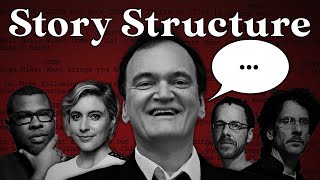

Writing is structure, not dialogue
45sChallenges common assumptions about screenwriting, sparking debate among aspiring writers.
▶ Play Clip"The title is an accurate and direct reflection of the content: the entire transcript is a conversation among professional screenwriters discussing various outlining techniques."
This transcript captures a multi-voice discussion on screenwriting, where professional writers share their diverse approaches to outlining and writing. The dialogue reveals a spectrum of methods, from detailed pre-planning to discovery writing, with a central debate on whether structure or dialogue is the most critical element of a successful script.
One writer argues that writing is fundamentally about structure, not dialogue. Dialogue is described as 'the cherry on top'—a supplemental element that does not support the main story. The real challenge lies in building the 'scaffolding' or 'skeleton' of the story.
A writer explains that planning too far past the middle of the story is counterproductive. By the time the writer reaches the midpoint, the characters and story have evolved, making earlier assumptions irrelevant. The writer emphasizes that the knowledge gained during the writing process transforms the story.
The writer describes the goal of reaching a point where the characters guide the story, and the writing becomes exciting and unpredictable. The aim is to move away from a rigid blueprint and allow the narrative to unfold organically, with the characters 'telling' the writer what happens next.
A writer shares a technique: starting with a page of single-line story beats (e.g., 'spaceship on the way to the Sun'). The writer then writes the script scene by scene, deleting each beat as it is covered. This process results in a first draft that is acknowledged as 'crap' but provides a foundation for revision.
A writer recalls a saying: 'If the author doesn't know where the story is going, the audience can't possibly know.' This underscores the belief that the writer must have a clear direction to guide the audience, even if the path is discovered along the way.
One writer uses a 'structuralist' approach, spending the initial portion of time drawing arcs, splitting out sequences, and visualizing the entire plot before writing. The writer needs to see the whole story to avoid getting 'lost in the weeds,' a process that is crucial for complex projects.
A writer avoids outlining before writing, finding that it 'kills all ideas' and makes the process too literal. This writer prefers to generate a large amount of material first and only then outline to organize what has been discovered.
A writer suggests that rigid rules (e.g., character establishment by page 10) are useful only when a writer is in trouble. Otherwise, they hinder creativity and lead to formulaic, uninteresting scripts. The key is to avoid making the script 'try to be like a script' and lose its individuality.
One writer details a method of creating a detailed step-out : listing every scene with its setting and a log line. This allows the writer to analyze the rhythm of day/night and the flow of action. At Pixar, this is expanded into a 'sequence outline'—a 4-page document breaking the film into 15-20 sequences by act.
A writer compares the outlining process to architectural blueprints for a skyscraper. The 'breaking' (planning) phase is the most crucial and hardest part, while the actual writing is 'carefree' in comparison, as the outline provides a clear roadmap. This writer uses a 3x5 corkboard with index cards to build the story 'brick by brick'.
The transcript reveals that there is no single 'correct' method for screenwriting. The most successful approach depends on the writer's personal process, from detailed pre-planning to writing by discovery. The consistent takeaway is that understanding and restructuring the story's foundation is often more challenging and critical than writing dialogue itself.
According to one speaker, what is the most important element of storytelling in screenwriting?
Structure, not dialogue.
How does one writer describe dialogue in relation to storytelling?
As 'the cherry on top'—a fun addition, but not the primary support for the story.
0:03
Why does one writer advise against planning too far past the middle of a story?
Because once you reach the middle, the characters and story have changed, making earlier plans irrelevant.
0:25
What is the 'story beat method' described in the transcript?
Writing a page of single-line story beats, then writing the script scene by scene, deleting each beat as it is covered until the page is empty and the first draft is complete.
2:43
What is the 'sequence outline' method used at Pixar?
Breaking the film into 15-20 sequences, each with a title and summary, on four pages (one per act), allowing the writer to see the entire film at a glance.
7:49
What analogy does one writer use to compare the outlining phase to the actual writing phase?
Outlining is like drawing architectural blueprints for a skyscraper; writing is the labor of building it. The blueprints are the most crucial part.
10:09
What does one writer claim happens when a script tries to 'be like a script'?
It loses its individuality and interest.
6:41
Structure Over Dialogue
This sets up the central debate of the transcript, challenging a common perception that writing is primarily about dialogue.
Discovery Through Writing
Introduces a key creative process: letting characters guide the story, which is a core concept for many writers.
2:03The Risk of Premature Outlining
Presents a contrarian view to heavy outlining, emphasizing that for some, outlining kills creativity.
5:09Sequence Outlining with Log Lines
Providing a concrete, actionable method for visual and structural analysis of a screenplay.
6:53The Blueprint Analogy for Screenwriting
Powerfully illustrates the critical importance of the planning phase over the execution phase.
10:09[00:00] So, oddly enough people think of
[00:03] writing is structure. Dialogue is the
[00:08] support the ice cream sundae it's it's a
[00:12] the real story telling the real
[00:16] writing building the the scaffolding the
[00:20] long time I tried to think out
[00:25] know things would completely change as
[00:29] realized that it doesn't do me much good
[00:34] I might know where I want to go I mean I
[00:39] what the third acts gonna be yeah you
[00:42] probably kill Bill with him but you know
[00:46] you're going and you're probably right
[00:49] want the ending to end as for you know
[00:54] for the most part you can kind of work
[00:59] the middle but to think beyond that is
[01:05] get to the middle when you've actually
[01:10] story now it's a different thing now you
[01:15] characters things that you could never
[01:19] are now they're in your blood it's like
[01:24] mythology to my movies to some degree or
[01:29] I write and I might have a checklist of
[01:33] the course of the time but some of them
[01:36] become irrelevant yeah
[01:41] some things you thought could have been
[01:44] and some things you may be half the
[01:47] time you get to where that would happen
[01:51] for this but by that time you get to the
[01:55] want to have it be this expert you want
[01:58] want to know who these people are and
[02:03] figure out where you want to go for the
[02:06] spot where I don't know what's going to
[02:09] to get off that that that that blueprint
[02:14] where now the characters are telling me
[02:18] be being disingenuous with you to say
[02:22] mean I never feel like I know how to
[02:27] that's a great way what you just said
[02:32] like spreading them around like that for
[02:38] to kind of get enough things going in a
[02:43] doing something worth telling something
[02:48] final draft and I write about a page of
[02:55] so spaceship on the way to the Sun you
[03:02] a moment so it goes on and just single
[03:09] of the story and what I've got to the
[03:14] top of the page so I've got about a page
[03:16] I'd say the kind of back up to the top
[03:20] scene and as I reach story beats I
[03:27] is getting longer and the story beats
[03:30] shorter eventually I delete the last
[03:34] script and that's it that's a first
[03:40] but that's okay because I know that
[03:46] there one is you've got something to
[03:51] that's often the hardest yeah the
[04:08] that if the author doesn't know where
[04:12] possibly know I write really
[04:17] spend I spend to this the first big
[04:22] notebooks and all I do is I draw like
[04:26] sequences I need to basically be able to
[04:31] can sit down and actually start writing
[04:36] and plan and plan then plan and this was
[04:40] this was even more crucial for me to
[04:43] you actually get into it and as you guys
[04:47] no matter how much you plan you know
[04:52] through the forest looking at like the
[04:55] then you get in there and you're
[04:58] you figure out stuff doesn't work and
[05:02] kind of a mixture I guess I don't
[05:09] mean I say that I definitely don't
[05:14] a moment when I do outline but it's only
[05:20] find when I outlined before I write it
[05:25] ideas I can't um I can somehow it makes
[05:33] I've never outlined before I use index
[05:40] I've never index carded the whole movie
[05:47] point when I've started writing a
[05:51] is to know
[05:54] how it's gonna start and I have some
[06:00] of like walking in the dark with a
[06:04] far ahead of you as as the light goes I
[06:08] trouble and if you're not in any trouble
[06:11] absolutely useless and possibly worse
[06:17] script has it has the characters
[06:22] don't think there's any reason to be
[06:25] to write a script and it may be that
[06:30] and have two-thirds of the way through
[06:33] don't know it's not really an I don't
[06:38] think that kind I think that kind of
[06:41] and it goes off it's because at that
[06:46] script and it's not and it's at that
[06:50] individuality and it's interest I mean
[06:58] out under the story and then you break
[07:01] that need to be there I go and I put in
[07:06] every scene so I know where you are and
[07:10] good to figure out so the the rhythm of
[07:15] Miss Sunshine is three days most films
[07:19] rhythm between day and night you don't
[07:22] know from one day to the next day you
[07:26] I'll go through and just do all the log
[07:30] lights log lines and just put them in
[07:35] point if something if there's an action
[07:38] something that you could Oh there could
[07:42] got all you know you got your 50 slug
[07:45] scenes then you just can go ahead and
[07:49] started doing at Pixar now is doing what
[07:53] break the film down into you know
[07:57] on four pieces of paper so it is a first
[08:01] title of the sequence and then what
[08:04] or six sequences in your first act
[08:08] quarter of the film what you'll take you
[08:12] the third quarter and then the last page
[08:15] four pages but it breaks down it by ACT
[08:20] the first page you get the end of the
[08:23] and and because it's broken down by
[08:26] this right here can go over here you
[08:30] whole film and I find that really
[08:34] but with index cards I always feel like
[08:38] everywhere you know on the floor of your
[08:42] able to put four sheets of paper in
[08:46] something isn't working or not I'm such
[08:50] you're going before you start out that
[08:55] things change you know I mean that's
[08:59] hopefully you'll at least get to the end
[09:02] semblance of what you started out trying
[09:07] I can usually look at it outline which
[09:10] be able to just have scene headings you
[09:15] something like that where she realizes
[09:18] whatever it is and that will that will
[09:22] that and I can usually start to see the
[09:28] the piece and what needs to be thought
[09:34] corkboard three feet by five feet with a
[09:39] of index cards and a whole bunch of
[09:43] and we say okay what's the teaser but
[09:46] brick each card represents a plot beat
[09:53] three or four six eight cards might
[09:57] you filled up this entire three foot by
[10:01] and
[10:04] together or alone alone as much harder
[10:09] essentially that the good analogy I
[10:15] around on their drafting tables or their
[10:19] design thus drawing the architectural
[10:24] to go build a skyscraper which is a huge
[10:30] know all of that but you can't build
[10:35] architectural blueprints to begin with
[10:39] writing is it's kind of carefree
[10:42] got this outline I've got these these
[10:47] happens next so the writing is a
[10:53] hardest part and it's not to me the most
[11:12] you
⚡ Saved you 0h 11m reading this? Transcribe any YouTube video for free — no signup needed.