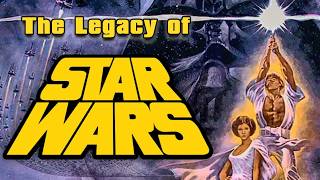

How Star Wars Created Industrial Light & Magic
35sThe founding of ILM changed visual effects forever, a fascinating behind-the-scenes story.
▶ Play Clip"The title is somewhat accurate but overly broad. The video goes into great depth about the production, storytelling, and personal impact of the film, but it does not primarily focus on or systematically prove how Star Wars changed cinema as an industry."
This video is a personal and analytical retrospective on the original 1977 Star Wars film and its massive cultural and cinematic impact. The creator shares his lifelong connection to the franchise, details the film's troubled production and pioneering special effects, and explores how its classic hero's journey and innovative world-building changed cinema forever.
After the success of American Graffiti, George Lucas renegotiated his Star Wars contract to secure licensing and sequel rights instead of a larger salary. This decision was pivotal, allowing him to control merchandise and sequels, fundamentally changing the film industry's business model.
David Prowse's lines as Darth Vader were dubbed over by James Earl Jones during post-production without Prowse's knowledge. Jones's voice brought the necessary gravitas, making Darth Vader's voice, along with his design and breathing, an iconic part of pop culture.
Because Fox's visual effects department had been shut down, Lucas founded Industrial Light & Magic (ILM) to handle the film's VFX. ILM went on to become a dominant force in the industry, winning 15 Academy Awards for best visual effects and working on over 300 films.
The narrative of Star Wars strictly adheres to the 12-stage hero's journey. The first five stages are exemplified: the ordinary world, the call to adventure (Obi-Wan's proposal), the refusal of the call, meeting the mentor, and crossing the first threshold (Luke deciding to leave Tatooine).
Instead of immediately bombarding the audience with the main conflict and hero, the film cleverly starts by following R2-D2 and C-3PO. They weave through the conflict, naturally introducing major elements and characters, making the complex galaxy accessible and preventing the audience from getting lost.
The iconic binary suns scene visually communicates Luke's yearning for adventure without heavy exposition. The scene's emotional impact is heavily driven by John Williams' masterful score, which crescendos as Luke gazes longingly and then fades as he turns away, making a familiar sunset feel both alien and relatable.
The film's three acts are neatly divided by location: Tatooine, the Death Star, and Yavin 4. The second act on the Death Star is particularly strong, balancing multiple plot lines (Obi-Wan vs. Vader, the droids' escape, and Han and Luke's rescue of Leia) with comedy and drama before they all converge in the hangar bay.
The final trench run sequence is a masterclass in editing, largely done by Marcia Lucas. A crucial element—the Empire firing on the rebel base once the moon moves into position—was added in post-production, providing the time-sensitive tension that elevates the scene from a simple dogfight to a thrilling conclusion.
The original Star Wars succeeded by wrapping a timeless, simple hero's journey in groundbreaking visual effects, sound, and music. Its legacy is not just a film, but the creation of ILM and a new era of blockbuster filmmaking, driven by George Lucas's ambition and innovative decisions.
George Lucas
person
Ralph McQuarrie
person
Mark Hamill
person
Carrie Fisher
person
Harrison Ford
person
Alec Guinness
person
Peter Cushing
person
Peter Mayhew
person
Anthony Daniels
person
Kenny Baker
person
David Prowse
person
James Earl Jones
person
John Williams
person
Ben Burtt
person
John Jympson
person
Paul Hirsch
person
Richard Chew
person
Marcia Lucas
person
Walt Disney
company
20th Century Fox
company
Industrial Light & Magic
company
Warner Bros.
company
Star Wars: Episode IV - A New Hope
film
Star Wars: Episode V - The Empire Strikes Back
film
American Graffiti
film
THX-1138
film
Rogue One
film
The Mandalorian
film
Andor
film
Star Wars: The Clone Wars
tv_series
Star Wars: Visions
tv_series
What was the crucial contract decision George Lucas made for Star Wars after the success of American Graffiti?
He secured the licensing rights to produce sequels and merchandise instead of seeking a larger salary.
4:43
Who voiced Darth Vader in Star Wars?
James Earl Jones.
6:13
Why did George Lucas found Industrial Light & Magic?
Because Fox's visual effects department had been shut down, and he needed a company to handle the film's special effects.
6:54
What narrative framework does Star Wars strictly adhere to?
The hero's journey.
9:54
What are the first five stages of the hero's journey as exemplified in Star Wars?
The ordinary world, the call to adventure, the refusal of the call, meeting the mentor, and crossing the first threshold.
10:07
How does the film cleverly introduce the audience to its vast galaxy?
By having the audience follow the droids R2-D2 and C-3PO, who naturally weave their way through the conflict and introduce major elements and characters.
11:42
What crucial element was added in post-production to heighten tension in the Battle of Yavin?
The Empire firing on the rebel base once the moon of Yavin moves out from behind the planet.
22:35
Who is largely credited with the editing of the Battle of Yavin sequence?
Marcia Lucas.
22:53
The Most Important Deal in Cinema History
This business decision to take licensing rights over a salary is often cited as a pivotal moment that changed how franchises monetize themselves, creating the modern blockbuster merchandising model.
4:43Founding Industrial Light & Magic
The creation of ILM out of necessity for Star Wars directly led to a company that would dominate the visual effects industry for decades, shaping modern filmmaking.
6:54Strict Adherence to the Hero's Journey
The video explicitly links the film's narrative structure to Joseph Campbell's monomyth, providing a clear, analytical framework for why the story resonates so universally.
9:54Clever Audience Introduction via Droids
This is a notable screenwriting technique identified in the video, showing how the filmmakers solved the problem of introducing a complex world without overwhelming the audience.
11:42In-Edit Addition of Tension
This reveals a crucial filmmaking principle: how a simple post-production change (a ticking clock) can dramatically elevate a scene from a standard action sequence to a high-stakes thriller.
22:35[00:00] It goes without saying that Star Wars is one of the biggest media franchises of all-time.
[00:04] I've had a deep connection to the series for as long as I can remember.
[00:07] And that's not hyperbole.
[00:08] I genuinely don't remember a time when Star Wars wasn't a massive part of my life.
[00:12] A lot of the films I cover I hadn't seen before deciding to make a video on them.
[00:15] Here however, this is a movie and franchise that I'm very familiar with.
[00:19] I've watched it more times than I can count.
[00:21] I can honestly say that, without Star Wars,
[00:23] I wouldn't be doing this YouTube thing.
[00:25] One of my earliest memories with film is watching Episode 4,
[00:27] and being completely awestruck by the battle of Yavin.
[00:30] Star Wars showed me what film could be and for that I'm incredibly grateful.
[00:34] I likely would never had cared much for YouTube as a platform either,
[00:37] if I hadn't discovered the many reviews, parodies, and video essays, on the franchise I grew to love.
[00:41] I was first introduced to Star Wars by my best friend when I was 7 years old.
[00:45] He was watching an episode of Star Wars: The Clone Wars.
[00:47] A show that I would grow to love and watch countless times.
[00:50] If you like Star Wars and somehow haven't seen it, I highly recommend the show.
[00:54] Soon after being introduced to The Clone Wars, The Force Awakens would be announced.
[00:58] Up to this point, I hadn't seen a single Star Wars movie.
[01:01] My friend owned the original trilogy on Blu-Ray though.
[01:03] and that's where my obsession officially began.
[01:05] He came over one day with the original trilogy, and we watched all three films in one night.
[01:09] I was immediately hooked.
[01:11] Episode 4 became my favorite film of all-time.
[01:14] At least for about two hours until I finished Episode 5.
[01:17] To this day, The Empire Strikes Back is in my top 3 favorite films.
[01:20] With Episode 4 not far behind.
[01:22] After that night, Star Wars became the most important thing to 8 year old me.
[01:25] I would soon go to Best Buy and get the prequels on Blu-Ray for myself,
[01:28] and watch those in a single night as well.
[01:30] It was a good time to be a Star Wars fan.
[01:32] Excitement was in the air.
[01:33] Though many were skeptical about The Force Awakens, most were excited.
[01:37] And since I was just getting into the series, I still had so much more to discover.
[01:40] I spent much of my childhood watching Star Wars movies and shows,
[01:43] reading Star Wars books, playing Star Wars video games,
[01:46] and of course, having lightsaber duels with my friend.
[01:48] Star Wars means something to me.
[01:50] And while the future of the franchise is uncertain at the moment,
[01:52] at least as fans, we always have the classics to fall back on.
[01:55] This is a franchise I could talk about for hours on end.
[01:58] For now though, I'll focus on the film that started it all.
[02:01] Simply titled, Star Wars.
[02:02] Although subsequently renamed, Star Wars - Episode IV: A New Hope.
[02:15] Any discussion about Star Wars needs to begin with the story of one man,
[02:19] George Lucas.
[02:20] Nowadays, for one reason or another,
[02:22] many have a negative opinion of George Lucas.
[02:24] He infamously insisted on including many of the weaker elements of the series,
[02:28] and without his incredible editing team,
[02:29] many believe he wouldn't be anywhere close to where he is today.
[02:32] And while that may or may not be true,
[02:34] Personally, I'm not interested in that story.
[02:37] Instead, I'd like to focus on the story of an ambitious young filmmaker,
[02:40] who wanted nothing more than to introduce a new galaxy to the world,
[02:42] and express his love for cinema.
[02:44] Star Wars wasn't George Lucas first feature film.
[02:47] He ended up making two projects before Star Wars ever came to be.
[02:50] Although, he had the idea for a space fantasy adventure before either project.
[02:54] One of his films was a financial flop,
[02:56] but the other was a massive success.
[02:58] In both cases however,
[03:00] Lucas was unhappy with the level of corporate meddling.
[03:02] With his first film,
[03:04] THX-1138, in particular,
[03:06] five whole minutes of the film had been cut out by Warner Bros.
[03:09] This instilled in the young filmmakers mind the importance of making his work as independently as possible.
[03:14] In January of 1973,
[03:16] George Lucas began working on his space opera full-time.
[03:19] Three months later, he had completed a 13-page treatment called,
[03:22] The Star Wars.
[03:24] The goal with The Star Wars, was to tell a classic story of good vs. evil.
[03:27] Cinema in the 70s was characterized by crime and anti-heroes.
[03:31] An honest, wholesome adventure wasn't seen as marketable, and thus not profitable.
[03:36] Still, Lucas shopped around his story to several different companies.
[03:39] Many of which unsurprisingly turned down the proposal.
[03:41] Interestingly, one such company would be Walt Disney.
[03:44] Who would eventually purchase the franchise for over 4 billion dollars in 2012.
[03:48] After two months of shopping around the treatment though,
[03:50] 20th Century Fox would agree to produce the film.
[03:53] There was still the issue of the budget the film would require, however.
[03:56] Naturally, with the amount of special effects shots, abstract costumes, and large locales required to tell this story,
[04:01] a high budget would be necessary.
[04:03] To secure such a budget,
[04:05] Lucas knew he would need something visual to appeal to the Fox board of directors.
[04:09] To do this, he enlisted the help of Ralph McQuarrie.
[04:11] Who painted several pieces of concept art to be shown to the board of directors.
[04:15] One look at these pieces, and it becomes clear why Lucas was soon granted an 8 million dollar budget.
[04:20] These are seriously incredible.
[04:22] And they serve as one of the earliest looks into the original vision for Star Wars.
[04:25] Around this time, Lucas had completed a script that was reportedly over 200 pages.
[04:30] Far longer than a typical feature film.
[04:32] He elected to instead take the first act of this story and make that into a film.
[04:36] Saving what he later dubbed as Episodes 5 and 6 for future movies.
[04:40] After the success of Lucas' second film, American Graffiti,
[04:43] it came time for Lucas to renegotiate the contract for Star Wars.
[04:46] Now having proven himself as a director.
[04:48] Instead of seeking a larger salary however,
[04:51] Lucas was solely focused on obtaining the licensing rights,
[04:53] to produce sequels and merchandise for Star Wars.
[04:55] This would prove to be one of the most important decisions George Lucas would make in his life.
[05:00] And a decision that would change the course of cinema history forever.
[05:03] That's a story for another time though.
[05:05] Next in the pre-production phase would be casting.
[05:08] George Lucas had a preference for casting unknown actors.
[05:10] This is what led to Mark Hamill and Carrie Fisher landing the roles of Luke Skywalker and Princess Leia, respectively.
[05:15] Both actors auditions are available online,
[05:18] and interestingly, when viewed alongside others being considered for the role,
[05:21] the pair clearly had the best auditions.
[05:23] Obviously, I'm no casting director, but the talent is evident.
[05:27] Especially in the case of Carrie Fisher.
[05:29] I genuinely could not imagine anyone else playing this character.
[05:32] For the third lead character, Han Solo,
[05:34] Lucas planned on following a similar route of casting an unknown actor.
[05:37] Harrison Ford was relatively unknown,
[05:39] but had already been in Lucas previous film, American Graffiti.
[05:43] Initially, Ford was only brought on to help with the auditions.
[05:45] But eventually, he won Lucas over and was cast as Han Solo.
[05:49] It goes without saying that he did an incredible job here.
[05:51] The charisma and cockiness he brings to the role feels natural.
[05:54] And it's in direct contrast to Luke's earnest character.
[05:57] The only big names to end up in the film would be Alec Guinness as Obi-Wan,
[06:00] and Peter Cushing as Grand Moff Tarkin.
[06:02] Other supporting characters include Chewbacca, played by Peter Mayhew.
[06:05] C-3PO, played by Anthony Daniels.
[06:08] R2-D2, played by Kenny Baker.
[06:10] And finally, Darth Vader, played by David Prowse.
[06:13] During post-production however, Prowse's lines would be dubbed over by the legendary James Earl Jones.
[06:18] Prowse actually wasn't even aware that his lines would be dubbed over by another actor.
[06:21] But, after hearing what he sounded like in the mask...
[06:24] "Start tearing this ship apart piece by piece until you find those tapes."
[06:28] "Find the passengers of this vessel."
[06:29] "I want them alive!"
[06:31] It was definitely for the best.
[06:33] James Earl Jones brought a certain level of gravitas to the role.
[06:36] Darth Vader is a major part of pop culture today,
[06:39] and, of course, alongside his design and signature breathing,
[06:41] his voice is a big reason for that.
[06:44] "Commander, tear this ship apart until you've found those plans."
[06:47] And bring me the passengers; I want them alive!"
[06:50] Finally, once the casting choices were ironed out,
[06:52] production finally began.
[06:54] Star Wars was a production characterized by malfunction, stress, and innovation.
[06:58] The legacy of Star Wars is often discussed,
[07:01] but a sometimes overlooked product of the Star Wars saga is the creation of Industrial Light & Magic.
[07:05] Lucas founded Industrial Light & Magic to handle the VFX shots in Star Wars,
[07:09] after finding out that Fox visual effects department had been shut down.
[07:13] ILM would eventually go on to become a juggernaut in the industry.
[07:16] Working on over 300 films,
[07:18] and winning 15 academy awards for best visual effects.
[07:21] Nowadays, chances are, if a blockbuster film has visual effects,
[07:24] they were done by Industrial Light & Magic.
[07:26] And it all started here, with the original Star Wars.
[07:29] Originally slated for a holiday 1976 release,
[07:32] Star Wars was pushed back to the summer of '77.
[07:35] As previously mentioned,
[07:36] saying it was a troubled production would be putting it lightly.
[07:38] At one time the crew had to split into 3 separate groups in order to meet deadlines.
[07:43] During this time, Lucas was diagnosed with hypertension and exhaustion.
[07:46] Unfortunately for him however,
[07:48] post-production would prove to be equally as stressful.
[07:50] Initially, the films editor was John Jympson.
[07:53] By George Lucas own admission, he did a poor job of explaining the film's material to John.
[07:57] This led to his cut of the film being described as "leisurely-paced."
[08:01] Halfway through production, Jympson was fired by Lucas and replaced by,
[08:03] Paul Hirsch, Richard Chew, and George's then-wife, Marcia Lucas.
[08:08] This is where the film we all know and love today began to take shape.
[08:11] They cut out massive segments of the story that were deemed unnecessary.
[08:15] We'll come back to these deleted scenes in a bit,
[08:17] but for now I'll just say this,
[08:18] they absolutely made the right call.
[08:20] The final piece of the Star Wars puzzle to fall into place,
[08:23] and arguably one of the most important,
[08:24] is the sound of Star Wars.
[08:26] Both sound effects and music.
[08:28] The sound effects were done by Ben Burtt.
[08:30] And it goes without saying that these played an instrumental role in the success of the franchise.
[08:34] From the ignition of a lightsaber,
[08:36] the howl of a TIE fighter,
[08:38] the beeps of R2-D2,
[08:40] and the most iconic of all,
[08:41] the breathing of Darth Vader.
[08:43] Star Wars has a unique sound to it.
[08:45] All of these noises are very clearly not of Earth.
[08:47] And they fit perfectly in the galaxy of Star Wars.
[08:50] And, of course, we can't forget about the score.
[08:53] Composed by the legendary John Williams,
[08:55] the score is nothing short of iconic.
[08:57] George Lucas himself said that,
[08:58] the score was one of the only aspects of the film to exceed his expectations.
[09:02] While there are a number of incredible tracks in this film,
[09:05] the best would be yet to come I feel.
[09:07] Future entries in the franchise would only continue to build on the sound of Star Wars.
[09:11] Finally, on May 25th, 1977,
[09:13] Star Wars was released.
[09:15] And immediately, it was a critical and financial success.
[09:18] Instantly, Mark Hamill, Carrie Fisher, and Harrison Ford were thrown into superstardom.
[09:22] George Lucas became wealthy overnight.
[09:24] And the film was nominated for 10 academy awards, winning 6.
[09:27] Star Wars had become a cultural phenomenon.
[09:30] A status it maintains to this day.
[09:41] In making Star Wars, Lucas was heavily inspired by mythology and philosophy.
[09:45] He wanted Star Wars to be a classic tale of good vs. evil.
[09:48] A story of a knight saving a princess, with the help of a wizard.
[09:51] It is the quintessential example of a hero's journey.
[09:54] The hero's journey is a narrative framework which Star Wars strictly adheres to.
[09:58] It's comprised of 12 stages, and while slightly out of order,
[10:01] Star Wars does contain all 12.
[10:03] I won't go over each one, but the first 5 serve as a good example of this concept.
[10:07] The first stage is the ordinary world.
[10:09] During this stage, we're introduced to our hero, and their life before their adventure.
[10:13] The second stage is the call to adventure.
[10:15] This happens when Obi-Wan asks Luke to come with him to Alderaan.
[10:18] The third stage is the refusal of the call.
[10:20] The fourth stage is meeting the mentor.
[10:23] This is what I mean when I say the stages are slightly out of order.
[10:25] The mentor, being Obi-Wan in this case, is actually the one who proposes the call to adventure.
[10:30] And finally for this discussion, the fifth stage is crossing the first threshold.
[10:34] This happens when Owen and Beru are murdered by the Empire,
[10:37] and Luke finally decides to go with Obi-Wan.
[10:39] This film doesn't actually begin with the aforementioned first stage though.
[10:42] We don't get introduced to the quote, "ordinary world," until 17 minutes into the story.
[10:47] The first 17 minutes are spent with two droids,
[10:49] R2-D2 and C-3PO.
[10:51] Oh wait actually, before we get to that, we've gotta talk about...
[11:00] The title crawl.
[11:01] One of the most iconic elements of Star Wars.
[11:04] I've always been split on the title crawl personally.
[11:06] I would prefer if a lot of these elements were shown to the audience, of course.
[11:09] I mean, they made a whole movie based on a single sentence in this crawl.
[11:12] But, with a galaxy as vast as Star Wars,
[11:14] there's simply too much going on for us to be shown every single aspect of the narrative.
[11:19] The title crawl also allows for us to be dropped right into the middle of the action,
[11:21] and still know what's going on.
[11:23] It's important to hook an audience with your first scene,
[11:25] and the title crawl gives the director the freedom to make the first scene as interesting as possible.
[11:29] Also, I know this is subjective,
[11:30] but the level of nostalgia I feel whenever a Star Wars title crawl begins is unreal.
[11:34] I genuinely get chills every single time.
[11:37] It's one of many reasons I can't wait for Star Wars films to come back to theaters.
[11:40] Back to those two droids from earlier though,
[11:42] they actually solve a problem I just brought up.
[11:44] Star Wars is a vast galaxy that is a complete unknown to us as an audience.
[11:49] The audience likely couldn't handle being introduced to so many moving parts at once.
[11:52] So instead, the opening of this film does something clever,
[11:55] to not bombard the audience with more information than they can handle.
[11:58] Instead of being introduced to our hero and the main conflict at the same time,
[12:01] we simply follow these two droids.
[12:03] They quite literally weave their way through the conflict.
[12:06] Introducing us to the major elements and characters.
[12:08] They then naturally introduce us to our protagonist,
[12:10] his world, his eventual mentor, and the call to action.
[12:13] The plot quite literally being a straight line,
[12:16] makes it impossible for anyone to become lost up to this point.
[12:18] Speaking of our protagonist though,
[12:20] it's impossible not to love Luke Skywalker.
[12:22] He's your typical coming-of-age story protagonist.
[12:25] He wants to go out and see the galaxy and he feels like his friends are all moving on without him.
[12:29] He wants adventure, excitement,
[12:31] anything but moisture farming with his aunt and uncle.
[12:33] I do sometimes forget how whiny Luke is in this film though.
[12:36] He's still a likable character here.
[12:38] But his development throughout this trilogy is insanely impressive from a writing standpoint.
[12:42] In a story like this, it's vital that the audience can connect with our protagonist.
[12:45] In this opening segment of the film, we learn a lot about Luke.
[12:48] We know why he behaves the way he does, what he wants, and how he plans on getting it.
[12:53] But all that dialogue pales in comparison to the binary suns scene.
[12:57] This moment allows us to feel the emotional weight of Luke's problem.
[13:00] We sense the intensity of his yearning for adventure.
[13:04] This is, of course, due to the great performance by Hamill, as well as the excellent direction from Lucas,
[13:08] but, let's be real here, the music does a lot of the heavy lifting.
[13:11] John Williams puts on a masterclass in this scene.
[13:14] The music softly growing as Luke ascends the hill, and finally hitting a crescendo,
[13:18] as he longingly gazes at the twin suns.
[13:21] Gazing at a sunset is a familiar concept to the audience.
[13:24] So the binary suns do a great job of,
[13:26] having the audience experience a feeling that is familiar, yet over so slightly different.
[13:30] Showing us that, even though Luke is in a galaxy far, far away, he's just like us.
[13:35] Just as suddenly as the musical crescendo grew however,
[13:37] it fades as Luke dejectedly turns away.
[13:40] I genuinely don't know how, but this scene gets me every single time I watch it.
[13:44] I've viewed it countless times, and it somehow hasn't lost it's impact.
[13:48] The audience feels everything they're supposed to feel.
[13:51] We now also want to see Luke go on this adventure he longs for.
[13:54] We want to see him leave the only home he's ever known and explore the galaxy.
[13:58] Luke being sheltered from the galaxy up to this point actually serves a purpose too.
[14:02] It allows for him to be a surrogate for the audience.
[14:04] We get a ton of necessary exposition from characters simply explaining things to Luke.
[14:09] My favorite example of this is Han's explanation of hyperspace.
[14:12] "Traveling through hyperspace ain't like dusting crops, boy."
[14:15] "Without precise calculations we'd fly right through a star or bounce too close to a supernova,
[14:19] and that would end your trip real quick, wouldn't it?"
[14:21] This is obviously a concept the audience isn't going to be familiar with.
[14:25] Without a proper explanation,
[14:26] hyperspace would seem like a get-out-of-jail free card, with no repercussions.
[14:30] It would lessen the tension in every subsequent dogfight.
[14:33] With this one line of dialogue though,
[14:35] we understand that there are consequences to this.
[14:37] And someone can't simply jump whenever they feel like it.
[14:40] Speaking of Han Solo, as previously mentioned, he serves as a narrative of foil to Luke.
[14:44] Whereas Luke still has a glimmer in his eye and hasn't seen much of the galaxy.
[14:48] Han Solo has been everywhere and seen everything.
[14:51] He's cynical and believes in himself over anything else.
[14:54] Of course, with new characters come new conflicts.
[14:56] Han Solo currently owes a mobster named Jabba a lot of money.
[14:59] This is shown to the audience in a way that doesn't waste time,
[15:02] and really fleshes out the character of Han.
[15:04] The scene I'm talking about of course, being the infamous "Han shot first" moment.
[15:07] Disregarding the controversy, it's an incredible scene.
[15:10] It shows us that Han really does come from a different world than our protagonist.
[15:14] And that's all we needed, one simple scene to establish these stakes.
[15:23] "Right here, Jabba."
[15:27] "Been waitin' for ya."
[15:28] George Lucas once mentioned that, upon the completion of Star Wars,
[15:31] he felt as though the film was more so abandoned, rather than finished.
[15:34] He wasn't all too proud of the finished product.
[15:37] So naturally, when given the opportunity, he made alterations.
[15:40] To say these have been met with some criticism would be putting it lightly,
[15:44] Now, keep in mind, the 2011 rerelease was the first version of the film I had ever seen.
[15:48] So I'm generally more forgiving toward it.
[15:50] I'm not gonna talk about every change made in these rereleases,
[15:53] but I will comment on the most relevant.
[15:55] A lot of the changes I'm generally neutral on.
[15:57] The CGI Dewbacks don't drag down my enjoyment of the film,
[16:01] the slightly updated and enhanced shots don't distract from the narrative at all.
[16:04] and some scenes, like Han chasing the stormtroopers down the hallway,
[16:07] are actually better in the rereleases.
[16:09] I just have two major complaints.
[16:11] Firstly, the infamous "Han shot first" scene.
[16:14] In the original theatrical release,
[16:16] Han shoots Greedo before he even has a chance to fire back.
[16:19] In the subsequent rereleases, it was changed so that Greedo shoots first,
[16:23] with Han's head being digitally moved over to dodge the blast,
[16:25] before he finally fires back.
[16:27] This may seem like a small thing, but it really takes away from Han's characterization in my eyes.
[16:32] Him dodging the blast before firing back fits his confident persona,
[16:36] but him firing, no questions asked, sets him up as a morally grey character.
[16:40] Greedo did make it clear that he was intent on killing him.
[16:43] So it's not as though Han killed him for no reason though.
[16:45] I believe this was changed to paint Han in a better light,
[16:47] but to me it's just a pointless addition that takes away from Han's character arc throughout the trilogy.
[16:51] With this change there's less of a 180 in his character throughout the trilogy,
[16:55] and more of a slight shift in his priorities.
[16:57] Admittedly, I don't feel all too strongly about that change though.
[17:00] It's the next change we'll discuss that baffles me to this day.
[17:03] Two major scenes were added to the rereleases.
[17:06] One is a scene just before the battle of Yavin,
[17:08] where Luke talks to his friend Biggs.
[17:10] A character originally largely cut from the film.
[17:12] I don't mind this scene being added in all that much.
[17:15] I like the performances here and it makes Biggs death more emotional
[17:18] The other scene that was added however, is the Jabba the Hutt scene.
[17:20] Words cannot accurately express how much I hate this scene being added back.
[17:25] In the Greedo scene it's established that Han owes this guy Jabba some money.
[17:29] If he brings Obi-Wan and Luke to Alderaan, he can clear his debt.
[17:32] That's all we need to know.
[17:34] In an originally deleted scene however,
[17:37] Jabba was meant to threaten Han and reiterate all this information that we already knew.
[17:41] Realizing that the scene was nonessential,
[17:43] and wanting to save money on the stop motion model necessary to complete it,
[17:46] Lucas and his editors decided to cut it out entirely.
[17:49] This was the right move in my eyes.
[17:51] However, in the 1997 rerelease, the scene was added back in.
[17:55] This time, with a full CG model for Jabba,
[17:57] and for some reason, Boba Fett is here too.
[17:59] I'll start with the things I like.
[18:01] Boba Fett being here builds anticipation for his appearance in The Empire Strikes Back.
[18:04] Now to the things I dislike.
[18:06] Firstly, having Jabba be shown this early on kills the mystery of who exactly this guy is.
[18:11] Having him be mentioned in this film before we finally get to see him in Episode 6,
[18:15] was a good set-up and eventual pay-off for the character.
[18:17] Secondly, just look at the model used in the 1997 release.
[18:21] Yes, it would eventually be updated in 2004, but both models are hideous.
[18:25] I don't know if it's just me but the model used in 2004 and 2011 looks off too.
[18:29] Something about the lighting is weird and Han just stands uncomfortably close to it.
[18:33] Speaking of Han's positioning being off in this scene.
[18:36] That brings me to my final complaint.
[18:38] Take a look at the original deleted scene.
[18:40] Keep in mind, at this time, Jabba's design hadn't been finalized.
[18:44] This presented a problem when it came time to put the scene back in the film however.
[18:47] As Han, at one point, walked behind Jabba.
[18:50] Naturally, at this juncture, a sane human being would give up.
[18:54] It's not worth the effort of solving this impossible problem for a scene that's pointless anyway.
[18:58] George Lucas isn't the kind of man to give up however.
[19:00] When he sets out to do something, he does it.
[19:03] They said he couldn't make a comedy, but he proved them wrong with American Graffiti.
[19:07] They said he could never make a space opera in a similar vein to Flash Gordon.
[19:10] But he proved them wrong with Star Wars.
[19:12] He is a master of innovation.
[19:14] So what did his infinite genius come up with.
[19:16] "Look, Jabba, even I get boarded sometimes."
[19:21] "You think I had a choice?"
[19:23] This is uniquely terrible.
[19:25] Jabba's reaction is strange and the noise he makes is just weird to be honest.
[19:30] The way Han awkwardly jumps up and down looks horrendous.
[19:33] And the worst part is in my opinion, this isn't in character for Jabba whatsoever.
[19:37] He's supposed to be this big crime boss that's been ruling over Tatooine for at least 30 years now.
[19:42] He spends a majority of this scene talking about how Han dropping cargo is bad for business.
[19:46] Letting that same man bully you like this in front of your henchmen isn't exactly good for business either.
[19:50] Jabba would've had this guy shot on sight for attempting something like this in any other film.
[19:55] Nothing about this scene makes sense.
[19:58] They created an impossible problem by trying to include it,
[20:01] and then clearly couldn't solve it.
[20:02] All for nothing because the scene just tanks the pacing anyway.
[20:05] I'm well-aware that there are upscaled versions of the theatrical release online, which is cool.
[20:10] But I honestly don't mind watching the rerelease for this film.
[20:12] It's just this one scene I have a problem with.
[20:15] Alright, now that's over with.
[20:16] That's pretty much all the negativity I have toward this film.
[20:19] And it's only because of a dumb change in a rerelease.
[20:23] "That's no moon."
[20:25] "It's a space station."
[20:27] "It's too big to be a space station."
[20:31] "I have a very bad feeling about this."
[20:34] One thing I love about the original Star Wars, is how neatly the three acts are separated.
[20:38] The first act takes place on Tatooine.
[20:40] The second on the Death Star.
[20:42] And the third on Yavin 4.
[20:43] It's small, but it helps us keep track of where we are in the narrative.
[20:47] Whenever I rewatch the film, I tend to forget the third act is coming up,
[20:50] because of just how good the second act is.
[20:52] The Death Star feels like such a massive set piece,
[20:54] with all the moving parts in the narrative and the events that take place within it.
[20:57] Firstly, you have Obi-Wan going to shut down the tractor beam.
[21:00] This plot line is dramatic, and culminates in Obi-Wan's duel with Darth Vader.
[21:04] You also have the plot line of C-3PO and R2 avoiding capture.
[21:07] This has the lowest stakes but it's meant mostly for comic relief, which it succeeds in.
[21:12] And finally, you have the main plot line, which is Han and Luke rescuing the princess.
[21:15] With these events balancing comedy and drama.
[21:18] They all come together to create a scenario worthy of a final act.
[21:21] And all the plot lines eventually converge in the hangar bay.
[21:30] "No!"
[21:34] To say this scene is iconic would be an understatement.
[21:37] According to various sources,
[21:38] Lucas had originally intended to simply have someone on the team get injured in order to add tension.
[21:42] Before later deciding on killing off Obi-Wan.
[21:45] And I think it was undoubtedly the right call.
[21:47] After getting all our heroes together, Obi-Wan had served his purpose within the story.
[21:51] With the final act being a battle in space, there wasn't any reason for him to be there physically.
[21:56] Him communicating with Luke later on also adds to the mysticism of the force.
[21:59] Which would be expanded on in future films.
[22:02] Another thing I love from the escape from the Death Star, is when Leia says the Empire let them go.
[22:06] It can be difficult in a story to let the good guys win, without making the bad guys look incompetent.
[22:10] By explaining why the Empire let them go, it allows them to remain a fearsome enemy.
[22:15] The reason the Empire let them escape makes sense too.
[22:17] In every scene in the Death Star up to this point,
[22:20] Tarkin has been trying to find the location of the rebel base.
[22:23] Finally, he decides to place a tracker on their ship and have the Falcon lead them straight to it.
[22:27] It doesn't come across as a plot contrivance because this has been built up throughout the entirety of the film's runtime.
[22:32] This leads directly into the final act, the battle of Yavin.
[22:35] Every time I watch it, I question how this was even possible in 1977.
[22:39] The effects work and editing in this scene is spectacular.
[22:42] The editing for this scene was done largely by Marcia Lucas.
[22:45] In the last few years, Marcia Lucas involvement with Star Wars has been greatly exaggerated.
[22:50] But, if there's one thing she deserves credit for, it's this sequence.
[22:53] It is an absolute masterclass and was mostly done by her alone.
[22:57] What's even crazier to me is the fact that a major element in this scene was added in post.
[23:01] We all know the story by now,
[23:03] The Empire tracks down the rebel base to Yavin 4.
[23:05] They go their in the Death Star to wipe out all the rebels at once by blowing up the moon.
[23:09] Meanwhile, the rebels decipher the Death Star plans and find a weakness.
[23:13] A 2-meter wide thermal exhaust port, which if a proton torpedo is fired into,
[23:17] would cause a chain reaction that would blow up the whole base.
[23:20] The stakes are firmly established on both sides.
[23:23] The rebels have to complete this near impossible task,
[23:25] before the moon of Yavin comes out from behind the planet.
[23:27] and the Death Star fires upon them.
[23:29] The thing is, that whole bit about the Empire firing on the rebel base,
[23:33] was added in post.
[23:34] That wasn't in the original script.
[23:37] I genuinely couldn't imagine this scene without that added tension.
[23:40] I would consider it absolutely necessary.
[23:42] Without it, the escape from the Death Star would've been a more exciting conclusion.
[23:46] As is though, the trench run is one of the most exciting set pieces in the series.
[23:50] The dogfighting is exceptional and the special effects play an instrumental role in that.
[23:54] The pacing is also amazing, it lasts for the perfect amount of time.
[23:58] The initial miss, followed by Red leader's death,
[24:00] gives the impression that this next run is going to be the rebels last chance.
[24:04] Luke's final run with Darth Vader right behind him serves as a thrilling conclusion.
[24:08] Vader picks off each X-Wing one by one, until finally, only Luke is in view.
[24:12] Only for Han to come in at last second with the save.
[24:15] And of course, Luke's force training comes full circle.
[24:18] With him relying on the force before hitting the shot.
[24:21] The way everything comes together in this scene is genuinely so impressive.
[24:25] All the plot lines are neatly wrapped up in one action-packed and dramatic sequence.
[24:30] Until all that's left is the medal ceremony, which is appropriately triumphant.
[24:34] In this moment, we're reminded of the kid on Tatooine who wanted to go on an adventure.
[24:38] And now here he stands, a hero.
[24:41] As was previously mentioned, George Lucas took inspiration from classic stories.
[24:45] Ideas like good vs. evil, a hero's journey, and knights rescuing princesses,
[24:49] are stories that have been told countless times and will continue to be told.
[24:53] Whether or not they're popular just depends on who can put the nicest coat of paint on it,
[24:56] and their own personal twist.
[24:58] In terms of the coat of paint,
[24:59] Star Wars has some of the most spectacular VFX ever seen up to that point.
[25:03] The music and sound effects are superb and the acting is top-notch.
[25:07] From a technical standpoint, the film is a marvel.
[25:09] And it was built on the back of a time tested narrative.
[25:12] That's not all Star Wars owes to its success though.
[25:14] The personal twist Lucas put on this story is it's setting.
[25:17] The galaxy far, far away.
[25:19] The simple narrative wasn't just put in place because it was safe.
[25:22] The straightforward events allow the galaxy of Star Wars to shine through.
[25:26] We aren't distracted by moral dilemmas or complex narratives.
[25:29] We're simply free to explore and learn about this galaxy.
[25:32] Later films would, of course, become increasingly complex,
[25:35] as the viewers become more accustomed to these characters and this world.
[25:38] and while I do consider a few of these films to be superior to this one,
[25:41] none of them would exist without this all-time classic.
[25:44] It set the foundation and established a legacy.
[25:56] I spent a lot of this video talking about how impactful Star Wars has been on cinema.
[26:00] And I've also spoken at length about it's effects in my own life.
[26:03] When making a video for this channel I try to keep the topic as positive as possible.
[26:07] I don't care much for negative film discussion.
[26:10] That's not to say I'll completely avoid talking about things that bother me within a film.
[26:14] But it is to say that if I overall don't enjoy the product,
[26:16] I'd rather not discuss it here.
[26:18] And a big reason for that is because I grew up on the Star Wars side of YouTube,
[26:21] during the release of the sequel trilogy.
[26:23] Where discussion was only negative all the time.
[26:26] Don't get me wrong, I hate those movies.
[26:28] But because of them, I honestly feel like I've hated on cinema enough to last me a lifetime.
[26:33] So I try to see the good in film as much as possible.
[26:35] And a positive mindset, especially when it comes to Star Wars, is hard to come by these days.
[26:40] Disney has done a lot of things wrong with Star Wars.
[26:42] But they also did some things right.
[26:43] Like Rogue One, Andor, the Clone Wars finale, and season1 of The Mandalorian.
[26:48] The future of Star Wars is in a dark place right now.
[26:51] We don't really know what's going to happen next for the franchise.
[26:54] It seems like it's stuck in Disney plus purgatory at the moment,
[26:56] with few theatrical releases on the horizon.
[26:59] I'm confident that the franchise will pull through however.
[27:01] And find it's rightful place in pop culture once again.
[27:03] Star Wars is a franchise synonymous with innovation.
[27:08] One of the best things to come from the franchise since the acquisition by Disney,
[27:11] is the Star Wars Visions series.
[27:13] It's an anthology series that features stories done by various animation studios.
[27:17] It gives these creators a chance to shine on a big stage.
[27:20] And some of these episodes are frankly incredible.
[27:22] In a similar vein to George Lucas preference for unknown actors,
[27:26] I'd love to see Star Wars serve as a testing ground for new ideas.
[27:29] Whether those be in VFX or just using the name
[27:31] to promote a story that may not have gotten the attention otherwise.
[27:34] For instance, you can do action films, drama, romance, comedies,
[27:38] all set in the Star Wars universe.
[27:40] That's just an idea though and I could see a lot of people hating that.
[27:43] A lot of fans have an idea in their head on what Star Wars should be, and that's mine.
[27:47] If Star Wars means something different to you, who am I to disagree with that?
[27:51] Fandom can be a beautiful thing.
[27:53] No matter what different ideas we all have, at least we have one thing in common.
[27:57] We love Star Wars and we want to see it succeed.
[27:59] We want to experience that same feeling as when we were first introduced to this galaxy far, far away.
[28:04] That sense of adventure and discovery.
[28:06] And whether that's even possible or not, I'd love to see someone try and recapture that feeling.
[28:11] I'm excited for the future of Star Wars, no matter how bleak it may seem.
[28:15] For now, I'd like to continue covering this franchise I love.
[28:18] Next in this series would be a video on one of my favorite films of all-time.
[28:22] Star Wars - Episode V: The Empire Strikes Back.
[28:26] If that's something you'd like to see, let me know in the comments.
[28:29] And subscribe for more content like this.
[28:31] Thanks for watching.
⚡ Saved you 0h 28m reading this? Transcribe any YouTube video for free — no signup needed.