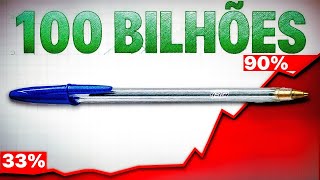

BIC vs iPhone: Shocking Sales Comparison
40sThe surprising fact that BIC outsells iPhone by 60x triggers curiosity and shareability.
▶ Play Clip"Delivers exactly what the title promises: a thorough historical and technical breakdown of the BIC pen's world-changing impact."
The BIC pen, with over 120 billion units sold since 1950, is the most commercially successful product in history. Its simple yet ingenious design, leveraging capillary action and affordable mass production, revolutionized writing and global literacy.
Over 120 billion units sold worldwide, far surpassing the iPhone (2 billion) and Rubik's Cube (344 million).
The pen's low cost helped skyrocket global literacy from 35% to nearly 90%.
Fountain pens were expensive and unreliable, limiting writing to an elite art form.
Invented the ballpoint pen but it was too rough for paper and never sold.
Laszlo Biro used oil-based ink, which dried quickly and enabled capillary action, solving leaking and gravity issues.
The attraction between ink and the ballpoint tip walls draws ink regardless of angle, similar to water rising in a thin tube.
Bich bought Biro's patent, used Rolex watch machines to manufacture steel spheres, and designed a plastic hexagonal body.
Hexagonal body prevents rolling; polystyrene allows visibility of ink level; small hole balances pressure; cap doubles as a clip and has a hole to prevent choking.
By 1953, 40 million units sold yearly; design unchanged for 70 years; literacy rate soared.
The BIC pen's perfect blend of physics, design, and affordability made it an unprecedented commercial success and a catalyst for global literacy.
How many BIC pens have been sold since 1950?
Over 120 billion units.
00:02
What physical principle allows the BIC pen to write at any angle?
Capillary action.
03:41
Who invented the ballpoint pen?
John Loud.
02:02
What type of ink did Laszlo Biro use to solve leaking?
Oil-based ink.
03:10
Why does the BIC pen have a hexagonal body?
To prevent rolling and make it easier to hold.
05:34
What is the purpose of the small hole in the pen's cylinder?
To balance atmospheric pressure and maintain capillary action.
05:47
What material is the BIC pen cap made of and why?
Polypropylene, which absorbs impacts and prevents breakage.
06:28
How much can a single BIC pen write?
Up to 3 kilometers.
06:28
What was the global literacy rate before BIC's mass adoption?
Around 35%.
06:55
BIC's Unmatched Sales
Establishes the scale of BIC's success, putting it above iconic products like the iPhone.
00:02Capillary Action as a Design Breakthrough
Explains the physics that made the pen work at any angle, a key innovation.
03:41Mass Production and Affordability
Marcel Bich's manufacturing strategy using watch-making machinery enabled the pen's low cost.
04:54Ingenious Design Features
Every detail (hexagonal body, hole, cap) serves multiple purposes, demonstrating perfect design.
05:34Impact on Literacy
Direct correlation between pen affordability and global literacy rise from 35% to 90%.
07:26[00:02] successful product in history. No matter where you are in the world, the BIC pen will be there too. Since its launch in 1950, more than 120 billion units have been sold worldwide. That's so
[00:17] impressive that the second-place iPhone only has 2 billion iPhone only has 2 billion sales, and the third-place Rubik's Cube has 344 million units sold since its
[00:29] launch. Even after 70 years, this product remains virtually unchanged in design. This pen is the most commercially successful product in the world, making 14 million sales a day. The revolution it
[00:42] caused in humanity is practically unparalleled. Since its launch, the price of other pens has plummeted, and the global literacy rate has skyrocketed. But one question remains in our minds: What is the secret that made this
[00:55] pen so successful? I studied every detail to tell you the answer. Today you will discover it. Today you will learn the untold story of the BIC pen, from how its intelligent use of
[01:09] physics made it the perfect product to its more than 26 uses. Yes, but to understand how Bic revolutionized the world, we need to go back in time. Writing was very difficult in the past; pens needed to be
[01:25] area. Writing was so complicated that it was considered an art form limited to very few people, until the fountain pen was invented. It has a metal nib and stores ink in an internal reservoir.
[01:38] This was revolutionary, but there was a problem: the nib was very rough, and because of this, you couldn't maintain a constant flow of ink. There was maintain a constant flow of ink. There was also another problem: the price – $50
[01:50] per unit, like R$900 for a pen. It's understandable, because at that time only 20% of the world's population could read and write. Then John Lounge created a system
[02:02] to use a metal ball instead of a fine nib. The goal was to make the writing and the line more uniform and to facilitate the use of the pen. This man had just invented the ballpoint pen. The material worked
[02:14] well on rigid surfaces, but it was too rough to use on paper. John's pen, therefore, never sold. Decades passed, many new designs were created, but no one could master the ballpoint pen if the ball
[02:29] was too tightly pressed. When fitting the ball, the ink wouldn't pass through the paper; if the ball was too loose, the ink would leak and stain the entire page. Finding the ideal design was extremely difficult because they needed to find
[02:41] the perfect combination of precise fit and millimeter-precise texture. Then came Lasl Biro's turn; the name sounds realized that the solution wasn't in the ball but in the ink. Most
[02:56] ink at the time was water-based, a thin ink that leaked easily and dried very slowly in books. This ink penetrated the paper fibers and stained the pages underneath. This pen also needed
[03:10] gravity; if it wasn't pointed at a 90º angle, the ink wouldn't flow. If the writer changed the angle of writing even slightly, the pen would stop working. Then they began testing with oil-based ink, a denser ink that
[03:26] dried almost instantly and stayed put instead of leaking. This was a brilliant move because it unlocked a unique physical effect that mysteriously pulled the ink towards the ball regardless of the angle the
[03:41] writer was at. Gravity was no longer necessary for the pen, and also... They did n't need any external impulse. This is the effect of capillary action, the same law that lifts water through the roots of trees and allows blood to circulate
[03:56] throughout our bodies. We can see this feat working in practice by placing a thin tube in a container of water and observing it rise. Why does this happen? Because the attraction between the liquid and the walls of the tube is
[04:11] stronger than the law of inertia, allowing the liquid to rise until its weight cancels its force. The denser ink was then pulled by the walls of the ballpoint tip. The ball always remained covered in ink and produced a
[04:26] consistent, smooth line regardless of the writing angle. Biro quickly patented that design, but there was a problem: the cheapest pen he sold cost R$190 per pen. So
[04:41] his product never reached the masses. At this stage in history, At this stage in history, world literacy was at 33%, and the pen was still a luxury item. But all this would change in a few
[04:54] years when the French manufacturer Marcel Beach discovered Biro's pen and saw great potential in it. He seized the opportunity to buy the Biro patent and began designing a new and improved version that could be mass-produced at a
[05:08] much lower price with the help of machines that manufactured Rolex watches. He devised a way to mass-produce small stainless steel spheres instead of using metal for the rest of the pen. He bought machines that could mold the
[05:21] plastic, and this was the final result. Although it looks like just a pen, it's hard to perceive how perfect the design was. There were no moving parts, springs, or complex materials, and each element had multiple functions. With the help of
[05:34] editing, we'll look at this more closely. The pen was built with a hexagonal body; this prevents it from rolling off the table and makes it easier to hold. The table and makes it easier to hold. The plastic used here is polystyrene; it's
[05:47] strong, cheap, and transparent. It allows the ink level to be seen at all times. There's a small hole in the pen's cylinder; it serves to balance the atmospheric pressure inside and outside, maintaining capillary action. When
[06:02] and outside, maintaining capillary action. When writing, the sphere rises a fraction of a millimeter, allowing the amount of ink deposited on the page to be thin and uniform. When the pen is not being used, the sphere returns to its
[06:14] original position and creates a seal, preventing the ink from leaking. The pen changes angle; capillary action prevents the ink from spilling out; the cap also functions as a clip because it's made of polypropylene, which absorbs
[06:28] impacts and prevents the pen from breaking; each Bic pen can write up to Bic pen can write up to 3 km at a time; women can use it to tie their hair; emergency doctors use the tube for
[06:41] induction; the cap has a hole at the tip so humans don't choke if swallowed; it can be used as a whistle, measuring device, and awl; and the plastic, along with all its material, is recyclable. The pen was so perfectly simple that it
[06:55] solved all the other problems caused by previous pens, and above all, it was cheap. Reaching the market in 1950, it was an instant success, in France in the first year. Marcel realized that native English speakers
[07:11] pronounced his name differently, so he removed the 'h', and that's how the name Bic was born. The world needed Bic pens, so by 1953 he was already selling 40 million units per year, and Bic conquered the world. Now
[07:26] anyone can write and draw because... It's easy, cheap, and in the following 50 years, 100 billion units of this pen were sold. The world literacy rate jumped from 35% to almost 90%, and the fact that the design of this
[07:41] product has remained unchanged since its launch proves how perfect it was. Thank you very much for your attention, and until the next video.


⚡ Saved you 0h 07m reading this? Transcribe any YouTube video for free — no signup needed.