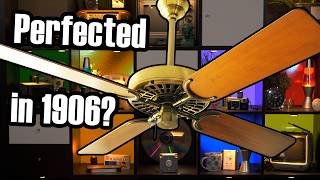

Ceiling fans are older than electricity!
53sShocking historical fact hooks viewers immediately, promising a story they've never heard.
▶ Play Clip"The title accurately reflects the video's core argument that ceiling fans have been compromised by market forces, though it slightly exaggerates the 'screwing up' aspect by focusing on a few key examples."
The video explores the history of ceiling fans, from their invention in the 1880s to their near-extinction due to air conditioning, and their surprising comeback during the 1970s energy crisis. It argues that while ceiling fans are a simple and effective cooling technology, market forces and a focus on style over function have led to a decline in quality, with many modern fans being far less effective than vintage designs.
Philip Diehl invented the electric ceiling fan in 1882, the same year Schuyler Wheeler invented the electric desk fan.
Air conditioning caused ceiling fans to disappear from public spaces and homes by the 1960s, as they were seen as outdated.
The 1973 oil crisis made energy expensive, renewing interest in ceiling fans as energy-saving devices.
The Casablanca Fan Company initially sold purely decorative fans that mimicked the slow-spinning props from the film 'Casablanca'.
The Hunter Original, a design from 1906, is still in production and outperforms many modern fans due to its powerful motor and aggressive blade pitch.
CFM ratings are misleading because they don't account for air velocity, room layout, or how the fan distributes air, making them a poor indicator of real-world performance.
The focus on style and cost-cutting has led to weaker motors and less effective fans, with many modern fans being far less powerful than vintage models.
Who is credited with inventing the electric ceiling fan?
Philip Diehl in 1882.
1:24
What event triggered the resurgence of ceiling fans in the 1970s?
The oil crisis of 1973, which made energy expensive and sparked interest in energy-saving devices.
14:22
Which company initially sold purely decorative ceiling fans that mimicked movie props?
The Casablanca Fan Company, founded by antiques dealer Burton Burton in 1974.
18:19
What is the name of the 120-year-old ceiling fan design that is still being manufactured?
The Hunter Original, a design from 1906 that is still in production.
36:05
Why does the video argue that CFM ratings are not useful for comparing ceiling fan performance?
CFM (cubic feet per minute) measures the volume of air moved, but it doesn't account for air velocity, room layout, or how the fan distributes air, making it a poor indicator of real-world performance.
48:55
What is the main reason ceiling fans became less powerful over time?
The motor is the most expensive component, so manufacturers use smaller, weaker motors to cut costs.
32:57
How does a ceiling fan cool a person without actually lowering the room temperature?
A ceiling fan creates a wind chill effect by moving air across the skin, which helps sweat evaporate faster, cooling the body without lowering the room temperature.
26:15
What unique maintenance requirement does the Hunter Original ceiling fan have?
The Hunter Original uses a cast iron motor housing and an oil bath bearing that requires oiling every five years.
36:40
What factor contributed most to the decline in ceiling fan quality?
The shift to overseas manufacturing, particularly in China, led to cheaper but weaker motors and a focus on style over function.
29:35
How did the film 'Casablanca' influence the ceiling fan market?
The film 'Casablanca' featured ceiling fans as props, and the Casablanca Fan Company was named after the film, initially selling fans that mimicked the slow-spinning movie props.
19:21
Invention of Electric Ceiling Fan
Establishes the historical origin of the electric ceiling fan, setting the stage for the entire narrative.
1:24Oil Crisis Sparks Resurgence
Highlights how external economic factors can revive interest in old technology, a key theme of the video.
14:22How Ceiling Fans Cool
Explains the scientific principle behind ceiling fan cooling, which is essential for understanding their value.
26:15CFM Ratings Are Misleading
Challenges the standard metric for fan performance, arguing it doesn't reflect real-world effectiveness.
48:55The Good Place Quote
Summarizes the video's central critique of market forces ruining a good product for mass consumption.
68:23[00:00] Did you know the ceiling fan is nearly as old as the electric light
[00:05] Actually, did you know it's older than electricity itself?
[00:09] We humans really don't like the feeling of being hot,
[00:12] and we figured out more than a thousand years ago
[00:15] that forcing the air around us to move
[00:18] a la the wind can help us cool down.
[00:21] Hand fans like this worked great for millennia, but they really did a number on the wrists.
[00:26] And while the solution to that for a distressingly long period of time was to
[00:31] outsource that problem to other humans,
[00:34] once industrialization started giving us access to powered machinery, we had a much better solution.
[00:40] It didn't take that much imagination to use that machinery
[00:44] to spin some angled paddles hanging from the ceiling
[00:47] to create artificial wind.
[00:49] Early fans were driven by simple gearing or belts
[00:52] powered by waterwheels or even steam engines,
[00:55] and the... nicer factory owners out there would spend the money to install ceiling fans
[01:02] to help their workers beat the heat in the summertime.
[01:05] And since we figured out how to build electric motors which spin things very early into this whole electricity business,
[01:12] electric ceiling fans were an obvious invention.
[01:16] Just attach some of those fan blades to a motor,
[01:18] hang the thing from the ceiling and you've got a ceiling fan
[01:22] powered by electromagnetism.
[01:24] Philip Diehl is credited for inventing the electric ceiling fan in 1882,
[01:30] the same year Schuyler Wheeler is credited for inventing the electric...
[01:34] regular fan.
[01:36] Electric fans were pretty obvious,
[01:38] and arguably the first mass market application for the electric motor.
[01:42] In fact, many pioneering motor manufacturers
[01:45] went into business to sell cooling fans.
[01:48] Much of the United States gets pretty hot in the summer, so
[01:52] electric fans became a very intriguing item.
[01:55] If you were convinced to subscribe for Electric Light,
[01:58] you'd have to do a lot of work running wires around the place to light up each room,
[02:03] and maybe you could use 'em to keep cool, too.
[02:06] The idea of an artificial wind machine
[02:08] that you could just switch on must have been incredibly compelling.
[02:12] I imagine to many folks at the time,
[02:17] But we had barely figured any of this stuff out yet.
[02:20] We still hadn't settled on AC or DC power when Diehl patented his fan, and even once we did,
[02:27] electric motors were incredibly expensive to make.
[02:30] But over time, we'd learn how to mass produce them.
[02:33] And since all it takes to make a fan from a motor
[02:36] is the fan part, before long
[02:40] they started to become a fixture of our lives.
[02:42] Around the turn of the 20th century,
[02:45] ceiling fans were a common sight, especially in public spaces.
[02:49] But by the middle of the century,
[02:51] they rapidly began to disappear.
[02:54] The advent of air conditioning
[02:56] turned a once revolutionary cooling technology into old news,
[03:01] and for many years, those of us in the US
[03:04] pretty much forgot about ceiling fans.
[03:07] Which might be surprising, because today
[03:10] ceiling fans are once again a very common sight.
[03:14] Though I hear tell much of Europe hasn't discovered them yet.
[03:18] Maybe by the end I'll convince you to give ‘em a try.
[03:20] But the reason ceiling fans
[03:25] is not quite as straightforward as you would think.
[03:29] If you're wondering how on Earth a video
[03:34] well, hello, welcome to the channel.
[03:36] You must be new here!
[03:37] But I've been spending so much time on this script
[03:40] because the humble ceiling fan can explain so much about us.
[03:45] It's resurgence in the United States
[03:50] where nostalgia for the past amplified a cultural moment of reckoning.
[03:55] But that nostalgia, while useful
[03:58] for reminding us of a good idea we had abandoned,
[04:01] also opened the door for a market
[04:04] which quickly turned to crap.
[04:06] Ceiling fans began to be sold
[04:08] not so much for their functional purpose,
[04:11] but instead for their fashionable looks.
[04:14] And when fashion comes first,
[04:16] weird things happen which we're still dealing with to this day.
[04:21] To understand what I mean, we have to start
[04:24] with what ceiling fans used to look like.
[04:26] This vintage ceiling fan made by the Hunter fan company
[04:30] might look like the most generic and traditional
[04:33] ceiling fan design you could possibly imagine,
[04:36] but that's because when this design was first made,
[04:40] fans were the only cooling technology we had.
[04:44] And the whole point of hanging one from the ceiling like this
[04:47] was to produce a lot of air movement so the cooling effect
[04:51] could be felt throughout a large area.
[04:54] That required big, aggressively pitched paddles
[04:57] which pushed on lots of air,
[05:03] However, when at operating speed,
[05:06] the paddles don't actually move very fast at all.
[05:10] At full speed, this fan only rotates at 200 rpm,
[05:14] and with the technology of the time, a strong motor
[05:17] designed to run that slowly needed to be quite large.
[05:21] Which is why the motor itself is what you're looking at.
[05:25] That's not a decorative cover with a motor inside.
[05:28] It's a 40 pound lump of cast iron and copper windings.
[05:33] This is function over form and even the details are functional.
[05:38] That pattern of holes may look pretty,
[05:40] but it's there for ventilation to keep the windings cool.
[05:44] And because those great big motors needed lots of raw materials
[05:48] and skilled labor to produce, they were pretty expensive.
[05:52] Even into the 1920s when we had figured out
[05:56] how to make motors pretty well, a ceiling fan like this cost the 2026 equivalent of about a thousand bucks,
[06:03] and pricing would remain similarly high for decades to come.
[06:08] The high cost of a ceiling fan meant
[06:10] it was mainly businesses and institutions that would spend the cash
[06:13] and go through the effort to install them.
[06:16] They had plenty of incentive
[06:17] to keep their employees happy and their guests cool
[06:20] so they could justify the cost, especially since one
[06:23] fan could handle a whole room.
[06:26] Also, thanks to the advent of light kits,
[06:29] which attached light fixtures to the bottom of a ceiling fan,
[06:32] installing one could add room lighting at the same time,
[06:35] making them a compelling purchase in the early days of electrification,
[06:40] even in parts of the country where it's only hot part of the year.
[06:44] Over time, as electrification spread and awareness of ceiling fans did too,
[06:48] they'd slowly gain some popularity in the home,
[06:52] but mainly among the wealthier set
[06:54] and mainly in parts of the country which were chronically hot.
[06:58] Once we had standardized on plugs and sockets... and voltage,
[07:02] it was a lot easier to just plug in a portable fan like this.
[07:07] These fans, with their much smaller blades designed to rotate very quickly
[07:11] could use much more compact motors, and that made them a lot more affordable.
[07:16] Plus, they don't need permanent installation
[07:18] and they can be moved around the house as you do.
[07:21] So these were a much better value in the eyes of most ordinary people.
[07:26] Still, ceiling fans were a very common sight around town wherever people congregated,
[07:31] like their favorite restaurants or maybe the barbershop,
[07:33] or the old soda fountains and the bank and whatnot.
[07:37] They were a staple of the community, which everyone would see as they went about their day
[07:41] and in the summer, which everyone enjoyed.
[07:45] That is, of course, until my hero Willis Carrier invented air conditioning.
[07:51] Fans can't actually lower the temperature in a room,
[07:54] but air conditioning can.
[07:57] And, air conditioning could also lower ambient humidity, too
[08:00] providing a whole new kind of comfort.
[08:03] Air conditioning was this marvelous new invention
[08:06] getting installed in movie theaters to boost ticket sales, and before long
[08:10] everywhere else a blast of arctic air could draw in some customers.
[08:15] As you may imagine, this caused demand for new ceiling fans to rapidly dry up.
[08:21] The public spaces they were most likely to be seen
[08:24] were also the first to install air conditioning.
[08:27] And before too long, air conditioning systems became affordable enough for average folks to buy one.
[08:34] Now, air conditioning was extremely energy intensive compared to ceiling fans.
[08:40] But during the post-war boom, where we were building power plants left and right,
[08:43] and we barely had to work to get coal and oil out of the ground,
[08:47] we weren't thinking very much about that.
[08:50] We were thinking about the tremendous work needed to upgrade the power grid
[08:54] such that all those new suburban homes could have an energy hungry air conditioner of their own, and later
[09:00] central air conditioners which cooled the whole house.
[09:03] But you know what?
[09:05] We did that work because we're humans who know how to do very hard things
[09:09] like run wires and upgrade power grids when we want to.
[09:14] If only we could remember that.
[09:16] Anyway, the point is air conditioning was expensive and very difficult to deploy,
[09:21] but energy was cheap and it was a sign of progress
[09:24] which was extremely desirable to a wealthy, growing nation.
[09:29] Meanwhile, ceiling fans were literally old technology.
[09:33] So as air conditioning became widespread,
[09:36] ceiling fans started to disappear from our lives.
[09:39] By the 1960s, there were few companies bothering to make them in the US.
[09:45] Robbins and Myers, the iron foundry turned motor manufacturer
[09:49] who made this desk fan and had acquired Hunter in 1949,
[09:53] kept the Hunter ceiling fan line in production
[09:55] as there was still reasonable demand for ceiling fans in outdoor spaces,
[10:00] but for indoor spaces
[10:03] ceiling fans became quite esoteric and the mark of a cheapskate.
[10:08] There were, however, plenty of situations where air conditioning was impractical,
[10:12] like large factories and warehouses.
[10:15] So there was still decent industrial demand for ceiling fans.
[10:19] But those buyers wanted cheap, reliable fans
[10:22] which did the job without a fuss.
[10:24] And that's how this came to be.
[10:27] This is an Emerson Heat Fan.
[10:30] And yes, it’s called a heat fan despite the fact that it's just a ceiling fan.
[10:34] That's important for what comes later.
[10:37] But those in the ceiling fan collector community often call this the blenderfan
[10:41] thanks to the motors resemblance to the base of a kitchen blender.
[10:45] And yes, there's a ceiling fan collector community because of course there is!
[10:49] Humans are awesome.
[10:50] Get yourself a proper fixation.
[10:52] It's fun!
[10:53] I know way too much about ceiling fans now.
[10:56] Anyway, much like Robbins and Myers,
[10:59] Emerson was a pioneering electric motor manufacturer
[11:02] who got started selling cooling fans
[11:05] because, again, it's the simplest thing to do with a motor.
[11:08] Stick some fan blades on it and job done.
[11:11] But over the years, Emerson grew into a major industrial supplier of electric motors
[11:16] which got used by all sorts of industries for all sorts of things.
[11:20] For decades they had been making ceiling fans
[11:24] very similar to this Hunter model, but as ceiling fans went from
[11:28] “desirable thing to keep your patrons comfortable” to
[11:31] “the solution for when air conditioning is too expensive,”
[11:34] Emerson got a little crafty with their production lines.
[11:38] They decided to take one of the washing machine motors
[11:41] they pumped out like some kind of motor factory,
[11:43] and stuck some fan blades onto it so they could sell it as a ceiling fan.
[11:47] And that's why this looks the way that it does.
[11:50] This is just a washing machine motor.
[11:53] That's a little oversimplified,
[11:55] because the technical details of this motor are quite different
[11:58] from what would go in an actual washing machine.
[12:01] Plus, they had to design a flywheel to attach the blades to
[12:03] and add a switch housing so you could actually turn it on and off
[12:06] and select between its speed settings.
[12:08] But this right here is the same case K63 motor housing which Emerson was using
[12:14] for all sorts of applications.
[12:17] They likely started using it so they could shut down the production line
[12:20] of pancake motors, which were only useful for the rapidly declining ceiling fan market.
[12:27] So as we approach the 1970s,
[12:30] you had essentially two options:
[12:32] an extremely traditional ceiling fan from Hunter
[12:36] or this... thing.
[12:38] However, the situation was very different in other parts of the world,
[12:42] particularly the warm climates of Asia.
[12:45] Buildings were rapidly getting electrified,
[12:47] but energy resources weren't abundant enough for air conditioning
[12:51] to become widespread for quite some time.
[12:54] So while we had basically stopped caring and arguably even trying,
[13:00] ceiling fan manufacturing was experiencing a huge boom overseas.
[13:05] For example, the Shell Manufacturing Company
[13:08] in Hong Kong built upon an idea
[13:13] Turning the motor inside out
[13:15] allowed for a sleeker looking fan, which was also a lot cheaper
[13:19] to build from a materials perspective.
[13:21] Here's an example of such a ceiling fan motor.
[13:24] Unlike the traditional American design where the stator windings surround the spinning rotor,
[13:29] in this design the stator windings are inside the rotor,
[13:33] and the outside surface of the whole thing is what spins,
[13:37] giving them their common name “spinner motors.”
[13:40] This greatly simplified the design of a ceiling fan
[13:44] and lowered materials cost substantially since you didn't really need a motor housing.
[13:49] Just attach the fan blades directly to the motor.
[13:53] Early designs had some glitches to work out, like bearings which failed prematurely,
[13:57] but eventually those issues were solved
[14:00] and this became a much more refined and cost effective design
[14:04] than anything we were making here in the States.
[14:07] On occasion, fans like this ended up getting imported
[14:10] to the US and sold as a cheap alternative to the fans from Emerson and Hunter,
[14:14] but it was a pretty rare occasion since nobody really wanted a ceiling fan.
[14:20] But that was about to change.
[14:22] Remember how this is called the heat fan?
[14:25] Emerson started making these things in the 1960s,
[14:29] but in 1973 we would go through a bit of an oil crisis
[14:33] which we clearly learned lots of very good lessons from.
[14:38] In response to the oil embargo causing energy to get much more expensive,
[14:42] including heating oil which was still quite commonly used back then,
[14:47] Emerson started to market their ceiling fans as heat recovery fans
[14:51] which could save on heating costs.
[14:54] See, in a space with high ceilings
[14:56] like a factory, warehouse, or even a church sanctuary,
[15:00] a temperature gradient forms in the winter due to warm air
[15:04] rising above denser, cooler air.
[15:06] And this means a lot of the heat energy coming from a building’s heating system
[15:11] simply ends up stuck at the ceiling where nobody can feel it.
[15:14] A pretty significant waste.
[15:16] If you could use some sort of mechanical device
[15:19] to push that warm air back down to the floor,
[15:22] then you could recover that wasted heat energy.
[15:25] Thus heat recovery, also known as heat reclamation.
[15:29] Getting the warm air back down to the floor where the people are
[15:32] would not only make the heat more useful, but
[15:35] since the thermostat is down there, too, the heating system won't need to run as often
[15:39] and it will burn less if it's suddenly much more expensive fuel.
[15:44] Emerson just so happened to make ceiling fans
[15:47] which would be perfect for heat reclamation,
[15:49] so they began to market them specifically for that purpose.
[15:53] And that's why their very utilitarian ceiling fan, which is the same ceiling fan it was before
[15:59] became the Heat Fan.k
[16:01] Industry and large institutions were slowly discovering
[16:05] that ceiling fans could be useful for saving energy.
[16:08] And the good word was starting to spread.
[16:11] And you know what else got really expensive very suddenly?
[16:15] Air conditioning.
[16:17] We still burned quite a lot of oil
[16:21] which meant the oil embargo made pretty much
[16:24] everything we did using energy much more expensive.
[16:27] And out of necessity, people began to realize
[16:30] that they could save some money on their electricity bills
[16:33] by turning up the temperature on their thermostats
[16:35] and using electric fans to keep cool.
[16:39] Basic portable fans were still widely available,
[16:41] now with less finger chopping!
[16:44] But while fans were all the rage,
[16:47] ceiling fans were still expensive and ugly industrial items,
[16:52] which relatively few people would consider appropriate
[16:56] [Scott Joplin’s Easy Winners plays in background]
[17:02] wave of nostalgia for the turn of the 20th century.
[17:05] Films like The Sting repopularized the ragtime music
[17:09] of Scott Joplin, and earlier films like Hello, Dolly!
[17:13] brought the Gay Nineties back into our collective attention,
[17:16] as did the restaurant chain TGI Fridays.
[17:20] Walt Disney World had just opened in Florida
[17:22] with a duplication of Disneyland's Main Street, U.S.A., bringing an idealized recreation
[17:27] of turn of the century America to a national audience.
[17:31] It was a whole thing, which lasted a surprising while.
[17:35] Cheers, the TV show wouldn't hit the airwaves until 1982,
[17:39] and yet the Tiffany lamp, stained glass and ornate woodwork aesthetic was still going strong.
[17:46] While we were enamored with that old timey aesthetic,
[17:50] well, we started getting obsessed with antiques and curios of the time.
[17:55] And, you know what was a quaint, old timey curio
[17:57] you could find in antique shops which hailed from the turn of the century?
[18:02] Ceiling fans.
[18:04] Yep, ceiling fans started to become a fashionable item
[18:09] thanks to our sudden obsession with the past.
[18:12] But it's even weirder than it sounds on the surface.
[18:15] I'm skipping details for time, but in 1974
[18:19] an antiques dealer named Burton Burton founded the Casablanca Fan Company
[18:23] to sell reproductions of antique ceiling fans.
[18:27] But when I say reproductions,
[18:30] I don't mean “ceiling fans that look like antiques.”
[18:34] I mean “objects which appear to be antique ceiling fans” because his earliest designs were,
[18:42] I kid you not, purely decorative.
[18:45] Initially, they started making reproductions
[18:52] and those made their way into lots of themed restaurants,
[18:55] including at least one Portillo's I have myself been to.
[18:59] They were rigged to rotate, but nowhere near fast enough to actually function as effective ceiling fans.
[19:05] Yet diners were so captivated by the visual of old timey
[19:11] spinning things that it became a shockingly huge fad.
[19:15] And the visual really was the point.
[19:19] For those who may not know the connection,
[19:21] the name Casablanca Fan Company was chosen
[19:24] because of how prominently ceiling fans are featured
[19:29] You know, Humphrey Bogart.
[19:30] Here's looking at you, kid.
[19:32] In the film, the ceiling fans shown on screen
[19:36] were props meant to convey to the audience
[19:38] that it's hot in Casablanca, and because they were movie props,
[19:43] they were rigged up to spin much more slowly
[19:46] than an actual ceiling fan would.
[19:48] A real ceiling fan in operation
[19:51] doesn't look very interesting or even recognizable on film
[19:54] because its blades will just blur together.
[19:57] And the look from the film is what Burton Burton was trying to replicate.
[20:03] He wasn't trying to sell actual ceiling fans.
[20:06] He was trying to sell a kind of dynamic decoration,
[20:10] which just so happened to be copies of antique ceiling fan designs.
[20:15] Quick side note, Emerson, who we already know was great at selling the same thing
[20:20] they had always been making for different reasons, also started
[20:23] selling their ceiling fans using the name Casablanca.
[20:27] I'm guessing the film must have been on TV a lot at the time.
[20:30] In fact, Emerson trademarked the name Casablanca
[20:34] before Burton Burton started his company,
[20:37] which we don't need to get into.
[20:39] Emerson was just trying to sell more of their fans,
[20:42] but the Casablanca fan company was trying to serve the weirdly huge demand
[20:47] for purely decorative turn of the century ceiling fans,
[20:51] which were suddenly all the rage in your favorite themed restaurant chains.
[20:56] This sounds nuts, but I mean, it sure was flair.
[21:00] And as the general public became exposed to ceiling fans in formal settings again,
[21:05] their reputation as quaint, oddball things to have in the home started to fade.
[21:11] After all, quaint was in!
[21:14] And the timing could not have been more perfect.
[21:17] People were being reexported to ceiling fans right at the start of an energy crisis,
[21:22] which renewed interest in their functional purpose, too.
[21:26] For a brief while, the options for actually functional ceiling
[21:34] But all it really takes to make a ceiling fan
[21:40] So many companies, including Casablanca,
[21:43] started purchasing real ceiling fan motors from suppliers like Emerson
[21:47] and concealing them in decorative shrouds
[21:50] which replicated the appearance of old timey fans.
[21:54] Give the blades some details, like perhaps a stencil or a woven inlay,
[21:59] and now you have a decorative fan,
[22:03] get this, actually works!
[22:06] Ceiling fans were now being sold as a premium item
[22:10] which was both an energy saving appliance and furniture,
[22:15] and this was only the beginning.
[22:17] You see, there would be a sequel to the 1973 oil crisis in 1979.
[22:23] And so ceiling fans, already experiencing renewed interest
[22:27] as a premium item for the nostalgic middle class,
[22:30] started flying off the shelves.
[22:33] We finally realized we had made a mistake
[22:36] in getting rid of all those ceiling fans.
[22:38] They made us comfortable before air conditioning, after all,
[22:42] and our collective decision to view air conditioning as a replacement for them
[22:46] turned out to be a false choice.
[22:50] As energy policy started to become a thing
[22:52] and we began looking at ways to increase energy efficiency,
[22:56] new homes started getting constructed with electrical boxes
[22:59] on the ceiling meant specifically for ceiling fans.
[23:03] Home builders were happy to go along with it, too,
[23:05] since a fan with a light kit could fulfill code requirements for lighting in bedrooms and living rooms.
[23:11] This massively increased the market for new ceiling fans,
[23:15] and with a new market came a flurry of innovation.
[23:19] For the first time in decades,
[23:21] new motor designs meant specifically for ceiling fans were being developed
[23:26] to make them even more energy efficient than they already were.
[23:30] Some were flops, but others were significant
[23:36] New controls for those motors appeared,
[23:38] offering more speed settings than the 2 or 3 you'd typically find.
[23:42] And if you wanted to get fancy, you could put in an in wall speed control
[23:46] so you didn't even have to pull on a chain to switch it on.
[23:50] And of course, with renewed interest,
[23:55] And now ceiling fans weren't just
[24:00] but could actually be a centerpiece of your living room
[24:03] to express your taste and brag to your friends about.
[24:07] Now I'm going to take a little bit of a break from the history here
[24:10] to explain what makes ceiling fans so different from a portable fan,
[24:15] and thus why they suddenly became desirable in the home.
[24:19] For one thing, mounting a fan on the ceiling
[24:22] means it's out of the way, yet always there which is convenient.
[24:26] But putting a fan on the ceiling produces
[24:34] Ceiling fans are still directional, of course,
[24:36] and you'll feel their breeze most when you're directly underneath them.
[24:40] But their large diameter means they produce a large column of air moving downward,
[24:46] which will bounce off the floor and spread out sideways,
[24:50] producing noticeable air movement throughout a room.
[24:53] As a matter of fact, this is the principle behind
[24:55] those high volume, low speed ceiling fans which have been popping up lately.
[25:00] Put a giant ceiling fan at the top of a warehouse or shopping center,
[25:04] and it will send strong lateral currents of air through the aisles and over a really large area.
[25:11] Ceiling fans are essentially trying to replicate a natural breeze.
[25:16] If you can imagine the sort of relief you feel on a warm day
[25:20] when the wind picks up enough to make the tree leaves rustle...
[25:23] well, that's pretty much the point of a ceiling fan.
[25:26] And you feel relief for two reasons.
[25:29] First, in still air, your warm body heats up the air next to
[25:37] you end up surrounded by a bubble of air
[25:42] A ceiling fan, even if it's running at a low speed, is able to constantly push that air away from you,
[25:49] which has the effect of making the room seem cooler than it is.
[25:53] This is perfect for amplifying
[25:57] and since most ceiling fans only draw 20 or 30W of power when running at their medium speed setting,
[26:03] that amplifying effect comes with virtually no cost.
[26:08] But it doesn't just amplify what your air conditioner does,
[26:11] it also amplifies what your body naturally does.
[26:15] We cool ourselves through perspiration,
[26:20] heat energy is pulled out of our bodies
[26:22] thanks to the same mechanism which makes air conditioning possible:
[26:26] The latent heat of vaporization.
[26:28] A ceiling fan churning up the air in a room
[26:32] will help your sweat to evaporate faster,
[26:34] which not only cools your body faster,
[26:37] but can also keep your sweat from building up on your skin
[26:40] and making you feel all gross.
[26:42] Best of all, a ceiling fan can do this without making much noise.
[26:48] Running at high speed, most ceiling fans
[26:52] and running at lower speeds, many are effectively silent.
[26:57] That's the logic which caused them to get popular again.
[27:01] Everyone already knew they could save energy using fans,
[27:04] but every other style of fan is not only loud,
[27:08] but also only really works for one person at a time.
[27:12] And while oscillating mechanisms existed
[27:14] to make portable fans like this sweep across the room...
[27:18] well, that's its own kind of annoying.
[27:21] Ceiling fans allow for a constant,
[27:25] and if that breeze makes you feel comfortable enough to raise your thermostat set point by a few degrees,
[27:31] a ceiling fan will save energy
[27:36] So for the millions of Americans who already have ceiling fans but might have gotten out of the habit of using them,
[27:43] switch those suckers on and see how they make you feel.
[27:47] It's a subtle effect, so it may take a while to notice,
[27:50] but their subtlety is the point.
[27:53] And ceiling fans have other benefits beyond cooling.
[27:56] Most ceiling fans offer a reversing function
[27:59] because by drawing air from below
[28:03] they can churn up the air in
[28:08] In fact, many fans set to their lowest speed
[28:14] but they'll still be moving enough air to keep the room at a uniform temperature,
[28:19] which can be very useful in the winter.
[28:23] Thermal gradients aren't as much of an issue in a home with typical ceiling heights,
[28:25] but keeping the air mixed up just enough can reduce the effect of drafty windows and doors,
[28:33] and can even help an HVAC system operate more efficiently,
[28:37] particularly when your system has distribution issues like poorly placed vents and returns.
[28:42] But let's get back to the story from the past,
[28:45] because their sudden popularity would soon lead to some inevitable consequences.
[28:51] Domestic manufacturing,
[28:56] couldn't possibly keep up with this very sudden demand.
[29:00] Not only were new homes getting constructed with several fans each,
[29:04] but folks looking to add fans to their existing home wanted options, too.
[29:09] In yet another example of fortuitous timing, the rather new concept of the big box home improvement store
[29:16] was starting to sweep the nation, and ceiling fans were some of their best selling items.
[29:22] Accordingly, the purchasing departments of stores
[29:25] like Builders Square, Home Depot, Lowe's and Menards
[29:28] started contracting with overseas suppliers
[29:35] Remember how Hong Kong was making
[29:39] Well, suddenly they were making them for us, too.
[29:43] But even that wouldn't be enough.
[29:45] The ceiling fan market in the US continued to grow
[29:51] So tons of ceiling fan factories started
[29:57] They were apparently puzzled by our desire
[30:02] but they were still fundamentally motors on sticks,
[30:06] and thus they were pretty cheap to make and to customize.
[30:10] Just as Casablanca was putting motors
[30:14] Chinese factories would do the same with their own motors.
[30:18] There's even some evidence that the, uh, unauthorized copying
[30:23] of intellectual property common in Chinese manufacturing started thanks to, of all things,
[30:30] the sudden and explosive growth in ceiling fans.
[30:35] Saying that it started thanks to ceiling fans is obviously speculation.
[30:38] But this was all happening right as manufacturing in mainland China was getting serious
[30:44] and factories were constantly copying design details from one another
[30:48] as deals brokered for American firms were made and, uh,
[30:54] broken.
[30:56] We're not necessarily the good guys in those stories.
[30:59] My friend Dan, who served as
[31:03] and who supplied many of the fans I've shown you,
[31:07] if you'd like to know the specifics of certain situations,
[31:10] but the early to mid 80s were a wild time!
[31:15] Nostalgia, the growth of big box stores, the shift to overseas
[31:23] all lined up to make ceiling fans
[31:29] which everyone wanted to be a part of.
[31:31] Because if you could manage to import
[31:36] But, if you didn't already see this coming,
[31:39] here's where we get to the bad news.
[31:42] Or, more fairly, the complicated news.
[31:46] As ceiling fans became popular and manufacturing got cheaper,
[31:51] the market changed in many ways which made ceiling fans abundant
[31:56] but ultimately much worse at their job.
[32:00] Initially, imported fans were pretty good.
[32:03] Yes, the motors were made cheaply, but they were still powerful.
[32:07] Remember, Hong Kong was making ceiling fans because it's hot over there too,
[32:12] and the compact size of the spinner motor
[32:18] It was really a match made in heaven.
[32:21] But the ceiling fan would become a victim of its inherent simplicity.
[32:25] And before long, things would go off the rails.
[32:29] Now that ceiling fans had become a commodity,
[32:32] most were being sold for one of two reasons:
[32:36] style or price.
[32:38] And both of those things began
[32:44] Big box stores had already started
[32:49] and were encouraging their
[32:53] The motor is the most expensive component in a ceiling fan.
[32:57] And to make it cheaper, it's got to get smaller and weaker.
[33:01] So they did.
[33:03] And ceiling fans became rather weak sauce.
[33:06] And this didn't get any better because
[33:11] didn't matter to the motor
[33:14] manufacturers quickly realized they could
[33:19] many different styles of fan and create a huge product line
[33:24] all based around the same pretty crappy components.
[33:28] But style is also what sells many premium fans, so even the quality options on the market
[33:35] would start to suffer as vanity took hold.
[33:38] For example, while the turn of the century fad would eventually end,
[33:43] a new fan fad started in the 90s, where plain ceiling fan blades were replaced with giant leaf looking things.
[33:50] And you can still by fans that look like that today.
[33:54] That design is charming,
[33:56] at least to some folks,
[33:57] but it simply doesn't work as well as a traditional fan.
[34:02] That design is far more decorative than it is functional,
[34:06] which is poetic given that's what put
[34:11] The resurgent ceiling fans of the late 70s were never sold purely on their merits,
[34:16] and once it became obvious that style was the main thing which sold ceiling fans,
[34:22] manufacturers looked at the race to the bottom they were already in and floored it.
[34:27] Before long, the mass market ceiling fan
[34:32] barely passable slop.
[34:35] And we are still dealing with that.
[34:37] There are countless options on the market today,
[34:40] but having played around with some vintage fans,
[34:43] it's become quite clear to me that we've pretty much lost the plot.
[34:47] The high speed setting of almost every ceiling fan I've ever lived with
[34:52] is nowhere near as powerful as this old Emerson fan.
[34:56] So if you've ever felt that ceiling fans don't seem to really do anything,
[35:01] there's actually some truth to that beyond their inherent subtlety.
[35:06] They genuinely became much worse when form took precedence to function.
[35:12] And there's what I would call a truly remarkable piece of evidence for this.
[35:18] Remember that ceiling fan from Hunter I showed you earlier?
[35:22] This particular example was made in the late 1970s,
[35:25] but this design traces all the way back to 1906.
[35:31] when Robbins and Myers
[35:35] they just sort of let those guys in Memphis keep on making the same ceiling fan motors they had always been making.
[35:42] If it ain't broke, don't fix it!
[35:45] And you bet the folks at Hunter
[35:49] Here's the installation instructions for
[35:55] And if you think it's remarkable that a fan from 1906
[36:02] wait’ll I tell ya they still haven't stopped!
[36:05] This is the Hunter Original,
[36:08] a 120 year old ceiling fan design which is somehow still in production.
[36:16] There's a bit of a Ship of Theseus situation going on here
[36:21] doesn't have quite the same motor design due to technical revisions over the years,
[36:25] and plenty of smaller details have changed, too.
[36:28] Plus, it's now made in China because of course it is.
[36:30] But Hunter is still using the same cast iron housing,
[36:35] and they are still using an oil bath bearing.
[36:40] Yes, that means this thing needs oil.
[36:44] There are so many reasons that's wild in 2026,
[36:47] but as the box is proud to boast,
[36:50] this is a proven design which stands
[36:55] You can probably already tell I am extremely fond of this.
[36:58] It's such a unicorn of a thing.
[37:01] What other machine has been in
[37:07] But before I fawn over it too much,
[37:09] I want to make sure you know that it takes a certain kind of crazy to buy one of these things.
[37:15] A Hunter Original currently retails for $750,
[37:19] which is quite a lot of money for such a basic fan
[37:26] But I am that kind of crazy.
[37:29] And this is a fascinating case study of what has happened to ceiling fans over the years.
[37:34] This is a machine which is stuck in time
[37:40] It's not trying to look cool or chase trends.
[37:43] It's not trying to be a cheap option, that's for sure.
[37:45] It's simply trying to be an excellent ceiling fan,
[37:49] and its continued existence proves that at least some people are still willing to pay for that.
[37:55] Let's do an unboxing, shall we?
[37:57] The first thing we're greeted by is the instruction manual,
[38:00] which lets you know right away
[38:06] I really appreciate that Hunter does this,
[38:08] especially since so many actually antique
[38:14] These things last forever.
[38:16] And before you ask, it's going to perform
[38:20] The motor produces a constant power output,
[38:23] so adding the fifth blade will just
[38:27] but it's still going to move the same amount of air.
[38:30] though the five blade configuration is a little bit quieter.
[38:33] As we keep going, we have the blades, of course,
[38:36] and like many fans, they're reversible
[38:40] Then we have the included bottle of oil
[38:45] just like its 1906.
[38:47] You will likely never really need to add oil again once installed,
[38:51] but it comes with a pipe cleaner to check the oil level,
[38:53] which they recommend doing every five years.
[38:56] Then there's the included very tiny
[39:01] This would be appropriate for standard eight foot ceilings,
[39:04] but if you've got taller ceilings,
[39:08] Two of the cast iron fan blade brackets are here, too.
[39:12] And then there it is.
[39:14] The 37 pound cast iron motor
[39:21] This is the same exact fan as the vintage one from earlier.
[39:25] The only major differences are that this one is painted brown rather than polished into an antique brass finish,
[39:31] and the blades are attached very differently.
[39:34] The vintage fan has a shaded pole motor which is not reversible, so to provide a reversing option,
[39:41] Hunter created the Adaptair
[39:46] Bet you didn't think there were ceiling fans out there with collectives.
[39:50] The current Hunter Original has a much more efficient permanent split capacitor motor,
[39:54] and since this kind of motor is trivial to reverse,
[39:57] it now has a reversing switch.
[40:00] Much less cool, but also much more practical.
[40:03] One quick note I want to make sure I include
[40:05] is that while this fan doesn't come with a light kit,
[40:08] it does come with an adapter ring
[40:13] This is actually how ceiling fans were traditionally sold.
[40:17] They'd be pre-wired for a light kit
[40:19] (that's why there's a blue wire coming out the top of this thing)
[40:22] but you'd get to choose which
[40:26] Or to not get one if you didn't need it.
[40:29] In fact, way back in the day,
[40:33] so you were basically building your own fan from a series of options.
[40:38] Too bad the world doesn't work like that anymore.
[40:41] And this motor, while identical in appearance...
[40:44] Well, it's now a little harder to say
[40:49] The current design actually is an inside out spinner motor.
[40:53] The windings are now close to the center of the fan
[40:56] and the rotor surrounds them.
[40:58] It's still a cast iron rotor and it still has that old bath bearing.
[41:02] So this is very much an old fashioned way to build a ceiling fan.
[41:06] But now it is more like a modern motor
[41:14] This is really apparent from the top, where you can see
[41:20] Obviously the smaller guts mean the cast iron
[41:26] but I for one, think it's extremely cool that Hunter has chosen to keep making it exactly like they always have.
[41:35] Except for that vent hole.
[41:37] Why is that hole a circle?
[41:39] That's very irritating.
[41:41] But I'll deal with that,
[41:42] because installing one of these
[41:47] (yes, that does mean I did buy two of them)
[41:49] has proven to be somewhat revelatory
[41:54] This thing is simply a much better ceiling
[42:00] Well, except for the vintage one of these.
[42:03] For one, this motor is nearly silent.
[42:06] At high speed I can detect the faintest bit of 60 cycle hum,
[42:10] but it's completely overwhelmed by the wind
[42:14] and running at full speed, despite the fact
[42:19] the noise it makes is remarkably tame.
[42:22] It might be a touch louder than the extremely ordinary
[42:28] Even more notable to me is that on its medium speed,
[42:35] It's just a very faint rustling on medium,
[42:38] and yet it feels like the
[42:44] Now "feels like" is an important thing to call out.
[42:48] I'm going to discuss this more later on
[42:50] because there's a lot more to a ceiling fan’s
[42:55] But I did buy an anemometer so I could measure wind speed
[42:59] to provide the closest thing to an objective comparison I can.
[43:03] The Kichler fan I took down,
[43:09] was registering about 2.2m/s
[43:14] This reading was taken at arm's length directly below the fan, and I moved around to find the sweet spot.
[43:20] And whaddya know, the Hunter Original
[43:26] while only running on its medium setting.
[43:30] So not only does it feel like the same thing to me,
[43:33] but the numbers seem to agree.
[43:36] This is especially interesting to me
[43:38] because the Kichler fan drew about 55W from the wall to produce that wind speed,
[43:43] while the Hunter fan was
[43:48] This ancient design would appear to be more energy efficient
[43:55] Now it will draw much more power on high.
[43:58] Here it was drawing 85W, though I've seen it get
[44:04] But of course when it does that
[44:09] The sweet spot on high seemed to bounce back and forth
[44:12] between 3.3 and 3.4 meters per second.
[44:15] That's 50% faster wind speed than the Kichler fan could produce.
[44:19] And best of all, it doesn't seem to be any louder when it does so.
[44:24] Look closely at the fan blades,
[44:28] It may not come across super well on camera,
[44:31] but the blades of the Original are pitched
[44:36] This means they don't need to be moving nearly as fast
[44:43] As has always been the case,
[44:44] this motor is only designed to rotate at about 200 rpm,
[44:48] but with these sharply angled blades
[44:54] The ceiling fan it replaced also got up to nearly the same rotational speed, but with shallower blades
[45:01] that just meant it made a similar amount of noise while not being nearly as effective.
[45:06] Another very traditional thing about this fan is how it mounts to the ceiling.
[45:11] While most fans now incorporate some kind of ball and socket joint
[45:15] which allows them to be suspended from angled ceilings,
[45:17] this is using an old fashioned hook and rubber bushing.
[45:22] That's it.
[45:24] Because this fan is so dang heavy,
[45:26] they really want you to attach this directly to the building structure.
[45:30] But if you know you've got a true ceiling fan
[45:37] Except despite knowing I had a ceiling fan box,
[45:40] these mounting holes in the bracket didn't line up in my case,
[45:43] so I had to drill an extra one and use a big washer for peace of mind.
[45:47] That was annoying, but I got there.
[45:50] The decorative canopy which conceals its mount and wiring attaches directly to the downrod itself
[45:55] and leaves a small gap against the ceiling.
[45:58] This looks a little weird,
[46:00] but it means if the fan is rocking somewhat
[46:06] and you don't have any irritating clicking or ticking noises to worry about.
[46:11] This is old fashioned,
[46:13] but it is truly an excellent fan and I would say
[46:19] That is, if what you want out of a ceiling fan is extremely good performance.
[46:25] But here's where we get to the very frustrating reality at the bottom of all this.
[46:31] Everything -
[46:32] Every single thing about a ceiling
[46:39] but also deeply subjective.
[46:42] We all have different priorities,
[46:43] and perhaps you would rather trade performance for something a little more modern.
[46:48] But we probably also don't even agree on what performance means.
[46:54] Every human is going to have a different reaction
[46:58] Our bodies perspire at different rates,
[47:00] which means the literal cooling power of an identical breeze
[47:04] is different from person to person,
[47:08] I can't really tell you what makes a good ceiling fan,
[47:12] because that depends on so many things,
[47:14] and that's a huge part of why ceiling
[47:19] It's difficult to be objective, so nobody really tries.
[47:24] Now we have come up with ways to make objective comparisons between ceiling fan models.
[47:30] But I am now pretty thoroughly convinced,
[47:33] mostly due to my experience with this fan,
[47:36] that those methods don't actually work.
[47:40] Let me explain.
[47:42] If you shop for a ceiling fan, you're going to find
[47:44] that they're given an airflow rating
[47:50] The EPA, through its Energy Star program,
[47:52] developed a pretty scientific test procedure,
[47:55] along with quite the testing rig for doing this.
[47:58] Now, I'm not actually sure
[47:59] whether this is the test procedure done to all ceiling fans,
[48:02] since it's the Federal Trade Commission which is responsible
[48:05] for these energy guide labels and not the EPA.
[48:08] Plus, this test is meant for
[48:13] Regardless, that's not important to the argument I'm about to make.
[48:18] Well, it might be, but more on that later.
[48:21] CFM is something we can measure objectively, and on the surface,
[48:25] it feels like the most apples to apples
[48:30] This thing is, after all, a fan.
[48:33] And moving air is how fans make you feel cool.
[48:37] But a ceiling fan is not a blower fan with a cowl
[48:45] Nor is it a squirrel cage fan feeding a duct.
[48:48] It's just a great big fan hanging in the open air, and its purpose isn't to move volumes of air,
[48:55] but to create artificial wind you can feel.
[48:59] Therefore, the velocity of the air once it gets to where you are is what matters to perceived performance.
[49:06] And because we're talking about ceiling fans, you're probably not going to be that close to it all the time.
[49:12] Sure, that testing rig can measure the volume of air flowing through that cylinder.
[49:17] But that's not actually very relevant
[49:22] To be clear,
[49:26] And if we look back at those old instructions
[49:31] So this isn't a new thing, but I am saying that CFM on its own
[49:36] describes less than you'd think.
[49:39] Take a look at this reading from the anemometer.
[49:41] I've placed it a couple of paces back from the ceiling fan,
[49:45] so it's measuring the lateral currents produced
[49:50] The reading is hovering around 0.8m/s.
[49:54] This is what matters to the subjective experience of a ceiling fan,
[49:58] because that wind speed determines what you're feeling on the ground.
[50:03] And the thing is, if all I do is
[50:08] the reading is cut in half and occasionally the airflow nearly stops.
[50:14] Turbulence is going to affect how quickly
[50:19] and you can see from the fact that the reading is bouncing around that it's anything but consistent.
[50:25] The effect is even more pronounced
[50:29] Ah, but what about the stand?
[50:32] Could that be influencing the reading of the anemometer?
[50:36] Perhaps, but that's kind of my point.
[50:39] Obstructions in a room like the furniture are going to change the path air takes after a ceiling fan throws it to the floor,
[50:47] and especially since air currents collide with each other,
[50:50] that could increase or decrease the wind speed on its way to you,
[50:55] and thus how effective the ceiling fan seems to be.
[50:58] CFM is irrelevant to those factors.
[51:02] It's not just the stuff in the room either.
[51:05] The shape of the room, the size of the room,
[51:07] and even where the ceiling fan was installed in that room
[51:11] all make significant differences to how it performs.
[51:15] Another huge factor is how close the ceiling fan is to the ceiling.
[51:20] As the sweeping blades push air downward,
[51:22] it has to be replaced by new air from above,
[51:26] and when the blades are right up against the ceiling,
[51:28] the fan can only grab new air through a relatively narrow slot at the edges,
[51:33] and that creates pressure gradients above the fan, which screw up its air distribution.
[51:39] This is why so-called hugger fans, designed for rooms
[51:45] In general, the lower the fan can be from the ceiling, the better.
[51:50] Safety standards in the US require the fan blades to be seven feet off the floor,
[51:54] and with standard eight foot ceilings,
[51:58] So I get why hugger fans exist,
[52:01] but the test procedure the EPA uses hangs
[52:07] so the results from that test are not representative of almost anyone's reality.
[52:12] Setting aside all those real world variables,
[52:18] can themselves deliver air extremely differently.
[52:21] For instance, these fans with their simple paddles
[52:25] are really just producing a column of downward air movement.
[52:29] And that means the fan’s diameter is going to affect
[52:32] how tall the lateral currents of air are
[52:35] once it hits the floor and spreads out sideways.
[52:39] A small fan with an identical CFM rating to a large one may not produce a noticeable air current except right down by the floor,
[52:48] which is not very useful if you're looking to install a ceiling fan
[52:54] This is, incidentally, why I think these newfangled
[53:01] The whole point of a ceiling fan is
[53:07] That's also why I find sizing guidance based on square footage to be silly.
[53:11] It seems mostly based on
[53:16] Go as big as you want.
[53:17] It'll probably work better.
[53:19] But even ceiling fans with identical diameters can distribute
[53:26] Fans with curved blades or fancy airfoil shapes are like that
[53:34] Those fans will throw some air out to the sides,
[53:37] so that their output can be felt directly
[53:42] And that can avoid the issue of obstructions changing the direction of air currents,
[53:47] which may or may not be better
[53:52] This CFM rating does absolutely nothing to explain any of this.
[53:57] Therefore, I am simply not at all convinced
[54:03] And even if it were,
[54:06] I am now very convinced that the
[54:12] Again, all of this is subjective
[54:17] But in my previous home, I installed two outdoor ceiling fans from Menards, which the Energy Guide label rated 3,911 CFM.
[54:28] Since the Hunter Original is also an outdoor rated fan
[54:35] the CFM numbers should be apples to apples,
[54:38] and since the original is rated 4,620,
[54:42] those Menards fans should have been
[54:46] But they were definitely not.
[54:50] I can't go back in time to make a true side by side comparison,
[54:53] but I would estimate that the Hunter is at
[54:59] So not only do I have plenty of logical reasons
[55:05] but I also have firsthand
[55:10] And it gets worse.
[55:12] The credibility of these labels
[55:18] If you look at the Hunter original on the Lowe's website,
[55:21] you'll see that they are claiming it moves 6,716 CFM.
[55:26] Awfully close to the 7000 Hunter was claiming back in the 70s.
[55:30] It's almost like it's the same fan or something.
[55:33] So where does this 4,620 number actually come from?
[55:38] Could it be there listing the airflow
[55:43] That would, after all, line up with typical use, I suppose.
[55:48] Well perhaps.
[55:50] But that 53 watt figure there?
[55:52] That's awfully strange.
[55:54] And not just because the FTC doesn't seem to know watts aren't energy.
[55:58] My testing, which says this fan runs at between 85 and 90 watts on high and at less than 40 watts on medium
[56:06] would seem to imply this fan was tested at a speed which doesn't actually exist.
[56:11] So how on Earth am I supposed to trust that CFM number means anything relevant to the fan's real world performance?
[56:19] But now we've got to talk about
[56:23] Because even if I had no reason to doubt their accuracy,
[56:27] I think there's a very good case to be made
[56:29] that the motivation behind them is backfiring
[56:32] and defeating the very point of a ceiling fan.
[56:36] Much like the energy guide labels on things
[56:40] this is there to encourage you
[56:45] Ceiling fans are an energy consuming appliance, after all,
[56:48] and that's why it shows you an estimated cost figure.
[56:52] And look, there are certainly gains to be made there.
[56:56] We've gotten much better at making motors over the years,
[56:59] and that's how the Hunter Original of today
[57:03] to do what the fan of 1970 something needed 155 watts to do.
[57:09] But we're not actually evaluating the efficiency of ceiling fans based on how efficient their motors are at performing work.
[57:16] We're doing it based on CFM per watt.
[57:20] Now, I understand the logic there.
[57:22] You can put the same motor into all sorts of fan designs,
[57:25] so the finished product matters more than its guts.
[57:29] But since I'm not convinced the CFM number from a test
[57:36] we could very well be making ceiling fans worse at their job by chasing a metric which is effectively meaningless.
[57:43] I think we need to remember
[57:45] we're talking about ceiling fans, folks.
[57:48] They are themselves an efficiency play,
[57:50] and the whole point of their resurgence
[57:56] And in order to actually be successful at that,
[57:59] first and foremost, the ceiling fan needs to be
[58:05] A fan could have a miraculous CFM per watt
[58:11] but then it might not be powerful enough to actually do anything.
[58:15] And that's the maddening thing here.
[58:18] We know that the relationship between CFM
[58:23] CFM per watt numbers get higher at lower fan speeds,
[58:28] so the metric becomes more impressive
[58:30] the weaker the fan is.
[58:33] Now, Energy Star is aware of this,
[58:36] and that's why the number they give is a weighted average.
[58:39] For instance, this fan model is rated 220 CFM per watt, despite the fact that on its highest speed,
[58:46] which draws 29.5W while supposedly delivering 4,053 CFM,
[58:51] the number only works out to 137 CFM per watt.
[58:56] But I don't actually know that its
[59:01] because Energy Star doesn't tell you CFM numbers, and the Energy Guide label hasn't specified which speed it's showing you.
[59:07] And the Energy Guide label says the fan only moves
[59:15] This whole situation is just royally forked up.
[59:18] But most importantly,
[59:20] performance is the thing which actually matters,
[59:24] and a fan which uses more energy can very well end up saving energy because it does a better job at being a fan.
[59:31] To illustrate this, let's go back to the Hunter versus the Kichler.
[59:35] The 85W this fan draws on high
[59:38] does mean the fan uses more energy than the Kichler,
[59:44] And yeah, that means using the Hunter fan will cost more.
[59:49] But if the Hunter running at 85W cools
[59:57] which it definitely will,
[59:59] then it can buy you a couple extra clicks on your thermostat,
[1:00:02] which will more than pay for those extra 30 watts.
[1:00:06] Even if you ran the fan 24/7.
[1:00:10] If spending an extra 30W means you can keep a tiny 1 kW air conditioner from running for just an hour a day,
[1:00:17] you'll have spent an extra 720 watt-hours
[1:00:23] And don't forget, this has a medium speed, too. Even a low one!
[1:00:27] And you don't have to run it 24/7.
[1:00:29] So it's not always going to use 85 or 90W.
[1:00:33] You simply cannot possibly come up with a single CFM number
[1:00:40] and our efforts to try are ignoring that an efficient
[1:00:47] So are we possibly barking up the wrong tree here?
[1:00:50] I think there's pretty good evidence that we are.
[1:00:53] Now look, if you've been watching me for a while,
[1:00:55] you might already know that my feelings here are complicated.
[1:00:58] I understand the desire to reduce
[1:01:03] especially since your average Midwestern home
[1:01:08] But they have to be good at the thing they're supposed to do
[1:01:11] if we have any hope of them offsetting air conditioning use.
[1:01:14] If we're creating efficiency targets based around CFM per watt,
[1:01:19] that may look good on paper,
[1:01:23] then we're defeating the point of
[1:01:29] To be clear, I'm not blaming energy policy
[1:01:34] It may play a part, but there are plenty of other pressures
[1:01:39] The race to the bottom is still very much a thing.
[1:01:42] But I am saying policy may be too focused
[1:01:47] and we should probably refine how we're evaluating them.
[1:01:50] Because as of now, it feels like we've lost the plot.
[1:01:54] And remember. We're talking about ceiling fans.
[1:01:59] They're not exactly power hungry
[1:02:03] And through our decision to chase diminishing returns,
[1:02:07] we're creating pressures I'm not super fond of.
[1:02:10] For example, the Energy Star certified fan we've been looking at
[1:02:13] has a DC motor, and many of them do these days.
[1:02:18] Those can be more energy efficient,
[1:02:20] but that adds a lot of complexity
[1:02:26] DC motors need DC power supplies
[1:02:31] which adds two electronic devices with potential points of failure.
[1:02:35] And I do think it's a bit ironic that this Energy Star certified fan
[1:02:38] has a standby power consumption of 0.3W,
[1:02:43] meaning it's going to use at least 2.6kWh
[1:02:49] That's fun.
[1:02:51] There are advantages to a DC motor
[1:02:56] For instance, they don't hum like an AC motor can,
[1:03:00] and they can offer many more fan speeds without requiring a fancy and potentially persnickety motor controller
[1:03:07] like you do with an AC motor.
[1:03:09] Solid state variable speed fan
[1:03:13] but they're not easy to come by.
[1:03:16] Additionally, though it's not my cup of tea,
[1:03:18] it's easier to incorporate things like smart controls
[1:03:23] when your ceiling fan has a DC power supply on board.
[1:03:26] So I get that market pressures
[1:03:32] Regardless, the permanent split capacitor AC induction motors in a typical ceiling fan are still pretty energy efficient,
[1:03:38] and best of all, they simply get hooked right up to line voltage.
[1:03:43] They don't have any electronics controlling them other than a capacitor,
[1:03:47] and thus there are only two things
[1:03:51] Either the bearing can fail
[1:03:56] or the capacitor can fail which will cause the fan to spin slowly or perhaps not at all.
[1:04:01] Barring a catastrophic short in the motor windings,
[1:04:04] or I guess a failed power switch,
[1:04:07] That's really all that can go wrong with a traditional ceiling fan.
[1:04:11] And replacing a failed ceiling fan capacitor is really easy, too.
[1:04:15] In fact, hardware stores stock replacements.
[1:04:17] There's plenty of merit to the simplicity of an AC motor,
[1:04:22] and the Hunter Original proves
[1:04:26] You just have to, you know, try.
[1:04:30] This is why I've developed more than a bit
[1:04:35] It's an extremely old ceiling fan design, and yet it seems to be among the best performing ceiling fans out there,
[1:04:43] at least of the kind you typically find in a home.
[1:04:46] And I mean,
[1:04:47] while it feels very surprising
[1:04:49] given that we live in the age of computer aided
[1:04:54] in other ways, it's really not.
[1:04:57] Yes, 1906 was 120 years ago,
[1:05:00] but it's not like we didn't know how to experiment back then.
[1:05:04] And we definitely wanted to
[1:05:10] Four plain, rectangular paddles
[1:05:14] but it clearly works and a lot
[1:05:21] Ceiling fans essentially didn't change at all
[1:05:27] and the resurgence of the 1970s.
[1:05:31] We just figured them out!
[1:05:34] That's how you make a ceiling fan which is good.
[1:05:37] Other than Emerson switching to a cheaper motor
[1:05:42] ...and shut down a production line,
[1:05:45] the fundamentals remained exactly the same
[1:05:51] And that's what's tricky about this story.
[1:05:54] The purpose of a ceiling fan
[1:05:59] Performance didn't matter as much now that they were meant to help your air conditioner
[1:06:04] and not provide cooling on their own.
[1:06:06] And that created affordances for
[1:06:12] Cost cut ceiling fans, in turn,
[1:06:17] And then once every big box store
[1:06:21] that created competition based on style.
[1:06:23] And then once everybody was copying each other,
[1:06:26] that created competition based on gimmicks like remote controls
[1:06:29] and these days, Alexa integration.
[1:06:33] After several rounds of this nonsense, we sort of forgot
[1:06:40] And all that complexity is before we get to the energy standards,
[1:06:47] we were measuring performance of a ceiling fan correctly.
[1:06:51] Which I'm not.
[1:06:54] And the fact that Hunter still produces
[1:07:01] Its existence is no means hard evidence of anything.
[1:07:05] A cast iron motor housing and an oil bath bearing
[1:07:08] are certainly not necessary for a well-performing ceiling fan.
[1:07:12] Anyone could copy this fan's performance for a much lower price.
[1:07:17] All you need is a motor which is equally strong,
[1:07:19] and fan blades with the same specification.
[1:07:22] And that's not hard to come by.
[1:07:24] But the enduring existence of this design proves
[1:07:27] there are enough people out there who believe function matters over form, and are still willing to pay for it.
[1:07:35] This thing's sales are helped, no doubt, by its timeless appearance,
[1:07:39] but asking someone to check the oil in their ceiling fan every five years with a pipe cleaner
[1:07:45] would certainly be a bridge too far for anyone who doesn't really care about ceiling fans.
[1:07:50] I suppose that's the rub, isn't it?
[1:07:52] Many people care enough to have one,
[1:07:54] and many people care what it looks like.
[1:07:57] But the ceiling fan as a concept is so simple
[1:08:01] that it's hard to believe there's more to it than that.
[1:08:04] I didn't until I met someone who collects these things, and now,
[1:08:08] unfortunately, I've been cursed with knowledge of what's been lost.
[1:08:12] I believe The Good Place has taught us that
[1:08:15] the Hunter original is the ice cream of ceiling fans,
[1:08:22] As Michael said,
[1:08:23] "there's something so human about taking something great and ruining it a little so you can have more of it."
[1:08:30] That's pretty much what happened with ceiling fans.
[1:08:33] It's not all bad news though.
[1:08:36] While most of the fans you can find in the home
[1:08:41] premium ceiling fan brands now exist,
[1:08:44] and I'm sure many of them made
[1:08:49] It's just kind of a shame what things look like today.
[1:08:53] Everyone who's got experience with ceiling fans
[1:08:55] probably has complaints about them too.
[1:08:57] I know I've had my fair share of them
[1:08:59] which rocked just enough to make some kind of a ticking noise which wouldn't go away,
[1:09:03] or which had a loud motor buzzing away all night,
[1:09:06] or which was weak and useless.
[1:09:09] But those complaints really come from
[1:09:16] Still, I'd rather have a landscape
[1:09:20] in every bedroom and living space they spend time in.
[1:09:24] And fans which don't need oiling.
[1:09:27] I know I'm repeating myself,
[1:09:28] but it's not like the Hunter original represents
[1:09:34] But its endurance makes a pretty airtight
[1:09:40] The formula has always been there,
[1:09:43] but first we need to stop ourselves from reinventing the wheel.
[1:09:47] I wouldn't have thought that
[1:09:50] would become subject to seemingly every human impulse
[1:09:54] and every Earth-changing event
[1:09:58] But maybe I shouldn't be surprised.
[1:10:01] After all, that's capitalism.
[1:10:05] ♫ tempestuously smooth jazz ♫
[1:10:08] Bonus thing!
[1:10:09] The builder grade fan I took down to replace
[1:10:15] of how we are still importing Asian fans
[1:10:20] This motor housing mimics the size
[1:10:25] which the Hunter Original actually is,
[1:10:28] but the flywheel the blades attach to
[1:10:33] just hiding in a vast expanse of empty space.
[1:10:37] We just still expect ceiling fans to look like this.
[1:10:40] And I mean, in the days when we were cost cutting like crazy,
[1:10:44] there was a time
[1:10:46] when we were just dangling light kits below spinner motors.
[1:10:50] But this just looks weird.
[1:10:55] So, did this video... blow your mind?
[1:10:58] I hope you didn't think it was too long-winded.
[1:11:01] Though that runtime sure is fun. Can't get mad at that!
[1:11:04] And I swear that wasn't just an excuse to pad the script with hot air.
[1:11:07] It's just a...
[1:11:08] fantastic coincidence.




⚡ Saved you 1h 11m reading this? Transcribe any YouTube video for free — no signup needed.