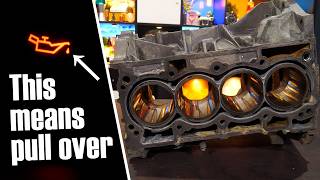

Never Ignore This Car Light!
33sUrgent warning about a common car light grabs attention and creates immediate curiosity.
▶ Play Clip"The title is perfectly accurate—the entire video explains how oil pressure is literally the force keeping metal parts from welding together under high speed and heat."
This video explains why the oil pressure warning light is critical for an engine's survival, using a teardown of a Nissan Cube engine. It covers the mechanical basics of an internal combustion engine, focusing on its lubrication system and the consequences of losing oil pressure.
The oil pressure warning light (oil can symbol) indicates immediate risk; pull over and shut off the engine safely.
Red = urgent problem (stop now), yellow = warning (check soon), other colors = information (e.g. high beams).
The engine block contains cylinders, which in this inline-4 design form combustion chambers for the air-fuel mixture.
A mixture of air and fuel is ignited, and the rapid expansion of gases pushes the piston down, converting chemical energy into mechanical work.
Pistons connected to the crankshaft via connecting rods translate linear motion into rotational motion to drive the wheels and accessories.
Flexplates are used with automatic transmissions; flywheels with manual transmissions. Flywheels are heavier to store rotational momentum.
Plain bearings (journal bearings) allow metal-on-metal surfaces to slide with a thin film of oil, preventing direct contact and seizure.
Counterweights and drilled balancing reduce vibration at high speeds (up to 10x idle RPM).
Displacement is the total volume swept by all pistons (1.8L for this engine). It determines a theoretical power ceiling.
Two compression rings and one oil control ring seal the piston against cylinder walls. Two rings are used because each needs a gap.
The cylinder head seals the combustion chamber and contains valves (4 per cylinder) that control intake and exhaust. Valves are like golf tees held shut by strong springs.
Intake, Compression, Power, Exhaust (suck, squeeze, bang, blow). Each cylinder fires once every two crankshaft rotations.
Camshafts open valves in sync with pistons. The timing chain keeps camshafts spinning at half crankshaft speed via a 2:1 gear ratio.
This inline-4 uses firing order 1-3-4-2 to reduce vibration, rather than a sequential 1-2-3-4.
Timing belts are quieter but require periodic replacement; if broken in an interference engine, pistons can hit open valves, causing catastrophic damage.
The oil pan holds ~4 quarts of oil. The oil pump, driven by the crankshaft, forces oil through a filter and into passageways that lubricate bearings and camshafts.
Oil pressure creates a thin film that separates metal surfaces, preventing direct contact. Without it, friction and heat cause seizure.
A pressure switch completes the circuit when oil pressure is low, lighting the warning. The light should turn off shortly after engine start.
Sudden loss is rare (pump failure). Gradual loss due to oil burning, or technician error (forgot to fill oil, loose drain plug).
Steps: drain old oil, replace filter, refill with correct viscosity oil (e.g. 5W-30), check level with dipstick. Torque drain plug to spec (25 ft-lb).
Heat and combustion byproducts (blow-by) chemically break down oil, reducing its ability to lubricate. Contaminants can form sludge that blocks oil passages.
The oil pressure warning light is not a suggestion—it indicates a catastrophic failure is imminent. Understanding how the engine's lubrication system works clarifies why even seconds without oil pressure can destroy an engine.
What is the immediate action when the oil pressure warning light comes on while driving?
Pull over and shut off the engine as soon as it is safe to do so, then call a tow truck.
0:14
What do red dashboard lights indicate compared to yellow lights?
Red lights indicate an unsafe condition requiring immediate attention; yellow lights are warnings that may not need immediate action.
1:39
What is the function of the crankshaft in an engine?
It converts the up-and-down motion of the pistons into rotational motion to drive the wheels and accessories.
5:17
What is the difference between a flexplate and a flywheel?
Flexplate is used with automatic transmissions; flywheel is used with manual transmissions and is heavier for rotational momentum.
6:20
What is engine displacement, and how is it calculated?
It is the total volume swept by all pistons (volume each piston moves through × number of cylinders). For this 1.8L engine, each piston displaces 450 cm³ × 4 = 1800 cm³.
13:57
What are compression rings, and why are there two of them?
They are metal rings that seal the piston against the cylinder wall. Two are used because each ring has a gap, and positioning the gaps on opposite sides improves the seal.
16:42
List the four strokes of a four-stroke engine cycle in order. (Hint: 'suck squeeze bang blow')
Intake, Compression, Power, Exhaust.
20:58
Why must camshafts spin at exactly half the crankshaft speed?
Because it is a four-stroke engine: the piston travels up and down twice per combustion event, but each valve opens only once per cycle.
23:36
What is the firing order of the Nissan Cube's inline-4 engine, and why is it used?
1-3-4-2, to reduce vibration compared to a sequential 1-2-3-4 order.
22:15
What is a 'fluid bearing'?
A thin film of oil under pressure that separates two metal surfaces, allowing them to glide past each other without direct contact.
32:52
What happens if a timing belt breaks in an interference engine?
The pistons can slam into the open valves, causing expensive damage.
28:07
How does the oil pressure switch/warning light system work?
In resting state (no oil pressure), the switch is closed, completing the circuit and lighting the light. When oil pressure rises, the switch opens, turning the light off.
35:45
What does '5W-30' mean in motor oil viscosity?
The '5W' indicates cold viscosity (similar to a 5-weight oil in winter), and '30' indicates hot viscosity (similar to a 30-weight oil when hot). Additives slow thinning as the engine warms up.
44:33
Why does engine oil degrade over time and need changing?
Heat and combustion byproducts (blow-by) chemically break down the oil, reducing lubrication and potentially forming sludge that clogs oil passages.
42:00
The Oil Pressure Light is a Lifesaver
Establishes the critical importance of the oil pressure warning light, framing the entire video around a life-or-death situation for the engine.
Fluid Bearings Explained
Clearly explains how oil pressure creates a thin film that prevents metal-to-metal contact, which is the core principle behind engine lubrication.
32:52Common Reasons for Oil Pressure Loss
Provides practical, real-world scenarios (oil burning, technician error) that help drivers understand when to be concerned.
38:57Why Engine Oil Degrades
Explains the chemical breakdown of oil due to heat and blow-by, connecting it to the need for regular oil changes.
42:00How the Oil Pressure Switch Works
Demystifies a simple but vital safety device, showing exactly how a pressure switch completes a circuit to warn the driver.
35:45[00:00] If there's one light on your car's
[00:05] it's this one:
[00:06] the oil pressure warning light.
[00:08] It usually looks like a little oiling can.
[00:11] And if that light comes on while you're driving,
[00:14] that means you should pull over and
[00:19] and then call a tow truck.
[00:21] And I'm not kidding.
[00:23] If that light comes on,
[00:24] your engine may be mere minutes away from self-destruction.
[00:29] And so continuing to drive is a very risky choice to make.
[00:33] Now, if you're wondering why exactly the engine
[00:39] that's the point of this video.
[00:41] Today we're going to explore the mechanical basics of the internal combustion engine,
[00:46] with a particular focus on its lubrication system
[00:53] There's a lot of stuff going on inside one of these contraptions,
[00:57] there's a good chance you'll think it's a miracle we've managed to make these things as reliable as they usually are.
[01:04] Now, if you're a gearhead or even just gearhead-adjacent,
[01:08] there's probably not much you're going to learn here.
[01:10] But if you don't really know that much
[01:14] and really how they keep themselves working,
[01:17] well I think you'll find this video to be quite informative.
[01:21] Before we really dive in, though,
[01:22] there's something you should know about the rest of the lights on your car's instrument cluster.
[01:27] And that's something is the rest of them!
[01:30] Because they all mean very important things
[01:35] They're even color coded to convey their urgency and meaning.
[01:39] Red lights are bad and need your attention now
[01:43] because they indicate an unsafe condition
[01:48] Yellow lights are warnings which can vary in severity
[01:51] but probably don't need your immediate attention.
[01:55] And other colors are usually reserved for simple information,
[01:58] like the blue light that warns you your high beams are on
[02:01] so please shut them off unless you're in the middle of the country — that's not for use with other cars around!
[02:06] Or the white or green status
[02:11] If you want to know just what exactly all those lights mean,
[02:14] your car will have an owner's manual somewhere
[02:17] and there's going to be a handy little section which explains each and every one of them and why they might light up.
[02:23] I'd highly encourage looking at that section of the manual
[02:26] and committing those details to memory.
[02:29] But anyway, this is a video about the engine and how it works.
[02:32] So let's dig into it.
[02:34] First, though, if you'll indulge me,
[02:36] here's a brief overview of how electric cars work:
[02:39] [two toots of the drill]
[02:41] But bigger.
[02:42] And now let's take a look at this Renault-Nissan MR-18DE,
[02:46] the engine which powers the venerable Nissan Cube.
[02:50] Let me just, uh, take it apart real quick.
[02:59] Okay,
[03:01] this is the engine block.
[03:03] It's really nothing more than an intricately cast
[03:08] but it's the heart of the engine and contains the cylinders.
[03:11] In this case, there are four of them,
[03:13] and they're all arranged in a straight line,
[03:15] which makes this an inline four cylinder engine.
[03:18] Probably the most common type of engine out there in cars.
[03:22] Not all four cylinder engines are alike, of course;
[03:25] these cylinders come in many different sizes,
[03:29] and they're not always arranged in a line.
[03:32] We'll talk more about that later, though.
[03:34] Oh also sometimes there aren't cylinders at all!
[03:36] But that's mainly a Mazda thing they only sometimes do
[03:40] because rotary engines are equal parts cool and terrible.
[03:44] But they're committed to them!
[03:46] Sometimes - for special occasions.
[03:48] Anyway, the cylinders are each a combustion chamber.
[03:52] The idea is to fill these cylinders with a mixture of air and fuel,
[03:55] and then ignite that mixture so it...
[03:58] expands very rapidly.
[04:01] I would say that mixture explodes,
[04:03] but it's not technically an explosion.
[04:06] What's really happening is that the carbon dioxide
[04:08] and water vapor that are produced in the combustion process
[04:11] have a much larger volume
[04:16] and that rapid expansion of hot gases
[04:20] can be harnessed and turned into mechanical work.
[04:23] And to do that we use pistons.
[04:26] Each cylinder gets a piston just like this inserted from the bottom,
[04:30] and these pistons are able to
[04:35] During a combustion event, as the mixture of hot gases inside the cylinder rapidly expands
[04:41] these pistons are forced downward into the engine block.
[04:44] And that's how we convert the chemical
[04:50] Now, the goal of this engine is to spin the wheels of a car.
[04:54] So ultimately the engine produces rotational movement.
[04:57] And since the pistons move up and down inside the cylinders,
[05:01] we're going to need a mechanism to translate
[05:07] If you noticed the weird stick thing
[05:11] well, this is the connecting rod
[05:16] to this thing.
[05:17] This is the crankshaft, and it is the thing that spins.
[05:22] The tachometer, the gauge which tells you engine RPM,
[05:25] is telling you how quickly this literal thing
[05:31] Now we're going to look at this closely
[05:36] But first I want to point out that the crankshaft
[05:41] That is how we actually make this spinning crankshaft
[05:44] do useful things for us.
[05:47] Bolted to one side of it
[05:48] is this large rusty wheel with teeth on its edges.
[05:52] This is what's known as a flexplate.
[05:54] The teeth on its circumference are there
[06:00] and turn the crankshaft
[06:04] But the rest of this connects the engine to the transmission
[06:08] so that once the engine is running
[06:10] the spinning crankshaft can spin the wheels of the car.
[06:14] Technical note: if you were expecting me to call this a flywheel,
[06:18] well, this is not a flywheel.
[06:20] It's a flexplate.
[06:22] What's the difference?
[06:23] Well, flywheels are used with manual transmissions,
[06:27] while flexplates are used with automatic transmissions.
[06:31] In a car with an automatic,
[06:35] the flexplate gets fastened
[06:38] and the engine and transmission
[06:42] But flywheels are completely different.
[06:45] They're used with manual transmissions
[06:47] and are not really fastened to the transmission at all,
[06:51] since in a stick shift the engine and transmission
[06:58] The clutch sort of presses up against the flywheel
[07:01] when engaged to connect the transmission to the engine,
[07:05] and it moves away from the flywheel when disengaged to separate them.
[07:09] And because of this, flywheels have a smooth surface
[07:12] on the outer side which the clutch pushes against.
[07:16] It's also quite a lot thicker and heavier than a flexplate
[07:19] to give the crankshaft more rotational momentum:
[07:22] helpful when getting the car moving from a stop.
[07:25] This Nissan Cube has a manual transmission,
[07:28] so its engine has a flywheel
[07:32] but everything else is identical.
[07:35] Now, while moving the car is the main thing the spinning crankshaft has to do,
[07:40] it also has to do things like generate electricity to keep the car's battery charged.
[07:45] And that needs to happen whether the wheels are moving or not.
[07:48] Which is why the other end of the crankshaft
[07:53] But on this side, all we have attached to it is the small pulley.
[07:58] This is the crank pulley
[08:00] and it provides power for engine accessories such as the alternator,
[08:03] air conditioning compressor and water pump via a drive belt.
[08:08] The pulley simply bolts on to the end of the crankshaft here...
[08:12] with this large bolt.
[08:14] Oh, and like in many engines,
[08:16] that pulley has some rubber like material in there
[08:19] to allow it to function as a harmonic balancer.
[08:22] But that's not important right now.
[08:24] What is important right now
[08:25] is how the uppy downy pistons actually make
[08:31] To explain, I want you to focus on these very shiny
[08:34] and perfectly circular surfaces you can find on the crankshaft.
[08:38] These are bearings,
[08:40] just plain bearings.
[08:42] which is a dad joke because
[08:46] [voiceover]
[08:49] with some notes on terminology.
[08:51] I made the mistake when writing this script
[08:53] of letting a technical definition supersede
[08:56] the common language most people use.
[08:59] These are indeed plain bearings,
[09:01] but they belong to a subset of
[09:06] And the circular, shiny things we're looking at on the crankshaft
[09:08] are usually referred to as the journals.
[09:12] But here's the thing.
[09:14] Journal is simply another word for shaft.
[09:18] All these things are is a polished, circular shaft
[09:21] which spins inside of a stationary circle,
[09:24] which wraps around and holds on to the shaft.
[09:26] Once put together, it's really just two concentric circles
[09:30] where one spins and the other doesn't.
[09:32] And both the spinning journal and its stationary
[09:36] holder are a bearing surface,
[09:38] which is what I wanted to highlight in this video.
[09:41] The interface between those two bearing surfaces
[09:44] is what really matters to the point here.
[09:46] And from either one's individual perspective,
[09:50] the other part is what's spinning.
[09:51] And so that's why I ultimately chose to refer to these as bearings.
[09:56] But I understand a lot of people will be very annoyed by that choice.
[09:59] And so... sorry about that.
[10:02] They consist of that smooth,
[10:04] shiny part in the center of the crankshaft
[10:06] and a thin bushing which surrounds it.
[10:09] You can see half of the bushings here in the block.
[10:12] [voiceover]
[10:13] See, this right here explains the problem.
[10:15] This is literally the bearing.
[10:17] This is the bearing surface.
[10:19] But technically it is a bushing.
[10:21] However, when people rebuild engines,
[10:23] they're going to refer to these things
[10:25] as the bearing because it's the bearing surface.
[10:28] And hopefully that helps explain why I had such decision
[10:31] paralysis around the terminology here.
[10:33] Five of the bearings are all arranged in a straight line.
[10:37] These are the main bearings
[10:38] which hold the crankshaft in the block and keep it centered,
[10:42] but the remaining four are wildly offset from the rest.
[10:48] These eccentric bearings are what the pistons attach to.
[10:52] The big round part at the bottom of the connecting rod
[10:55] can be split in half by loosening these fasteners.
[10:58] And then you can attach the piston and its bushings
[11:01] to its respective bearing.
[11:04] Now, I want to point out as I very loosely attach this,
[11:08] that the mating surfaces here are both metal.
[11:13] This is literally metal on metal contact,
[11:16] and these components slide against each other as they spin around,
[11:21] which feels problematic, doesn't it?
[11:24] Keep that in mind as we continue.
[11:26] If you're wondering why the
[11:31] well, remember, this is the thing that spins.
[11:34] And since the bearings that the pistons
[11:40] you need counterweights to keep it balanced.
[11:42] And that's what these are.
[11:45] This is roughly how fast the
[11:50] And at redline, it can be spinning ten times as fast.
[11:54] So you really want this thing
[11:56] as perfectly balanced as you can possibly get it
[11:59] to reduce vibration which could tear the engine apart.
[12:02] And you can even see marks
[12:06] out of the counterweights after casting to make fine adjustments to balance.
[12:11] But anyway, back to the pistons.
[12:13] Once assembled, the pistons function
[12:16] very much like your feet when pedaling a bicycle.
[12:19] In fact, if you look at the crankshaft closely,
[12:21] you'll see that on each end of it
[12:23] is basically the exact same
[12:28] And here's what it looks like with
[12:33] There are several things wrong with this demonstration.
[12:37] For instance, this is upside down.
[12:39] But you'll notice that as the crankshaft rotates,
[12:42] the four pistons move up and down into pairs.
[12:45] When the outer two are at the bottom,
[12:47] the inner two are at the top and Nissan Versa,
[12:50] and they go round and round like a very strange Ferris wheel.
[12:54] I mean, there is a lot of iron in there.
[12:57] and here's what that looks like with the pistons and crankshaft inside the block
[13:01] and the starter motor turning the crankshaft.
[13:04] The block constrains the lateral movement of the pistons
[13:07] which means the piston needs to be able to pivot back
[13:10] and forth with respect to its connecting rod
[13:13] as it flies around the crankshaft below.
[13:16] That's why the connecting rod
[13:18] is attached to the piston with what's called a wrist pin
[13:23] That allows the top of the piston to sort of wiggle back and forth with respect to its connecting rod.
[13:28] And that's how the piston can stay on
[13:33] while its connecting rod is flailing all around below.
[13:37] Here's a fun fact!
[13:39] While editing this video,
[13:40] I discovered that I accidentally deleted this section from the script.
[13:44] So here's me putting it back!
[13:46] When we are talking about an engine's size,
[13:49] we're not actually talking about
[13:54] At least not entirely.
[13:57] We measure an engine's size by its displacement,
[14:00] and that is defined by how much volume the pistons displace
[14:05] as they move up and down inside the cylinders.
[14:08] The pistons can only move down so far,
[14:11] which only opens up so much space.
[14:14] And in this engine, each piston moves
[14:16] through a volume of 450cm³.
[14:20] There are four of them, of course, and added together,
[14:23] that means the pistons displace a total volume
[14:26] of 1800cm³, or 1.8 liters.
[14:31] And that is why this is a 1.8l engine.
[14:35] However, we could increase this engine's displacement
[14:39] without making the cylinders any bigger at all.
[14:42] All we'd need to do is increase the stroke of the pistons
[14:46] so that they travel farther down before they start
[14:53] But that's much easier said than done, because to actually make that happen,
[14:57] we'd need an entirely different and much larger crankshaft,
[15:02] which will require redesigning the block.
[15:05] And the power delivery characteristics of a piston engine can vary dramatically when the pistons have a longer stroke,
[15:12] so it might not be desirable for all applications.
[15:16] This is all very complicated,
[15:18] but an engine's displacement presents a hard limit
[15:22] to how much power it can theoretically produce,
[15:24] and this is why, purportedly,
[15:27] there is no replacement for displacement.
[15:30] Then again, my daily driver has an engine displacement of null,
[15:35] and yet it can still do 0 to 60 in well under five seconds.
[15:39] So I'm not sure how true that is these days.
[15:41] But anyway, let's move on.
[15:43] And at this point, we've looked at nearly everything
[15:48] But now you might have noticed a bit of a problem.
[15:52] I said that the cylinders are combustion chambers
[15:55] and expanding gases pushed the pistons down.
[15:59] But, uh, right now
[16:00] those gases don't have anything to push against.
[16:03] This is just a weird series of cups
[16:05] where the bottom can move up and down for some reason.
[16:09] To actually turn all these into combustion chambers,
[16:12] we need to seal it up.
[16:14] And that's done with the cylinder head.
[16:16] But also the piston rings.
[16:19] Before we even talk about sealing the top of the chamber,
[16:22] we also need a seal between the pistons themselves and the walls of the cylinders.
[16:27] The pistons are actually slightly smaller
[16:29] than the cylinders and can flop around in there a little bit.
[16:32] So each one has not one, not two,
[16:35] but two piston rings and a third oil control ring,
[16:40] but it doesn't have the same job.
[16:42] The two piston rings near the top, known as compression rings, are simply metal rings with a bit of spring tension in them
[16:50] which causes them to expand and fill
[16:56] There are two of them because
[16:59] it needs a gap, and that gap means the seal isn't so good.
[17:04] So, well, we just throw a second one on there,
[17:06] and ideally you'll position the gaps on opposite side -
[17:10] Well, that one broke!
[17:11] [through laughter]
[17:15] So with the pistons now
[17:19] we have to seal the top of this thing
[17:24] And that's what this guy is for.
[17:27] This is the cylinder head
[17:29] and it gets bolted to the top of the block and, with the help of the head gasket,
[17:33] actually seals the cylinders up
[17:38] But this does far more than just that.
[17:41] This is also what allows fresh air and fuel into the cylinders,
[17:45] what expels exhaust from the cylinders,
[17:47] and what ignites the air/fuel mixture.
[17:52] Well, the spark plug is what does that for each cylinder.
[17:55] But the spark plugs live in the cylinder head.
[17:56] You can, see 'em poking out just there.
[17:59] To actually let air and fuel into,
[18:05] the cylinder head contains valves.
[18:07] Like most modern engines there are four valves per cylinder,
[18:13] You really only need one of each,
[18:15] but geometry makes it so you can have more total area
[18:18] if you have two smaller valves rather than one big one,
[18:22] and that allows the engine to breathe more easily.
[18:25] From this side, the valves look like little circles,
[18:28] but what they actually look like is golf tees.
[18:32] And I'm totally serious.
[18:33] They're basically just large golf tees.
[18:36] I'd remove one to show you, but you see,
[18:38] they're held shut with extremely powerful springs
[18:41] and I do not have the guts to remove them for you.
[18:45] So I bought these ones!
[18:47] All that each of these little valves is really doing
[18:50] is plugging a hole in the cylinder head.
[18:53] On the sides of the cylinder head are the intake and exhaust ports.
[18:57] These are where air and fuel goes into the engine on one side
[19:01] and exhaust comes out of it on the other.
[19:03] Look into those ports and you can see the backsides of the valves and the holes that they're plugging.
[19:10] To keep that hole plugged up and the combustion chamber sealed,
[19:13] a spring being held by this retaining mechanism
[19:16] is constantly pulling up on the
[19:22] But if something pushes down hard enough to overcome the force of the spring,
[19:26] the valves will poke out from where they sit
[19:29] and suddenly the hole isn't plugged any longer.
[19:32] There is now a pathway for air to make its way through this port and into the cylinder.
[19:37] We now have all the ingredients
[19:42] that we can move gases into and out of under our control.
[19:46] But what actually opens and closes the valves?
[19:51] Well, these things,
[19:53] but, more on them in a moment.
[19:56] Now, we need to discuss the four stroke engine cycle.
[20:00] Virtually every engine out there
[20:04] or a very small weed whacker engine,
[20:05] or in a very old car is a four stroke engine,
[20:09] which means that when looking at a single cylinder,
[20:12] the piston actually travels up and down
[20:15] two complete times per combustion event.
[20:18] First, it travels down during the intake stroke,
[20:21] where the intake valve is open and fresh air
[20:27] Then the valves will close and the piston travels back up
[20:30] during the compression stroke, which squeezes
[20:36] When the piston is at the top,
[20:37] the spark plug fires
[20:39] which ignites that mixture and forces the piston down during the power stroke,
[20:43] which is the only stroke that actually produces motive power.
[20:47] And finally, the piston moves back up again
[20:49] with the exhaust valve open during the exhaust stroke,
[20:53] where the piston will push the exhaust gases out of the cylinder.
[20:57] And then that repeats.
[20:58] That's intake, compression, power, and exhaust.
[21:02] And for a helpful way to remember that,
[21:03] which I'm sure many of you out there really want me to say...
[21:07] suck squeeze bang blow.
[21:10] To make that sequence actually happen though,
[21:12] the valves need to open and close in time
[21:18] And to make that happen, we use rotating camshafts like this.
[21:24] These fellas are held captive with
[21:29] When the pointy bit on each one of these cams,
[21:35] it will press down on its respective valve and open it.
[21:40] Here's what that looks like.
[21:42] I want to point out yet again that this is metal on metal contact,
[21:46] but you may notice in this footage that some kind of dark
[21:49] liquid appears to be oozing out of various places
[21:52] and getting all over the cams.
[21:55] That's engine oil.
[21:57] Where is it coming from?
[21:59] The oil pump.
[22:00] But hold on, we're not there yet.
[22:02] First, I want to point out that the sequence
[22:06] is programed by the physical shape of these things,
[22:09] and that, along with the crankshaft design, dictates
[22:12] the engine's firing order.
[22:15] This engine doesn't fire the cylinders in sequence.
[22:18] In fact, it skips around a bit with a firing order of 1 - 3 - 4 - 2
[22:24] And if I slowly rotate the camshaft,
[22:27] you'll see that the lobes stick out in that same order
[22:31] because they have to open the valves in that order.
[22:35] This engine could have been designed
[22:37] with a simple 1 - 2 - 3 - 4 firing order,
[22:40] but that would require a different crankshaft
[22:43] where pistons one and three are at the top,
[22:46] while two and four are at the bottom.
[22:48] And when you do that with an inline four cylinder,
[22:51] it tends to be even more of a vibrating mess than it already is.
[22:55] Which is why the pistons are paired like this
[22:57] and the firing order skips around a bit.
[23:00] It's just a better balance.
[23:02] But now we have a bit of a timing problem.
[23:05] We need to make absolutely sure that those valves are opening
[23:09] when they should be in relation
[23:15] One way to do that would be to mechanically interlock
[23:21] which is exactly what this and any engine does,
[23:24] but it's a little more complicated than you might imagine at first.
[23:28] Recall this is a four stroke engine,
[23:30] which means the pistons travel up and down twice for every time a valve opens.
[23:36] But since the camshafts only make one rotation to open their valve,
[23:42] that means we need the camshafts to be spinning
[23:50] We need to do that so the crankshaft makes two rotations for every one rotation of the camshaft.
[23:56] Luckily, that's easy to do with our old friend gears.
[24:01] You may have noticed a couple of gears
[24:02] on the end of the crankshaft away from the flex plate.
[24:06] This smaller gear will drive
[24:11] That's this guy, the timing chain,
[24:14] and it lives underneath this cover on the side of the engine.
[24:17] Its job is to transmit motion from the crankshaft at the bottom
[24:22] all the way up to the camshafts at the top.
[24:25] Now the chain is going to keep
[24:29] but importantly, the crankshaft's
[24:35] as the gears which drive the camshafts.
[24:38] There are 23 teeth on the crankshaft gear
[24:40] and 46 on both of these camshaft gears,
[24:44] and that ratio will ensure it always takes
[24:49] for the camshaft to make a single rotation.
[24:52] And so long as this chain doesn't break,
[24:55] they will remain perfectly locked together
[24:57] such that the valves always open at the same time
[25:00] in relation to the pistons inside the engine block.
[25:04] Of course, we can actually
[25:08] and that's why this gear is so thick.
[25:10] But we are not getting into that today!
[25:13] At this point, I've covered all the
[25:17] And while this is a very common design,
[25:20] it's by no means universal.
[25:22] For one thing, lots of engines have more than
[25:25] or even less than four cylinders.
[25:28] Three cylinder engines have snuck their way into lots of cars
[25:33] And of course, there's all those V6es and V8s
[25:37] V engines are interesting
[25:39] because they add a second bank of cylinders,
[25:47] This makes them only marginally larger
[25:51] while doubling the number of cylinders,
[25:56] But more cylinders means
[26:00] which is why the old four banger is so dang common.
[26:04] It's good enough.
[26:06] but even within inline fours, there's a ton of variation.
[26:10] This engine has separate camshafts
[26:15] and where these live is above the cylinder head.
[26:19] And that makes this a dual overhead cam engine.
[26:23] If you've ever seen DOHC on an engine cover
[26:25] or like on the side of an old car as a badge,
[26:28] that is literally referring to these two cams
[26:32] and where they are in relation to the rest of the engine.
[26:35] Some engines only use one camshaft,
[26:39] but it will have more lobes on it, so it can actuate
[26:44] And that would be a single overhead cam engine,
[26:47] SOHC.
[26:49] But the camshaft isn't always over the heads.
[26:51] Sometimes it lives in the block.
[26:54] Many of those engines will use push rods,
[26:57] basically metal sticks which ride on the cams,
[27:00] and then they stick up into the head so that as the cams
[27:04] rotate and the lobe pushes up on the stick,
[27:06] the push rod will actuate itself against a rocker arm,
[27:09] which then pushes down on the valves.
[27:12] Those engines aren't that common these days because putting the cams over the heads has a lot of advantages.
[27:18] Oh, and not every engine will use a timing chain.
[27:23] For some reason we decided
[27:29] Okay, the reason was
[27:31] that it made engines a little quieter
[27:33] and it's not completely without merit.
[27:34] But don't get me started on Ford's wet timing belt situation.
[27:39] Just an utterly terrible idea
[27:44] Regardless, engines with timing belts
[27:49] because many engines are what's called an interference engine,
[27:53] where the valves will actually occupy
[27:58] that the pistons do when they're at the top.
[28:01] So long as the engine is in time,
[28:03] this doesn't matter because the pistons
[28:07] But if the timing belt were to break
[28:10] and the cams stop turning with a valve open
[28:15] then as the crankshaft keeps on rotating,
[28:21] and cause lots of very expensive damage.
[28:25] You don't want that, so you have to change
[28:31] Timing chains are much, much
[28:37] Usually, though, it's not catastrophic.
[28:39] Instead, they simply start to stretch out a bit due to the links wearing down,
[28:44] which makes valve timing sloppy,
[28:50] Though if it does get bad enough to where the chain skips a tooth,
[28:54] replacing a timing chain is a lot more involved than a belt,
[28:58] so there is that to consider.
[29:02] Right, and some pushrod engines don't use a belt or a chain.
[29:05] If the camshaft is close enough to the crankshaft,
[29:08] you can simply use interlocking gears.
[29:11] But again, pushrod engines in cars
[29:15] with some notable exceptions.
[29:17] Oh, and also there's flathead engines where
[29:21] But those are very old designs,
[29:25] And eventually you just have to stop.
[29:27] Speaking of stop...
[29:28] At this point, you're probably wondering
[29:30] how any of this relates to the intro
[29:32] and the thing about that little red light
[29:36] Well, everything we've been talking about is made of metal.
[29:41] There's metal on metal contact everywhere inside this engine,
[29:45] and those bits of metal spin really, really fast.
[29:50] Or in the case of the pistons,
[29:52] those bits of metal slide against each other really, really fast.
[29:55] And that's going to cause a lot of damage
[30:03] And that is what engine oil is for.
[30:06] Hanging off the bottom of the
[30:10] And this is effectively just a big bucket
[30:12] which holds several quarts of motor oil.
[30:16] Well, this engine has a weird design
[30:18] and the block is split into two pieces.
[30:21] So it doesn't really have an oil pan per se,
[30:23] but the gist is the same.
[30:26] This bottom half of the block alongside a plate,
[30:29] which is the closest thing to an oil pan this engine has,
[30:32] holds just about four liters of oil.
[30:35] Apparently its precise oil capacity is four and 3/8 of a US quart.
[30:41] And sitting below the crankshaft inside the oil pan
[30:46] is this thing: the oil pump.
[30:48] every engine which isn't a tiny little thing for like a lawnmower,
[30:52] has an oil pump and in this one it's driven
[30:58] So long as the crankshaft is spinning, the oil pump will be too.
[31:02] And what this does is suck engine oil
[31:07] force it through a filter to catch any contaminants,
[31:09] and from there, the oil gets sent through many,
[31:12] many tiny little holes and passageways throughout the engine.
[31:17] Look closely at practically any part of an engine which moves,
[31:20] and somewhere along the mating surface, you're going to find a hole which eventually leads back to the oil pump.
[31:28] There are so many holes because when an engine is running,
[31:31] oil is getting forcefully sprayed all over the dang place.
[31:34] in fact, if you were wondering
[31:40] well, some of these deliver oil under pressure
[31:45] so that it can lubricate the bearings of the camshafts
[31:48] as well as the cam lobes as they slide along the valves.
[31:51] That's why there's oil oozing out of different places in this footage.
[31:55] Some of the other holes in this head gasket
[31:57] allow that oil to return to the oil pan with the help of gravity,
[32:01] though other holes are for engine coolant,
[32:03] which we won't be talking about today.
[32:06] Regardless, let's take a close
[32:10] because they reveal how this works the best.
[32:13] This port with an orange O-ring on it
[32:18] Once it finds its way in the block,
[32:20] the oil flows through a series of tubes,
[32:23] and you can sort of make out the shape of these tubes
[32:26] and how it tees off here in both directions
[32:28] by looking at the casting of the block.
[32:32] If we look at the main bearing surfaces in the block,
[32:35] we'll see that there's a hole in each one of its bushings.
[32:38] If I remove the bushing, we'll find another larger hole behind it.
[32:43] The oil pump forces a steady stream of oil through those holes whenever the crankshaft is spinning,
[32:49] and that creates a fluid bearing.
[32:52] Once there's oil pressure, the metal surfaces
[32:57] Instead, they glide past each other with a thin film of oil between them.
[33:02] That's how the bearings allow the engine to spin smoothly
[33:05] despite the fact that they're literally just two pieces of metal.
[33:09] But you'll notice that there's a channel
[33:14] that is there to create a pathway for engine oil
[33:19] and into the crankshaft itself.
[33:22] Notice that the bearing also has a hole.
[33:25] That hole will move around as the engine spins,
[33:28] but it will always be above that groove
[33:30] and so will always be fed oil from the block.
[33:34] And here we can actually see where the hole leads:
[33:37] another hole on another bearing; the bearing
[33:42] This is so that those bearings also get lots of lubrication
[33:46] and we get that fluid bearing effect
[33:50] Which by the way in case it's not clear
[33:52] oil is only under pressure inside
[33:58] There's a whole bunch more of them too which I haven't covered
[34:00] inside the cylinder head to keep the camshafts lubricated
[34:03] as well as the moving parts of the valves.
[34:06] But once the oil makes its way out of whatever
[34:08] confined space it used to be in,
[34:10] it will just sort of ooze out.
[34:12] And then it's got to get back to the bottom of the engine
[34:15] so the oil pump can suck it up again.
[34:18] So there is also a series of pathways throughout the engine
[34:21] that will simply return any pooling oil to the bottom via gravity.
[34:25] And that's why internal combustion engines
[34:31] If I were to turn this engine upside down and try and operate it,
[34:34] or frankly, even on its side like it is now,
[34:37] oil would be pooling in places it shouldn't
[34:41] And so the lubrication system just...
[34:44] wouldn't work.
[34:46] And that's bad because everything
[34:53] If for whatever reason, the engine were to lose oil pressure,
[34:57] then suddenly you have a very big problem.
[35:00] That nice fluid bearing effect you get which keeps the metal parts from actually touching each other
[35:05] will go away and now... metal parts
[35:12] and that's going to produce a lot of friction,
[35:14] which will produce a lot of heat.
[35:16] And before long the engine will seize,
[35:19] meaning parts get fuzed together
[35:24] It is possible to get a seized engine unstuck,
[35:28] but it will definitely be damaged in some way
[35:30] and will likely have a greatly shortened lifespan.
[35:33] So you never, ever, ever, ever want to run an engine
[35:37] without knowing that there is sufficient
[35:42] And that is what that light is for.
[35:45] It's connected to a pressure switch
[35:50] In other words, when there is no oil pressure,
[35:53] that switch completes a circuit which lights up that light.
[35:57] This is what the pressure switch looks like.
[35:59] It's an unassuming little thing.
[36:01] Once the engine is turning,
[36:03] the oil pump will start forcing oil into all those passageways.
[36:07] And this port on the side is tapped off of those passages.
[36:11] So sufficient oil pressure will open this
[36:17] This design allows you to check that the pressure switch is actually functional,
[36:21] because if you simply turn the key without cranking the engine,
[36:25] you should see the oil pressure light.
[36:27] There's no oil pressure yet because the engine isn't running!
[36:30] But when you start the engine,
[36:32] that light should go out almost immediately.
[36:35] And if it doesn't, there's a problem.
[36:38] That problem isn't necessarily with the engine, of course.
[36:42] It could simply be a bad pressure switch.
[36:45] But that's a really risky assumption to make
[36:48] because if that light and the switch is working as it should,
[36:52] then if the light comes on, you are
[36:55] then running your engine without oil pressure, which will kill it.
[37:00] Oh, and fun fact eagle-eyed viewers
[37:04] may have noticed that this car had a bad pressure switch,
[37:07] but it failed open.
[37:09] The oil pressure light was never coming on
[37:11] even without the engine running.
[37:13] Here's me turning the key and that light is nowhere to be seen.
[37:18] This meant the car could never warn me that I've lost oil pressure,
[37:22] which isn't as bad as actually losing oil pressure,
[37:27] Luckily, I happened to buy this entire engine for making videos
[37:30] and it had its own oil pressure switch on there,
[37:33] so I just swapped them over.
[37:34] And now that light is actually doing its job.
[37:37] Quick side note,
[37:38] a lot of older cars didn't have an oil pressure warning light
[37:41] and instead had an oil pressure gauge,
[37:44] but that's mostly gone,
[37:49] Some new vehicles still have oil pressure gauges,
[37:52] but they're mainly found in big trucks
[37:54] because getting to see an engine oil pressure readout makes some people feel big and manly and important.
[38:01] But I mean, most people don't really care
[38:05] how much oil pressure an engine
[38:08] And without knowledge of how much is actually correct,
[38:11] a gauge isn't that useful anyway,
[38:13] and that's why a simple pressure switch
[38:17] "oil pressure is below a safe threshold," is frankly better.
[38:22] Yeah, I said it.
[38:24] Gearheads like to call these idiot lights
[38:26] because we used to expect people to know
[38:31] In fact, some cars in the past had a little yellow warning light
[38:34] which literally said "check gauges."
[38:37] But while I too lament the loss
[38:41] a little more about how their cars work than they seem to now,
[38:44] I think it's fair to say a warning light is all that's really needed,
[38:48] but you do need to know what that warning light means.
[38:52] On that note, why might you actually lose oil pressure?
[38:57] Well, it's very rare for it to suddenly just happen.
[39:02] I hope I haven't made it sound like this is something
[39:04] you need to be extremely vigilant about all the time,
[39:06] though you probably should watch the oil pressure
[39:12] and I'll explain that further in a moment.
[39:14] If you're just driving around on a normal day, though,
[39:17] it's extremely unlikely
[39:22] That would really only happen
[39:26] And given that it's literally the most lubricated part
[39:30] since it sits in oil and pumps it around,
[39:33] that's quite rare.
[39:35] It does happen, but it's extremely rare.
[39:38] However, if your engine burns oil,
[39:41] which it shouldn't, but it tends to start happening
[39:44] when an engine gets very old and worn out.
[39:47] Or if it wasn't designed very well,
[39:50] well then the amount of oil inside
[39:57] There's quite a good deal of margin for error,
[39:59] so losing a quart of oil between
[40:04] But if your engine burns through a lot of oil,
[40:08] then eventually the oil level can get low enough
[40:11] that the oil pump starts to have trouble
[40:16] If this is happening, the oil pressure
[40:22] That is not as bad as not having
[40:28] The bearings inside the engine
[40:32] and they're going to start wearing
[40:36] So you probably need to add some oil to your engine
[40:42] But the most common reason you might one day lose
[40:49] For example, you went in to get an oil change
[40:52] and the technician forgot to actually fill the engine
[40:54] with new oil after they drained the old oil out.
[40:57] Or maybe they forgot to put the drain plug back.
[41:00] Or perhaps they didn't tighten it enough
[41:01] and it backed itself out as you were driving
[41:04] and your car puked all of its oil onto the ground.
[41:07] To be clear,
[41:10] But seriously, after you get an oil change,
[41:13] pay attention to that light for a while.
[41:16] You really want to make sure it goes out quickly
[41:22] But speaking of oil changes,
[41:23] this car is due for one, so let's do it!
[41:26] Why not?
[41:27] In fact, I have no idea whether it's actually due for one.
[41:30] But that's kind of why I'm doing it.
[41:33] Changing your own oil is actually quite easy,
[41:36] but I don't really recommend it because it's messy,
[41:40] you have to deal with the old oil
[41:42] (and yes, parts stores will take
[41:46] And, it honestly hardly saves any money.
[41:49] But why don't I show you the process?
[41:52] Actually, first, if you don't know why you have to change the oil
[41:56] every some thousand miles or so, well, here's why:
[42:00] The oil gets really hot
[42:02] and the piston rings aren't perfect.
[42:05] Remember, there's a whole bunch of explosions going on in here!
[42:09] Several every second, just at idle!
[42:12] And the intense pressure inside the cylinders means
[42:15] some combustion byproducts are going to end up getting past the piston rings
[42:20] and into the crankcase where they'll mix
[42:26] That will eventually start to chemically break it down.
[42:29] And if that's not bad enough,
[42:31] the oil which clings to the cylinder walls gets extremely hot,
[42:35] which also causes chemical breakdown.
[42:37] Over time, this causes the oil to lose its lubricative properties,
[42:42] and that means your engine can start to wear.
[42:45] And if you're really overdue for an oil change,
[42:48] little bits of stuff can precipitate out
[42:50] of old engine oil and stick to things.
[42:53] That's engine sludge.
[42:55] And if it gets bad enough, it can start breaking things
[42:58] by plugging up those tiny oil passageways.
[43:01] So you gotta change your oil regularly to keep that from happening and to keep the engine healthy.
[43:08] I'm deliberately not commenting on how often
[43:13] But my basic advice is consult your owner's manual and maybe do it a little more often than it says you should.
[43:21] But I've got one of those
[43:25] How about that?
[43:26] But this one does.
[43:28] So first I'll get it up in the air a little bit.
[43:31] You don't need a lift to do this.
[43:33] If all you want to do is your own oil changes,
[43:35] you can purchase these ramps
[43:39] and that'll give you enough room to work with.
[43:42] There's two things you need access to from the bottom:
[43:45] the drain plug and the oil filter.
[43:47] Though in some cars the oil filter is somewhere else
[43:50] or possibly behind a cover of some sort.
[43:53] You'll also need something to catch
[43:58] And then of course, you'll need new oil and a replacement filter.
[44:02] Here's a five quart bottle of the cheapest oil I found in the store,
[44:06] because this car is not worth getting fancy over,
[44:08] and here's a replacement filter which fits the car.
[44:12] Speaking of the oil,
[44:13] your car's engine is going to call for a specific oil viscosity,
[44:17] which some people refer to as its weight.
[44:20] The Society of Automotive Engineers came up with a way to define motor oil viscosity
[44:25] using a simple numbering scheme, and bigger numbers are more viscous.
[44:29] This car needs 5W-30 motor oil.
[44:33] And the cool thing about that
[44:34] is that this oil has two different viscosity grades.
[44:38] When the oil is cold, it has
[44:43] That's the 5W, and the W is for winter.
[44:47] But when the oil is hot
[44:49] it has the viscosity of a 30 weight oil.
[44:53] Now any oil loses viscosity and gets thinner as it gets hotter.
[44:57] And this is no different.
[44:58] But as the engine warms up, additives in this formulation
[45:02] slow down that thinning process.
[45:05] And that's how when it's hot, it has the same viscosity
[45:08] as an unmodified 30 weight oil.
[45:11] This is actually a really neat thing we figured out how to do.
[45:14] And it means the engine has
[45:18] but still has the same protection
[45:23] Right. And the breakdown of those additives over time
[45:26] as the oil gets contaminated with combustion byproducts and whatnot, lowers the oil's viscosity grade.
[45:32] And that's yet another reason you need to change it periodically.
[45:36] So to do that, I'll start by draining the old oil from the engine.
[45:40] But first I'm going to remove the filler cap up top,
[45:43] which will allow that oil to leave the engine more quickly
[45:46] by breaking the vacuum and letting air into the top of the engine.
[45:50] Then I'll put the drain pan below the drain plug of the engine,
[45:54] but I'm going to position it off-center.
[45:56] You'll see why shortly.
[45:58] Quick note, the transmission will also have a drain plug,
[46:02] so make sure you know how to tell the engine and transmission apart before you drain the wrong thing.
[46:07] Next, I'll use a wrench to crack the drain plug loose.
[46:11] The engine is warmed up,
[46:14] with a gloved hand I'll then remove the plug.
[46:18] If you keep pressing in on it while you back it out,
[46:21] you can usually keep it from dripping any oil at all
[46:26] and then you can simply yoink it out
[46:31] And now that it's flowing out of there,
[46:33] you can see why I didn't center the drain pan.
[46:36] As the old oil flows out, we'll deal with the oil filter.
[46:40] This style of oil filter has built in threads
[46:47] Or in the case of this car,
[46:49] whatever you call this part,
[46:53] Anyway, these should only be put on hand tight,
[46:57] which means they should come off easily,
[47:00] but should is carrying a lot of weight there.
[47:03] And that's why I have this oil filter wrench.
[47:07] Once it starts coming loose, keep in mind
[47:09] this thing is filled with oil and will be gross.
[47:12] Many drain pans like this one have a spot
[47:15] molded into them to put the used filter and let it drain out.
[47:18] And now I'll take the new filter and with my gloved hand,
[47:22] I'll smear just a little bit of the old oil onto the gasket
[47:26] before screwing it onto the engine.
[47:28] And again, this should only go on hand tight.
[47:33] By the way, these claim to last long enough to only change the filter every other oil change.
[47:38] But these are like five bucks,
[47:41] Its job is to trap
[47:45] before they plug up all those little parts and stuff,
[47:48] which would be very bad.
[47:49] So I don't think it's worth risking it.
[47:51] Just replace it.
[47:53] By this point, the engine is probably almost done
[47:58] But if for some reason it's still flowing, let it flow.
[48:02] Once it's down to barely a trickle,
[48:07] Ideally, you'd replace this crush washer which seals that hole,
[48:11] but I did not get a replacement, so I will be reusing the old one
[48:15] Once I've started threading the plug by hand,
[48:18] I'll then reach for an impact wrench.
[48:20] Except I'm joking.
[48:21] Don't ever use power tools for this.
[48:24] If you screw up the threads on the oil pan,
[48:26] this oil change went from an easy job to a very bad day.
[48:30] So only use hand tools when dealing with drain plugs.
[48:35] I even looked up the torque spec for this guy.
[48:37] It's 34.3 Newton meters or 25 pound feet.
[48:42] And I used this old torque wrench which I have
[48:46] but hey.
[48:47] It's the thought that counts.
[48:48] [click]
[48:50] And now we're done down here.
[48:52] But we're very much not done done
[48:58] Well, it probably has about half a quart stuck in there
[49:01] this one made when getting some of this footage,
[49:04] but it's definitely not enough for it to run without damage.
[49:07] If I were to start it now, that would be very bad.
[49:10] Oh, fun fact, did you know engines are dishwasher safe?
[49:13] The dishwasher would not agree, but, uh,
[49:16] it did clean it.
[49:18] Anyway,
[49:19] now we have to put new oil into the engine,
[49:21] which is done via the filler cap.
[49:24] This is literally just a big hole that leads into the timing cover.
[49:28] Look, you can even see the timing chain a little bit.
[49:31] Pour new oil into here and it will fall down into the oil pan...
[49:35] or whatever this is- let's just call it the oil sump.
[49:39] However, this car will not need this entire bottle of oil.
[49:43] In fact, it would be overfilled if I put the whole thing in
[49:46] and an engine with too much oil is also a problem.
[49:51] So I'll put most of it in there,
[49:53] but then I'll have to check how much oil is inside using the dipstick.
[49:57] Which is literally just a stick in a tube.
[50:00] And that tube leads to the engine's oil sump.
[50:03] The stick has markings on the end,
[50:05] and once you've cleaned it using a rag or paper towel or whatever,
[50:08] you'll stick it down into the tube
[50:13] The tip of the stick should have poked down into the oil,
[50:16] and you'll be able to see the oil level when you pull it out.
[50:19] If you're not seeing any oil towards the markings,
[50:22] you're probably still about a quart shy
[50:27] Just keep adding a little bit at a time, though,
[50:31] and eventually you'll start to see the oil in the range.
[50:34] I'm going to shoot for just below the full mark,
[50:37] which will account for any oil
[50:39] which might be sticking to the timing chain and junk.
[50:42] And once it's full,
[50:44] well that's an oil change.
[50:46] It's really quite straightforward.
[50:48] Now all that's left to do besides dealing
[50:53] is to put the oil cap back on and start the engine.
[50:56] But now a note on prefilling the oil filter.
[51:01] Some people insist that you should fill the oil filter
[51:04] with clean oil before putting it on to the engine.
[51:07] The theory is that this oil filter
[51:12] and so when I start the engine,
[51:14] there will be a brief moment
[51:19] But personally, I think this is a very silly thing to obsess over.
[51:24] Why?
[51:25] Well, because not only is the oil filter filled with air right now,
[51:27] but so is every single one of the passageways inside the engine.
[51:31] So forgive me for not thinking
[51:33] filling this with oil is going to make a huge difference.
[51:37] Granted, this engine has a tiny little filter
[51:41] But why don't we take a look at how quickly
[51:43] that oil pressure light goes out once I start the engine?
[51:47] Okay.
[51:47] I just changed the oil.
[51:48] Let's crank it up.
[51:50] [engine starts]
[51:54] Yeah.
[51:55] What, one second?
[51:58] One extra second.
[51:59] It's not a big deal.
[52:01] I mean, you go ahead and fill these things with oil if you want to,
[52:04] but I feel like doing that is just creating
[52:10] The film of old oil that's sticking to the bearings, etc.
[52:13] is going to be enough to prevent damage in the 2 or 3 seconds
[52:17] it takes the oil pump to fill even a really big oil filter.
[52:21] Regardless, now that the engine is running, it's prudent to check the oil filter and drain plug for any signs of leaks.
[52:29] And assuming there are none,
[52:31] you're done!
[52:32] We've looked at a great deal of stuff today,
[52:34] but we've just been looking at
[52:39] Yeah, there are a whole lot of spinny bits in there,
[52:42] and they all need lots of lube to keep on spinning,
[52:45] but they don't start spinning unless
[52:50] For instance, we need to deliver
[52:54] and we need to ignite that fuel with a spark plug.
[52:58] We use a computer to do those things,
[53:00] and we've been doing that for decades now.
[53:02] But the computer needs to know
[53:05] precisely where each part of this engine is,
[53:08] so it can tell when it should do those things.
[53:12] In the next video on
[53:17] well, that part, the management part,
[53:20] because while this is a very intricate
[53:24] it is literally useless without the digital system
[53:28] which controls the spark plugs, the fuel injectors
[53:31] and even the intake valve timing.
[53:34] I'll be covering all of that in the next video in this series,
[53:37] so stay tuned.
[53:40] ♫ load-bearingly smooth jazz ♫
[53:43] [whirring sound is increasing in speed]
[53:45] [schwoop]
[53:46] [banging]
[53:47] [comically metallic crash]
[53:48] It's fine!
[53:50] It's fine.
[53:51] Nothing happened.
[53:52] It just fell off the table.
[53:54] It's fine.
[53:56] This is the crank pulley and it provides power for the engine accessories.
[54:02] That's not working.
[54:04] and it provides power for engine accessories such as the alternator,
[54:08] the air conditioning compressor...
[54:12] I thought you would behave a little better.
[54:13] You didn't. You didn't.
[54:16] [oh no here we go again]
[54:20] [the sounds weren't as funny this time]
[54:23] It's fine.
[54:24] Nothing happened.
[54:26] It's fine.
[54:28] So now I guess I need to start plotting my atonement for the bearing/journal decision.
[54:33] Does one plot an atonement?
[54:35] Well that's not important right now.
[54:36] What is important is that you imagine the animated character Doug Funnie writing in his bearing.
[54:43] For some of you, that hurt.

⚡ Saved you 0h 54m reading this? Transcribe any YouTube video for free — no signup needed.