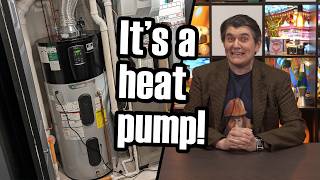

Water Heater That Costs $20/Month?
45sImmediately challenges expectations by revealing a water heater that costs less than $20/month and is 'free' in summer, sparking curiosity and saving money.
▶ Play Clip"Title is a clever pun, but the video delivers a thorough, honest review of heat pump water heaters — no bait-and-switch."
This video provides an in-depth review of a 120-volt plug-in heat pump water heater, explaining how it works, its installation requirements, and its performance in various conditions. The creator shares personal data and experiences to assess the true costs, benefits, and trade-offs of this technology.
A traditional water heater can cost upwards of $50 a month, but a heat pump water heater costs less than $20 a month, and in summer it can be effectively free.
Heat pump water heaters use the same technology as a refrigerator but in reverse, collecting heat from the air and transferring it to the water.
The 120-volt model plugs into a standard household outlet, avoiding the need for a dedicated 240-volt circuit, which is a significant advantage.
The upfront cost is higher, and it may take a decade to pay for itself, but rebates and incentives can accelerate the timeline.
The water heater needs a drain for condensate and access to a certain volume of air (450 cubic feet or 12.7 m³).
The A.O. Smith model has 8-inch collars that allow for flexible ducting solutions, which is a unique feature.
The heat pump draws about 400W but can move 1200W of heat from the air, resulting in 1600W of total heating power.
In summer, the cooling effect can offset air conditioning use, making hot water effectively free.
Data loggers showed that in winter, the cooling effect is minor, typically 5-6 degrees cooler in the room where it's located, and negligible elsewhere.
The water heater is slow to recover, taking 13 hours initially, but with a full tank, it can provide nearly 90 minutes of continuous shower time.
The heat pump can only raise the temperature of the entire volume by about 6°F per hour, so recovery is slow.
The hybrid model has resistive heating elements as a backup, but they only put out 900W, making them slow.
Power draw increases as water temperature rises because refrigerant pressure increases, making the compressor work harder.
How does a heat pump water heater work?
A heat pump water heater uses the same technology as a refrigerator but in reverse, collecting heat from the air and transferring it to the water.
01:09
What is the operating cost of a heat pump water heater compared to a traditional one?
It can cost less than $20 a month, and in summer it can be effectively free because it offsets air conditioning use.
00:17
What are two installation requirements for a heat pump water heater?
It requires a drain for condensate and needs access to a certain volume of air (450 cubic feet or 12.7 m³).
06:21
What is the power draw and heat output of the heat pump water heater?
It draws about 400W from the wall but can move about 1200W of heat from the air, resulting in 1600W of total heating power.
17:40
How long did it take to heat the tank initially?
It took 13 hours to heat the tank from cold water to 120°F on first installation.
31:14
What is the cooling effect of the water heater in winter?
The cooling effect is minor in winter, typically 5-6 degrees cooler in the room where it's located, and negligible elsewhere.
26:31
How long can you shower continuously with a full tank?
It can provide nearly 90 minutes of continuous shower time from a full tank.
32:56
What is the heat pump's heating rate?
The heat pump can only raise the temperature of the entire volume by about 6°F per hour, so recovery is slow.
36:45
What backup heating option does this model have?
It has a hybrid mode with resistive heating elements as a backup, but they only put out 900W.
40:26
Why does power draw increase as the water heats up?
The power draw increases as the water temperature rises because refrigerant pressure increases, making the compressor work harder.
45:05
Cost savings of heat pump water heaters
Provides a concrete, compelling number that immediately demonstrates the value proposition.
00:17Installation requirements
Highlights the practical considerations that are often overlooked in marketing materials.
06:21Heat pump efficiency explained
Breaks down the physics of heat pumps in an accessible way, showing why they are so efficient.
17:40Winter cooling impact is minimal
Provides data-driven evidence that counters a common concern about heat pump water heaters in cold climates.
26:31Recovery time is slow but manageable
Offers realistic expectations about the main drawback and how to mitigate it.
31:14[00:00] For all, they usually just... do their thing and the only time they cross your mind is when they stop doing their thing But water heaters are among the most energy intensive appliances in our lives.
[00:17] Having hot water on demand is so energy intensive that a very ordinary water heater can cost upwards of 50 bucks a month to use. But this water heater costs an average family less than $20 a month,
[00:33] and in the summer, using it is arguably free. Because this machine heats the water inside the tank by chilling the air surrounding it.
[00:45] Quite literally the coolest kind of water heater you can buy. we have had to import heat energy from an external source,
[00:57] either the power grid or some sort of heating fuel like natural gas or propane. uses the same technology as your refrigerator - but in reverse.
[01:09] and throwing that heat outside, But this thing gets cold as it runs It collects heat from the air around it and bottles it up inside.
[01:28] but relocating heat which is already there requires just a fraction of the electricity As in as little as one fourth as much electricity.
[01:44] It's a 120 volt model which simply plugs into a standard household outlet. For those of us in North America, that is a really big deal!
[01:58] to a dedicated 240 volt circuit. switching to an electric one rarely made much sense. You'd first need to run a new circuit for it, which can be quite expensive
[02:13] And even if you were up for that, the power-hungry nature of traditional electric water heaters makes their operating cost But these things completely change the equation.
[02:28] As they run, they merely sip a few hundred watts. Best of all, because of the magic of heat pumps, the operating cost of this electric water heater is in fact less than the gas-fired water heater it replaced.
[02:46] Look, let me get this out of the way. And if you have a gas water heater, neither should you.
[02:58] The significantly higher upfront cost of a model like this it's going to take like a decade to pay for itself, assuming it ever does.
[03:10] The actual math depends, of course, on your local energy prices, and certain situations like rebates and incentives will accelerate that timeline. so the math will undoubtedly change in the future.
[03:25] But aside from making electrification easier and kind of cheaper, especially during the warm months of the year. some of which are quite significant
[03:40] and could be a showstopper to some families. In fact, puzzling through and testing the various trade-offs involved with these is precisely why I wanted to get one.
[03:54] You see, I am in the worst possible position to have a heat pump water heater, and many plumbers, including the one I ended up hiring to install it, Why? Well, the fact that they cool the air to make hot water is a little inconvenient
[04:14] And I live in Chicagoland, Now, if your water heater lives in a basement or some other place you don't spend much time like a utility room,
[04:28] This will make that space a bit colder, but you're not likely to notice that anywhere else in your home. so my water heater lives in a cramped utility closet.
[04:45] And for the icing on this inconvenient cake, So using hot water will make the adjacent room colder.
[04:59] But you see, because energy is energy, And spoiler alert, I was right.
[05:11] Yes. Long story short, I do not regret this one bit that anyone suggesting these are inappropriate for cold climates is full of it.
[05:24] and they still have trade-offs which you'll need to consider. those trade-offs are actually a lot smaller than they seem.
[05:37] or are simply intrigued by the idea of a water heater that just sips electricity while it gobbles up heat Oh, you better believe we'll get to that.
[05:52] But they are a little different. So let's go over the things that might make the installation process a tad tricky. In many situations, installing one of these is incredibly straightforward.
[06:09] in most ways, this is a very ordinary water heater. which will be familiar to any plumbing professional.
[06:21] But it does need two things most water heaters don't. this dehumidifiers the air when it's running and thus it produces condensate.
[06:34] So you'll need a drain nearby or a condensate pump to deal with that. And second, in order for the heat pump to capture energy from the air, it has to ingest warm air and expel chilled exhaust
[06:47] If your water heater is located in a utility room or basement, it will probably have enough space and there will be nothing to do. 450 cubic feet, or 12.7m³ of accessible air volume.
[07:07] With eight foot ceilings, we're talking a room that's about six by ten feet. And - an important caveat for some of you
[07:19] you can just install this like any other water heater, figure out your condensate drain and plug it in. it's going to need some help getting enough air.
[07:34] And this is one of two reasons why I chose this specific model. A.O. Smith has equipped their heat pump water heaters with eight inch collars on the top Nobody else does it like that, which is a shame
[07:50] because those collars allow for a huge variety of simple air supply and discharge solutions using flexible ducting. For instance, if you want to pull air from one room and discharge cold air to another room,
[08:04] it's relatively easy to do that. I wanted some flexibility to tinker with down the road. You may also notice this water heater is gigantic.
[08:20] sitting on top of it, which makes it much taller than usual. and that's to make the tank real big to make up for its slowness.
[08:34] Yes, this is the major catch of a 120 volt plug-in heat pump water heater. They are glacially slow. Now, if you already have a 240 volt electric water heater, then you should know that hybrid
[08:50] and the same traditional heating elements as usual. And frankly, if you've got an electric water heater,
[09:02] they're kind of a no brainer, assuming you have an appropriate space for one to live. as much as possible, which can save up to 75% on your water heating costs.
[09:16] they can switch to those power hungry heating elements, This one though... can't do that.
[09:28] All it's got is the heat pump, and that makes it very slow Now, this likely will not matter to you except when you first install it.
[09:40] But if you do run out of hot water with one of these, So every manufacturer recommends upsizing I had a 50 gallon gas water heater before,
[09:56] and that's why I went with this 66 gallon heat pump water heater. these are also available with 80 gallon tanks. there would be plenty of room for this behemoth to fit in this closet,
[10:11] meant the condensate situation was going to be trivial to solve, but getting it in there wouldn't be so easy To actually position it required removing
[10:25] and reattaching the exhaust pipe from my furnace. Also, the drain line for my home’s fire sprinkler system needed reconfiguration, which intersected with the larger footprint of this thing.
[10:40] For those of you who keep asking, that's why I have this fire alarm bell. If a sprinkler head pops and water starts flowing through the system, that thing will go off. These challenges, though they did complicate the installation somewhat,
[10:54] would be small potatoes to an experienced plumber. purview is the ducting part. I knew this could be an issue for getting bids, and it was.
[11:07] to do what was necessary to get it positioned and plumbed, until I figured out how I wanted to do the ducting.
[11:20] After the necessary work was finished, the water heater was filled with cold water plugged in and it got to work. to get 66 gallons of cold water up to 120°F.
[11:38] I didn't have truly hot water again until the wee hours of the morning, which is something you should be prepared for if you decide to get one of these. Another thing you should be prepared for is a bit of extra noise.
[11:50] since this isn't hiding in a basement. Now, I absolutely love the sound of refrigeration, I'd say it's a bit louder than a typical fridge.
[12:07] but the compressor does get a little buzzy as refrigerant pressure builds. it's pretty tame and I cannot hear it anywhere else in my home but this room.
[12:21] Also, it's nowhere near as loud as the furnace next to it. Here's what it sounds like when my air conditioning comes on. the gas water heater that used to be here was genuinely louder
[12:39] But anyway, when I woke up the day after installation, I had both 66 gallons of piping hot water ready to go and a job to do. because there was already a vent above the closet doors
[12:56] so I just used an 8 inch to 6 inch reducing collar, some six inch flexible duct, and an adapter boot And now the water heater gets supply air from outside the closet.
[13:12] I have since learned that vent was there for code reasons having to do with gas appliances in an enclosed space, But A) eventually I intend to get rid of the furnace and replace it with a heat pump,
[13:27] And 2) these folding doors have about a one inch gap on all sides. So this closet was never truly enclosed in the first place, and therefore I feel no shame whatsoever in being a wee bit naughty.
[13:43] Oh, and that gap is why I didn't bother doing anything for the exhaust. but it finds its way out eventually. I have played around with things a bit since it was first installed,
[13:59] this duct was all I needed. these things have an air filter which needs periodic cleaning. and puts a message on the display.
[14:13] you have to think about with a water heater, so I figured I'd mention it. an anode rod is, well, should you need to replace it,
[14:26] since you have to take the top shroud apart to get access to it. But most people never, ever touch the anode rod, But then you probably already knew what the anode rod is anyway.
[14:43] Everything else is just normal water heater maintenance. to install a very slow, gigantic, expensive, somewhat noisy and esoteric water heater.
[14:57] Well, the simple answer is I'm a heat pump enthusiast. And this is such a cool use of one! During much of the year, the last thing I want is to add heat to my home.
[15:11] In fact, I pay for electricity to run a heat pump Though we Americans call that “air conditioning” for reasons which aren't important, but apparently is very confusing to certain northern European thought leaders and policy makers at the moment.
[15:28] See if you take a look inside the top, you'll find most of the same parts that you'd find in a small window air conditioner like this. That's because air conditioners - get this...
[15:43] what we call “air conditioners” are just one-way heat pumps To do that, they take heat energy from indoors and move it outside.
[15:56] When you stick this thing through a window or even just a hole in a wall, then this heat exchanger, called the condenser. will sit outside while this second heat exchanger, called the evaporator, stays inside.
[16:10] the refrigeration cycle kicks into gear and it will pump heat from the indoor evaporator to the outdoor condenser. This lowers the indoor air temperature and produces cooling.
[16:25] But what if instead of just pumping that heat outside to get rid of it, like, oh, I don't know, produce hot water for bathing and other domestic purposes?
[16:38] Yes, that is exactly why this has an air conditioner sitting on top of it It's doing the exact same thing that an air conditioner does,
[16:50] The only change is that the somewhere else in question is a great big tank of water. into a long stretch of pipe wrapped around the water tank a whole bunch of times.
[17:07] Just like the condenser in this air conditioner, that piping will release the heat absorbed in the evaporator. But since that piping is in physical contact with the water tank the water inside absorbs that heat and over time it gets hot.
[17:27] This may seem like a rather convoluted way to produce hot water, but the thing about heat pumps is they can move more heat energy than they consume in the process of doing so.
[17:40] it only draws about 400W from the wall. But since those 400W are running a heat pump which can use about 1200W of heat out of the air,
[17:54] 1600W of total heating power ends up being released into the water. From just 400W of electricity! That fourfold increase in heating power is how these things are so cheap to run,
[18:07] and why this one can get away with a regular plug. but in the summer months when I'm going to pay for using my air conditioner anyway using hot water becomes effectively free!
[18:22] With every other water heater out there, taking a shower results getting imported from the power grid, or, as was the case for me,
[18:34] starting a literal fire and burning natural gas. This thing, though, each time hot water is used, starts In the summer months, I now get extra cooling and dehumidification
[18:49] as a free side effect of using hot water. The energy used by the water heater itself was not free. But every kilowatt-hour it consumes in the summer to generate hot water
[19:05] happens to do essentially the same work as a kilowatt-hour running my air conditioner does. So every dollar I spend on hot water saves a dollar on cooling. Now there are two giant asterisks there.
[19:20] it doesn't actually produce all that much cooling. In fact, I've been disappointed by how rarely it kicks on and thus how little it seems to help the humidity situation in my home.
[19:35] Now, I don't use very much hot water, but a typical family of four taking daily 20 minute showers and running a load through the dishwasher will probably only see this thing run for 5 or 6 hours a day in the summer.
[19:49] And my central air conditioner, which is on the small side at only a two ton unit, is roughly five times as powerful as this thing. this might offset an hour of air conditioning use.
[20:05] That's not nothing, but it's also not that significant. Still free hot water, though, if you agree with my accounting. And the second asterisk is that accounting only works if the water heater
[20:18] can actually get the cooling it produces somewhere you need it. then sure it's making your basement a little cooler and drier, but it's probably not helping upstairs.
[20:32] Again, though, that's what's so cool about these models having those collars for ducting. and can potentially switch stuff around from season In my case though, this room is
[20:47] where my HVAC system gets literally all of its supply air. which connects the three floors as a giant air return, So whenever my HVAC system runs, it's actually pulling air
[21:06] Thus, this is genuinely helping my air conditioner, And you know what else is cool? I now have an emergency cooling source permanently set up and ready to go.
[21:23] See, I have one of those electric cars which lets you plug stuff into it, will happily run from my car. So if, say, there were a widespread power outage during a heat wave,
[21:37] plug the water heater into my car, and fill the bathtub with hot water. it will produce a similar amount of cooling as a small window unit.
[21:53] That's not a lot of cooling, of course, but during a test where it was 96°F outside, the water heater was able to keep the room it's in below 68 degrees, despite my central air conditioning being completely shut off all day.
[22:08] So I know at least one room of my home can stay and weirdly, a bathtub. This could also come in handy if, you know, my air conditioner conks out.
[22:22] But what about the winter months? Generating cold air as a consequence of producing hot water isn't quite so appealing Well, that's why I installed this thing back in early February.
[22:40] because that's when the situation isn't quite so rosy. In fact, people are so put off by the idea of having one of these in the winter
[22:52] that split heat pump water heaters, which use an outdoor unit to gobble heat up from outside air, are becoming a thing. But for the most part, I've honestly been a little puzzled by those.
[23:04] you do with this, but for two, by my math, shouldn't drop the indoor air temperature all that much,
[23:17] and thus split heat pump water heaters feel like a lot of extra work for a potentially marginal and only seasonal benefit. if my math was right or not.
[23:30] To provide you with an objective measure of the impact installing this would have, I put temperature loggers throughout my home many days before it was installed. And here’s what that data looks like in the room in which the water heater lives.
[23:46] Can you tell when on this graph the heat pump water heater was installed? It was switched on for the first time right here. But this was the first time it had ever run,
[24:02] During this section the water heater was running non-stop for over 10 hours but since the furnace kept kicking on and adding heat in response to the temperature upstairs,
[24:15] the room stayed at pretty typical winter temperatures the whole time. Wait, did I just say it was running for over ten hours? I did say these were glacially slow.
[24:28] (it probably won't) in plenty of other spots around the house, too none of that data turned out to be interesting in the slightest,
[24:42] which is irritating because I bought more data loggers so I could log ten different locations. take a look at the temperature upstairs near the thermostat. If I overlay the temperature graph from inside the utility closet,
[24:56] as a sudden drop in temperature. absolutely no noticeable difference at all to the temperature upstairs.
[25:08] First, this data looks so spiky because I lower the thermostat And remember, this logger was next to the thermostat,
[25:22] so we shouldn't expect to see much impact from the water heater since, the thermostat is just going to react and switch the furnace on. might have caused this drop here, in actuality
[25:37] and thus the thermostat set point was lowered. which was in my living room right next to the staircase. the water heater is in without actually being in the same room.
[25:53] And as you can see, whether the water heater was running or not Now, again, because I don't keep my home at a stable temperature all day long, it
[26:05] But notice that here, and the temperature in my home was dropping as a result, the water heater switching on didn't accelerate the decline.
[26:19] And here, when I actually was keeping a steady temperature in the house, Literally the only room in my home
[26:31] and even then it's a minor effect. and these logs indicate that in the winter months, and 6 degrees cooler, and only when it's running.
[26:48] let me explain how math got me to this answer ahead of time. The reason I'm constantly saying “energy is energy” you'll be able to make predictions.
[27:04] Elevating all 66 US gallons of water that this can hold from 55 degrees to 120 degrees is the same thing as elevating 250kg of water by 36°C.
[27:16] needed to raise a gram of water by one degree Celsius, and so raising the 250,000g of water in this tank by 36°C requires 9 million calories.
[27:31] not the kilocalories we measure food energy with. we can simply convert that 9 million calorie figure to roughly 36,000 BTUs
[27:44] which is the unit we typically use for heating and cooling. the water heater will have to absorb to heat the entire tank of water in the winter: In actual fact, it will likely only absorb about 27,000 BTUs
[28:03] because roughly a quarter of its heating power comes from the electricity it consumes. just how much of a nothingburger this is. Sure, this may yoink 36,000 BTUs of energy from the air to heat a full tank of water,
[28:18] but my furnace can put out about 55,000 BTUs. So to heat the entire tank of water requires the same amount of energy that my furnace puts out in just 40 minutes.
[28:34] is wildly oversize for my home, but the point remains Water heating is energy intensive, but space heating is much more so.
[28:49] My two ton central air conditioner can remove So running my air conditioner for just 90 minutes
[29:02] as it heats an entire tank of water. I've observed that on a mild summer day after sunset, my air
[29:14] by about one degree Fahrenheit per hour. using all 66 gallons of the hot water in the tank
[29:27] will only cool the house down by at most, about 1.5°F. is mostly localized to this one room, I knew that in here the temperature drop would be greater than 1.5°F, and it is.
[29:44] But because the furnace keeps kicking on periodically, that six degree temperature drop is about where it bottoms out, the room warms back up pretty quickly.
[29:58] the times of year where I'm not using heating or cooling all that much, Unless my HVAC system kicks on,
[30:10] and the effect can be more significant. Genuinely, There are still some things I want to tinker with, but it really is tinkering,
[30:27] and the kind that only a weird nerd like me would want to do. I hope at this point I've successfully convinced you that the cooling effect Those potatoes are so small, in fact,
[30:41] that if I ever wanted to use this room as an office or whatever, the cooling of the water heater and keep it nice and warm. kind of questionable, but I'll get into that later.
[30:57] Now we should discuss the big potato. The thing that genuinely is a potential showstopper. This is, indeed, the slowest water heater you'll ever live with.
[31:14] When I first installed it, because I didn't have the duct run to it yet, and it kept re-ingesting its exhaust thanks to the shape of the closet, It took 13 hours of running nonstop to get the tank up to temperature.
[31:29] a new “what happens when you run out of hot water” test and that was after I had raised the set point
[31:41] And now that we're in summer, and thus it has a head start, that time has improved again to seven hours.
[31:55] But that's still a long time to wait to get your hot water back. The thing is, though, when it's charged up with 66 gallons of hot water, it takes a lot longer to burn through it all than you probably think it does.
[32:10] For instance, one of the first tests I did was to fill my bathtub with piping hot water, which draws about 30 gallons or not quite half of the tank. And then I hopped in the shower after starting a stopwatch
[32:23] And folks, It took more than 45 minutes of very hot showering to use the remaining 36 gallons of hot water.
[32:38] Now, obviously different shower heads go through water faster than others, But I've never thought my showerheads were all that water saving, you can probably get nearly 90 minutes of continuous shower
[32:56] time out of just one tank of hot water. water heater only takes an hour or two to recharge when it runs out, If you run out of hot water from this thing in the winter,
[33:14] But before you freak out about that, you should know that water heaters are a little peculiar. the tank is filled via a dip tube,
[33:30] while hot water is drawn off the top. than cold water, so it floats and a sharp
[33:42] boundary layer keeps the already hot and the incoming cold water separated This means that if you in a partner end up using, say, then you don't end up with a water heater filled with lukewarm water.
[33:59] Instead, you'll have 33 gallons of piping hot water floating on top of 33 gallons of cold water. water ready to go for whatever you might need, but also the water heater
[34:13] only has to heat the 33 gallons you used. to recharge from those showers is just 5.5 hours. but if nobody's going to use hot water again until the evening,
[34:31] I can't answer that for you. But no, it doesn't. households use a lot more hot water than others do.
[34:45] so I'm not going to pretend that But there are many, many hours in the day For instance, when you're at work or when you're at sleep.
[35:03] can recover hot water faster than your household uses it, before with a conventional storage water heater,
[35:15] either gas or electric, it almost certainly can, But there is some nuance to be aware of. where I talked about electric water heaters
[35:28] at the bottom of the tank and another about halfway up. of running out of hot water or genuinely run out,
[35:41] With less water to heat, it heats up much faster, and you'll have at least some truly hot and then it will switch to the bottom element to heat up the rest.
[35:57] But these 120 volt plug-in heat pump models can't do that. They heat the entire volume of water as one. and a rather inconvenient consequence for going over that limit.
[36:13] The 11 hours it takes to bring a full tank of ice cold winter water up to 130°F tells us two things. tank capacity in a 12 hour period,
[36:27] It will always be fast enough to catch up to you. But it also tells us how fast the heat pump actually is. The heat pump can only raise the temperature of the entire volume
[36:45] So if you cross that limit and use more than 66 gallons in an 11 hour period and end up running out of hot water, it could be a while before you get your hot water back.
[37:01] I must point out that typical usage patterns make running out of hot water Even if everyone in your household showers in the morning, the water heater will probably be completely recovered
[37:18] But the bottom line is, if running out of hot water is anything close to a regular occurrence in your household,
[37:30] these plug-in models are just not going to work for you. Maybe that's a sign you're going a little heavy on the hot water there. Fun fact, you are in control of your own choices!
[37:44] Now let's get into some of the weird nerd stuff. which I hope I've convinced you of, is that these things are great. A large majority of households will be adequately served with one of these,
[37:59] And in the summer some of them are not trade-offs at all. And if you don't care to learn more. Bye.
[38:11] But I will tell you about the two minor issues The first one is incredibly strange and I cannot explain it.
[38:23] not long into taking a shower, the water suddenly got cold for about 60 seconds. It wasn't ice cold, but like you're running out of hot water cold.
[38:35] I have no idea why or even how that happened. water to end up near the top of the tank, but it has happened
[38:48] My speculation is that since the tank is heated externally, which will occasionally produce that outcome,
[39:00] Oh, and that leads me to one thing I think it's possible heat pump water heaters like this will have far fewer problems with mineral buildup over time.
[39:14] to produce bubbles of water vapor and nucleation sites, are able to precipitate out and build up.
[39:27] last an unusually long time, though again, that's just speculation. It also appears A.O. Smith may be having some reliability issues with these.
[39:39] Speaking of potential reliability issues, the other minor issue I had just happened a few weeks ago. randomly tripped, and I didn't notice the water heater hadn't been running for a while.
[39:57] I think this probably happened when we had quite some gnarly storms roll through, which caused quite a lot of flickering of lights, though thankfully I never lost power. Luckily, I noticed it soon enough that I just reset it,
[40:13] and it wasn't an actual issue for me, but it could have been. I never explained the second reason I went with this model from A.O. Smith. Despite being a 120 volt plug-in model,
[40:26] water heaters with resistive heating elements as well. should the heat pump fail, but if, for whatever reason,
[40:38] become a problem, I can switch it to resistive mode It even has those two heating elements and can do the same “only heat the top half of the tank” trick as all the rest.
[40:53] those heating elements only put out 900W. oh boy. The same 50 degree to 130 degree climb,
[41:09] should take a little over 14 hours with 900W of heating power, assuming zero losses. In fact, I've been annoyed that nobody has made
[41:24] If your hot water usage is modest, half the day to heat up the whole tank? such a water heater until quite recently.
[41:38] But the only reason I ever envision wanting to switch it to resistive mode won't happen until the future. And even then, I probably still won't do it. of using a space heater in the same room
[41:54] That's because if you are heating the room with resistive heating and the water heater absorbs that heat with its heat pump, You've just created a slow, ordinary
[42:10] so you might as well just switch it to resistive mode and have it But guess what? gas water heater with extra steps.
[42:25] the winter came from my gas furnace, one of these is to reduce my use of gas. reducing the use of gas quite substantially.
[42:42] my furnace only runs about half of the year. I do not need to heat my home at all, and since my previous it's a total elimination of gas during the warm months.
[42:59] I'm saving some gas. at turning gas into heat than my water heater was. So even though it might feel a bit silly to do this two step process,
[43:13] it is a slight savings and I care about that. But before too long, I intend to replace the furnace and that is why I wanted to get this hybrid model.
[43:26] To reiterate, the point of heat pumps is that they can move more heat than it takes to run them. A good heat pump like this water heater will be able to move
[43:38] than a resistive heater would release using the same amount of electrical energy. and that heat ends up getting gobbled up by the water heater,
[43:52] It's just a very strange cascading heat pump setup. But for my home, I don't want to oversize the heat pump, and if it’s sized correctly,
[44:06] then it will barely be able to keep my home warm in the coldest weather we experience. could potentially tip the scale just enough to become a noticeable problem.
[44:21] So if that ever happens, switching it to resistive mode Just more expensively. heat pump facts revealed by having this plugged
[44:37] And finally, I'll explain all this nonsense. as is the case inside the refrigeration circuit, its literal temperature and vice versa.
[44:53] And as temperature goes up, so does pressure. This means that as the water in the tank warms up, refrigerant pressure on the high side slowly climbs,
[45:05] And we can see this in the power draw. can give us an estimate for how close the water heater is to finished.
[45:18] When it was first plugged in, it actually didn't start the heat pump and instead used the resistive elements. is below 55 degrees, and being filled with ice cold water on February 3rd, it definitely was.
[45:38] But after about an hour of that, it switched the heat pump on. the refrigerant condensed into liquid at a very low pressure, probably like 60 psi given this is charged with R-513a.
[45:54] This meant the compressor was barely doing any compressing and power draw wasn't even 300W. But as the water got warmer and the pressure started climbing, until hitting a max of roughly 460W.
[46:12] But so is the pressure difference. At 120 degrees, R-513a condenses at 180 psi - three times the pressure.
[46:24] But because the refrigerant needs to actually be hotter than the water to heat it, it was probably condensing around 135°F, which would be a pressure of 220 psi.
[46:36] That's why it's working so much harder and drawing more power. When set to the factory default of 120°F, it would essentially always stop at 460W of power draw.
[46:49] it would climb all the way to 500W. But what's interesting is every time you draw a hot water out of the tank
[47:03] refrigerant pressures immediately fall and so power draw does, too. Here I was doing laundry and set the washing machine to hot.
[47:15] Normally I don't do that because modern laundry detergents work great in cold water. But you know, I wanted to see how much hot water laundry day might need. did start up, but you can see right here
[47:29] climb in power draw was interrupted. And the same thing happened again when I started a third load.
[47:42] so it never got close to running out of hot water. But I will acknowledge that I have a front load washer so the picture might not be so rosy with an old school washer.
[48:00] It's fine. of the refrigerant is that we can look at the power draw For example, here, power draw began around 400W since it was just replenishing
[48:19] from me taking a shower and most of the water in the tank was still very hot. and since that draws nearly half the water from the tank, and so was the refrigerant temperature
[48:34] But you'll notice here it shut off early. rhyme or reason, but usually it doesn't result since the water at the top of the tank
[48:48] But I will say there have been some occasions In fact, that's the main reason Though I've always liked my water heaters on the hot side.
[49:03] I also wanted to figure out whether this thing would end up fighting my humidifier. The humidistat video I made over the winter is actually what got all this started.
[49:16] See, this humidifier, like many, works much better But since drawing hot water will eventually cause the water heater to switch on and start dehumidifying,
[49:31] But luckily it seems the designers of this thing were thinking ahead. That's part of why it's so huge.
[49:43] So if you don't use any hot water, heat leaks out so slowly that it only needs to switch on And while I don't know if they all work like this
[49:56] with a full tank of hot water, it ignores small draws. Even if I take a 20 minute shower, it usually doesn't react to that. Unless you draw some minimum volume of water out of it in one go,
[50:10] which I'm estimating to be between 15 and 20 gallons, until the top portion of the tank has cooled off enough to justify starting back up.
[50:22] the bottom temperature sensor a good way up the tank, and that it was done specifically for humidifiers. and indeed every other I've ever paid attention to, would fire up
[50:37] In fact, it would start up twice during the course of a dishwasher cycle, And so the old water heater would typically respond to the humidifier
[50:52] But as far as I can tell, this water heater has never responded to the humidifier. the next time it fires up, but it'll make it all day before that happens
[51:08] unless I use hot water in some other way so I can happily report This room did get dryer whenever it finally decided to start, but the rest of the house stayed delightfully moist.
[51:23] let's finish up with all this nonsense. It is true that my HVAC system’s one and only air intake is in this room, but the shape of this room causes much of the air
[51:37] Virtually no airflow moves across the room which provides heating and cooling from the furnace, and thus it creates this massive dead zone.
[51:54] So when the water heater runs, pulls in air once that cold air seeps out, This means, especially in the spring,
[52:10] And because I'm me, I solved that problem with a bathroom fan, So that bathroom fan mounted to the wall pulls
[52:24] which is right near the water heater’s exhaust vent, and blows it through this duct I even used one of those outdoor vent covers to make sure it's throwing
[52:37] air down, and right where the furnace will gobble it up. it’s plugged into, detects the temperature in this closet and this analog thermostat up here is wired
[52:53] across the R and G terminals of my furnace to make the furnace Now, regardless of whether my thermostat is requesting heating or cooling, the furnace fan and the bathroom fan will help
[53:08] Get the furnace to suck it up and spread it around my home. Now this works and it works decently well, I only did it like this because this closet is so cramped.
[53:26] It seemed kind of fiddly to run another six inch duct to the water heater, to connect to the exhaust collar. of a whole bunch of other situations where a blower fan
[53:40] I would like to see heat pump water heaters which is energized whenever the compressor is running. This temperature controller solution works, but not all that well.
[53:55] because it usually doesn't get colder than 57 degrees in the closet. So I'd rather just have some way to turn on the fan
[54:09] I'd also like to see an auxiliary relay, so you can send a fan call to an HVAC system at the same time But you know, I've got stuff and I know how to use it.
[54:25] But I was caught off guard by how loud that bathroom fan would be, I deliberately got a very quiet one. Since this awful bathroom fan situation ended up making more noise than I expected,
[54:41] and since actually getting it to work well would require fiddling with the set point throughout the year, I am going to try and run another six inch duct to the water heater’s exhaust collar and put a larger and more normal kind of vent where this one is.
[54:57] and put that vent back to code compliance status. Once I do this, the water heater itself will solve the dead air will still be right above the furnace intake distribution throughout my home should be the same as now.
[55:17] duct might sweat with condensation in the warmer and more humid parts of the year, but this room does get pretty dry and it always runs for at least two hours at a time,
[55:31] so I'm not sure whether that will actually be an issue. And, well I'll also have to play around with new solutions for forcing the furnace I'm thinking what I'll probably do is just move that thermostat
[55:46] outside the closet and right next to the discharge vent. and it'll make adjusting the temperature at which the furnace also giving me the option to disable that outright.
[56:01] But I do have a loose end to tie up. At the end of that one, I told you about a mystery box the water heater when electricity prices are high.
[56:18] because I'm a sicko who likes to game that sort of thing. with a 120 volt coil wired to a plug, when the water heater got power to the overnight hours
[56:34] Doing this had absolutely no noticeable effect on hot water availability since I never used the entire tank in a day, but it also didn't really have an effect on my power bill.
[56:48] but the impact was far too small to pick out from everything else I use electricity for. It's a long story, but my already pretty low
[57:02] And so I was saving very little money by shifting the energy drawer to the overnight hours. This modern heat pump water heater has Wi-Fi and Bluetooth because of course it does
[57:14] and can thus participate in demand response programs if that's your jam. I'm honestly not interested in trying to optimize when it runs.
[57:26] Besides, if your family's big enough to push this to its limits, there's not much savings to have. ♫ refrigeratedly smooth jazz ♫
[57:42] Hey, so remember how I had all those other data loggers running? Mostly because... it was all pretty minor stuff and not really relevant to the grand scheme.
[57:54] But I was logging stuff such as “what is the actual air temperature inside my ductwork” while the furnace fan has kicked on in response to the water heater running. as well as a story about how Lowe’s managed to lose this water heater for like two weeks,
[58:12] well you can check out the video on Connextras which will be popping up at the end screen. I don't know. rrrgh!
[58:28] and the thing is, this is such an easy way to add pumping. well, usually, but even in my case... it wasn't all that wild of a project. energy is energy and water is water!



⚡ Saved you 0h 58m reading this? Transcribe any YouTube video for free — no signup needed.