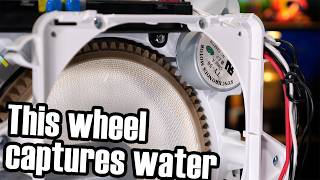

No Cold Surface? How This Dehumidifier Works
47sThe unique explanation of a dehumidifier that doesn't rely on cold surfaces or refrigeration is fascinating and counterintuitive.
▶ Play Clip"Delivers exactly what the title promises: a fascinating deep dive into desiccant tech with clear verdict on who it's for."
This video explores rotary desiccant dehumidifiers, explaining their unique mechanism that uses a silica gel wheel and heating element to absorb and release moisture, unlike conventional refrigeration-based dehumidifiers. It compares their performance in terms of efficiency, noise, and suitability for different climates, concluding that they are significantly less efficient in warm conditions but can be advantageous in cold, damp environments.
The video introduces a new type of dehumidifier that uses a rotating desiccant wheel rather than refrigeration, making it quieter and without cold surfaces.
It relies on condensation on a slightly cool surface but doesn't require refrigeration; uses a desiccant material (silica gel) that absorbs moisture and releases it when heated.
Silica gel can release moisture when heated, enabling a continuous cycle of moisture absorption and desorption.
Inside: a slowly rotating wheel of corrugated silica gel, a fan, a heating element, and a heat exchanger made of plastic tubes.
A small blower sends air through a heating element and then through a small section of the desiccant wheel, heating it to release moisture.
The hot, damp air from regeneration is cycled through a heat exchanger (plastic tubes) cooled by ambient air, causing condensation that collects as water.
The blower cycles air in a loop through the heating element and wheel section; the heat exchanger cools the air to condense moisture, which drips into a bucket.
Unlike conventional dehumidifiers, this type works in cold temperatures without freezing, as it doesn't rely on cooling to condense moisture.
Has more moving parts but all are simpler than a refrigeration compressor; no harmful refrigerant needed.
The heating element consumes about 300 watts, similar to a small conventional dehumidifier.
Two large humidifiers raised a bathroom to ~80% relative humidity; tested the desiccant unit for 2 hours.
After 2 hours, the desiccant unit consumed 600 watt-hours and removed 195g of water, yielding 0.33 liters per kilowatt-hour.
A vapor compression dehumidifier consumed 680 watt-hours and removed 1,207g of water, achieving 1.775 L/kWh – over 5 times more efficient.
A cheap Peltier-based 'dehumidifier' removed only 22g of water in 2 hours using 70 watt-hours, with an efficiency of 0.31 L/kWh.
The desiccant unit's efficiency (0.33 L/kWh) is nearly identical to the Peltier unit (0.31 L/kWh), both far below the conventional unit.
Similar technology is used in energy recovery ventilators to exchange air without losing temperature or humidity.
The tested unit lacks a humidistat, has only on/off and two fan speeds, and may not perform optimally in warm conditions.
The desiccant unit removed 80-90 grams per hour consistently across different temperatures and humidities (40-80% RH, 66-72°F).
Desiccant dehumidifiers are most useful in climates like the UK where it's cold but damp; they work reliably above freezing.
Six UK models showed efficiencies between 0.54 and 0.66 L/kWh, still only about 1/3 of a conventional machine.
A commercial unit (Technofrigo AD3000) has an efficiency of 0.71 L/kWh, still well below the 1.775 L/kWh of the conventional unit.
The desiccant unit is significantly quieter and contains less copper, steel, and aluminum, making it less resource-intensive to manufacture.
The 300W heating element adds heat to the room, which in cold climates can be beneficial by lowering relative humidity just through warming.
The extra heat from the desiccant unit can be useful in winter, but resistive heating is typically expensive; its overall efficiency depends on climate and heating source.
In warm conditions where dehumidification is needed without heating, the desiccant unit is about 1/5 as effective as a conventional one; thus, it's mainly suited for cold, damp climates.
In most of the US, the climate doesn't favor these units; they are often bought by people wanting to reduce humidity but end up disappointed due to poor performance in warmer seasons.
Rotary desiccant dehumidifiers are an innovative alternative to conventional units, offering quiet operation and cold-weather functionality, but their efficiency is significantly lower except in specific cold, damp climates where the added heat is beneficial.
What is the efficiency of the tested rotary desiccant dehumidifier in liters per kilowatt-hour?
0.33 L/kWh
11:25
What is the efficiency of the tested conventional vapor compression dehumidifier?
1.775 L/kWh
12:38
How much power does the heating element in the rotary desiccant dehumidifier consume?
Approximately 300 watts
08:52
What is the main advantage of a rotary desiccant dehumidifier over a conventional one?
It works in colder temperatures without freezing.
07:09
How does the efficiency of the Peltier dehumidifier compare to the rotary desiccant unit?
They are nearly identical: 0.31 L/kWh vs 0.33 L/kWh.
14:04
In what climate are rotary desiccant dehumidifiers most useful?
Cold, damp climates (e.g., the United Kingdom) where dehumidification is needed alongside heating.
17:43
What is the efficiency range of UK retail desiccant dehumidifiers mentioned?
0.54 to 0.66 L/kWh
18:26
Why is the holistic cost evaluation of desiccant dehumidifiers difficult?
Because the extra heat they produce can be beneficial in cold climates, but resistive heating is typically expensive.
24:03
Cold-Weather Functionality
Desiccant dehumidifiers don't freeze up in cold temperatures, a key advantage over conventional units.
07:09Efficiency Disparity
The conventional unit was over five times more efficient than the desiccant unit in the same warm conditions.
11:25Desiccant vs Peltier Efficiency
The rotary desiccant unit had nearly identical efficiency to a cheap Peltier device, highlighting its poor performance in warm climates.
14:17Quiet Operation and Resource Use
Desiccant units are much quieter and use fewer resources to manufacture, making them attractive for noise-sensitive environments.
20:25Climate-Specific Verdict
The video provides a clear, evidence-based conclusion: these are only suitable for cold, damp climates where heating is welcome.
25:46[00:00] may not look like anything but a slowly rotating disc of stuff. But would you believe it's actually part of a dehumidifier? Not long ago, I made a video about what I'd call ordinary dehumidifiers.
[00:19] most dehumidifiers work by making something cold and blowing air past the cold thing so the air drops below the dew point temperature, which forces the water in the air to condense on the cold surface.
[00:35] And the most efficient way to make something cold is to use the refrigeration cycle, So dehumidifiers, at least good ones, are really just air conditioners with the parts rearranged and with different controls.
[00:47] they do not cool the air. In fact, they make it hotter as they extract moisture The other video explains all that in much too much detail.
[01:00] But it turns out you don't have to use the refrigeration cycle. This is a totally different kind of dehumidifier. It's a lot quieter, and it doesn't have anything inside of it that gets cold.
[01:15] And somewhat strangely, while it does rely on the condensation of water on a cold-ish surface to collect it in this bucket, it doesn't have to do anything at all to get water out of the air.
[01:30] This is called a rotary desiccant dehumidifier, and they are quite fascinating. But they're also really, really uncommon here in the US.
[01:43] I had to resort to this "Aeocky" thing from Amazon just to tinker with one. I think I'm pretty sure I know why they're not common here. If the word desiccant rings a bell, that's a substance which is hygroscopic.
[02:02] It likes moisture so much that it'll just absorb it right out of the air. Though it might adsorb it, but I am not getting into that distinction. Silica gel is a common desiccant and you've probably run across that in those little pouches which,
[02:18] despite the fact that you genuinely should not. Uh anyway, there are also desiccant products sold specifically for dehumidification purposes. Damprid is a product which contains various salts which are very hygroscopic.
[02:35] but the trouble with that approach is that most desiccants are single-use items. Once they've absorbed moisture, they're used up and stop working.
[02:48] Silica gel has a trick up its sleeve. It'll adsorb moisture from the air just fine, but if you get it hot enough it'll actually release the moisture it's adsorbed.
[03:01] and some clever person figured out a way to exploit that and make a functional dehumidifier using silica gel. And through the magic of buying two of them, I have a pre-made one right here so I can show you.
[03:19] you may notice there's a bit of a wiring situation going on. I'm not going to get into it here, but I will tell the story on Connextras.
[03:31] The Cliffsnotes version is that if you spot what might be a design flaw in this thing's operational logic... This is more or less an optimal design. What we find inside is a slowly rotating wheel made of silica gel with a tight corrugated structure.
[03:48] Quick side note, my brain doesn't like that this is called gel. To me, that implies soft and squishy and this stuff is very hard. But the technical meaning of gel has to do with chemical structures and polymer science,
[04:03] Anyway, the corrugated structure gives it a large surface area, and a fan not unlike one you'd find in a PC case, gently pulls air through the desiccant wheel. One section, roughly a fifth of the wheel's area, is covered both front and back
[04:22] Instead, that section of the wheel has a completely separate airflow situation going on. It takes air in through this hole, then sends it via a duct to a metal box sitting right behind the desicant wheel.
[04:40] You can actually see it glowing when operating. And that heats the air coming from the blower before it's sent through that small section of the desiccant wheel. The now hot air is able to regenerate the desiccantand release the moisture it's holding on to.
[04:57] I can actually feel when I put my hand in front of the hole that the air coming out is very damp. It's like the air in a bathroom after taking a long hot shower. We're trying to remove that water from the air, not just heat it up and move it around.
[05:15] And that's why this machine also has this heat exchanger. This simple plastic... thing is constructed much like a radiator. So these two holes become an intake and an exhaust.
[05:32] Air pushed through this hole will travel up all these tubes which are definitely not just plastic drinking straws. And then when it reaches the top, it ends up coming back down these tubes before exiting the second hole.
[05:46] This bundle of straws may be simple, but when it's installed in the unit we find that its intake and exhaust holes line up with the intake and exhaust of the small blower. That means the blower is actually just repeatedly moving air through this thing and that small section of the desiccant wheel in a loop.
[06:04] Before long, because of the heating element, that loop of air gets very hot and very damp In fact, it's so damp that the air inside of it is practically fully saturated with water and at nearly 100% humidity.
[06:21] That means if the air inside these tubes is cooled even just a little bit, it's gonna fall below the due point and moisture will condense out of it. And wouldn't you know it, when assembled, the straws are in the same air path as the rest of the desiccant wheel.
[06:38] So, the large PC fan ends up cooling them with ambient air. You can actually see them right here in this assembled machine. The slightly chilly walls of these straws will quickly build up condensation on their insides.
[06:52] And once enough builds up, it falls down into the bottom cavity and comes out these two holes. Then that water is directed into the little collection bucket. The desiccant naturally grabs moisture from the air regardless of temperature,
[07:09] which is a huge advantage compared to a conventional dehumidifier. Since those work by cooling, in colder ambient conditions they can freeze up, which limits their effectiveness —
[07:21] as this freezing up can start to happen at fairly normal room temperatures. In contrast, this thing doesn't care what the air temperature is.
[07:34] It does need to be above freezing, of course, as otherwise the water it collects will turn to ice. the silica gel will simply yoink it right out as it passes through the honeycomb structure.
[07:47] And since you can reverse that process simply by heating it up, a slowly rotating wheel of the substance can create an infinitely repeatable moisture charge discharge cycle You could say this machine has more moving parts than a conventional dehumidifier
[08:05] since it has two fans plus the synchronous motor to rotate the wheel and the gears inside of there. But all of those parts are a lot simpler than a refrigeration compressor. And this approach doesn't require any environmentally harmful refrigerant, which is a nice bonus.
[08:22] We've made a lot of progress making better refrigerants and I kind of wish we'd stopped paying so much attention to that as a boogeyman because it's not only a solvable problem but actually has been solved in many applications.
[08:37] Every article I read about some new alternative to refrigeration generally ignores that progress On that note, what a perfect segue to the, uh not exactly small caveat of this approach.
[08:52] While the motors in here are small and only consume about a dozen watts of power, the heating element needs roughly 300 watts.
[09:05] That puts it at an extremely similar power consumption to this conventional vapor compression machine. Which is somewhat surprising considering how much smaller and lighter this is. But it's also convenient because it means we can simply run these things in the same conditions for the same amount of time
[09:23] to judge how much more or less energy efficient they might be compared to each other. And if this footage looks familiar, that's because I did all this testing last year. I set up two very large humidifiers in this small bathroom to keep the humidity as high as reasonably possible.
[09:41] Together, they got the room to around 80% relative humidity. The first test I ran last year was with the rotary desiccant machine because this was the one I was most curious about.
[09:54] I've used plenty of these conventional dehumidifiers in my life, After two hours of running in that miserable room, it had consumed 600 watt-hours of energy.
[10:06] And at the end of two hours, it was clear that the dehumidifier was losing the battle with the humidifiers as the room remained at about 80% humidity the whole time. But how much moisture did this thing get out?
[10:22] I poured the water from its collection bucket into this container on a tared scale and it read 188 grams. I tried to get as much as I could back into the container and got it up to 191 g.
[10:39] But let's just go ahead and call that 195 just to be fair. That doesn't seem like very much, but to calculate liters per kilowatt-hour, first I needed to convert the 195 grams of water into ounces.
[10:51] And since this is water, that's the same as 6.87 fluid ounces. Now, as I'm sure you know, there are 128 fluid ounces in a US gallon. So, that's 0.05367 gallons.
[11:06] So, I multiplied that by 3.8 and got 0.2L, Anyway, with 0.2L produced using 600 watt-hours of energy, that works out to 1/3 of a liter per kilowatt-hour.
[11:25] Remember that number, 0.33L per kilowatt-hour. With this guy set up in the same testing environment, at first it used a little less electricity than the rotary desiccant model.
[11:40] When first powered on, it was only consuming 265 watts, and this was on its highest fan setting. throughout the system and pressures change, Shortly into the test, it had increased to 345 watts.
[11:57] Also noteworthy, this fella was actually able to overcome the humidifiers and drop the ambient humidity. Running non-stop, the room stabilized at about 60% relative humidity.
[12:10] If that sounds like this machine was removing a lot more moisture, At the end, it had consumed 680 watt-hours, just a hair more than the desiccant unit.
[12:22] It produced over a liter of water, in fact, 1.2 L. the precise total was 1,207 grams of water.
[12:38] Which means this machine under these conditions will remove 1.775 L of water per kilowatt-hour, which is over five times as efficient as the rotary desiccant unit.
[12:51] Well, I also tested this piece of garbage. This is a "dehumidifier" which uses a Peltier element to create a cold surface via thermoelectric electric cooling
[13:04] and has a piddly little fan to blow a bit of air across that cold surface. Now thermoelectric cooling is just not an efficient technology and I'm pretty confident that the only reason these exist is to have the cheapest search result on [insert website] for "dehumidifier"
[13:22] and they're mostly just exploiting people who don't know any better. Want to know how much water this thing produced in that same incredibly damp testing environment after 2 hours? Twenty-two grams.
[13:36] 70 watt-hours. Its only saving grace is that it uses just 35 watts of power. But its efficiency still works out to a paltry 0.31 L per kilowatt-hour.
[13:51] That is 1/5th as efficient as the vapor compression machine. If this piece of junk is 1/5th as efficient as the machine which is five times as efficient as this machine...
[14:04] that means these two machines are equally efficient. It's not quite exactly the same, but 0.31 versus 0.33 L per kilowatt-hour is awfully darn close.
[14:17] And both of them are much much less than 1.775. So, uh, are rotary desicant dehumidifiers just as inefficient as Peltier dehumidifiers?
[14:32] First I would be remiss if I didn't mention that this technology isn't unique to standalone dehumidifiers like this. especially where humidity must be kept in control even when the air has to be quite cool.
[14:50] You'll also find similar rotating wheels of silica gel in some energy recovery ventilators. Those are devices which allow for the exchange of indoor and outdoor air without changing the temperature or humidity of the indoor air very much.
[15:05] It's not always a rotating wheel, sometimes it's more like a cube surrounded by careful ducting, but they're starting to become common in residential settings, which is great. But the rest of this video is only going to address devices like these:
[15:18] standalone boxes you put in a room and plug into the wall which extract moisture from the air and collect it. Also, I don't want to suggest that this machine is representative of the technology writ large.
[15:31] It can only be on or off. It doesn't have a humidistat - it only has two fan speeds and a sleep timer.
[15:43] Plus, my test conditions weren't exactly this technology's bread and butter. which might have limited the ability of the plastic straw radiator thing to cool the air inside below the dew point.
[16:01] So perhaps it would work better in cooler temperatures. Well, I've let this thing run for 2 hours in a whole bunch of different conditions and the amount of moisture it extracts from the air is weirdly consistent no matter what.
[16:16] The relative humidity during that test was only about 40% and the air temperature was 72 Fahrenheit, 22 C. It still managed to pull out 160 grams of water in 2 hours,
[16:30] which is over 80% of what it did in the damp AF bathroom. about 60% and roughly the same temperature, and it still extracted 186 g of water - not much more.
[16:46] Then I did it again in the morning with the temperature down to 66° F, that's about 19° C, and the humidity at 50% and it extracted 169 grams of water.
[16:58] Kind of seems like no matter what it's going to pull out something like 80 to 90 grams of water per hour. So its efficiency is apparently not that affected by ambient conditions. Now, granted, I never tried this over the winter.
[17:13] I should have, but I forgot because of the fact that I live in the Midwest and DEhumidifying is the last thing on anybody's mind from October to March. But the weirdly consistent results I was getting were backed up by a little internet sleuthing.
[17:29] if you watched the first video, you'll remember that I said cold but damp just isn't much of a thing here. And to clarify by "here" I mean most of the United States.
[17:43] Those are the conditions where a rotary desiccant machine is the most useful. So long as the air temperature is above freezing, this will keep working. Like for instance, the United Kingdom.
[17:57] So I spun up Amazon.co.uk in the hopes I could see what the efficiency of other models is like. And, well, none of this looks much better.
[18:12] and I don't know whether these numbers are the result of government testing or manufacturer testing. But assuming their best quoted moisture extraction occurs on their highest power setting,
[18:26] then these six models can manage 0.54, 0.535... 0.66,
[18:38] and 0.62 62 L per kilowatt-hour, respectively. The best of these is twice as efficient as the one I've tested,
[18:50] but that's still only one third as efficient as a vapor compression machine. But I wanted to see how big boy commercial versions of this technology might fare. So I found this brochure from Technofrigo Tuscany, and it has charts!
[19:05] They back up the notion that the moisture removal of these things is oddly consistent, It seems to plateau right at about 20 degrees C. And the first model listed, the AD3000, can remove 23 kg of water per hour.
[19:22] That's quite a lot, but so is its power input. That's like 10 British kettles! And it means its efficiency is only 0.71 L per kilowatt-hour,
[19:37] which is still significantly worse than the 1.771 L per kilowatt hour I observed in my test of the vapor compression dehumidifier. Frankly, I'm surprised this thing doesn't quote some average moisture removal per energy unit but...
[19:52] then again, the moisture it can pull out of the air varies a lot, especially once the temperature starts to fall, so I can understand that being a practically impossible metric to give. And I should also note that the conditions for the vapor compression machine were fairly close to ideal during my testing
[20:09] and its efficiency is by no means consistent. So, the same general [?] factor applies to giving it an efficiency metric. Well, here's where things get a little complicated.
[20:25] First, setting efficiency aside, the rotary desiccant machine does have several advantages. Here's how loud it gets. [slowly building soft whooshing sound]
[20:42] [compressor growls to life and a loud fan starts] There's a compressor in there and a blower, which is quite loud. But in fairness, that's mainly because these move a lot of air.
[20:58] But in its lower power mode, it's even quieter, though its power level and effectiveness are cut roughly in half. This thing is also much less resource-intensive to manufacture.
[21:13] It doesn't have nearly as much copper, steel, and aluminum in there as this thing, and is mostly just a plastic box. a lot of them are commodity parts
[21:26] and none of them require brazing pipes together or pulling a refrigeration loop into a vacuum or charging it with refrigerant. And unless there's some dark secret to silica gel I don't know about, this thing doesn't appear to be any more environmentally costly than your average gadget.
[21:42] because these things regenerate the silica gel using a heating element, they add heat to whatever space they're put in. Now, you'll recall from the last video that so does this thing,
[21:57] but most of the heat it generates is coming from the water condensing on the evaporator. In a similar way, the water which is adsorbed into the silica gel will also release latent heat energy. But if this thing pulls 100 grams of water out of the air per hour,
[22:13] that would only result in 73 watts of heat output, which is small potatoes. But the wrinkle here is that in the conditions where this machine is most helpful,
[22:27] those 300 watts of heat from the heating element are also going to lower ambient humidity simply through heating the air in the room. For the sake of argument, let's say we've got this running in a bedroom
[22:42] with a floor area of 200 square feet and 8ft ceilings. That's 1,600 cubic feet of air volume or about 45 cubic meters. If that volume of air is at room temperature and 60% relative humidity, then there's about 460 g of water in that room's air.
[23:02] Now, if this is able to remove 80 grams of water from the air in an hour, then through moisture removal, it will drop relative humidity to about 50%. But if the air temperature in that room goes up by just 2° C thanks to the 300 watts of heat it's putting out,
[23:20] then even without removing any moisture, relative humidity would still fall to 53%. So the effect of the desiccant wheel is only marginally greater than simply heating the air.
[23:33] But wait, we're not just heating the air or just using the desiccant - we're doing both at the same time so... Yes. So long as you actually need the heat.
[23:48] The regeneration of the desiccant requires a substantial amount of heat energy which makes them very inefficient from a liters per kilowatt-hour of input power perspective.
[24:03] But if the extra heat they put out is actually useful, as it often is in the cooler climates these are usually sold in, It is resistive heat, which is typically the most expensive kind of heating,
[24:16] and that makes a holistic cost evaluation practically impossible when your primary source of heating is less expensive, And it also contributes to lowering ambient humidity - which is its job.
[24:32] And honestly, that's why I find this application of the technology somewhat frustrating. The desiccant wheel is definitely effective at removing moisture, but since the heating it does to make that process happen also lowers ambient humidity by virtue of increasing the air temperature,
[24:51] it's hard to determine how much work the desiccant is actually doing. And this is especially hard to tease out because each room you might put this in will have a different rate of moisture ingress and a different amount of insulation -
[25:05] both of which affect how much each of the two mechanisms will actually lower the ambient humidity. But there is clarity in when these make sense to use. If you're in a climate where it's chilly enough that you need to heat your home,
[25:19] but it's so humid that you still have excess moisture issues, this is perfect. The extra heat it produces is still useful both because it's heat and because it will also lower humidity,
[25:32] but because it also extracts moisture, it lowers humidity even further. And if you have a space which is too humid, but also too cold for one of these vapor compression machines to work well due to icing,
[25:46] They're kind of the only option really. But if you're not looking for extra heat output when you need a dehumidifier, The input power of these two machines is roughly the same, just 300 watts.
[26:03] But this can only do about a fifth as much work. So if I wanted this rotary desicant machine to actually be as effective as this small vapor compression machine, I would need to quintuple its input power to 1,500 watts.
[26:18] And then it literally would become a space heater which happens to be able to extract some moisture from the air. And all of that heat will be on top of the heat that's generated in the desiccant as water adsorption occurs,
[26:32] which will be similar to the amounts that this thing generates when only using 300 watts. So yeah, if it's warm when you need to dehumidify, these are terrible. In conclusion, as nifty and clever as this idea is, it is not fit for purpose in many climates.
[26:50] Here in the US, it's not fit for purpose practically anywhere, which might explain why this unit has such poor reviews on Amazon. For example, here in the Midwest, the outdoor air temperature is so much colder than the indoor temperature throughout the winter
[27:05] In fact, we often get out the humidifiers during the heating season. And by the time indoor humidity starts to climb in the spring to the point of being a problem,
[27:17] well, we're only a few weeks away from switching on the air conditioning. And since once that happens the last thing we want is more heat, if a dehumidifier is necessary, we always want it to be as efficient and effective as possible.
[27:32] And the weather's warm enough that the icing probably doesn't matter. But if you're on one of those islands in the middle of the ocean which is always kind of humid, and you're far enough north or south of the equator to where it's just a bit nippy outside in the winter
[27:45] but not so cold that the indoor air is definitely going to be dry from all the heating you need to do... Although, I will say this one smells a little funny when it's running.
[27:57] it does have some very hot parts in there very close to the silica gel wheel so, I'm inclined to believe it's just the nature of these things to smell slightly funky. It's not horrible or anything, but it is noticeable.
[28:12] ♫ adsorbently smooth jazz ♫ and yeah, well, we've already screwed it up because I completely forgot that
[28:30] Uh, first though, let me explain how it works. Once again, I'm doing disassembly work on camera just because that's what I'm doing.
[28:43] I've used plenty of these conventional dehumidifiers over the years of my life. Those work well for smalls spa sf...
[28:55] Oh, yeah. I grabbed... I put my finger right on the heat sink. end of video captions gag
[29:08] I mean I did forget to do any testing over the winter. This isn't much of a gag, though, is it? Well it was another dry subject.




⚡ Saved you 0h 29m reading this? Transcribe any YouTube video for free — no signup needed.