[00:00]
The only thing keeping your garage from smelling like gasoline all the time is that plastic box full of charcoal. a series of videos for the month of November
[00:12]
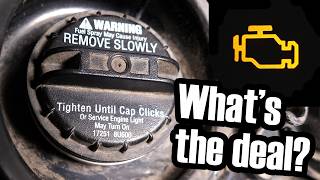
Today we'll be looking at the evaporative emissions system and why your car can tell that you forgot to put the gas cap back on. is carrying a box or canister just like this.
[00:29]
It's filled with the same activated carbon you might know from the filter or perhaps an air filter advertised as fighting odors. And it's there to solve an unsolvable problem.
[00:43]
but we also need that fuel tank to be completely sealed. heh, right.
[00:55]
That's embarrassing. Now you know I wore my PJs to the office. The fine folks at Good Store have done the incredible.
[01:09]
Artist Yvonne Tran created this design for last year's sock subscription, And now it's available for the rest of your legs!
[01:23]
These pajama bottoms use material that's on the lighter side, but super comfy, and they feature generous pockets like all pants ought to, pajama or not. you should check out the links in the description and pinned comment.
[01:39]
And of course, since it's a product of Good Store, to continue support for the Maternal Center of Excellence in Sierra Leone.
[01:51]
I've loved seeing the pictures you've sent me as these have arrived at your door. We are offering the Christmas Light Socks as a standalone purchase.
[02:07]
they are coming your way soon. these festive stockings make a great stocking stuffer. And we've got mystery socks as well,
[02:19]
some extra inventory from last year's project and it's yours if you want it. Now, sadly, we won't be doing another run of Technology Connections socks, sounds sufficiently satisfying, the Awesome Socks Club
[02:35]
The folks at Good Store wanted me to mention that because the Socks Club is returning to limited enrollment periods. but new signups are only available during certain parts of the year.
[02:48]
And they don't just have silly socks these days, These boxer briefs are awfully comfy. And don't forget we've got powdered dishwasher detergent
[03:03]
But remember these pajamas, as well as the Christmas light socks for the socks and undies clubs will close on the 15th of November,
[03:18]
Operators are standing by - I'm just kidding. And now back to the box full of charcoal. So liquid gasoline has this rather annoying habit of not staying liquid.
[03:37]
which will easily evaporate into a vapor. ...which is actually the reason it's so useful as a fuel for piston engines. burns so rapidly that it's practically an explosion
[03:53]
And because liquid gasoline evaporates we could use the simple carburetor to meter and deliver fuel to an engine.
[04:05]
if gasoline wasn't so easy to turn into vaporline. But its ease in evaporation is also a very big problem. unburned gasoline vapors are really, really nasty.
[04:22]
For one, they are a major contributor to atmospheric smog. which cause photochemical smog, but that's way too much effort. Basically, mixed sunlight with volatile organic compounds in the atmosphere,
[04:35]
And because gasoline is essentially let it touch the air and smog is going to happen. And if that's not bad enough, one of the constituent parts of gasoline is benzene,
[04:52]
which, fun fact is a known carcinogen. So gasoline vapors in the air we breathe are capital B Bad, It's the emission of an environmental pollutant
[05:07]
To prevent those emissions, we really want to make sure through a fuel injector and blow it up.
[05:20]
liquid gasoline from ever coming into contact with the atmosphere But if you've ever used a jerry can before, Thanks to the volatility of gasoline,
[05:35]
any sealed container containing it will become increasingly pressurized And if temperature goes down, that container can get all Now, you may not carry a jerry can with you, but every gasoline powered
[05:51]
car carries with it a container which is full of liquid gasoline: And if this tank becomes pressurized the car can start having a difficult time
[06:05]
and thus the engine may not run very well. So we actually can't seal it up But there's an even simpler reason we can't just seal it up.
[06:20]
The tank has to be vented in order for you to fill it with fuel. neck to the fuel tank isn't very large, so when you're refueling, there's going to be a full column
[06:33]
Unless the fuel tank is vented to let the air inside of it escape as the incoming fuel displaces it, and the fuel pump you're using will just keep clicking off
[06:48]
So we have this dual problem. We can't actually seal the fuel tank, so it has to be vented. But we also can't let any gasoline vapors escape through that vent.
[07:03]
The fuel tank itself does have a small vent on its top side, but instead that vent leads to a hose which leads to the box.
[07:16]
must go through that box, and the activated carbon it contains. Activated carbon has a ridiculously giant surface area,
[07:28]
which might come along with air as it leaves the tank, either during a fill up or as temperatures rise on a hot day. which allows your Brita pitcher to remove flavor altering contaminants from tap water.
[07:44]
It's just we're removing a single contaminant from the air, Or petrol for those who speak metric. eventually need replacement.
[07:58]
So if I just revealed a maintenance item nobody told you about? Unless something goes wrong. How is that possible?
[08:11]
it's holding on to back out of it and reset the filter Notice that there are three hoses coming out of the charcoal canister.
[08:25]
is what leads to the vent on top of the fuel tank. and thus contains the dirty air to be filtered by the canister. So in the scenario when you're filling the tank
[08:42]
as liquid gasoline displaces the air inside and forces it out, that dirty air enters the filter through the middle hose, gets filtered and then leaves the filter as clean air through the hose on the right.
[08:54]
That hose leads to a little nubbin stuck up into the car's bodywork, Which is important because there are times where the fuel tank will actually like when the weather cools off
[09:08]
But also because of the third hose. Well, it's hard to follow, but it leads all the way
[09:20]
The other end of that hose hooks up to this And it's called the purge valve. Under certain conditions, the engine computer will command that purge valve to open.
[09:36]
when the valve opens, the hose connected to it will be exposed to the negative pressure the engine creates as its pistons descend during the intake stroke.
[09:49]
and with the tubing now exposed to engine vacuum, the engine is going to start sucking air through that hose. the suction from the engine causes fresh atmospheric air to enter
[10:07]
and as that air flows backwards through all the activated carbon, it will actually remove the adsorbed gasoline vapors
[10:19]
which will then ingest those vapors and burn them. We force the fuel tank to breathe through this hose and thus this box of charcoal.
[10:33]
become trapped in the carbon and don't make it to the atmosphere. can only hold on to so much vaporous gasoline,
[10:46]
to engine vacuum through this hose. fresh air backwards through the filter which resets it, up to the engine where it will ingest them, burn them,
[11:03]
But this approach only works If purging doesn't happen, then the charcoal canister and thus will stop working.
[11:19]
So cars began to monitor the purge flow using various sensors, and would set an evaporative emissions system fault if it didn't detect enough flow. But we eventually realized that even with a working purge valve,
[11:34]
except for the canister vent is completely sealed up, If there's a hole in any of this tubing,
[11:46]
then gasoline vapors from the tank are able to bypass the charcoal canister altogether and will escape to the atmosphere. cars were given equipment to test
[11:58]
whether the fuel system is actually sealed or not. a very common and extremely clever arrangement of a second valve on the canister and a pressure sensor.
[12:14]
which monitors the pressure in the purge line. because the purge line is connected to the charcoal canister, But the electrical connector above the vent hose
[12:31]
And when the engine computer sends power to this valve, it shuts. I can tell the computer to close that valve with my scan tool. When the canister vent valve is closed,
[12:46]
the fuel tank is still vented to the charcoal canister through this hose, pressure, is blocked off and thus the fuel system actually does become completely sealed from the atmosphere.
[13:00]
And so if the engine computer commands the purge valve to open while the vent valve is closed, suction through this hose will cause the pressure inside the entire system, including the fuel tank
[13:13]
and the charcoal canister, to go into a partial vacuum. And that allows the system to check for leaks. In these scan tool recordings,
[13:26]
coming back from the pressure sensor which is slightly annoying, which revealed the vent valve data PID.
[13:39]
The blue line shows how far open the purge valve is, And the green line shows us the pressure in the purge line.
[13:51]
but you can see tiny little dips each time That's a result of the pressure dropping The service manual doesn't make it clear
[14:06]
to confirm proper operation of the purge valve, but older systems were doing flow checks similar to this. But now, watch the data PID for vent control valve.
[14:19]
as the normal condition is for the vent to be open. which does not require power from the computer. is sending power to the vent valve in order to shut it,
[14:35]
Now watch what happens. With the fuel system now sealed from the atmosphere, opening the purge valve causes a dramatic drop in pressure due to engine vacuum.
[14:50]
But then the computer closes the purge valve while keeping the vent valve shut. the system should hold this negative pressure And sure enough, that's what happens.
[15:06]
until the moment the vent control valve switched to off. there was a sudden increase in pressure as air rushed in.
[15:18]
And that happened because of that whole “liquid gasoline really doesn't like to stay liquid” thing. the higher its vapor pressure becomes.
[15:33]
Which is why the computer is also looking at a temperature sensor in the fuel tank. The reading it gets from that sensor will affect how it runs this test.
[15:45]
it expects to see more pressure rise than when it's really cold. So the test becomes more or less forgiving depending on temperature. than the current temperatures dictate it should,
[16:00]
P0442 for EVAP control system small leak detected or P0455 for EVAP control system gross leak detected.
[16:13]
because they indicate there's a problem. There could be a crack in a hose somewhere or a fitting which has failed, which will let vaporous gasoline escape into the atmosphere.
[16:26]
And as we've already established, this is not good. a giant hole in it so you can add more fuel. And that hole needs to be sealed just as well as everything else.
[16:41]
or a gas cap where the seal has gone bad Your car checks the evaporative emissions system And if, say, you forgot to put the gas cap back on,
[16:59]
Despite the vent valve being shut the pressure is not falling. so closing the vent valve ain't doin’ nothin’.
[17:15]
because there was a giant hole in the fuel tank the whole time! your car can't tell the difference between a leak from a bad gas cap
[17:27]
and a much more serious leak from a crack in one of these hoses, It knows the difference between a small leak and a large leak, some cars may even put a message somewhere saying
[17:43]
you forgot to tighten it, or even put it back, is the most likely reason for a large leak code to suddenly appear. It's just.
[17:57]
That's a really common place for an EVAP system leak. If your car if your car develops an evaporative emissions as a new gas cap or a good cleaning of the filler neck,
[18:12]
is there next to the purge valve. to check system pressure manually, which is useful But they can also hook up what's called a smoke machine to that port,
[18:29]
and it will slightly pressurize the entire system with smoky air. With the help of a scan tool to close the vent valve and keep the system sealed up, The smoke coming from the smoke machine will visually reveal where the leak is,
[18:44]
you're going to find something with smoke pouring out of it. Then fix that leak, and the next time the car runs its EVAP Oh, and remember when I said the charcoal canister
[18:58]
should last the life of the car unless something goes wrong? every gas pump out there warns you not to top up. The filler neck is at a much higher point than the fuel tank itself,
[19:13]
because the top of the fuel tank has a hole in it This isn't normally a problem because, as you can see, actually meets the fuel tank.
[19:29]
When refueling, once the fuel level in the tank gets above the top of that hose That's the slurping noise at the end of the fill up, and once it backs up to the nozzle, the fuel pump shuts off.
[19:43]
And then gravity will cause whatever fuel is left inside the filler neck Which means, thanks to gravity, And that's what topping up is.
[19:58]
little bits of fuel down there, so long as you don't go too fast and can potentially get another gallon or two into the tank. that liquid fuel ends up coming out of the fuel tank
[20:14]
you can flood the charcoal canister with liquid gasoline, which can destroy both it and the vent valve and the pressure sensor. But with today's gas prices, who'd even bother?
[20:30]
Oh, and if you've ever had a car suddenly become a pain to refuel, well, on rare occasions the vent valve can become stuck closed. Probably code P0448 for a stuck canister vent
[20:48]
It won't see that sudden release of vacuum pressure So it flags a trouble code. And that's because this means the charcoal canister can't be purged,
[21:01]
But the practical consequence for you is that with the fuel tank no longer vented at all, during refueling you'll run into constant filler neck backups, resulting in extremely slow
[21:16]
But anyway, that's kinda it. How many of you knew there was a box full of charcoal hanging under your car? that makes obvious sense once you puzzle through the why,
[21:32]
Like if I asked, “did you know that every zipper pull has the letters YKK on it?” The world doesn't work like that, and then you find out that it does.
[21:48]
Okay, well, thanks for watching. ♫ purgedly smooth jazz ♫
[22:01]
I love standing under my precarious lift. And since the charcoal anister, And so can youuuuuu
[22:17]
You can just keep squirting You can just keep squirting - whywha - so long as you don't!
[22:31]
little bits of fuel down there, so long as you gon’t do destroy - ah, farts!
[22:44]
Y’know, it wasn’t anything I meant to investigate, but I wonder if the ease of evaporation from liquid to gas is the thing behind “gasoline” I know about the connection to Vaseline, but maybe this is the answer to the bothersome “why call a liquid a GAS?” thing which irritates some of you who speak Metric. My car doesn’t, though :)