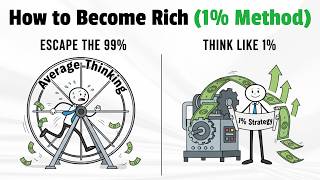

Define 'Rich' Before You Chase It
43sChallenges viewers to stop vague goal-setting and get specific about wealth, which is a counterintuitive first step.
▶ Play Clip"Delivers solid foundational wealth principles without exaggeration—title aligns well with content."
This video presents a wealth-building framework centered on mindset shifts, income capacity, leverage, and disciplined systems. It argues that true wealth starts with clarity of purpose and a transition from consumption to ownership thinking, emphasizing that skills, networks, and assets drive financial growth.
Wealth begins with defining what 'rich' means personally—financial freedom, net worth, time control, or assets—rather than chasing shortcuts or viral ideas.
Shift from buying things to building assets. Owners focus on creating systems that generate cash flow, skills that increase income, and networks that provide opportunities.
Before obsessing over investing, expand earning power through high-value skills like sales, negotiation, communication, financial literacy, marketing, or technical expertise.
Use systems, people, technology, or capital to multiply results without proportional effort. Shift from trading time for money to building mechanisms that work without active presence.
Wealth is built in boring, disciplined habits. Automate savings, invest regularly, control lifestyle inflation, and review financial goals monthly. Avoid trend-chasing and emotional decisions.
Risk management through emergency funds, insurance, diversification, and tax planning ensures wealth remains stable and growing over the long term.
By combining clarity, higher income capacity, leverage, disciplined systems, and patience, wealth becomes a predictable outcome of intentional behavior rather than luck.
What is the first step to becoming rich according to the video?
Define what 'rich' means to you personally (e.g., financial freedom, net worth, time control).
00:02
What does 'ownership thinking' involve?
Focusing on building assets, generating cash flow, and acquiring skill and networks.
00:46
Why should you increase income capacity before investing?
Saving a small income limits growth; expanding earning power through high-value skills raises your income ceiling.
01:29
What is leverage in wealth building?
Using systems, people, technology, or capital to multiply results without increasing effort.
02:25
What key habits maintain wealth growth?
Automated savings, regular investing, controlled lifestyle inflation, and monthly financial goal reviews.
03:27
What risk management tools are recommended?
Emergency funds, proper insurance, diversification, and tax planning.
04:18
Define Your 'Rich'
Emphasizes that vagueness leads to scattered effort; specificity is foundational.
00:02Skill Investment Over Early Investing
Challenges the common obsession with investing early, highlighting that income capacity is the real multiplier.
01:29Leverage: Active vs. Asset-based Income
Illustrates the critical shift from trading time to building systems that generate income passively.
02:56Compounding Disciplined Decisions
Reinforces that time multiplies consistent, boring actions more than any flashy strategy.
03:44[00:02] start with a lottery ticket, a viral idea, or some secret shortcut. It starts idea, or some secret shortcut. It starts with clarity. Most people say they want to be rich, but they cannot define what rich actually means to them. Is it
[00:16] financial freedom, a certain net worth, time control, or owning profitable assets? Until you define your target, your effort is scattered. Real wealth begins when you decide on a specific financial destination and align your
[00:32] daily actions with it. That means tracking your income, understanding your expenses, and knowing your current net worth without guessing. Wealth is built by people who measure reality honestly.
[00:46] consumption thinking to ownership thinking. Consumers focus on what to buy next. Owners focus on what to build next. Instead of asking what can I next. Instead of asking what can I afford, start asking what asset can I
[01:01] create or acquire. Assets generate cash flow. Skills generate income. Networks generate opportunities. When you invest in learning high value skills, building relationships, and creating systems that produce income
[01:17] beyond your time, you step onto the wealth path. Rich people are not lucky. They are intentional. They design their environment, habits, and goals around
[01:29] long-term growth instead of short-term pleasure. If you want to become rich in real life, you must increase your income capacity before you obsess over investing. Saving a small income can only take you so far. Expanding your
[01:43] earning power changes everything. Focus on developing skills that are valuable on developing skills that are valuable in the marketplace. sales, negotiation, communication, financial literacy, marketing, or technical expertise in a
[01:57] growing industry. These skills raise your income ceiling. The marketplace rewards value, not effort. You can work long hours and still struggle if your skills are average. Wealth grows faster when your value grows faster. Once your
[02:13] income increases, leverage becomes your next tool. Leverage means using systems, people, technology, or capital to multiply results without multiplying
[02:25] effort. Business owners use teams. Investors use capital. Content creators use platforms. Professionals use automation tools. Instead of trading one hour for $1, build mechanisms that produce income even when you are not
[02:41] actively working. This might mean starting a scalable business, investing in dividend paying assets, building intellectual property, or creating digital products. The goal is simple. Shift from active income only to a mix
[02:56] of active and assetbased income. When money starts working alongside you, not just because of you, wealth accumulation accelerates. Real wealth is not built in a dramatic moment. It is built in disciplined,
[03:11] boring consistency. The truth is that most people fail not because they lack consistency. Becoming rich requires a financial system, automated savings, regular investing, controlled lifestyle
[03:27] inflation, and clear financial goals reviewed monthly. If your income rises, but your spending rises at the same speed, you stay stuck. Wealth requires margin. That margin becomes investment fuel. Patience is your hidden advantage.
[03:44] Compounding works quietly but powerfully. Whether you invest in businesses, real estate, stocks, or your own education, time multiplies disciplined decisions. Avoid chasing every trend. Avoid emotional financial
[04:00] decisions. Instead, build a written strategy. Decide your asset allocation. Decide your risk tolerance. Decide how much you will reinvest. Review performance regularly and adjust intelligently, not emotionally. Finally,
[04:18] protect what you build. Risk management matters. Emergency funds, proper insurance, diversification, and tax planning all play a role in long-term wealth. Rich in real life means stable, growing, and protected. When you combine
[04:34] clarity, higher income capacity, leverage, disciplined systems, and long-term patience, wealth stops being a dream and becomes a predictable outcome dream and becomes a predictable outcome of your behavior. Here.

⚡ Saved you 0h 04m reading this? Transcribe any YouTube video for free — no signup needed.