
The Power of Suggestion: Mind Control for Content
44sThe psychological concept of 'power of suggestion' is intriguing and counterintuitive, promising a secret to building obsessive audiences.
▶ Play Clip"Delivers a solid, structured framework on the power of suggestion, though it's padded with self-promotion and repetitive summaries."
This video explains the psychological concept of the power of suggestion and how content creators can use it to build deeply loyal, 'obsessed' audiences. The speaker outlines a three-level framework—signal, belief, and action—each with specific tactics to subtly influence viewers without direct persuasion.
The power of suggestion is the idea that certain words can implant thoughts, feelings, and beliefs in viewers' minds without them noticing. It allows you to influence someone indirectly, bypassing their natural defenses.
When people come to conclusions on their own, they trust you much faster. This is compared to the movie Inception, where ideas are planted in dreams to influence behavior.
Level one is about producing content that is higher signal than everyone else in your category. High signal means viewers consistently feel their time was well spent. This is achieved by being relevant, non-obvious, and validated.
1) Content must be precisely on target for the ideal viewer. 2) The main idea must be non-obvious and novel. 3) Ideas must be validated with proof and data.
Level two is about changing the viewer's fundamental beliefs. This is done by presenting a contrasting frame (before/after), using a relatable character, and framing the journey as small effort for large reward.
Level three is about getting the viewer to take action and experience a real result. This requires quantitative proof of the result and tactically implementable steps. The suggestion must be indirect—show, don't command.
Across all three levels, five components are essential: relevant/relatable, small effort/large reward, non-obvious, validated with proof, and tactically implementable steps. These act as a checklist for every piece of content.
By mastering the power of suggestion and consistently applying the five elements, creators can build audiences that are not just viewers but obsessed followers who trust them implicitly and take action. This transforms content into a form of 'mind control' that viewers never realize is happening.
What is the power of suggestion?
The power of suggestion is an idea that certain words can implant thoughts, feelings, and beliefs inside of viewers' heads without them even noticing.
00:42
Why does the power of suggestion work so well?
When people come to conclusions on their own, they trust you much faster.
02:02
What are the three levels of obsession?
Level 1: Signal layer, Level 2: Belief layer, Level 3: Action layer.
02:31
What are the three factors for high signal content?
1) Content must be precisely on target for the ideal viewer. 2) The main idea must be non-obvious and novel. 3) Ideas must be validated with proof and data.
05:22
How do you change a viewer's beliefs?
By presenting a contrasting frame (before/after), using a relatable character, and framing the journey as small effort for large reward.
09:59
What is the key to level three obsession?
Getting the viewer to take action and experience a real result, using quantitative proof and tactically implementable steps.
13:27
What are the five universal elements for content?
Relevant/relatable, small effort/large reward, non-obvious, validated with proof, and tactically implementable steps.
18:26
Trust through self-discovery
Explains the core psychological mechanism: people trust conclusions they arrive at themselves.
02:02High signal factors
Provides actionable criteria for creating content that stands out.
05:22Belief change tactics
Details specific methods to shift viewer beliefs, a key to building loyalty.
09:59Action layer importance
Emphasizes that real obsession comes from viewers taking action and getting results.
13:27Five universal elements
Synthesizes the entire framework into a simple checklist for creators.
18:26[00:01] that's truly obsessed with everything you make, there's one psychological trick that beats everything else. It's called the power of suggestion. And if concept and how to use it in your content, you will become a master of
[00:16] personal brand building overnight. Now, I know this works because content is all followers, I've done billions of views, and I've spent years studying how to use psychology to build cult audiences that keep coming back. So, in this video, I'm
[00:30] going to break down the power of suggestion, how it works, why it works so well, and how you can use it tactically in your content to build an S-tier audience that's obsessed. First, let's just define what the power of
[00:42] suggestion actually means. It's very simple. The power of suggestion is an idea that certain words can implant thoughts, feelings, and beliefs inside of viewers' head without them even noticing. Think of it like a persuasion
[00:55] someone directly, they often have a guard up, and so your messaging suggestion allows you to go around their them even knowing it. For example, if I
[01:08] I was being super direct, I might say something like, "I'm the best in the system is broken. Here's mine, you should buy it." But that comes off as brash, overly salesy, and way too bragadocious. So, most people will hear
[01:22] that, but then they'll dismiss it and not trust me. Instead, I could use content to approach selling in a more indirect way, where I say something closer to this. These are the five best content strategies I used to grow these
[01:34] businesses to over 20 million a year last year. After hearing those and the explanation that goes with it, viewers may arrive at the same conclusion that I am one of the best at content, that their system is broken, that I do have
[01:46] it. But they came to that conclusion without me needing to say it. This is a difference. The power of suggestion allows you to influence someone without them to believe. And the reason this is so powerful is because it turns out when
[02:02] people come to conclusions on their own, they trust you much faster. This is from. Now, the best proxy for how this works is the movie Inception. In the movie, the main characters go deep into other people's brains to implant ideas
[02:17] this because they're trying to change the way they think and influence their here, except that instead of trying to influence dreams, we're using content to subtly build trust as the viewer watches our videos. Now, there are three
[02:31] these bank shots, the power of suggestion, in your content. And each one maps to a different level of how obsessed the viewer will get. I call Level one is the weakest all the way up to level three, which is the strongest.
[02:47] level three obsession, they will most likely watch and buy literally anything nerdy, but this whole framework is really why certain personal brands are able to build such obsessive fan bases so quickly. It's all because of the
[03:02] power of suggestion. So, for the rest of this video, I'm going to explain those the way you can use the power of suggestion to get viewers into them. By breaking these things down, I also built a similar guide with psychology and
[03:17] strategy about my entire content system. It breaks down how I come up with ideas, how I write hooks, how I do research, as well as how I monetize and go from view want to grab it, you can get it at the link shortformsystem.co,
[03:31] dive into the framework. These are the three levels of obsession explained. The first level is called the signal layer. And this one is the easiest to tap into. you implement what I say, should be able to get some of your viewers into level
[03:46] one in the next 30 days. In level one, all you have to do is produce content that is higher signal than everyone else in your category. And here's what I mean by high signal. How often does a viewer leave your video thinking it was worth
[03:59] their time having watched it? Let's say you make 100 piece of content, and 30 of them are valuable for the viewer. That is a 30 to 70 signal-to-noise ratio. Or in other words, 30% of the time, your videos are high signal. The higher that
[04:13] consistently valuable your videos are, the more obsessed the viewer will get. the easiest because all you have to do is achieve this high signal. And you do that by sharing information the viewer thinks is valuable. In this case, the
[04:27] suggestion part is invisible. You don't actually have to implant any thoughts in the sheer fact that you're more valuable more often will get them to start it. If I asked you right now who your favorite creator or personal brand was
[04:43] in your niche, who comes to mind? For me, it's maybe someone like Hormozi or Daniel Dayley. For most of us, the reason those names pop into your mind is because those people are more consistently higher signal. More often,
[04:55] from it. And I know this sounds obvious for level one. You don't have to do any level two and three, you'll realize how make sense in the structure. So, level one obsession is the easiest. All you
[05:08] consistently higher signal compared to everyone else in your niche. So, the if we want our content to be high signal, what does that actually mean? What do we have to do or put in our content to make it valuable? There are
[05:22] content if you want it to come off as higher signal. The first one is obvious, I know it sounds too simplistic, but so many people get this wrong, it's worth repeating over and over. Your content has to be precisely on target for the
[05:37] person that's watching it. Not kind of related, not broadly related, it has to them. You need to pick topics that specifically apply to your ideal viewer. Now, the second factor to making content high signal is that the main idea you
[05:51] cover has to be non-obvious. And this is the hard one. It's the one that versus people who build obsessed audiences. High signal does not come that other people say with just different editing. It comes from
[06:06] creative, outside-the-box ideas, combining two things that don't typically go together. Creativity is just the merging of two worlds that typically don't collide. So, if you're recycling the same ideas from other
[06:18] views, but you're never going to build an obsessive audience because your stuff is not non-obvious. This is the factor most people miss. In the world of AI content, the only stuff that will cut through is the non-obvious, novel, and
[06:31] unique. So, if you want more non-obvious ideas, you need to spend time consuming stuff outside of your category. Go to tangential niches or completely unrelated niches. See what's working over there, and then collide it with a
[06:43] already understand. That's where creativity comes from. The third factor in creating high signal content is that your ideas need to be validated. The high signal comes from stuff that viewers can verify to be true and proven
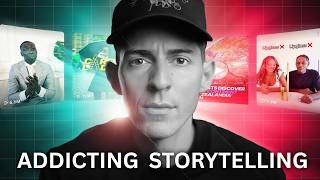
[06:56] to be effective. Now, here's an example of a piece of content I made that was specifically designed for level one obsession. A few months ago, I invented and broke down how it works. It's a six-step psychology framework for how to
[07:09] capture and hold attention through storytelling. Now, this video is pure level one obsession content. It's on target for my ideal viewer. It's about storytelling. It's non-obvious and novel. The dopamine ladders framework is
[07:21] something that I came up with, and it's validated with data. I use examples and metrics to justify each step in the framework. After watching this video, the viewer will have learned a framework they hadn't heard before, fully
[07:33] understand and absorb it, and walk away feeling like their time was well spent. That is all you need to do in your content consistently to build level one obsession. Now, this is important. In the video, I never once said I'm the
[07:45] storytelling from. But after watching it, that's exactly how most viewers would feel. This is the invisible power of suggestion at work in level one. So, to summarize, if you want to get started making viewers obsessed and get them to
[07:58] level one, these are the exact tactics you need to have in all pieces of content that you make. At a high level, you have to produce more high signal space. [music] And at a low level, these three things is what makes up high
[08:10] signal. Number one, all your topics have to be super relevant to your ideal viewer. Number two, your videos have to be built around a non-obvious or novel And number three, whatever you're claiming needs to be validated with
[08:24] proof to justify why they should trust you. Those three things should be the create moving forward. This will get you to level one. All right, level two obsession is called the belief layer. Where level one is simply about making
[08:37] high signal content, level two is about actually changing the beliefs in the away from your content having changed their beliefs for the better, then they will start becoming level two obsessed. Now, what does it actually mean to
[08:51] change someone's beliefs? It means that before they watched your video, they then after they watched your video, they thought about it completely differently. wrong, but because you introduced a new way of thinking that they can't unsee.
[09:06] suggestion really starts to kick in. Remember that bank shot framework where you're kind of going around their blocker? Well, level one, that bank shot you had to do is make good content, and they would go around the blocker for
[09:19] you. But in level two, you're actually intentionally planting something in their mind. And the effect is as if you went in their dreams and changed their this consistently, it is way more
[09:31] really where rapid fandom starts being built. Because when someone just learns smart, they like you. But if you can change how they fundamentally believe, completely different level. And every time they think of this new belief, they
[09:45] will associate it with you and give you the credit. So, how do you actually do content that literally changes the beliefs inside someone's head things you can do in your content to make this belief shift happen more
[09:59] present your information with a contrasting frame. And this typically comes from comparing two situations. Then versus now, A versus B. The viewer's current situation is the before and then you frame what the after could
[10:14] and should look like. Framing your points in a relative sense, comparing old versus new, is the easiest way to lock in behavior change. For example, let's say I wanted to change your eating habits. If I just said, "You need to eat
[10:26] 200 g of protein per day." It would have a pretty limited effect. Very few people would stick with that. But if I framed that point by showing what one person looks like when they eat 100 g of protein like you are now versus what
[10:38] they could look like if they eat 200, that same visual, that would have a huge effect in changing someone's belief. This then implants in the viewer's mind that if they were to make that behavior change, their belief is that the outcome
[10:51] need in your content to make this belief change happen is to deliver the message by a relatable character. The viewer needs to see someone that looks like them who started where they started and then ended up where they want to go.
[11:04] actually land. Because when you introduce a transformation that happens to someone that's unrelatable, they'll often dismiss it. But when it happens to can't help but say, "Well, if they could do it, I could do it, too." And that's
[11:17] third factor to incorporate in your content that would drive a belief change is by framing your points with a small cost and a large reward. If the path from where the viewer is today versus where they want to go looks like years
[11:32] chances are they're not going to believe that they can get the result. But if you can frame their journey as a surprisingly low amount of effort to get a huge perceived result, well, they'll start to accept that their belief might
[11:44] change. Now, here's an example of another video for me that was positioned as level two obsession. I specifically picked this so that I could try to shift beliefs. A few months ago, I made this video about how I went from zero to 100k
[11:56] on YouTube in just 5 months. Now, this video is pure level two obsession. First of all, it has a contrasting frame. Most people assume YouTube takes years, but I challenge that assumption by offering a scenario where I did it in 5 months.
[12:08] It's also being delivered by a relatable character, which is me. I started at zero in 2024 and then 5 months later, I hit the goal. And it frames the journey as a small input to get a large perceived result. Just 5 months of
[12:20] effort to get 100,000 subscribers. Now, my goal was that after watching this video, viewers weren't just walking away with YouTube tips. They would walk away with the belief that fast growth on YouTube was possible. I wanted their
[12:32] internal model for the upper bound of speed to expand. And here's the key. I never once said, "You should believe you can grow faster." I never argued with just showed them my story, walked them through the timeline, and then let them
[12:46] arrive at the new belief on their own. This is the indirect power of suggestion at work in level two. So, to summarize, if you want viewers to get past level one and into level two obsession, your content needs to change their
[12:58] fundamental beliefs. And you do that by making sure your content has these three things. One is a contrasting frame that pits their current situation against the relatable character that has already gone through the journey that they can
[13:12] transformation that has a small perceived effort for a large perceived and over, the viewer doesn't just think you're valuable, they believe it implicitly. Because you changed the way they see the world and they feel like
[13:27] if you think that's powerful, wait until you hear level three. Level three obsession is the action layer and this is the highest level of obsession a about making high signal content and level two is about changing the viewer's
[13:41] beliefs, level three is about getting the viewer to actually take action and experience a real result. If watching your content compels them to go out and do something that they've wanted to do but haven't been able to, that is what
[13:54] Now, here's what makes level three tricky. You might think all you have to do is just go out and tell them what to do. Give them a step-by-step, be super actually breaks the whole power of suggestion framework and it turns out
[14:08] most people don't do what you tell them. Because remember, suggestion is when the viewer arrives at the conclusion on their own. That's the magic sauce when content influences passively. The moment you start commanding them to do
[14:21] like homework, and they don't want to take the action. So, in level three, the suggestion in your content also has to be a bank shot. You're not telling them that is so overwhelming that if all they do is replicate it, they might achieve
[14:35] the same result. The viewer watches your content, sees the evidence, and then And when you do this, they end up walking away from your content with the sense. I'd be stupid not to try that." And when they go out and try it and
[14:49] looking for the whole time, that is when the deepest level of obsession actually you're not just somebody that taught them something. You're not just somebody that changed the way they think, you're the person that influenced the action
[15:03] So, how do you create level three content that [music] subliminally bank shots them into taking action? There's only two factors that really matter. The first one is that you need quantitative proof of the result that they want. This
[15:17] is the most important thing. Not vague metrics, not broad claims like this will work, specific actionable defendable stats proving that whatever your concept teaching growth strategy, don't just say, "This will help you grow faster."
[15:32] Show them how this exact strategy helped somebody grow from two to 15,000 followers in 6 weeks. Give them the specific data mapping to that specific result. Because when the viewer sees hard proof attached with specific
[15:46] numbers, it removes all ambiguity. They won't have to wonder if their action and effort will get the result. This proves that it will. And that is what will nudge them towards action. The second factor that really helps is to share
[15:58] This means broken down steps to the not focus on your hooks and you'll be good. Specific actionable steps that they cannot mess up. Now, this isn't telling them what to do, it's using data
[16:12] and then showing them what you did so they can connect the result to the because all they do is teach at a strategy level and they don't actually Or they're afraid of giving away the secret sauce that makes their paid stuff
[16:27] valuable. But here's the thing, the more granular and tactical your steps are, if accompanied by data, the easier they are to follow to get someone the result. And when they come back and become obsessed. Think about it. If you've ever watched
[16:40] probably been able to take some of the recommendations, use them, and then get the result in the content world that you were looking for. I see this all the grew from two to 20k subscribers just by watching your videos." Or "I got
[16:54] millions of views just by following your frameworks." This is level three content from me and I'm doing that on purpose. I'm giving the roadmap on purpose so know as soon as someone takes their first action and gets the result they
[17:07] want, they become level three obsessed with me and keep coming back over and over. Now, here's an example of content I made that is level three obsession content. I made this video breaking down exactly how to write a YouTube script.
[17:20] Now, this is pure level three. It has quantitative proof with a bunch of stats that map to all the things I'm saying and it has the step-by-step tactical workflow that I personally use to get those results. Now, my goal was that
[17:33] wouldn't just think, "Oh, that was valuable." Or "Oh, I see it now." But that they could actually apply, take action, get result, and then attribute commanded, "You need to go rewrite your scripts right now." All I did was show
[17:48] my tactical framework, show the results I got, and let them complete the puzzle on their own. That is the power of suggestion at work in level three. The proof suggests action, the action creates results, and the results drives
[18:00] to get your viewers to the highest level obsession, level three, you need to make content that drives them to take actual action. And you do that by making sure your content has qualitative defendable proof and the tactically implementable
[18:13] steps that got to that proof. When you nail these, the viewer doesn't just think they're valuable, they associate you as being the one that got them the deepest form of obsession there is. All right, so before we end this video,
[18:26] action steps are super, super clear. if you zoom out and see all three levels of obsession, there are really five components across all three that you need to include in all your content. If
[18:39] five, you will get through that obsession ladder faster than everyone else. Think of these like the universal inputs for the power of suggestion. The beginning, is that your content needs to be relevant and relatable to your ideal
[18:53] three levels. If you feel like the topic is not relevant, then you shouldn't make that video because you will not have someone accrue obsession. Now, here's to avoid it. Most people pick topics that are way too broad. They kind of
[19:07] also apply to lots of others cuz they're chasing views. The fix here is very simple. Narrow your topic coverage all the way down. Because the more specific viewer, the more it will feel like you're reading their mind. And that
[19:21] feeling is the first layer of suggestion. Now, the second element your content must have is that it must feel like small effort for large reward. And level three. The viewer needs to believe that the gap between where they are
[19:34] today and where they want to go is manageable to cross. If your content complicated and hard to achieve, they'll on it. Now, here's where most people mess this up and even I am a victim of
[19:46] this sometimes. We frame our solutions as overly complex because we think complex equals valuable. But the truth is, it's actually the opposite. When the completely. It's simplicity that gets someone to actually take the action and
[20:00] then associate that result with you. The fix is to simplify your solution all the way down in a way that the most possible people can take the action. Now, the want to ascend this ladder, is that your ideas have to be non-obvious. This is
[20:13] probably the hardest one. It's the key differentiator in level one and level two. Non-obvious ideas create obsessive audiences. Tattoo that to your head. If everyone else in your niche, you are just a regurgitated voice. You might get
[20:27] views, you might get followers, you have no real obsessive audience potential. If you want to fix this and you want to actually be novel, spend time outside your niche. Collide two things that don't typically go together and you will
[20:41] become more unique. This video is a perfect example. The power of suggestion is a psychology concept, a deep deep psychology concept. I'm bringing it and colliding it with content growth. That makes something new, non-obvious, and
[20:54] content is that your ideas need to be validated with proof. This showed up in both level one as what makes your signal trustworthy and level three as what makes the action worth taking. Without proof, you're just another person with
[21:08] source of truth. Now, here's where most people mess this up. They just share frameworks and strategies that don't have any data to validate their reality. The fix is to first get the proof, then make the content based on the proof, not
[21:21] final element for your content is that you need to have tactically implementable steps. And this was obviously the core driver of level three. If a viewer can't take the steps to get the result you showed, they're
[21:33] action. When you do this effectively, the viewer doesn't just consume their content, they actually get a result because of it. And that's where they get full framework. Five elements every piece of content you make from now on
[21:46] should have all five of these. Use this as a checklist. Relevant and relatable to the viewer, small effort, big reward, non-obvious frame, validated with proof, steps. Now, here's the thing. The creators that build the most powerful
[21:59] personal brands, the ones with truly obsessed audiences, they hit all five of those in every piece of content. When you do that, the power of suggestion is working in all three ways all the time. The viewer learns stuff they didn't
[22:12] previously know, their belief shift, and they're compelled to take action. At that point, your content isn't content anymore. It's literal mind control. You act. And the best part is, the viewer will never realize it's happening.
[22:25] mind that whenever they see your face and watch your stuff, good things happen and they'll keep doing it. And that is the power of suggestion. All right, video. We got a little nerdy on this one. Every four or five videos, I like
[22:38] to go super deep on a psychology concept that nobody's covering. Hopefully, this gave you tactics and suggestions for how to tweak your content to kind of build more of this obsessive nature. As always, if you're a business owner
[22:50] trying to learn how to use content, how to build content systems, how to get free, this will be the best channel that you ever follow. Please make sure to videos. I'm doing everything I can to really give you the non-obvious sauce
[23:04] mentioned earlier, if you want my entire content system, everything from ideas, how I write hooks, how I do my research, all the way through my monetization funnels, literally turning views into dollars, I just posted that for free.
[23:17] shortformsytem.co, you can get it for free at the link below. If you have any them in the comments. We use the comments to inform our next video, so if there. All right, we will see you guys on the next one. Peace.


⚡ Saved you 0h 23m reading this? Transcribe any YouTube video for free — no signup needed.