From Zero to 620K Followers: My Start
45sThe creator's impressive follower counts and organic growth story instantly grab attention, making viewers want to learn the secret.
▶ Play Clip"Delivers a solid, actionable framework that matches the title's promise, with only minor padding."
The video presents a four-part framework for building a personal brand, based on the creator's experience growing a following of over 620,000 on LinkedIn and 190,000 on Instagram. It emphasizes an emergent, audience-first approach over a deliberate, plan-first strategy, and provides four questions to help viewers identify their own positioning.
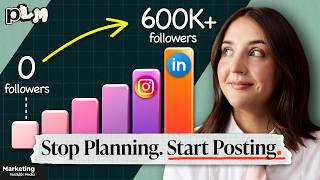
Started posting about marketing in 2020 as a second-year student without a positioning statement or niche. Now has 620,000 LinkedIn followers, 190,000 Instagram followers, 20,000 newsletter readers, and 600 paying community members, all built organically without ads.
Positioning is what you want to be known for and who you want to be useful to. It is not your color palette, bio, or tone of voice. It is a decision you make deliberately or the internet makes for you based on what you post.
Two ways to build a personal brand: plan everything first (deliberate) or start publishing and figure it out as you go (emergent). The creator used the emergent approach, publishing, watching what worked, and getting clearer over time. This concept comes from Henry Mintzberg.
Writing a strategy down early makes you defend it and stop adjusting. Publishing first turns every post into a mini test, revealing which ideas get quoted, saved, or turned into DMs.
The framework consists of four questions: 1) Subject - what could you talk about repeatedly? 2) Argument - what do you believe that a reasonable person would disagree with? 3) Mission - what are you trying to change or help people do? 4) Audience signals - who is responding and what are they telling you you're useful for?
Look at your saved folder, search history, and open tabs. What do colleagues come to you about? Can you write 50 posts on it without repeating yourself? Can you name the person who'd stop scrolling for it? If not, the topic is too broad.
The subject gets you started, but the opinion you keep coming back to makes you distinctive. It must be something a reasonable person could disagree with; otherwise, it's a description, not a position. The creator's opinion is that most marketing is noise.
An opinion doesn't tell you what to make, but a mission does. The creator's mission is to make marketing simple and accessible so people can tell the difference between what matters and what's noise. It doesn't need to be public but must be true and specific enough to say no with.
Likes are the easiest to give and tell you almost nothing. The signals that matter are saves, shares, quotes, and DMs. Look for the repeat: one post doing well is a fluke, but the same theme landing three or four times is a signal to build on.
When you have no audience, start with what excites you. Look at your own behavior as a consumer: what makes you stop and comment or repost? Treat thoughtful DMs as gold; one thoughtful DM tells you more than 100 passive likes.
The creator spent too long trying to cover everything, worried that getting specific would shrink the audience. The lesson: if you're speaking to everyone, you're speaking to no one. Being early is when you can afford to test because no one is watching yet.
Personal branding isn't a document you write once and follow. It's a practice you keep rerunning as you change. The direction was deliberate, but the definition was emergent: the creator picked the lens, and hundreds of thousands of people told them what it was good for.
Positioning is not a one-time document but an ongoing practice of testing, learning, and adjusting based on audience feedback. The four-question framework helps you identify your subject, argument, mission, and audience signals to build a personal brand that evolves with you.
Positioning is a decision
Clarifies that positioning is a deliberate choice, not a set of aesthetic or tonal elements, which is a common misconception.
00:50Emergent strategy for creators
Introduces Mintzberg's concept to personal branding, showing that publishing first and learning as you go can be more effective than planning everything upfront.
02:40Writing a strategy early is a trap
Highlights the psychological pitfall of committing to a plan before receiving any audience feedback, which can stifle adaptation.
03:53Meaningful audience signals
Provides a practical method for reading feedback by focusing on costly actions like saves, shares, and DMs rather than passive likes.
08:54Speaking to everyone is speaking to no one
A memorable, quotable principle that underscores the importance of specificity in personal branding.
11:18[00:00] When I started posting about marketing in 2020, I didn't have a positioning statement and I didn't have a niche mapped out. I was a secondyear student sharing what I was learning. Today, that's grown into 620,000 followers on LinkedIn, 190,000 on Instagram, 20,000 newsletter readers,
[00:18] and 600 paying members of my marketing community. All built completely organically without ads. But to. I built it the way creators do, and that difference is the whole reason it worked. This
[00:34] is part one of a four-part series where I break down exactly how I've built my personal brand. Let's start with the word everybody uses and almost nobody defines, which is positioning. So,
[00:50] what does it really mean? Positioning is what you want to be known for and who you want to be useful to. It isn't your color palette. It isn't your bio and it's not your tone of voice document. It's a decision and you either make it deliberately or the internet makes it
[01:07] for you based on whatever you happen to post. This is where a lot of personal brand advice gets it backwards. We're told to figure out exactly who we are. Choose a niche, write the perfect positioning statement, and then start publishing. But if you want to win
[01:23] on the internet, it has to be the other way around. The audience comes first and your positioning is the reason they stay. Being known for one thing is what makes you findable, recommendable, and worth following. Here's what we'll go through. First,
[01:38] the difference between how creators build a brand versus how marketers approach it. Then, the exact framework that built my personal brand and changed my life. And I've turned those four questions into a worksheet you can use to build yours, too. You can find it in the link in the description.
[01:57] There are two ways to build a personal brand. You can plan it all out fast or you can start moving and figure it out as you go. At uni, I was taught the fast way and I was taught it strictly.
[02:10] Marketing was corporate and transactional. You plan before you're allowed to touch anything. And the whole point of a personal brand was to land you a job. I think that's still the version most people are taught. You think, you define, and then you execute, planning it on paper before you go
[02:27] off and do it. The way I built my personal brand went the other way entirely. I published, watch what worked, and got clearer about what I should be known for as I went. There's a name for that
[02:40] difference, and it comes from Henry Mintbug. It's called the deliberate versus emergent strategy. A deliberate strategy is planned up front. You set the intention in detail and then you execute it as
[02:53] intended. It's how a campaign works and it's the right call when you already know the destination. An e margin strategy is a pattern that forms over time. One you didn't expressly intend when you
[03:06] started. You act. You notice what's landing and the strategy is then shaped by that. Mintberg's point is that deliberate strategy gives you direction but emergent strategy is how you learn what works in practice. Deliberate is writing, "I'm the go-to person for B2B email marketing
[03:24] in your notes app in week one, then forcing every post to fit it." Imagine is posting about email, social, careers, and copywriting for 3 months, seeing that the email posts are the ones that
[03:36] people save and share and only then calling yourself the email person. A marketer fast personal brand is deliberate where you think fast and then do. But a creator fast personal brand is a margin where you do fast and the thinking happens live. The moment you start
[03:53] writing a strategy down, you start defending it. You stop adjusting because changing course now means admitting you were wrong. That's a trap of writing your personal brand document in month one
[04:06] because you've locked yourself into a version of you that you invented before a single person responded to you. Publishing first means every post becomes a mini testing oneonone. You find out which idea gets quoted back to you, which one gets saved, and which one gets turned into a DM.
[04:22] The positioning that comes out of that describes something real rather than something you get. So, let's move on to the framework because if a statement isn't the starting point, what is?
[04:36] I have four questions for you. Answer them as you go and by the end of this video you'll be able to identify your positioning rather than having it written fast. The first question is around your
[04:49] subject. What could you talk about repeatedly without running out of things to say? Look at your saved folder, your search history, and the tabs that you've got open. What's the thing that colleagues come to you about? What is the topic that you're sending your friends links about at
[05:06] 11 at night? That is your short list. Could you write 50 posts on it without repeating yourself? And can you name the person who'd stop scrolling for it? If you can't picture them, the topic is too broad. Because a topic only becomes positioning once it's a specific
[05:22] person on the other end of it. For me, that was marketing. In 2020, I was a secondyear university student studying marketing, advertising, and branding. I was job hunting into a pandemic
[05:34] and the space I wanted to learn in didn't exist yet. So in June that year, I started an Instagram page about what I was learning, not about what I already knew. In January the following year, I moved it across to LinkedIn as graduation loomed and the job search got real. That's
[05:50] the part that gives you permission to start. Now, you don't need to be qualified enough to publish. You don't need to be interesting enough to keep going while nobody's watching because nobody's watching for a while. My first year got me to around 40,000 followers on LinkedIn and 25,000 on
[06:07] Instagram. And that felt huge, but it built slowly from zero. Now, notice that this is the creator move, not the marketer one. A marketer would have researched the niche and written down the plan, whereas I just started publishing. Question two is all about your argument. What do you believe about
[06:25] that subject that a reasonable person would disagree with? The subject gets you started, but it doesn't make you distinctive because plenty of people post about marketing. What makes you distinctive is the opinion you keep coming back to without meaning to. It's the argument you'd have
[06:42] at dinner, in the comments, or in a meeting, and the one you'd defend if somebody pushed back. It has to be something a reasonable person could disagree with. Because if nobody could argue, then it isn't a position, it's a description. My opinion is that most of marketing is noise. That
[06:59] the foundations are the part that matters and that you should be very critical of nearly everything you see online. Everything I write, teach, and do goes through that lens. So, when a trend blows up,
[07:12] my first question isn't how do I use this? It's whether it matters at all. And my opinion isn't my content calendar. I don't make posts about how most of marketing is noise. I put everything else
[07:24] through that filter. So, I cover the same platform updates and campaigns and trends as everyone else, but it's my angle that's different. Question number three is, what is your mission? What are
[07:37] you trying to change or help people do? An opinion is the thing you believe and it doesn't tell you what to make, but a mission does. And that is the version you can build a whole content plan on top of, which is where we're going in episode two. My mission is to make marketing simple and
[07:54] accessible so people can tell the difference between what matters and what's noise. It's never been on a website or in a bio. And it doesn't need to be public, but it does need to be true and specific enough to say no with. Here is what that sounds like in practice. For years,
[08:12] everybody said that short form video was the only way to grow. And I didn't chase it. Most of my content and most of my business is still carousels and writing because that's what makes marketing simple for the people I'm talking to. The mission chose the format for me rather than
[08:28] letting the trend decide. And our final question, what are our audience signals? Who's responding and what are they telling you you're useful for? You pick the direction, but your audience sharpens
[08:42] the definition. Audience signal is the feedback the internet hands you every time you press post. And once you can read it, you can stop guessing and start following what's already working. So,
[08:54] what counts as a signal? Now, it's not likes because likes are the easiest thing to give and they tell you almost nothing. The signals that matter are the ones that cost people something.
[09:06] What gets saved because somebody wanted to keep it? What gets shared because someone wanted to be seen next to it? What gets quoted back to you weeks later because it's stuck and it turned into language they use? And what lands in your DMs because it hit a nerve and they wanted to tell
[09:22] you about it privately. Watch for the topic that keeps pulling those reactions and the specific thing people start coming to you for. That's your audience telling you what you're useful for. How do you tell what to lean into? Well, you look for the repeat. One post doing well is a fluke and
[09:39] chasing it will send you around in circles. The same theme landing three four times is a signal and that is the one that you build on. The sweet spot is the overlap between what you actually want to keep making and what keeps landing because that's what you can sustain once the novelty of
[09:55] posting wears off. But what if you're early and you have no audience and no feedback yet? Well, the signal is quieter, but it's still there. You just need to read a different one. Start
[10:07] with what excites you, the topic you can't stop making things about, even when it's getting five views. Then look at your own space as the reader because you're a consumer before you're a creator.
[10:19] What makes you stop and comment? What topics get you excited? What do you feel compelled to repost? The posts that pull that out of you are showing you what works and you already have that instinct before you're on the other side of it. Then treat your real responses as gold because one
[10:35] thoughtful DM from a stranger tells you more than 100 passive likes ever will. That's how I started watching what I was drawn to and others and which of my own posts quietly got saved. The
[10:47] strategy only sharpened later once there were enough people responding to see a pattern. My audience went from students to graduates to working marketers to a paid community and a business. So, who I was talking to changed every few years. But what never changed was
[11:03] the mission underneath it. Making marketing simple and cutting through the noise. And that's the reason I didn't have to start again from zero each time. My audience was never my positioning. My point of view was. That's the difference between choosing a niche,
[11:18] which is just picking a topic, and developing a point of view you can carry across any audience. Here's where you're expecting the big mistake. The decision I'd rebar if I could start over,
[11:32] and there is one. I spent too long trying to cover everything, worried that if I got specific, I would shrink my audience. And it took me a while to trust if you're speaking to everyone,
[11:45] you are speaking to no one. The thing I would tell myself is that being early is when you can afford to test because no one's watching yet. Once you've got followers and a brand people recognize, testing gets harder and you've got expectations to manage. With no eyes on you,
[12:02] there's nothing to protect. So you can experiment properly and get as specific as you can without boxing yourself in. The rest I wouldn't change and not because it was perfect because it definitely
[12:14] wasn't. It's because I don't think positioning is a job you ever finish. Over the last year my identity has shifted again from something like a thought leader to an entrepreneur and I'm walking the whole thing out all over again. I still get lost in the writing and
[12:30] the publishing and even running through these four questions today. I can see my own answers moving and a clearer path showing up as I go. So that's my lesson for you. Personal branding isn't a document you write once and follow. It's a practice you keep rerunning as
[12:46] you change. Look back at where we started with deliberate versus emergent and you'll see the direction was deliberate and the definition was emergent. I picked the lens, and a few
[12:58] hundred,000 people told me what it was good for. So, if you've been answering along, you should have four things. Your subject, your argument inside it, the mission you're building on,
[13:11] and a way to read what your audience tells you and adjust as they change. That's your positioning. It's maybe not the comm's document you're used to as a marketer, but it's got me this far,
[13:23] and I think it will help you, too. I've built a positioning statement worksheet with HubSpot that walks through those same questions so you can get yours out of your head and onto the page. It's free and it's linked in the description that gives you the what. In episode two, I will give
[13:40] you the how showing you my content calendar, the tools I used to create, the batching, and share the details on the month I trusted the system so much that it fell over. Subscribe to the
[13:52] HubSpot YouTube channel and turn on notifications so you don't miss it. And I will see you there.
⚡ Saved you 0h 14m reading this? Transcribe any YouTube video for free — no signup needed.