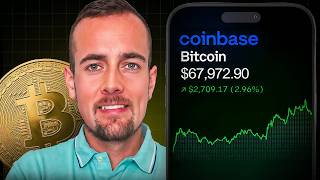

Bitcoin Price Pattern Predicts Rally?
41sControversial price prediction based on historical patterns sparks debate and FOMO.
▶ Play Clip"Delivers a clear step-by-step guide but pads the first 2 minutes with market commentary before the actual tutorial."
This video provides a step-by-step guide on how to buy Bitcoin using Coinbase, along with an analysis of Bitcoin's price patterns and storage options. The presenter walks through the purchasing process in the Coinbase app and explains the pros and cons of keeping Bitcoin on exchange, in hot wallets, or in cold storage.
Bitcoin's price history shows a predictable pattern: a head and shoulders formation signaling a bear market, followed by consolidation and then a massive rally. A similar pattern is forming now, suggesting a potential accumulation phase.
Encourages buying when prices are low rather than at all-time highs. Emphasizes the importance of understanding Bitcoin's value before investing.
Coinbase is recommended for its long history, large user base, and availability in over 100 countries. The presenter uses it for demo purposes.
Demonstrates placing a one-time order: select Bitcoin, choose order type (one-time, limit, or recurring), enter amount, and confirm. Shows buying $50 worth of Bitcoin at $67,818.
A recurring buy strategy that averages out purchase price over time. Recommended for long-term positions to avoid overpaying in lump sums.
Three main storage options: keeping on exchange (via Coinbase), hot wallets (like MetaMask, Trust Wallet, Base), and cold storage (hardware wallets like Ledger). Each has trade-offs between security and convenience.
Coinbase securely stores 97% of Bitcoin offline and insures online-held Bitcoin, minimizing risk for users keeping funds on the exchange.
Cold wallets are most secure but add custody risk: losing the recovery phrase means permanent loss of access. Self-custody requires careful management.
The video effectively delivers a beginner-friendly guide to buying Bitcoin via Coinbase, covering essential steps and storage considerations. The presenter emphasizes the importance of understanding Bitcoin's fundamentals and using dollar-cost averaging for long-term investment.
What is dollar-cost averaging?
Buying a fixed dollar amount of Bitcoin on a regular schedule (e.g., daily, weekly, monthly) to average out the purchase price over time.
04:25
What are the three main storage options for Bitcoin?
Keeping on exchange (e.g., Coinbase), hot wallets (software-based), and cold storage (hardware devices).
06:41
What security measures does Coinbase take to protect Bitcoin held on exchange?
Up to 97% of Bitcoin is encrypted and stored offline in geographically separated locations, and online Bitcoin is fully insured.
07:08
What is the primary risk of using a cold storage wallet?
Custody risk: if you lose or mismanage the recovery phrase, you can permanently lose access to your Bitcoin.
08:39
What is the difference between a one-time order and a limit order on Coinbase?
A one-time order fills immediately at the best available price, while a limit order allows you to specify the exact price you want (or better) for the order to execute.
03:43
Bitcoin Price Pattern
Provides a historical comparison showing a similar head and shoulders pattern, suggesting a potential accumulation phase for investors.
00:01Dollar-Cost Averaging Strategy
Explains a key investment technique that reduces timing risk and is ideal for long-term Bitcoin holders.
04:25Coinbase Security
Highlights the protective measures Coinbase takes, reassuring users about the safety of keeping funds on exchange.
07:08Risks of Self-Custody
Warns that cold wallets introduce custody risk, emphasizing the importance of securely managing recovery phrases.
08:39[00:01] times to be buying Bitcoin and here's why. If you look at Bitcoin's price history, you'll notice a predictable pattern is taking place. Back in 2020, we saw a huge run up in the price followed by a bearish head and shoulders
[00:14] pattern signaling crypto winter was ahead. From there, Bitcoin consolidated and remained flat for about 6 months before beginning a massive rally north of 600%. Fast forward to today and you'll notice
[00:28] a very similar head and shoulders pattern that has formed and sure enough, the price dropped shortly thereafter. Based on what we've seen before, Bitcoin is probably going to consolidate trading sideways and then potentially begin the
[00:41] tell you that there's no guarantee that this will happen, but a lot of the big investors are treating this as an accumulation phase. Just looking at corporate holder of Bitcoin in the
[00:55] world, they bought over 44,000 new Bitcoin in March alone. So, I'm going to show you how to buy Bitcoin in this quick start guide as well as talk about a few storage options at the end. But, I do have to mention that this isn't
[01:08] financial advice. I'm not a financial advisor and crypto investing in general is risky. But, with that said, I want to ask you this. Would you rather be buying ask you this. Would you rather be buying Bitcoin at the all-time high of 126,000
[01:20] or today when it's roughly 50% cheaper? If you believe in the long-term potential of any asset, the time to buy is when it's on sale or when there is blood in the streets. And if you aren't familiar with Bitcoin and why it has
[01:33] value in the first place, I would suggest educating yourself on that before diving into investing. I just did a 40-minute course on that exact topic here on YouTube, so I'll go ahead and put a card in the corner and a link down
[01:45] below. Before making any investment, you need to be familiar with what you own because that's going to allow you to ride out the lows. So, I would recommend pausing this video, watching that one first, and then coming back. And real
[01:58] and subscribe if you're interested in more crypto content. So, let's talk about how to buy Bitcoin. In order to do this, you're going to need to use something called a cryptocurrency exchange. This is similar to how you buy
[02:11] stocks using a brokerage platform and it's basically just a separate app for crypto investing. For me personally, I use and recommend Coinbase. They've been around for almost 14 years now and they've grown to a user base of over 100
[02:25] million worldwide. They're also supported in over 100 different from outside of the US, there's a good chance that your country is supported. So, let's jump into my Coinbase app now and purchase some Bitcoin. All right,
[02:38] guys, so here we are over in my Coinbase account that I use for demo purposes and guide, be sure to check out my full Coinbase tutorial in the corner and you through setting up an account and all of the basics. And if you don't have
[02:54] a Coinbase account already, you can actually get some free Bitcoin when you sign up using my link below or visit ryanoscribner.com/coinbase.
[03:06] but it's usually a spin the wheel offer where you will win a random amount of Bitcoin after you open up an account using my link and then place your very first trade. So, feel free to pause the video, click the link, and grab your
[03:19] free Bitcoin. And this also helps to support my channel, so thank you. But, let's go ahead and make our Bitcoin purchase through Coinbase now. The first step is going to be clicking on the blue buy and sell button at the bottom and
[03:31] then we're going to select buy and you can either select the crypto from the list or type it in here at the top. Bitcoin is the most popular under crypto, so we're going to go ahead and select it here. And then, we are going
[03:43] to choose between a one-time order, a limit order, or a recurring buy. With a one-time order, it's going to fill immediately at the best available price. Now, with a limit order, you can actually specify the dollar price you're
[03:57] looking to pay for Bitcoin. So, right now it's 67,040. If you wanted to only buy at 67,000 or better, you could do a limit order and looking to buy. Um but, you would need to make sure that it hits that price in
[04:12] order for your order to be filled. This can also be useful on the sell side if you want to specify the exact price or better that you're looking to sell for. And then finally, you have the option to set up a recurring buy where you invest
[04:25] every day, every week, twice a month, or once a month. And this can actually be the best strategies for buying Bitcoin because you're following something called dollar cost averaging. With this strategy, it basically means you're
[04:37] buying on a set schedule, so you're going to end up buying sometimes when Bitcoin is up, you're going to buy when it's down, and over time what happens is you pay closer to the market average price for Bitcoin and it avoids lump sum
[04:50] investing and potentially overpaying. So, that can be useful for a long-term strategic position in Bitcoin, but for now, just to demonstrate, we're going to be doing a one-time order here and we're going to buy $50 worth of Bitcoin. Now,
[05:05] right now it's set to use my US dollar wallet and I don't have enough funds, but if I click here, I can actually buy this directly from my bank account, so you don't actually have to deposit money ahead of time if you don't want to.
[05:18] So, we're going to buy $50 worth of Bitcoin and we're going to click here on screen, it mentions it's going to be available to trade instantly, available to transfer instantly, and at the bottom, you can see details about the
[05:31] spread and the dollar-based fee involved. If this looks good, you can go ahead and click on the buy now button and then it says here order is submitted. We're going to click here on view transactions and it shows us here
[05:45] that we did in fact buy $50 worth of Bitcoin and it's 0.000724 Bitcoin. If we click on that, we can see the order details and the price we paid was 67,818 and 16 cents. Now, if we click on the
[06:01] home screen, we can now see our portfolio balance has changed. And if we scroll down here and select Bitcoin under the watch list, we can see a price chart here for Bitcoin, but we could also scroll down and track our balance
[06:16] and our return. So, you can keep track of your Bitcoin investment here to tell whether or not you're making money or losing money on both a daily basis and your total unrealized return. I'm currently down a little bit over 10%
[06:28] with an average cost of about 76,000, but this is a very small amount of Bitcoin here that I have purchased. So, that's how you buy Bitcoin using the Coinbase app. Now that we've covered how to buy Bitcoin, let's talk about some
[06:41] storage options and there's really three choices here. Keeping your Bitcoin on exchange, hot wallets, and then cold storage. So, let's break each one of these down now. If you keep your crypto on exchange, that basically means
[06:54] keeping your crypto where you bought it. Now, that does introduce some risk into trusting the exchange to be the custodian of your digital asset. With Coinbase, however, this risk is very minimal because they take two very
[07:08] important steps. First, up to 97% of their Bitcoin is encrypted, geographically separated, and held in offline storage. And second, all of the Bitcoin held through online computers is fully insured. So, most people would
[07:22] agree that Coinbase is a safe bet, but you have to evaluate each exchange individually and make your own decision here. Now, if you don't want to keep your crypto on exchange, you can use a crypto wallet and there's two types
[07:34] which are hot wallets and cold wallets. For starters, a hot wallet is going to be a software-based application that's either desktop, app-based, or a combination of both. Popular hot wallets include MetaMask, Trust Wallet, and Base
[07:48] from Coinbase. When you create one of these hot wallets, it gives you your recovery phrase to store in a secret offline location. Now, this type of wallet is slightly more exposed to hacks because of the online nature, but it
[08:00] still gives you full custody over your digital assets. Coinbase has their own self-custody version of their app called Base and I'll put a link in the corner as well as down below for my full tutorial on that hot wallet. Now, cold
[08:13] wallets on the other hand are hardware devices that are not connected to the application alongside the hardware device to access your crypto wallet, but your crypto is stored fully offline with
[08:25] this type of device. Cold wallets are the most secure crypto wallets and they're often best for long-term crypto storage. But, if you plan to buy and sell cryptocurrency more often, using a cold storage wallet can be a bit
[08:39] impractical. In the past, I have always used and recommended Ledger for a hardware wallet and you can check out their official store by visiting ryanoscribner.com/ledger to learn more. But, keep in mind, crypto
[08:52] wallets add a different kind of risk to the equation and that is custody risk. If you lose or mismanage your recovery phrase, you can permanently lose access decide to go this route, you have to take some time to familiarize yourself
[09:06] with how self-custody works. So, guys, that's the basics of buying Bitcoin and different options for storing it. I hope this video helped you out and if it did, make sure you drop a like and subscribe if you haven't already. If you have any
[09:19] questions, leave me a comment down below and I'll do my best to respond to each one. And don't forget to use my link down below when you sign up for Coinbase to get that free Bitcoin bonus. You can click below to watch my full 40-minute
[09:31] course on Bitcoin, why it has value, and how it works, and I'll see you there.




⚡ Saved you 0h 09m reading this? Transcribe any YouTube video for free — no signup needed.