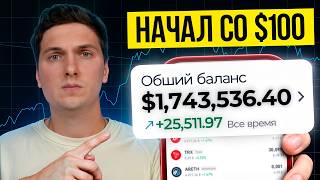

Why Buying Bitcoin in 2009 Was a Genius Move
44sHindsight regret and 'what if' scenarios are highly engaging, making viewers imagine potential wealth.
▶ Play Clip"The title promises a beginner-friendly crypto guide and delivers exactly that with clear explanations of market cap, inflation, and trading steps."
This video provides a comprehensive beginner's guide to cryptocurrency, contrasting Bitcoin with gold as a store of value and explaining the impact of inflation. It covers essential concepts like market capitalization, chart analysis, and practical steps for trading on exchanges using tools like CoinMarketCap and TradingView.
Bitcoin is now the ninth largest asset by market cap; gold is first. The dollar was once backed by gold but now unlimited printing causes inflation.
$100 in 1900 now has purchasing power of $2.60, showing how fiat money loses value over time.
Gold has risen in price but suffers from centralized storage and risk of confiscation by governments.
In 1933, President Roosevelt forced citizens to surrender gold at $20.67/oz, with penalties up to $10,000 or imprisonment.
Bitcoin cannot be physically confiscated, has no central control, and its fixed supply (21 million) prevents inflation.
If Bitcoin matched gold's $20T market cap, each Bitcoin would be worth $1 million; half that gives $500,000.
Market cap = total coins in circulation multiplied by current price. FDV is maximum supply times price.
CoinMarketCap shows market cap, FDV, circulating supply, and links to official project sites and social media.
A low token price doesn't mean a low valuation; high supply keeps price low. XRP ($2) has higher market cap than BNB ($570) due to supply.
You can see what a coin's price would be if it had the same market cap as another, e.g., Dogecoin at $10 if it matched Bitcoin's cap.
Japanese candlesticks show open, high, low, close per time period. Green = price up, red = price down. Wicks show intra-period extremes.
Levels are key for entries; trading breaks or bounces at support can yield 10% gains per trade.
Use referral code 2358 to access closed resources. No paid courses, only community support.
Spot trading means full ownership of the asset. Beginners should use spot, not futures.
Futures allow leveraged contracts; leverage multiplies both gains and losses. Beginners should use 1-3x leverage and isolated margin.
Liquidation occurs when losses exceed the margin; adding more margin pushes liquidation further away.
The video effectively demystifies crypto basics, from inflation and gold's limitations to Bitcoin's decentralized value, and provides a hands-on guide for trading on exchanges using market cap analysis and charting tools.
How much would $100 in 1900 be worth in purchasing power today?
$2.60
01:40
What happened in the US in 1933 regarding gold ownership?
President Roosevelt forced all citizens to hand over gold at $20.67/oz under penalty of $10,000 fine or imprisonment.
03:26
What is the maximum supply of Bitcoin?
21 million coins
05:56
How is market capitalization calculated?
Market cap = total number of coins currently in circulation multiplied by the current price of one coin.
06:50
What does FDV stand for and how is it calculated?
Fully Diluted Value; equals maximum supply multiplied by current price.
07:35
Why might a coin with a low price per token still have a high market cap?
Because the coin may have a very large circulating supply, making each token cheap but total value high.
12:41
What tool can you use to compare market caps of two different cryptocurrencies?
Market Cupof
13:54
What do the body and wick of a Japanese candlestick represent?
The body shows the opening and closing prices; the wick shows the high and low prices during that time period.
19:41
What is the liquidation price in futures trading?
The price at which the exchange closes your position because your margin is no longer sufficient to cover losses.
47:55
What leverage range is recommended for beginners in futures trading?
1x to 3x
43:05
How can you make the liquidation price farther from the current price?
By adding more margin to the position.
50:22
Fiat currency inflation
Concrete historical example shows how inflation erodes purchasing power over decades, making the case for scarce assets.
01:40Gold confiscation history
Reveals that even gold is not immune to government seizure, highlighting the need for decentralized assets.
03:26Bitcoin's fixed supply
Fundamental principle that makes Bitcoin inflation-proof and comparable to digital gold.
05:56Market cap vs token price
Crucial distinction that prevents beginners from being misled by low token prices.
12:41Japanese candlesticks explained
Clear visual explanation of how candlesticks form, a foundational skill for technical analysis.
19:41[00:02] best point, at the very beginning of the development of a huge economic mechanism financial system. And as we now think, it would have been good to buy bitcoins in 2009, even if only for a small amount of money, at least for 10 dollars. Also, in a
[00:16] remember this time, and then it will be clear that this was, it turns out, simple terms what crypto is. The instructions that I didn’t have when I entered the market. And, of course, I’ll tell you how you can make
[00:31] world's largest assets and market capitalization. Bitcoin is currently in ninth place. Gold is in first place. Naturally, we measure all this capitalization, all prices, in the world reserve currency, the dollar. At one
[00:46] time, the dollar was tied to gold, and no more could be printed than gold was mined. Now, after the abolition of the gold standard, this is not the case, and dollars unlimited quantities. And if something starts to become more abundant, then
[01:00] over time, as the amount of money supply increases, the money supply loses its value, and thus inflation occurs. If you print twice as much money as there is now in one day, there won't be
[01:14] twice as much money in the world, it will simply depreciate by 50%. This means that the purchasing power of the dollar will fall. And what used to cost us $50 to buy, for example, a product in a store, will now
[01:27] cost us $100 to do the same thing. That is, they printed more money, but in fact, this banknote is now equal to this banknote. This is not just a hypothetical example, this is the reality we live in. For example, $100 in
[01:40] 1900 now has the purchasing power of $2.60. So , if you had to spend $100 on something in 1900 , the same value would be worth $3,781 today. But, for example, 1 million
[01:55] dollars then is like 37 million dollars now. And if this happens with the dollar, the world's strongest currency, then things are even worse with other currencies . This is what happened to the British pound. What
[02:08] $100 could buy in 1900 now costs $15,707. This means that even if the money is just sitting in my pocket or in a bank account, it loses value every day. This process
[02:20] assets that cannot be printed in infinite quantities, for example, gold. Here, for example, you can see a table showing how the price of gold has changed . And you see that over the years the price has only increased. But gold has many
[02:34] transportation, problems with decentralization, because it is stored centrally in banks and in reserves, so gold is not distributed decentrally around the world. I will explain why this is bad, since gold is
[02:48] in banks, in government reserve vaults. And in fact, most of this gold does not belong to ordinary people. It belongs to large structures, states, banks. And at one point, in certain countries,
[03:00] the state may lay claim to your gold when, for example, it urgently needs money. Unfortunately, this has happened more than once in history . Also, different states have repeatedly established different bans and restrictions on
[03:14] gold ownership. In general, no matter how much you want it, gold still does not actually belong to you, and it is regulated by the laws of the country in which you live. And let me give you real examples of how it was. For example, USA
[03:26] 1933. President Roosevelt signs a law requiring all people to hand over their gold to the government and receive $20 in return. Coins, bars, certificates, all of it had to be surrendered to the government, and she paid
[03:41] $20.67 an ounce. Those who did not comply and hand over their gold faced a fine of $10,000 or imprisonment. By today's standards, that's more than $100,000, or prison. Thus, Roosevelt wanted to
[03:54] fight the Great Depression. Then some raised the price of gold to $35 per ounce, which effectively devalued the dollar. And the people who received dollars in exchange for gold were essentially left with, well, practically, uh,
[04:07] nothing. Well, not with nothing, but with very, very little money. Now their gold, to the state, was worth much more than the money they had left in their hands. And imagine, from then until 1974, gold ownership in America
[04:22] remained limited. USSR, there is nothing to even talk about here, because in the USSR private ownership of gold was completely prohibited . All gold mining and gold ownership was controlled by the state. If you were found with
[04:34] state. If you were found with even 1 gram of gold, you faced prison and criminal prosecution. Germany - 1930s, when all the gold was confiscated from Jewish families. India - 1963, when restrictions on gold ownership were also introduced
[04:46] restrictions on gold ownership were also introduced . In Australia, from 1959 to 1976, all citizens were required to hand over their gold to the Reserve state control over private property, including
[05:01] capital assets such as gold. In response to all this total control, with the development of technology, Bitcoin appears. Bitcoin is not physical, so it cannot be taken away. You can recommend that people not own
[05:13] Bitcoin, you can ban it, you can impose strict restrictions, but nevertheless, the transfer of information within the network will still take place, which means that Bitcoin will still exist. That is, it is impossible
[05:26] we saw that states tried to fight Bitcoin, then they took a different course of acceptance. And now we see that the US is creating its own reserve contain a huge amount of bitcoins. China and
[05:42] , for ordinary people, this is good because it is decentralized and it is not controlled by the state, it is not controlled by some bank. It does not have a single control center, which is why it is called decentralized. And Bitcoin is not subject to
[05:56] inflation, because 19,800,000 Bitcoins have already been issued . This means that only 21 million coins can exist. There won't be any more of them.
[06:09] mined. Now let's think about whether Bitcoin's market capitalization can catch up with gold. I think in the long term this is quite possible. If Bitcoin's market capitalization were equal to the current market capitalization of gold
[06:24] , Bitcoin would be worth $1 million. This is the cost of one coin. And even if it takes a long time, but reaching at least half of gold's capitalization, which is, in principle, even more realistic,
[06:38] means the price of Bitcoin will already be $500,000. That is, you see the capitalization of Bitcoin now and the capitalization of gold. And you see that we are at the very, very beginning. What is this capitalization anyway? What do
[06:50] these numbers mean? Market capitalization is the total number of coins currently on the market multiplied by the price of one coin. At this moment, 21 million Bitcoins have not yet been issued, the maximum supply has not yet been reached,
[07:05] and there are currently only 19,836,000 Bitcoins in the market. We multiply this number by the price of one Bitcoin and get the market capitalization. To put it simply, this is how much money is needed to
[07:21] buy up all the bitcoins that exist at the current price. The same with gold. 20 trillion dollars is how much money it would take to buy up all the gold on earth, assuming we buy it at the current price. There is also such an indicator as FDV. FDV is the
[07:35] total number of all coins that will be issued over time, multiplied case, Bitcoin will only have 21 million coins issued. We multiply it by the current price and get the FDV indicator. Now let's move on to practice. If you didn't
[07:49] understand now. There is a website called Coin Market Cap where you can see a list of all cryptocurrencies. If you need to find a cryptocurrency, someone told you about it, advised you to buy something, you can go to this site at Coinmarket
[08:02] here is also not necessarily necessary. Here in the search, enter the name of this coin, for example, XRP. And now you have all the coins that have it in the name. Come to the coin. Here you can see the chart of this coin for
[08:16] 1 day, for 7 days, for the last month. You can look at the schedule. There are links to the official website, for example, to Twitter, and to other social networks. This is very important. When visiting the crypto world, it's best to follow links from Coin Marketcap, or from
[08:30] official websites that lead you to other sources, not just something you found online. The official address of the contract is also here. You can add this coin to your Trust Wallet in Metas wallets with just one click.
[08:44] the future, I think you will . It's very convenient. And this is precisely where we see the indicators that we just discussed. For example, manual capitalization is this circulating supply multiplied by the
[08:58] current price. Here are these XRP coins that are currently on the market, multiplied by the price that the XRP coin is currently at. And that is market capitalization. FDV is the maximum supply, the maximum amount of
[09:13] XRP that will be in the market, multiplied by the current price. Here we can hover and see that 58% of the coins are currently on the market. All other coins have not yet been issued and are not yet traded. This happens very often with different
[09:27] cryptocurrency projects. In fact, this happens in the stock market too. Not all coins are immediately available for trading; they are gradually released to avoid putting too much pressure on the price. If all coins were
[09:39] available for trading at once, many people would likely want to sell them. Those who, for example, the team that received these coins for free for participating in the development of the project or the investors who invested
[09:51] in the project at the early stages, they receive their coins so that when the project enters the market, they don’t simply sell everything and drop the price, right? Because when there are many sellers in the market, the price falls, when there are many buyers, the
[10:04] price rises. So, to prevent sellers from selling all their coins and thereby causing the price of the coin to fall, the unlocking process is gradually taking place. A few and so on. This is called token unlocking. Here on Coin
[10:16] cryptocurrency section. There is an unlocking of tokens. Here we can see various new projects. There are a lot of them, believe me. If you come in and don't know what these projects are, I don't know most of these projects either, because,
[10:31] everything. There's a lot going on in crypto . But the mechanism itself, you can hover over here and see how much of the
[10:43] number of tokens that will be unlocked. In this case, 42 million tokens are In this case, 42 million tokens are 4% 4.2% of the total supply. Accordingly, we can expect that if a project is about to unlock its tokens in the
[10:57] see the exact time when the unlocking of this number of tokens will occur. Most likely, the price of coins example with the dollar. If you print twice as many dollars, their price will
[11:13] happens with coins. When more coins become available, they often drop slightly in the market after being unlocked. And this is also worth taking into account. All of this will be useful to us in the future for analyzing projects, for analyzing coins, in order to
[11:28] understand what influences the price in general. It's not just a coincidence that the price went up, the price went down, but we already understand that there are prerequisites and reasons, and we can already predict that some coin will go down, for example, because it will
[11:41] soon have a large token unlock. Let's get back to cryptocurrencies, go here to the cryptocurrency section and see that here is the rating of cryptocurrencies and they are sorted. They are sorted by
[11:55] market capitalization. And I would say that market cap is the main look at, because a lot of people look at the price of a coin and think that that is at the price of a coin and think that that is how expensive this or that
[12:10] fact, we can see that, for example, in fourth place is XRP with a value of $2, and in fifth place is BNB coin with a value of place is BNB coin with a value of $570. But in reality, XRP is more
[12:25] $570. But in reality, XRP is more expensive than BNB. Although XRP is only worth look at the market cap, we see that XRP has a much higher market cap than BNB. XRP is currently worth $130 billion, while BNB is
[12:41] only worth $82 billion. So why is XRP cheaper than BNB? It's all about the maximum offer. The maximum supply of XRP coins is 100
[12:53] billion coins. If we look at the maximum supply of the BNB coin, by the way, you see, they do not have a maximum supply. So, theoretically, they can print more coins, but they only have 142 million coins in total. So, when you
[13:09] compare these numbers, one project simply has more coins, so each project has fewer coins, so each coin is worth more. But this does not affect capitalization in any way. Some projects deliberately produce huge quantities of
[13:24] coins to keep the price very low. And when you buy a Shibainu coin, for example, you can buy a huge number of these coins for 1 dollar. And people think: “But when their price becomes 1 dollar, then I will be a millionaire.” In
[13:39] fact, this is very difficult to achieve, because you have to look at what the project's capitalization must be for its price to become one dollar. Because in fact, for the price to double, the capitalization must
[13:54] also approximately double. For example, there is a website called Market Cupof, where we can compare two different projects. And we can, for example, look, let's take the same XRP project and take, for example, Bitcoin.
[14:08] What will happen when XRP's market capitalization is the same as Bitcoin's now? We $27. That is, it will be simple if XRP's capitalization catches up with Bitcoin's. So, we can check any coin, for example, Dogcoin,
[14:20] if it catches up with Bitcoin, then how much will one coin cost? 10 dollars. Shibanu, if it catches up with Bitcoin, it will be worth this much, will be worth this much, $0.002. And it will grow 227
[14:34] times. It will be something absolutely incredible, yes, if it achieves such a capitalization. And even then, it won't be worth $1. Even if it catches up with Apple in terms of market capitalization, it still won't be
[14:47] worth $1. And in this way, we simply unlink the price of a coin from its real value in our heads. this company, this project. Bitcoin, coins that are worth much more than $80,000. However, they are not even close to
[15:02] $80,000. However, they are not even close to Bitcoin's market capitalization is currently $1.6 billion. If there were not 21 million Bitcoins in total, but
[15:17] only one Bitcoin on the market right now , and it had already been issued, how much would that one Bitcoin be worth? Now, if we were to cut everything down and exchange all bitcoins for just one. Again, this is a theoretical problem, but if there
[15:30] were not 19,800 bitcoins, but only one, it would be worth its market capitalization, that is, $1.600 million . And that's why it doesn't matter if you have 1 or
[15:45] 001 bitcoins, you still own that portion of a bitcoin. Owning 001ni Bitcoin does not make you a less-than-full owner of that Bitcoin. That is, its main
[15:57] part is not stored by any other person or centralized bank. Therefore, it is absolutely irrelevant how many coins are actually in circulation. The are actually in circulation. The
[16:12] can be used to calculate how much the price of a particular coin can grow . And now, when you are told that some coin can grow to $1,000 or $2,000, you can simply go and calculate its
[16:24] capitalization must grow for it to reach certain price values. It's the same hear someone say, "Bitcoin is going to be $10 million, $30 million." You should always understand by capitalization how much it will be. Here, for
[16:38] example, are all the world's largest assets, 10,507 assets with a total value of $109 trillion. You see, there's gold, silver, bitcoins, it all adds up to $109 trillion. At the moment, gold has a
[16:53] capitalization of 20 million dollars . This represents approximately 21-22% of the total global capitalization. Accordingly, it must be understood that if Bitcoin catches up with gold, it will also
[17:06] make up 21-22% of the world's money. That is, thanks to Coin Market Cap, we can initially analyze coins. Be sure to use these links, go to the
[17:18] official websites of these projects, go to social networks, read what people write about the project, whether the project has a community, because all of this plays a big role. this project or the project you are studying are of no use to anyone and in
[17:34] no community, all of this is important, and all of this will influence the price in the future. You can also additional information there. In principle, this is an analogue of Coin Market Cap, but in some ways it is more convenient. For example, the same West, in my opinion,
[17:50] looks more informative on cryptocurrency. And here, for each project, you really have a lot of information right before your eyes that you can analyze. closer look here. For example, if we take vesting and token unlocking,
[18:03] you can see who exactly they will be distributed to and when, for example, to the team or to investors. All this is written down here. But for a more detailed analysis of a specific coin, we need to look at its chart and analyze it. Now we will learn how to
[18:18] use TradingQ, the most advanced tool that, I think, go directly to the products on the main page and go to the supercharts. And right here, without registration, we can already view these graphs. Here on the top left
[18:33] we can switch between different coins. You can write here manually , for example, AH is EHUM. To understand where I get this information, we're on Coin Market Cap, looking at cryptocurrency,
[18:47] for example, Ethereum, and next to each cryptocurrency there's its ticker. For Ethereum cryptocurrency there's its ticker. For Ethereum it is AH. We just take it and shove it in there. Or XRP, BNB, Sol. Each, every coin has its own ticker, which
[19:01] you can enter in TradingQue. For example, you entered ATH. And then you can choose what you want to watch. Regarding the dollar, naturally, we will look at the USD. ETH Husd, from which exchange will we
[19:14] , but usually the exchanges with the longest history of the coin are at the top. That is, it differs only in the history of
[19:26] should understand that there is no single universal chart for the different exchanges, and the price could have varied slightly on different exchanges at different times . Here you can click on the three stripes and click Dark theme, if that's more
[19:41] . So, what you see on the chart now are Japanese candlesticks. A candle has a body and a wick. The body is called its wide part. The wick is a thin part that shows what
[19:55] better understand how candlesticks are formed, instead of a long explanation, it is better for you to see it for yourself once. Let's switch here at the top to 1 minute. And then we will see that each candle is
[20:10] equal to 1 minute. This is a red candle, it is equal to one minute. This green one is also one minute. And as you can see, every new minute a new candle appears. That is, literally every 60 seconds a new candle appears.
[20:24] If the price falls during this minute, a red candle appears. If the price has risen during this minute, a green candle appears. But this wick suggests that the price actually went even lower. That is,
[20:39] after the previous red candle, our price fell to here. But at the end of this minute the candle closed here. And we see that every minute candles appear in our house. And in real time we see how they are drawn. That
[20:54] is, we see that now the green candle has become even larger and has covered the wick. If this green candle goes all the way to here and then returns here, we will see a wick like this. That is, this candle wick shows us
[21:09] where the price reached at this time. Naturally, I am showing you these minute candles so that you can clearly understand how it all works. And on the minute chart, on the minute candles, you can see a very small range
[21:21] . This is more suitable for analyzing something very local. If we want to see the whole picture, then here it is worth switching, for example, to hourly candles or four-hour ones. You see, then
[21:35] our candle starts to stretch like this, and here we can bring our chart back to normal. In fact, the candles did not stretch anywhere. We just zoomed in so close to the graph that we couldn't see anything. It's like a photograph;
[21:49] yes, you can zoom in on it on your phone, but you can also see the full picture by zooming out. Here we can do the same with this graph. And as we can see, hourly this graph. And as we can see, hourly candles also show us a picture of a
[22:02] limited period of time, because if we start to zoom out, the candles look very, very unclear. Uh, and below we can see the dates, what specific date, what date we are looking at the chart for. Therefore, if we want to
[22:16] look at the chart even more closely, we can choose four-hour candles. I four-hour candlesticks the most, because you can analyze, in principle, information there for the last month, for two months, it is displayed quite correctly. If
[22:29] we want to look at the entire Bitcoin chart and analyze the whole monthly candles, because each candle here equals one month. And
[22:42] new candle appears. Accordingly, one movement, this green candle, means that Bitcoin has grown this month. And when we point it out, we see below what month it was. Here, you see, it says November, October, September, August,
[22:58] July, June, and so on. That is, each candle is a separate calendar month. candle is a separate calendar month. Trading volumes are shown below. The higher Trading volumes are shown below. The higher the volumes, the more trading there was at that time
[23:11] . As a rule, as volumes increase, we see an increase in volatility. This means that our price will go somewhere, either up or down. Let's stick with the four-hour candles. We also have additional tools that we
[23:25] can use. For example, we can select a tool like this here. And on the graph, when we see some patterns, when we see things that we want to note for ourselves, we can draw directly on it. For
[23:39] convenience, let me turn on daily candles now. And here, for example, there is a tool that allows us to draw certain, well, we, for example, mark, mm, see a certain level on the chart . Here on the four-hour candles
[23:54] we also see this same level, and the level to which the price constantly came and from which it bounced upwards. This is a very useful pattern because if we notice it in trading in the future, we can
[24:08] trade from it, because levels are important things. If the price does not break through this level, then it is a support level. It seems to support the price in case this level is broken. Here we see it
[24:23] happened. Now this level becomes a resistance level for us . Some people draw levels in their own way, of course. Some people just draw with a line. But in reality, levels don't always look like a line. It's always
[24:38] more of a range than a line. And as we can see, here our price also went outside the range. In principle, we can adjust it and say that, for example, this area there from 90 to 95.000 is the
[24:54] resistance level. Again, everyone has their own strategy. Some trade breakouts of levels, others seek to buy when the price breaks through this level. Because if the price here, for example, broke through this level and went up,
[25:08] then this level would already be a support level for us . And usually, when a level is broken, like here, for example, a fairly sharp movement occurs. Some people trade rebounds, for example, here, and open trades in the hope that
[25:23] the price will rebound downwards, also trading from levels. I also prefer to trade from support levels. And for me, for my strategies, this level would be ideal, uh, it would be ideal to open trades here and trade these kinds of
[25:38] movements. Here is an example of my trades on the stock exchange. Here, where buy, uh, is a purchase, where s is a sale. And so you see that I trade from such levels, precisely from the lower boundaries, and try to take it all away. That is,
[25:54] here, uh, I sold after the rebound. Here we also touched on this point of 80,000 dollars. As soon as we got a little below 80, well, I immediately bought too. Here are such short
[26:07] bought too. Here are such short transactions with 10% profit per transaction. Here you can also draw such a local level. All this is your vision, your observation. Then all this remains on the graph. This is the most valuable thing,
[26:21] because you can see in history whether your forecast worked out or not, because you can predict where the price will go next . For example, you believe that the price will go up, into a certain zone. You
[26:35] can mark this zone for yourself. Here, mark it, for example, highlight it in some other color, and write here, for example, the expected reversal, then mark where the price will reverse. That is, you can, in principle,
[26:48] That is, you can, in principle, you were able to predict the price and whether the price actually went where you predicted. I think that here on tradingQ it may not be clear,
[27:01] because there are a lot of tools, especially with levels, but where to find these levels, how to see them, whether this level is really like that or not. We have a separate video on trading on YouTube. Here is a
[27:14] hint. We also have a dedicated trading course on our Telegram channel that can easily take you from a beginner to a trader who understands what they're doing. Plus, there are strategies from traders on our team. You can
[27:27] trading. That's why we created this Investcoin signals channel, not so you could simply trade using signals, but so you could watch how different traders execute
[27:39] trades. We have four people running this channel , and each of them has their own separate strategy. Some trade Smart Money, others trade Smart Money, others trade short-term intraday trades. There are
[27:52] candlesticks there. There are traders who generally trade on bars, like Vlad, for example, one of our traders. Well, naturally, we share statistics every month . All statistics are also open. We also provide links to all posts
[28:05] . And you can check and see. when the trader wrote about what was included in the deal, when he locked in the profit, what kind, and you can see all of this. All this will add real trading experience to you. You
[28:18] will better understand the market, you will better understand and see patterns, because everything in the market is built on patterns. These are the levels, there are no general levels that must necessarily be here. All this is
[28:34] looking, going through the graph and drawing levels. Over time, you begin to notice them much more often, much more. And already, in principle, you look at the chart, and immediately plot and draw support and
[28:49] resistance levels. In general, this is a base that is definitely worth starting with. Well, cryptocurrency. First, we will use a crypto exchange because crypto exchanges are the easiest place for a beginner to start . At least on a crypto exchange,
[29:02] external influences. No one will be able to steal them, because when you create your wallet, there are many different ways in which you can simply go to the wrong website, press the wrong button, and your money will be given to the scammers. There is
[29:16] simply register using your email. There are also mobile applications that are also convenient. You can download the Exchange app from the App Store or . If you register on the Bybit exchange, use
[29:30] our code 2358 when registering, and you will gain access to all of our closed resources. we don’t have any paid courses. You can support our community simply by registering on the exchange. If you already had an account, please contact our support team. We'll
[29:44] all our products and transfer your Qvac verification to another account, or to already be registered using our link. Again , in the description below this video there is a link to register on Bibт and a link to our support service. It is
[29:57] whose link you used to register. If you have any problems with resolve on your own, you can contact our support team. Also, are worried that something bad might happen to you on the exchange,
[30:11] then if this happens, if you registered using support team and send us your problem, and we, through our managers, most important thing is that we cannot simply write to our manager on behalf of those people
[30:27] else’s link. You then need to contact the person whose link you used to register, because we can only help people who we have registered on the exchange, we need to top up our balance. This
[30:40] can be done through P2P trading. Go to the Buy Cryptocurrency section and select P2P trading. Here we click confirm. We select purchase here. We select the currency that we will top up. For example, it could
[30:52] be rubles. Enter here the amount you want to top up. How much? There, for example, 10,000 rubles. Payment method. You choose. There are Russian banks here, among others. For example, if you use Tinkoff, then
[31:05] enter T here, and you will see a local card yellow - this is Tinkoff. They renamed the banks to yellow for Tenkov and Gregen for Sberbank simply to comply with the sanctions. In fact, there are no sanctions, just
[31:20] the names of the payment methods have been changed. So, Tenkov and we find local Card yellow. If you have a Sberbank Local Card S Green, or if you top up in another country's currency, like dollars or euros, there are also European banks here, including VI
[31:36] are also European banks here, including VI , Revlut, and anything else you can imagine. to top up your balance. Next, when you find the person from whom you want to buy cryptocurrency, click buy USDT. This shows real people
[31:49] who are selling cryptocurrency, and they are selling it inside the exchange. The exchange guarantees that the transaction will be carried out cleanly and that no one will be deceived. If will immediately connect with you via chat. This means that you definitely won’t be deceived here. But still,
[32:03] here in the filter section, go and select verified merchants so as not to waste your time on any sort of investigation or anything else. Only trusted merchants will be here then , those who are verified by the
[32:15] exchange, they have a good reputation, and they have been making transactions here for a long time and professional activity. As you can see, this person has 1,600
[32:27] can see, this person has 1,600 completed requests already. 300, 400, 1.700 and so on. After replenishing the balance, we can go here in the assets section to the funding account, and our USDT will be located here in the
[32:39] order to trade, we need to click the transfer button and transfer them from the funding account to the single trading account. And here we enter the dollars. Now the money has been transferred to our single trading account, which is located
[32:54] trading account. We see our USDT here. We can use this money trading account can be traded on them . Everything in the deposit and withdraw money. This way, you can separate the
[33:08] exchange from the money you want to trade. That is, everything you trade money that you don't trade, which is simply stored on the exchange, can be Here on the single trading account there is a trade button, and you can immediately
[33:23] go to two sections: spot and derivatives. But we can also go to the trading section. And there is a spot here. The first is spot trading. Let's move on to it. Here we will click Bitcoin USDT. Spot trading allows us to buy
[33:37] or sell cryptocurrency while fully owning it. That is, when we make a purchase of Bitcoin with you, it may not be a whole Bitcoin, it may be a small part of it. We bought 001 Bitcoin and we own it completely. We can
[33:50] withdraw it from the exchange to any other exchange, to our crypto wallet, perhaps not an exchange one, but a decentralized one. We can do whatever we want with this cryptocurrency This is how spot trading works. There are other types of trading where we do
[34:03] not fully own the asset. In spot trading, we fully own the asset. Therefore, for beginners, I think this is the very basic one. So, if you find a cryptocurrency on Coin Market Cap, for example, you find a coin
[34:15] you want to buy, you just go to the exchange, go to spot trading, and here in the top left you can find this cryptocurrency. For example, can find this cryptocurrency. For example, type XRP and find XRP USDT. Please
[34:28] note that here it says spot, and below it says perpetual. So, when choose from the spot section, because perpetual is already futures, it’s different. Here you do not fully own the asset and cannot withdraw it anywhere.
[34:42] Therefore, be sure to choose spot here if you want to buy will buy for. Here we have USDT, and also USDC. This is actually an analogue. The same goes for the cryptodollar. It's just that USDT and USDC are issued by different companies, but they
[34:58] all have real dollars in the bank as collateral, so 1 USDT equal to 1 dollar. We can also buy, for example, XRP directly for Bitcoin or for Euros, but we will choose USDT. Yes. This is the
[35:12] sure what to choose, you can see the can see the trading volume here on the right. That is, there are 129 million here. This is the turnover in 24 hours, how many people traded this coin. And then you
[35:25] can see that, for example, USDC has a turnover of 8 million in 24 hours. This pair that has the highest trading volume and the most people trading on it . If you, well, can't figure out what exactly to choose here. Now, of
[35:39] all that is here, we don't need to pay attention to anything for now. which is written here. Next, there is a graph that we can also see. We have already seen the charts and understand how these candles are formed. Here on the
[35:53] the part of the interface through which we will give commands to the exchange. And here we can click on a market order to buy cryptocurrency right now. We choose what we want to buy or sell. We will buy. And here we
[36:07] see what we will buy. On the left we have XRP for USDT. Well, let 's switch to Bitcoin for example and buy bitcoins, because it will be easier for you. Buy. Here we choose the market one. If we choose the market one, then we do
[36:20] n’t need to enter anything except the price for which we want to buy bitcoins. here we need to indicate the price at which we want to buy, etc. We just choose the market one. We will buy at the current price. For example, we enter 100
[36:33] dollars and click buy BTC. Your market order has been filled. And now the bitcoins we bought for $100 is in a single trading account, where we have USDT, which we transferred here from the
[36:45] funding account. And right below we can find bitcoins. Here it is for $ dollars that we bought. Naturally, the price changes here because Bitcoin can rise or fall. But in the future, we can also sell
[36:59] this bitcoin and secure the profit. That is, this is the easiest way how we can buy some cryptocurrency and make money on its growth. Here on B displayed. To make it visible, you can set the trading history here
[37:12] . Here you put a tick. And that's all. After that, you will see You can see exactly when you purchased. If you hover over it, the average purchase price will be displayed . Now, when you want to sell and lock in your profit, you
[37:25] simply click sell right here. You also choose the market one. And with this slider you can simply select, for example, 100%, because you want to sell 100% of the approximate amount you will receive, written in dollars. It
[37:39] of Bitcoin also changes. To withdraw this bitcoin from the exchange, you can funding account. Click the transfer button and select from the single trading account to the Bitcoin funding account. That's it , translate.
[37:53] bitcoins will be added to your funding account. Well, I already have it . for some amount, I already have it . I click the display button opposite it. I enter here the address of the wallet where I want to withdraw the network type. Only the Bitcoin network is available for Bitcoin here. For
[38:06] other coins, you will have other networks available. That is, here in this way, in this way, you can withdraw any cryptocurrency and enter the amount. But I think if you don't have a crypto wallet yet, you most likely won't
[38:20] withdraw what you bought. Therefore, you can simply bring it to a funding account or keep it in a single trading account. If you're interested in trading and exploring it further, follow this link to another video
[38:33] There we covered absolutely everything about limit orders, take profit, stop loss, conditional orders, and trailing orders. All this will help you trade more professionally on the market and use all the exchange's functionality. There
[38:47] we literally analyzed every single parameter that is here, what it means and how to use it. The next section is futures trading. . When we move on to futures trading,
[38:59] it is visually no different from spot trading . Same schedule. The price is also displayed here. Here we can also switch between coins. But, by the way, if we look at the same XRP coin, we see that the
[39:11] trading volume on the spot, you can see the spot here, on XRP is $129 million per day over the last 24 hours. But the trading volume on XRP futures was 1 billion over the last 24
[39:24] hours. That is, much more, approximately 8-9 times more than on the spot. Futures are traded much more, in much larger volumes. And all because
[39:36] with futures you can use borrowed money from the exchange. Futures contracts are not spot. Here you do not own the cryptocurrency you are trading. We chose Bitcoin USDT, but futures are a contract, a kind of
[39:51] obligation to buy some asset at some price. These are such papers, you could say, receipts, yes, well, to put it simply . And because they're just contracts and not a real asset, we can do more
[40:07] things with them than we can with a real asset. For example, it is very easy to trade short in futures, that is, to go down. We can bet, as it were, that the price will go down. Of course, this is not a bet in the literal sense, because we
[40:21] are opening a bearish position with you, and we can always close it. But if our price goes up, we will lose money. If the price goes make money. Here on the right in this trading terminal there is a buy and
[40:35] sell button. And it says long and short. Long means to bet on a rise, short means to bet on a fall. Let's replace the word bet with positions. Open a long position and open a short position. I try to
[40:49] use simpler terminology to make it easier for beginners. Well, let's get used to the word position. Because when you and I enter into a position, even when you and I buy bitcoins, we still enter into a position in bitcoin.
[41:03] Next, here we can choose the trading leverage. Leverage is the credit exchange. That is, having $100, if we set the fifth leverage, we can open a position for $500. That is, our money is multiplied by leverage. If
[41:17] we choose the tenth, then with our $100 we can open a position worth $1,000. And the profit we get, we will take from $1,000, and not just from our $100. But there is also a downside to this: if the price goes
[41:30] against us, we will also suffer 10 times more losses. We'll be incurring losses on $1,000, not just on our $100. And it's not really a good strategy when you go into futures thinking that with
[41:43] $100, you can open a position for $ 1,000 or $500. On the contrary, tool to open a position. You have, for example, $100, and you can open a position for $50 using
[41:59] sensible in terms of risk management, because on average you should enter a trade with 2 dash 3% of your deposit. This means that you contribute 2-3% of your balance to each transaction. If you
[42:12] enter into one trade, you will most likely lose that money. This will no longer look like trading, but rather like some kind of betting or a casino. If you want to make money long-term , don't use more
[42:26] than 3-4% of your deposit. And right here at the top you can set the walrus mode. If you choose isolated margin, you will only risk the money you have in the trade. You opened a deal for 10 dollars
[42:40] ended up being worth $50. Of this money, debt exchange will give you 40 dollars, because you set the fifth leverage. With isolated margin, you will only risk the $10 you initially
[42:53] put into the trade. If you choose crosswall, you will be risking all the money in your account. What it means to take risks and how you can lose this money, I’ll tell you a little later now. I just suggest that beginners
[43:05] use isolated margin so that you can definitely hit the target and not lose money. Next, let's choose, for example, the third shoulder. I recommend that beginners trade there from the first to the third shoulder and move on to the fifth
[43:18] strategy. Then, of course, you will be able to switch to cross margin. And in fact, with cross margin, it doesn’t matter so much what leverage you trade with as the volume of the position you enter into. So, isolated margin,
[43:31] quantity. Let's click or click fill by cost. When we fill by cost. When we write here, for example, 10, we see how much of our money will be used . It says 3 dollars here.
[43:44] All. Why? Because I have a third shoulder. If I bet $30, then $10 of my money will be used here, and the exchange will lend me the remaining $20, because I have third leverage, and my money
[43:56] is multiplied by the leverage, and the total cost of our order is obtained. An order is an order from the exchange to buy or sell. Let's click buy or go long . And here we see that
[44:09] your order size is less than the minimum. The thing is that on the spot, on Bybit, we for a couple of dollars we can buy bitcoin. This is not the case with futures. Futures have a minimum position size for each coin. Therefore, in order to
[44:23] we need a large amount, because here, in my opinion, it’s about 60 dollars. 60 dollars is also not enough, 90 dollars. So, we managed to open a position with you for 90 dollars . That is, I clicked buy long, and we got this position. And on
[44:39] other coins we can open a position for a much smaller amount. The lower the market money we need to open a position on that coin. For example, there is Pepein, or even at the Salon we already need much less money. And there are many
[44:54] coins that are not so big, on which we can open a position literally there for a few dollars we can already open a position. So, let's see what we got. I just opened a position for $90. Opened a long position. Here
[45:08] we can immediately see our profits or losses. Here is a trading pair. We third leverage. Everything that we set in the settings. The amount, how many settings. The amount, how many bitcoins we bought, how much we
[45:21] need to understand that the cost of our order is $84. Here I entered 90 dollars. Why did I enter $90, but a position opened for
[45:34] $84? Because here the quantity is written 0.001 bitcoins. And here this quantity is also written. That is, this 0.001 bitcoin is the minimum position that we can open. Here, in
[45:48] this field, if we write, for example, 50 60 dollars, yes, then it will show zero BTC. That is, we will not be able to open an order, we will not be able to open a position for $60 on Bitcoin. We can't do it for $70 either. You see, it says zero,
[46:01] 80 dollars is also zero. And as soon as we enter 90 dollars, for example, a zero immediately appears here. That 01 is the amount of bitcoins we can buy. And this number of bitcoins is the minimum step for the
[46:15] price. That is, you and I can open a position for $90, then, for example, for $140. You and I will not be able to open a position. We also sell 001 bitcoins. Even if we enter $140 here , we will buy it for $84, just like
[46:30] here. Do you understand? Because we can buy at least 0.001 bitcoins. Next we can buy only 0.002 bitcoins, and this will already be twice as expensive as this position. That is,
[46:44] if we, for example, write down 170 dollars, then we will be able to buy 0.002 bitcoin. This is about the minimum position volume. And why does what you enter actual position that you have opened, because your
[46:59] calculated here below. And, for example, I opened this position at $84. I used $30 of my own for this. And she gave me the rest of the money on third leverage, a little less than 30. You see, it's
[47:13] 281. And no matter how many 100 dollars I enter here , I'll still have a position of 001 bitcoins. The only thing is that when you increase the price, the amount of margin that you entered here may increase, but this is only in the
[47:29] preview. In fact, in fact, you still use the amount of margin that is needed to buy this amount of Bitcoin. Even here, despite the fact that it says 30 dollars,
[47:42] our money will be used as a margin. This is our money that we use to open a position. In fact, we used $28 here. And what’s also very interesting is that we already have a liquidation price. The liquidation price is
[47:55] $56,000. This means that if Bitcoin drops to $56,000, we will we will see that what is shown here is liquidation. Liquidation is when we lose our money. How much money will we lose? We opened an
[48:09] we will only lose the money we invested in this trade. Here it is The amount of walrus required to open a position is 28 dollars, 28 USDT. This means that if the Bitcoin price reaches
[48:24] liquidation, we will lose 28 USDT. Our liquidation now amounts to, please note, $56,700. We can move this liquidation further down. In order to do this, we simply need to
[48:36] increase the margin amount here. Let me explain how liquidation occurs. We opened a trade for $84, where $28 were ours, and the exchange lent us the rest of the money . Accordingly, when we earn money, we earn money
[48:49] both with our own money and with the money that the exchange gave us as a loan. And we take the profit for ourselves. But if the price falls and we lose money, then we incur losses not the money that the exchange lent us . And we must cover the losses from this
[49:05] money, from the exchange, from our account. That is, money will be taken from these 28 dollars to cover losses. And at a certain point, our money here, $56,000 of our money, will no longer be enough to cover the
[49:19] losses that will be on the exchange money that the exchange lent you. And then the liquidation simply happens. That is, the exchange takes these 28 dollars from you in order to cover the losses that
[49:31] you incurred from their money that you borrowed from them. Accordingly, the exchange never ends up in the red, but it is also an excellent tool for us, because with its help we can trade more flexibly and use money. We don't need to
[49:43] freeze $84 from our balance now to open a position, right? That means we only need $28. We have a third shoulder. $28 to open a position at $84. And we can push the liquidation price even
[49:56] lower. Here we click edit. And here we will increase our margin. dollars. Please note that dollars. Please note that our liquidation price will move from $56 to
[50:09] see that the liquidation price has become $36,000. And now our money will be enough to cover the losses on the exchange for even more. Even $50,000 won't liquidate us, because we already have more
[50:22] money here in the margin. We have more money involved in the transaction, so it will last for a longer time, for a greater price movement. We can reduce in the trade, but then the liquidation price will move closer to us. Here we
[50:34] click edit, click reduce. We can reduce the maximum added here. That is, we cannot make less here than we initially used to open the deal. Further on, we have already seen here the unrealized PNL.
[50:48] And we have an implemented PNL. Unrealized - these are unrealized losses. Those losses that have not yet been recorded. Well, or profit. Profit may also be unrealized, that is, not recorded. That is, potentially, right
[51:00] now we could have a plus of $20 or $100 in our position, but we haven’t yet recorded them because we haven’t closed the position, so they’re called unrealized. There are realized losses. And the realized
[51:14] losses, for example, are made up of the commission that we used when opening the transaction. We have already paid the commission for opening the trade, and therefore it is already Also, here on the right we can close our position, for example, market, and
[51:27] then we will close it at the current price. Here it immediately says that the expected loss will be this many dollars, there 5 cents. But it can also will be a certain amount of dollars. Click OK. And we closed
[51:42] our position. This is a database for futures. If you want a more detailed video, again, go to the separate video, because I know that not everyone will want to go into more depth on this topic . But if you're interested,
[51:55] go ahead and we've already covered all the aspects there, including all the orders and all the possible actions with our margin and leverage. So this is a very useful helped you understand the basics of cryptocurrency. You may have already started
[52:11] your journey. We have even more videos on our channel on this topic. If you have the comments below this video. Thank you all and I wish you big earnings. Good luck.

⚡ Saved you 0h 52m reading this? Transcribe any YouTube video for free — no signup needed.