
The 5% GST Mistake That's Killing Your Meesho Profit
60sExposes a common, costly error sellers make with GST calculations, offering a clear formula to fix it.
▶ Play Clip"Delivers exactly what the title promises — a clear, step-by-step guide with real numbers and a downloadable tool."
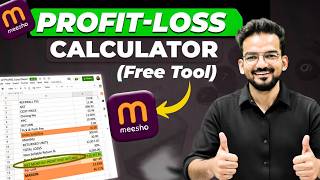
The video is a step-by-step tutorial on calculating real profit or loss on Meesho, using a practical example of selling a T-shirt at ₹299. The host breaks down every cost component—GST, commission, customer acquisition cost, RTO, returns, shipping, and taxes—and provides an Excel sheet for sellers to replicate the calculations.
The selling price on Meesho is always inclusive of GST. For items under ₹1000, GST is 5%. The formula to remove GST is: Selling Price × 100 / (100 + GST%). For ₹299, it's 299 × 100/105 = ₹284.76 (rounded to ₹284). The difference (₹14) is the GST collected from the customer.
Meesho does not charge any commission, so the commission line is set to zero. This simplifies the calculation.
CAC is the ad spend divided by delivered orders. Example: ₹3000 ad spend for 80 delivered orders gives a CAC of ₹37.5 per order. This is subtracted from the revenue.
RTO (Return to Origin) occurs when a customer rejects a shipment. The courier return loss formula is: (packaging loss × (courier return % - damage %)) / delivered orders. With 15% courier return, 2% damage, and ₹20 packaging loss, this equals ₹3.25 per order. Customer return cost: (average return loss × return rate) / delivered orders = (₹160 × 5%) / 80 = ₹10. Damage cost: (product cost × damage rate) / delivered orders = (₹100 × 2%) / 80 = ₹2.5.
Meesho may charge shipping, so a standard ₹50 is assumed. Packaging cost is ₹10. These are subtracted as losses.
TCS (Tax Collection at Source) is 0.5% of the selling price without GST, and TDS is 0.1%. For ₹284, TCS is ₹1.42 and TDS is ₹0.28.
After subtracting all costs (CAC, RTO, returns, damage, packaging, shipping, TCS, TDS) from the net settlement of ₹172, and adjusting for GST inputs (₹3.22), the bank transfer is ₹168. After deducting product cost (₹100), the final profit is ₹72.
Selling at ₹99 with lower ad spend (₹1000) and product cost ₹50 results in a loss of ₹38. Even with product cost ₹30, the loss is ₹18. The host emphasizes chasing profit, not sales.
The video provides a comprehensive, formula-driven approach to calculating Meesho profitability, highlighting the importance of accounting for every cost. Sellers are encouraged to use the provided Excel sheet to accurately assess their own profit or loss.
What is the GST rate for items sold under ₹1000 on Meesho?
5%
00:46
What is the formula to remove GST from a selling price?
Selling Price × 100 / (100 + GST%)
01:13
How is Customer Acquisition Cost (CAC) calculated?
Ad spend divided by delivered orders.
08:11
What does RTO stand for and what does it mean?
Return to Origin — when a customer rejects a shipment or the address is not found, the product returns to the warehouse.
05:15
What is the formula for courier return loss per order?
(Packaging loss × (Courier return % - Damage %)) / Delivered orders
09:05
What are the TCS and TDS rates on Meesho?
TCS is 0.5% and TDS is 0.1% of the selling price without GST.
19:15
In the example, what is the final profit after selling a ₹299 T-shirt?
₹72
26:08
GST is included in selling price
Many sellers mistakenly calculate GST on the full price, leading to incorrect profit margins.
00:30CAC formula
Understanding CAC is essential for unit economics, a concept also used by startups like Sharp Tech.
08:11TCS and TDS deductions
These small deductions are often overlooked but affect net profit significantly at scale.
19:15Chasing sales vs. profit
Selling cheaply can lead to losses even with high order volumes, emphasizing the need for correct pricing.
26:37[00:02] a new episode of our Meesho learning series. Where I will show you step by step calculations using how to calculate profit or loss on Meesho. That's why look at it very carefully. Now you guys have come on my screen. Here inside the screen
[00:16] I am going to show the real profit calculation of Meesho. I am going to here I will show you the real profit calculation of MSHO and how pricing happens on Meesho. So the first thing is
[00:30] selling [music] price. Whatever you sell is always inclusive of GST. So let's say you are selling a T-shirt for Rs 299. Ok? If you are selling for Rs 299 then GST is included in it. Now what happens generally? If you
[00:46] sell a T-shirt for less than Rs 1000, it comes under 5% GST. Ok? So here it is less than 1000. Look, it is also written here with GST 5%. Meaning 5% GST is included in it. Now
[00:58] [music] there is a formula to calculate GST. It's formula in it. I will also give you this entire Excel sheet. Just understand carefully. You will get the sheet. Don't let him bother you that you don't sit down to write. Meaning okay
[01:13] ? So let's say it is worth Rs 299. So what is the formula you have used? It is 299 * 100 / what is the formula you have used? It is 299 * 100 / 105. You have to add that amount in 100 on
[01:25] which GST is levied on this product. Suppose it is a T-shirt and it comes under 5% product. Suppose it is a T-shirt and it comes under 5% GST, then 100 + 5 means 105. So GST, then 100 + 5 means 105. So whatever the amount is * 100 / 105. If
[01:39] whatever the amount is * 100 / 105. If your product comes under 12% then * 100 / 112 your product comes under 12% then * 100 / 112 and if it comes under 18% then * 100 / 118 and if it comes under 18% then * 100 / 118 and if it comes under 28% then 100 / 128
[01:51] and if it comes under 3%, then generally jewellery items come under 3% [Music]. So if [Music]. So if that comes then these 100/103 whatever percentage GST your product
[02:04] comes in, you have to add that amount to 100. If it comes in 5 then it is 105, if it comes in 12 then it is 112, if it comes in 18 then it is 118, if it comes in 28 then it is 128 and if it comes in 3% then it is 103, right? Selling [music] Price in 100 by that amount. Now what do people generally do
[02:21] ? He withdraws only 5% of Rs 299, which is the biggest mistake. Brother, you should understand that this amount is inclusive of GST. If I apply 5% on this then I am already calculating GST on the increased amount. How will I do it?
[02:35] GST is included in this. There is no need to pay GST on this. This is not excluding GST. This is including GST. So including GST. So GST [music] has to be taken out of this. So 284 is coming. How are you coming
[02:47] taken out of this. So 284 is coming. How are you coming ? Selling price * 100 by 105 is it okay? I also wrote the formula here. Now the remaining amount becomes GST [music]. The formula is applied here. Minus this.
[02:59] Your GST amount has arrived. So here is all the calculation with GST [music]. Here all the calculations are done without GST and this is the remaining GST amount. Now I have taken this in plus. Why? Because I have taken ₹14 from the customer. If I
[03:12] sold a T-shirt for Rs 299, then Rs 299 is including GST. But after removing GST it costs ₹24. Or if we look precisely, it will be around 24.76 i.e. 285. The ₹14 something that is coming is
[03:25] your GST amount which you have taken from the customer. Ok? Now after this comes the commission. Meesho never takes it, so it becomes zero. So here I made it zero. Now Meesho will not charge zero commission and Meesho will also not charge GST on it. If it was
[03:39] But Meesho does not accept it, so we have marked it zero. Ok? Now it's because of this. What is cake? Customer acquisition cost is how much money you spend to acquire a customer.
[03:51] [MUSIC] Now I've got Annex Two to take out the cake. I will explain this to you as well. After this, whatever customer returns we get, how much loss are we incurring on that. This will be the cost. This is also
[04:06] in Nx2. I have also marked each one inside. Look here N x 2 N x 2, I will Look here N x 2 N x 2, I will bold it instead of bulleting it so that bold it instead of bulleting it so that you will understand it better.
[04:24] whenever we enter something in Excel, These are some of the Excel formulas.
[04:36] ? I have put a single quotation mark. This is called a single quote. Some people call it an inverted comma. But when we say single comma, if it is
[04:48] spoken in technical language then it is called single code. Single quotation mark [music] Learn all these things as you go. Ok ? So what to do here? What have I done minus that cake we will reduce. Whatever we have taken from the customer. If
[05:02] we have earned Rs 284, we have sold a T-shirt worth Rs 284 to the customer. Actually, customer acquisition cost is how much money we spend to bring a customer [music] we will subtract that. We will [music] we will subtract that. We will
[05:15] RTO [MUSIC] What does RTO mean ? Return to origin means we packed it [nasal sound] and sent it through the delivery boy. But the customer rejected it on the way. If they refuse to accept it or the customer's address is not found, then
[05:28] it becomes RTO. He comes back to your warehouse as it is. So we incur a cost in that too. So I will add that here also. Return Damage: If the customer returns the product or the return is received in the courier and the product is damaged, then that
[05:43] too is our loss. We have to incorporate that too. Ok? Because the business runs on profit, we will calculate every single penny. Ok? After this, packaging cost, shipping cost. So first let me explain to you all these things related to Nx2.
[05:58] I have also selected it in this so that you can understand that we are talking about it. Ok? So what is the formula for removing the cake first? So what is the formula for removing cake? You can understand this by the example that we have sent a total of 100 orders.
[06:11] We received 100 orders. Ok? We received 100 orders. Now only 80 were delivered, meaning 20 orders were not delivered. So only 80 have been delivered. Consider 80 orders add spend of ₹3000. I am explaining this hypothetical situation here.
[06:27] Hypothetical means that I am explaining with an example. But here I am explaining with an example that 100 orders came. 80 I got delivered. 20 mine were not delivered. Ad spend was ₹3000. That
[06:43] my ad spend for bringing 100 orders was ₹3000. Ok? Now comes your courier return RTO rate including 2% of damage. I have also taken 2% of damage here. Ok? Because I know that there is
[06:59] RTO rate for courier return is 15% for this client. And the customer return rate here is 5%. Ok? Whatever your business may be, I have not taken this as an example, meaning I have not taken random figures. Rest of your
[07:15] business, if you are selling it inside Meesho, then you will be able to see inside Meesho what is your core return percentage and what is your RTO percentage. It's simple. There is nothing much mathematical involved. It is clearly visible
[07:28] What is the percentage of customer returns? So you can calculate from here what is your RTO percentage ? What is customer return percentage? And enter your numbers here accordingly. summarize. 100 orders came in, 80 were delivered. Ad spend was ₹3000 to
[07:44] bring those orders. The percentage of customer return, the customer return rate, my percentage, I have taken a random 5%. You can check it from your dashboard. The courier return percentage is the courier return RTO percentage [music] including damage
[07:59] RTO percentage [music] including damage 2% is my 15%. Again random figures you take your exact numbers. Ok? So [the music] takes a hypothetical situation. Now let's come to next to pay. Now we will take out the cake. So [music]
[08:11] what's the formula for cackling? Add spend divided by delivered orders. Ok? How many delivery orders did we have? 80. 80 orders were delivered. Our ad spend was Rs 3000. I have put the formula here. K5
[08:25] K5 by K4 3000 by 80 Okay, here comes our cake of ₹37.5, I have applied the formula, you just have to change the numbers here
[08:37] and it will automatically calculate your cake, okay, if you do n't know Excel then no problem, I will give you the sheet, I have applied the formula for each and every thing, I have also explained that look here are the figures, okay, code returns loss, I have taken an idea of code returns
[08:51] that [music] there is a loss in my packaging etc. Basically, mine he told me that I have this much loss on one packaging. So around ₹20 he is saying that when I take out the shipping level of my packaging etc., there is
[09:05] a cost of ₹20. So I took the cost of ₹20. 20 * placed in brackets is 15 - 2 and what is 15 - 2? That 15% was my courier return percentage. 2% was my
[09:17] damage. So we are going to take only the exact percentage of courier return. we are going to take only the exact percentage of courier return. Ok? So 15 - 2 is the percentage of damage removed from the courier return, so this is the exact percentage that
[09:30] goes into the courier return. Now understand how to get this [music] done. There are 100%. 100%. 100 orders means 100% 80% delivered. 100 orders means 100% 80% delivered. 20% survived. What happened to 20%?
[09:43] Courier return of 15% has come. It has also been damaged during courier return. during courier return. And customer damage came to 5%. Total ho gaye 100% that 80% out of 100 [music] delivered. 15% are courier returns
[09:56] including 2% damage and 5% are our customer returns. We got complete 100% marks. Ok? Now I had calculated a number for our returns that we have a loss of ₹20 due to packaging and whatever the packing etc. and whatever the
[10:10] packaging and whatever the packing etc. and whatever the shipping level is into bracket 15 - 2 means 15 is our courier return percentage minus 2% of damage, so this is our exact courier return percentage. Now after this close the bracket, then
[10:23] what is divide by 80 80? We had our deliver orders. So our courier return loss was ₹3.25, I have written it exactly here. And here I have put the formula. Look,
[10:38] Look, I have done this 20 * 15 - 2 / 80 here myself. Ok? If you want me to take it out from here, I will take it out from here because there are already numbers in percentage here. But I am telling you that
[10:51] figures will reach something different. Do not put percentage. 20 * 15 - 2 is 15% of 100, so it becomes 15. Now, for example, if you have 500 orders, I am explaining for example [music] and let's say 80% of
[11:08] your orders are delivered. So how many delivered orders have there been? 80% off 500 Dikha bhi deta hoon haath ke haath into [Music] 80% 400 orders. 400 are our deliver orders. Now the 15% that is coming to us is the
[11:24] core return percentage. So I will take 15% of it. 75 and 5% are our customer returns, add these 5% and it becomes 500. Here it is
[11:40] visible that you are getting Rs 500. So here I am also explaining to you that you should drive your things as per your convenience. I am putting it this way so that you will understand. You will see the sheet later and it will become clear. Ok ? So we have applied this formula here.
[11:53] Now if I were to take your numbers this way, what would I take instead of 15 ? 75 [music] takes it here because ? 75 [music] takes it here because 15% off 500 is 75. Ok? If I take 2% for damage
[12:07] 15% off 500 is 75. Ok? If I take 2% for damage then how much will 2% of 500 cost? Ok ? Let me know in the comments. Come on, let me tell you. 10 ok? So 2% of 500 is 10. And what were the total delivered orders, brother? 400.
[12:24] So how much will your loss be in this case? Worth ₹3.25 paise. Yours is also coming. It's coming out the same [music] because I've taken the numbers exactly. Meaning 80 15% 5% if these numbers go up or down for you then your number will be different. Now what we are doing is
[12:37] then your number will be different. Now what we are doing is how much loss I am incurring on the order. Brother, whatever loss we are incurring in returns, you will have to divide it on the order. So that you can increase the order pay cost. Ok? You will
[12:51] increase the order pay cost. Ok? You will comes the cost of customer returns. What is the formula for cost of customer returns ? Brother, I said that generally I incur a loss of ₹160 on customer returns.
[13:05] How will this look now? You go to your Meesho panel. You can see it on my screen. Go to Meesho panel. Go to Returns. Here you will see the Returns [Music] panel in Meesho and then to go here you have to go to your courier
[13:18] pickup. If you go here, you will see Generally you can see. However, it ranges between ₹155 to ₹175.
[13:32] I took a [music] beach average of ₹10. Ok? Because Meesho always charges forward shipping , it is not charged anywhere else, I will show you that later. But this much cost is bound to come in returns.
[13:46] If your product is returned, Meesho will not charge you for forward shipping Meesho will not charge you for forward shipping but will charge you between ₹150 or ₹155 to ₹175 depending on the courier company you have selected. Ok
[13:59] ? So this is that thing. So what do you have to do in this ? I am taking an average of 160. You also take an average of 160. What did I do with the formula here? Why 160 * 5? Because only 5% of my customers are returns. Ok? So whatever percentage is there, I
[14:12] took five here. Ok? Let's assume that your result is 10% instead of 5%. your result is 10% instead of 5%. So what will you do here? 160 [music] * Whatever percentage out of 100, if it's 10%, if it's 12%, take 12. 16 * 12 / 80
[14:30] What have I just taken? Only 5% of what we have is not about orders here. Here we are talking about percentage. So here I have made the formula accordingly, according to 100. You can check your number as per your convenience. Ok? So
[14:42] can check your number as per your convenience. Ok? So 160 * 5 / 80 is okay? The bracket is closed here. There is a rule of big mass. If you know a little mathematics. Whenever you install it, first put the bracket on it. Then
[14:59] we incur a loss of Rs 160 but when the returns come. Along with this we have 5% so I took five and have 80 delivered orders. So this is my cost per customer return, how much is my loss per customer return ? Of ₹10. The damage cost I
[15:15] ? Of ₹10. The damage cost I took is 100 * 2%. 100 * 2 because let's assume that the cost of my product is ₹100 per damage. Like I ₹100 is going to be the cost of my product. I will not be able to sell it further as it is damaged.
[15:28] So I took the cost of ₹100. I suffer 2% damage. So 100 * 2 close the bracket and divide by 80, there are 80 delivered orders. So your damage cost is ₹2.5 Now we are calculating all this but the cost of the order is
[15:44] Now we are calculating all this but the cost of the order is that whatever loss we have incurred on one order, within 100 orders, this much happened on customer return, this much happened on damage , this much happened on core return. We will divide all these on order. But we'll take it out
[15:56] on order [music]. Now this will help you understand. show you how to do it now. Now let's first put in the number that we just
[16:08] determined here, nx [music] from 2. So we will make CAG here -37.5. Ok? -37.5 which we have spent on ad but on order. We have spent Rs 3000 across.
[16:21] Spent Rs 3000 to deliver 80 orders. But we got that Rs 3000 done in 80 orders. But we got that Rs 3000 done in 80 orders. 37.5, you must have seen in Sharp Tech also, they talk about unit economics. This
[16:36] unit is running only on economics. [MUSIC] Okay? So -37.5 was our cake. I put that here. But whatever ads we spend inside MSHO, Meesho also charges GST on it. Why does he take it? Because whenever Meesho
[16:51] However, you get its input inside your GST portal which you claim. So that's why I made it -6.75 here because it's going away from us right now. We had taken this ₹14 from the customer. We ca
[17:05] n't even afford this. This will go to our GST portal. ₹14 came to us. We paid ₹6.75 to Meesho as GST. Ok? Move ahead. ₹10 customer return cost. I have taken this from here. Ok? -10 Now this is our loss.
[17:22] We do not have to pay GST to anyone on this. So GST will not be applicable in this. The cost of core return was Rs 3.25. Again this is my cost. I have a B show, I don't want to give it to anyone. So there is no question of GST. Return damage cost -2.5
[17:36] Here it is. We just took it out. So our loss was ₹2.5. Again I have a loss so I do n't have to pay GST here [Music]. The packaging cost I paid here is ₹10. Why did you take a minus? Because we are suffering losses. Meaning, it was spent in a
[17:49] losses are being incurred, those expenses and losses will go into minus here. Only what we are taking from the customer will go into profit. will go into plus. This is what I mean by saying this. So our packaging cost is ₹10. I had asked this to our seller.
[18:03] If you feel that my packaging cost is high then you can add that. And if you pay any GST on it, then enter that also. That I have paid so much GST [music] on that too. Ok? After this the shipping cost.
[18:15] Why am I paying for shipping costs here ? Now you will say that brother sir, there is no shipping charge in Meesho. Meesho then collects shipping from the customer. Takes. But MSHO charges you a lot of shipping as well [MUSIC]. You may never have checked it. Go and
[18:31] check your reports anytime. Meesho often charges you shipping as well. So I am going with a standard shipping amount of ₹50 here. I am
[18:45] sometimes it doesn't. Even if your sales decrease, you do not have to incur any loss. There is no need to incur any loss at all. So I am taking ₹50 here. We will not rely on whether Meesho will take the shipping or not. That's why I am charging ₹50 shipping in advance here, thinking
[19:01] I am charging ₹50 shipping in advance here, thinking that Meesho will definitely take my ₹50 shipping. Whether Meesho takes it or not. If you do n't take it, I will make profit. And if he is taking it, then brother, I am already making a claim, so I will not suffer any loss.
[19:15] Ok? Now TCS will come. What is TCS? Tax Collection at Source. Ok? Will not go into depth. It is the language of accounting. I will just tell you about it superficially so that you don't get confused. TCS is charged at 0.5%
[19:30] of the selling price without GST. So how much was 0.5% of selling Look, I have taken it out here, it was Rs 284 without GST, we took 0.5% of it.
[19:43] 284 without GST, we took 0.5% of it. After this TDS 0.1% of selling price without GST. You will be charged 0.1% on the selling [music] price without GST. So this is also our loss. I took 0.1% of it.
[19:58] Now I have subtracted all the expenses from the net settlement 284. I have subtracted all the expenses from the net settlement 284. I have ₹171 left. Ok? Or [music] If I tell you the exact number, then
[20:10] consider this number as 171.51. Ok? Like let me round this off. Here it
[20:23] rounded off to 172 only. Ok? In fact, I round everything off so that I round everything off so that you can understand things better.
[20:40] clearer to you. So this is your ₹172 which you have received as settlement from Meesho. Ok? And here it is - ₹3. [Music] What have I done? Out of the ₹14 that
[20:53] I received as GST, wherever I paid GST, my shipping cost was ₹50. So Meesho will charge GST on that too. definitely charge GST on that [music] because that GST has to be deposited with the government
[21:07] and the government will ultimately show it in your GST portal. So what this means is that I took ₹14 from the customer and then wherever I paid GST, I marked that. So – three means I already have inputs in the GST portal.
[21:20] I already have inputs in the GST portal. Ok? If you already have input then Ok? If you already have input then don't give it to me or the GST people. If Meesho, if GSC people tell me [music] that brother, you have taken ₹14 from the customer. You
[21:33] give us ₹14. I will say brother, I have brought 14. But brother, I have also given ₹7 to Meesho for ad spending. See that too it is showing in my input. He will say okay, give me the remaining ₹7. I would say why should I give the remaining seven? Brother, I again gave ₹9 to Meesho in the
[21:48] name of shipping cost. Ok. He will say okay. Now you are in profit. We have ₹2 for you. I will not give it to you sir. We will give it to you. Ok? Then you will say that no no, you have also taken ₹1 from me in the name of TCS.
[22:01] Test Collection at Source I want that too. ok sir. Let's go to -3. Right now 0% off selling price without GST which is coming here [Music], let me double it here
[22:13] so that something is visible because [Music] is not visible off 0.28. Now this cost of 0.28 paise of TDS,
[22:26] Ok? So what it means is that you have to take ₹3 from the government. Those who do not get it will be adjusted next month. So you always have to calculate GST separately. Because GST is never going to come into the pocket. If there is
[22:41] more left than the customer, you will give it to the government and if there is no left, the input will remain lying there. It will be adjusted next month and vice versa if you know if you take any expense for your office [music] any item, you should take it with your GST invoice,
[22:55] what will happen with that, for example suppose you take any electronic appliance for the office [music] take any electronic appliance for the office [music] fridge, AC [music] you take a cooler, you take a table,
[23:09] whatever item you buy, you must take GST invoice on that, what will that do, for example suppose or suppose I show you the remote of an AC. Now let's say this AC [music] is worth about
[23:21] Now let's say this AC [music] is worth about ₹65,000. Ok? So there is an AC worth Rs 65,000. I must have done a GST on this [music]. So what did I do? I took my GST input there. Now let's assume this input is already Rs 65,000. For example,
[23:34] if it is worth Rs 65,000 and I also had 18% GST on it, ₹55,000, then I had to pay an AC worth Rs 55,000. I have paid Rs 10,000 in the name of GST [music].
[23:46] So that ₹10,000 at least will come to me as input and I will adjust [music] next month. If you do not take input and if you have received sales from the customer, then I am showing you an order in which you are seeing ₹14. When your monthly 1000
[24:01] orders become 10,000 orders or 1 lakh orders, then this amount will be huge. If you sold 10,000 T-shirts, then how much did you make, brother? how much did you make, brother? This 10,000 * 14 took GST of ₹1,400.
[24:15] This 10,000 * 14 took GST of ₹1,400. Now tell MSHO to give the money. Then this amount looks big, right? ₹1400 has to be given to the government. Ok? So it will help you in that case. ₹10,000 will you say that everything else is fine? But I have also paid ₹1,000 there
[24:29] while buying the AC. So you claim that too. So that is your money. That will also be useful to you. Ok? So whenever you buy any item for the office, always take GST invoice on it and keep claiming it. Ok ? Now let's come to the topic so that we do
[24:43] n't get confused. I will remove this amount. So GST calculation will always be done separately because it will not come into the pocket. If any money is left, it will be adjusted next month. Otherwise it will have to be given to the government. Ok? So they don't count. Now here
[24:56] comes our ₹12 settlement that we received from [Music] Meesho. But what is our bank transfer here? Why would a 168 bank transfer be 168? Because
[25:08] Why would a 168 bank transfer be 168? Because I have taken 172 from Meesho. But what happened to ₹3 I have taken 172 from Meesho. But what happened to ₹3 ? It is showing ₹3 but this is more. Let me show you the exact number.
[25:22] 3.22 And here also some 171 something is coming. Let me show you this [music] too. We have to calculate every single ₹1 so that there is no loss anywhere. So it is 171.51. By subtracting 3.22 from this, some ₹18 gets transferred to your bank. Ok? Now
[25:39] the cost of the product, brother, whether I am selling a T-shirt for Rs 300 or a T-shirt for Rs 299, I have bought it from somewhere. The cost of making it has also been incurred. Understand it like this, this T-shirt of ours is a T-shirt worth Rs 299 which I am selling, there must have been a cost involved in making it.
[25:55] So I am assuming the cost to be ₹100. your cost is ₹100, I have deducted ₹100. So ultimately what do I have left?
[26:08] ₹72. I have withdrawn it through net settlement only. Because why not do it through bank transfer? Because GST calculation is also shown in it for explanation. Ok? But it has to be done through net settlement only because
[26:20] GST calculation does not matter much to us because if it happens then that input will be available. So I have kept the bank transfer point but I am also removing it in front of you so that you do not get confused. You are left with a profit of ₹72. Now you must have
[26:37] noticed that many sellers on Meesho sell very cheaply. For example, let's say you sell very cheaply. For example, let's say you bought a T-shirt for ₹50 and are selling it for ₹90 or ₹80. So let me take an example that if you buy a T-shirt for ₹50 and
[26:54] sell it for ₹90, ₹92, ₹98, ₹100, ₹15. As you will see on the screen, there are many sellers who are selling very cheaply. Are they selling it for less than 100 or for 101, 105, 110? So let me take an example, if we sold 100 for less than ₹100, what would we
[27:09] earn? Let's assume I am selling it for Rs 99. Ok? I am selling it for Rs 99. Ok? I am selling it for less than Rs 100. Including GST. Everything is the same. I am sure the returns etc. will definitely happen. Whatever you buy, in fact I am
[27:22] quality will be worse. There will be more returns in that. [MUSIC] Okay? So You say, no brother, I don't spend that much on ads. Let's make your point bigger. How much will you charge instead of Rs 3000? You will take tax of Rs 2000. I assume
[27:38] I would have charged only ₹1000 for 100 orders. Take 1000. Let's elevate your point. How much did our brother come? -12.5
[27:50] so the losses mean these returns etc. have become that much [music]. Okay, I will adjust. So here we have taken the cap of ₹12.5 which has gone into my ad spend. It will take this much. You will spend ₹1000 for 100 orders. The rest of the
[28:04] returns etc. will definitely come that much. Ok? Shipping cost now packaging cost ₹10. If you don't get 10, I would have spent ₹5. Let's take five. Let's make ? When you sell for 99, we are
[28:21] assuming that the ad spend will be less, that I will spend ₹1000 on ads, then Meesho will charge only ₹50 for shipping, so if you sell for 99, what did you earn, ₹11, MSHO
[28:33] gave you [music] net settlement and what did you get in your hands, now you will say that my product cost was ₹50, let's say you have incurred a loss of ₹38, loss of ₹38, now there are many such sellers selling for 99 at 95
[28:48] and we think that a lot of orders are coming. 1000 orders are coming in a day. 500 orders are coming. A lot of money is coming in. [Music] Money isn't coming in, it's going out of my pocket. The sale is coming. You guys are running after sales. Not
[29:02] chasing profits. Whereas you have to chase profit. So always keep in mind that you want profit. Sales will come. I don't want any [music] in the hall. Ok? So you see, if we sell for 99 rupees and reduce the ad spend to just 1000 rupees, then the cash comes to 15 rupees,
[29:19] less than 38 rupees, but brother, 50 rupees are going into shipping, contrary, we incurred a loss, okay, and if I had increased the ad spend, then
[29:32] this loss would have increased further. Suppose you say that the cost of my T-shirt will not be Rs 50 but Rs 30. Okay brother, take it for 30, still there is a loss of ₹18. What have you earned? I incurred a loss and didn't get anything. So I will always keep the pricing of the product
[29:47] absolutely correct. I control everything. Now you will get all such marketing and e-commerce related videos on this channel only. And here I have created a complete sheet of real profit calculation of Meesho.
[30:02] Go inside and watch the video. You will be asked a basic form. You have to fill that form. After filling the form, you will get this sheet. You have to download it and you have to use it. So make sure you download it so that you can
[30:16] check the actual profitability of your business whether you are making profit or loss. Now if I have I am posting two more videos here. You must remember to see this before leaving.




⚡ Saved you 0h 30m reading this? Transcribe any YouTube video for free — no signup needed.