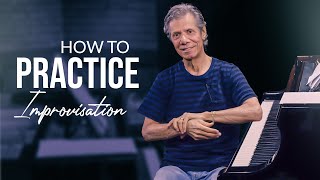

Improvisation Is Like Breathing
36sThe analogy of improvisation to breathing and walking is instantly relatable and sparks curiosity about a seemingly impossible skill.
▶ Play Clip"Title perfectly matches content; the video is entirely about how to practice improvisation using a gradient approach."
The speaker compares practicing improvisation to a newborn learning to walk, emphasizing a step-by-step or 'gradient' approach. The key is not to push beyond your current ability but to make small, manageable 'adventures' to avoid feeling overwhelmed and losing motivation.
The speaker equates practicing improvisation to fundamental activities like breathing or walking, suggesting it should feel natural.
The core recommendation is to use the 'gradient' principle: practice step by step, gradually increasing difficulty.
A baby learns to walk by falling and getting up repeatedly, without caring about failures, succeeding little by little until they can run. This is a perfect model for practicing improvisation.
Keep practice within your current ability level. Make 'smaller adventures' to avoid failure that can discourage further practice.
To practice improvisation effectively, adopt the gradient principle: start where you are and make small, manageable steps, avoiding the temptation to go too far beyond your current fluency.
What principle does the speaker recommend for practicing improvisation?
The gradient principle: step by step progression.
00:36
What analogy does the speaker use to illustrate the gradient principle?
A newborn baby learning to walk - failing, getting up, and gradually improving.
01:07
What should you avoid doing when practicing improvisation according to the speaker?
Going too far beyond your current ability level.
02:11
What happens if your practice adventure gives you a loss?
You may feel you can't do it anymore, meaning you are not practicing correctly.
02:26
Improvisation is like breathing
Sets the tone that practice should be natural and continuous.
Baby learning to walk
Powerful, relatable analogy explaining the gradient principle.
01:07Smaller adventures
Key technique to maintain motivation and avoid discouragement.
02:11[00:00] How do you practice improvisation and it's analogous to how do you breathe? How do you practice breathing?
[00:12] Like how do you practice walking? But anyway, whether it's walking, breathing, playing the piano, thinking, whatever you're
[00:24] practicing, as soon as you put the word practice in, as soon as you're studying something, you're trying to study it, to improve it, to make it better, my suggestion is when it comes
[00:36] to study that we use this principle that I've described in some detail in previous workshops, you can look over them again, called gradients.
[00:51] You do it step by step. Think of a new born baby, right? They're not walking yet, but they want to walk. So you know what, around one, around a year old or right around there, a year old, a little
[01:07] older, they start to get up on their feet, you know, how do they learn to walk? Well they walk, it's a gradient, you know how, you're wow, the first step, the parents go, wow, he walked, look, he took a stand, then he fell down, but then he got up and he
[01:24] walked again, right? It's a good example of gradient, you know, and then what is he, but you see the purpose that a taught has at that point to want to walk, he doesn't care how many times he falls down,
[01:38] he just keeps getting up and he keeps doing it and he keeps succeeding a little by little, you know, till he's running a marathon a couple of years later, right? So it's exactly the same principle of how you practice improvisation, like wherever you
[01:54] are, in terms of your fluency or how well you can get it going, you have to start there and just keep doing it, you keep doing it and doing it and doing it and if you don't stay,
[02:11] if you don't keep going too far over your current ability level, just keep pulling it back to where you make it smaller adventures, rather than making it, if you make it an adventure
[02:26] that gives you a loss and you go, I can't do that anymore, then you're not practicing correctly.
⚡ Saved you 0h 02m reading this? Transcribe any YouTube video for free — no signup needed.