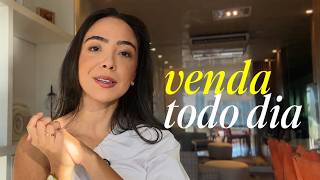

Selling is just being a bridge
45sReframes selling as connecting problems to solutions, reducing intimidation and appealing to beginners.
▶ Play Clip"The title promises selling anything online, and the video delivers a solid method, though it's more conceptual than a step-by-step guide."
This video presents a comprehensive sales method for selling anything online, emphasizing that selling is about connecting people with solutions rather than being pushy. The speaker shares personal experiences and outlines key strategies like active vs. passive selling, content creation, and sales funnels.
Selling is connecting a person with a problem or desire to a product that solves it; you are the bridge.
The speaker claims to have made millions in sales without spending a cent on advertising.
Started selling candy, cake in a jar, honey bread, and breakfast baskets as a teenager to earn extra money.
Learned to sell by going where people are, using Facebook groups and having his brother sell for him.
Active selling involves approaching customers directly; passive selling attracts customers through smell or content. Both are useful.
Using free ebooks or email sign-ups to capture leads for later conversion.
Content is no longer optional; it's necessary for visibility and attracting customers.
Products must align with the audience attracted by the content; e.g., not selling vegetarian meat to barbecue enthusiasts.
Top of funnel attracts many people via content; middle identifies those needing a solution; bottom converts buyers; loyalty and referrals follow.
Social media platforms like TikTok, YouTube, Instagram are channels to find or be found by clients.
Mastering the basics of sales—content creation, understanding your audience, and building a funnel—is crucial before refining strategies. The speaker offers free lessons via WhatsApp for those wanting step-by-step guidance.
What is the definition of selling according to the video?
Selling is connecting a person who has a problem or desire to a product that solves that problem; you are the bridge.
00:30
What are the two types of sales mentioned?
Active sales and passive sales.
02:48
What is 'digital bait'?
Digital bait is offering something free (like an ebook) in exchange for contact information to later convert into a sale.
04:22
Why is content creation no longer optional?
Because without online presence, you cannot be discovered, limiting your reach to existing clients or referrals.
05:41
What is the sales funnel?
A funnel-shaped process where at the top many people are attracted by content, then narrows to those who understand the solution, and finally to buyers, with loyalty and referrals at the bottom.
08:04
What is an acquisition channel?
A means by which you find your client or are found by them, such as TikTok, YouTube, or Instagram.
10:57
What should you do if a sales page has errors?
Test the customer journey yourself and show photos to others to ensure everything is working properly.
09:40
How can you get referrals from existing clients?
Ask satisfied clients to refer others and offer them a discount or benefit in return.
10:32
Selling as a Bridge
Reframes selling from pushy to helpful, reducing psychological barriers.
00:30Active vs. Passive Sales
Clarifies two fundamental approaches, giving sellers control over their strategy.
02:48Content Creation is Essential
Emphasizes that visibility is key; the most known product often sells best.
05:41Sales Funnel Concept
Provides a structured framework for understanding customer journey from awareness to loyalty.
08:04Acquisition Channels
Highlights the importance of leveraging multiple social media platforms for client acquisition.
10:57[00:02] sell anything online to earn extra income or even increase sales in an existing business. We know that selling might be the most practical and simple way to earn more
[00:16] money. But many people think they simply don't have the talent, that they don't know how to sell, that they can't do it, when in reality selling isn't a domino effect or something as difficult as it seems, much less pushing a product on someone.
[00:30] Selling is nothing more than connecting a person who has a problem or a desire to a product that solves that problem. You are the bridge between these two things. And when you understand that and understand how to be that bridge, you
[00:45] and understand how to be that bridge, you today I want to show you my sales method and explain step by step how to start selling anything you want without leaving home. And
[00:58] even if you're worried about, " Oh, but I don't have any investment in advertising, traffic, or anything like that." Relax, because in recent years I've made millions in sales without investing a single cent in advertising. And that's why I
[01:12] 'm the ideal person to tell you this. So , how did my story with sales begin? As you all know, I started from scratch. I always came from a humble family, and because of that I ended up having to fend for myself very early on,
[01:25] afford to give me extravagant things, like a cell phone or anything like that. So, I was a teenager who wanted to have those things and I started working very young. The first thing I ever sold in my life was candy. So, I used
[01:38] to sell cake in a jar and honey bread. Later on , I started selling breakfast baskets, I started selling everything you could imagine. At Easter I I sold Valentine's Day-related items . I understood that through
[01:52] selling, I could make some extra money in my life to save, I learned to sell in a very intuitive way, so I didn't know, I didn't exactly have a technique for doing it. I just understood that where there are people,
[02:08] people buy things, and if I have things to sell, I need to go where the people are. So, back then I was selling in Facebook groups. I got my brother to sell for me because he would go to college; he
[02:21] also worked in a very large industry with a lot of people, so I split the profit with him. He sold for me and also had an audience, you know, the traffic from the marketplace, which at the time was Facebook. That was around 2014
[02:34] . But today we have other marketplaces, including some that are even better for doing this. If it were today, I would easily put it on iFood or 99 Food. And here we get into what I want you to learn in this
[02:48] video. There are two types of sales: active sales and passive sales. What would active selling be in this context? It's when you go up to someone and say, "Hey, so-and-so, I'm selling this, do you want to buy it? It costs this
[03:01] much." That famous annoying salesperson that we generally have a certain prejudice against, thinking that to be a salesperson you have to be a pushy, insistent person who forces people to buy something they don't want. But that's not how it works
[03:13] . The problem is that many people, because they don't know or haven't mastered this technique, end up being pushy and annoying when trying to sell, which leads to us having this negative perception. But that has nothing to do with it. So, in real life, I'll give you an example.
[03:27] If you have a little park there, and all the children go to play in that park on Sundays, and the mothers and everything, and then there's a popcorn cart. What is active selling? It's when the vendor says, "Popcorn, popcorn, come here, so-and-so," and goes after the
[03:41] customer. Sometimes they hand out a free sample to generate interest in the person. So what exactly is passive selling? It's when someone walks by, he hasn't said anything, but she smells the bacon-flavored popcorn and gets a
[03:53] craving, so she gets in line to get her popcorn. There is no right or wrong, there is no, oh, the right thing is to be active, the right thing is to let the person come and see. No. But when you master both forms of selling, you gain more
[04:07] control over how much you will earn. Anyone who works in sales needs to know what to do to sell more. In a month that's slow, for example, and online it's exactly the same thing. You can attract people through
[04:22] content creation, through digital bait, as we call it, right? So, who hasn't ever entered their email address on a page to get a free ebook? This is nothing more than digital bait. Or sometimes you go to a website to buy
[04:36] clothes, an accessory, something, and it asks you to leave your email address , right? Then you'll start receiving promotions in your email. All of these are ways for him to get your contact information so he can later try to convert it into a
[04:49] sale. There is also a technique called social selling, where the person goes after the client. So, for example, you interacted with my profile, followed me, liked something, commented on something. Instead of waiting
[05:03] for you to want to buy from me at some point, I'll go there myself, contact you and say: "Hey, [name], I saw that you engaged with this content, this, this, this. Do you need anything?" Try to understand the person's context; there's a whole
[05:15] technique behind it. It's not just about doing this, but you can also make many sales when you pay attention to people like that. Some people will be annoyed, they won't respond, that's fine, you respect the fact that they didn't want to
[05:27] respond. And some people will respond and buy and repurchase, so that's good too. So, the first thing you need to master, regardless of what you sell—whether it's a service, a product, or whatever—as an affiliate or
[05:41] if you have a store, is creating content. Content today is no longer optional. So you don't have a "if I want to , if I like it, I'll produce content" mentality anymore. Today, a company that doesn't... Whether you're online or
[05:54] not, a professional who isn't online simply doesn't exist discover your work, you can't get recommendations, and you're left depending solely on existing clients or referrals. Like it or not, there's a
[06:08] limitation. It's kind of bad. The more you 're seen, the more you'll be remembered and consequently, the more you'll sell. What sells the most isn't always the best. Often, what sells the most is the most well-known. So, the first thing
[06:23] you need to do is master the content production process for your niche and start positioning yourself on social media. When you start producing content, you'll attract a certain type of audience. So, for
[06:36] example, the people watching this video want to learn how to sell, how to work from home, and earn more. I reach a group of people who have common interests. And then I'll start offering products that make
[06:49] sense for that audience's lives. There's no point in creating content about barbecues and then trying to sell vegetarian meat. It doesn't make sense. So, your products, your offers in general, need to be consistent with your target audience. With
[07:03] the content you're producing, it will often be the ideal product for that group of people to solve their unusual problems or desires. It's very important to know this because
[07:17] sometimes we say that someone went viral for the wrong reason, right? That's when someone goes viral just because, like the case of the girl in the right? But anyway, it went viral, great, but she didn't have anything specific to
[07:32] show. So you end up attracting a lot of curious people who will only stay while that trend lasts, and then they'll leave, they won't stay. Now, when you produce content that all has a theme talking about the
[07:48] same problem, the same desires of that target audience, then you start attracting customers to your business. So, on your social media, you always have to understand that it's like a shop window. There's a store there,
[08:04] service provider or you sell a product, you have your social media as a shop window, where you're showing what you know, the benefits of your product or your... The service you provide is the best among all the other profiles and
[08:19] today we know there are many. And then you develop your sales funnel. And the sales funnel has this name precisely because of its shape, where at the mouth of the
[08:31] funnel are people, where at the top of the funnel there are more people. It's a large number of people who are attracted by the content. For example, in the middle of the funnel are people who were attracted by the
[08:45] people who were attracted by the content, but also already understand that you have a solution. And then it will narrow down because there will be fewer people, and that's totally normal. You don't need to worry about 100 clicks
[08:58] you have, for example, on a product, not resulting in sales. If only it were that easy! If it were that easy, I'd already be like this. El Musk would be poor compared to me from how much I would have already sold. But it's not like that. We have one out of 100 people
[09:12] who clicked, sometimes two buy, three buy. That's the conversion rate. Right? Of how many people saw it, how many actually bought it? Because maybe someone saw it, clicked, but didn't like it. Maybe they clicked, but when they
[09:25] went to pay there was a problem. Maybe the photo wasn't good and then they took too long for them to receive the link and that's why they gave up. It could also be that sometimes the page takes too long to load. Many people lose
[09:40] a lot of sales simply because of errors on the page and they don't even know it. So you have to do the customer journey as if you were going to buy it yourself to test if everything is OK, if everything is in order. Show the photos to other people
[09:52] sense. Because sometimes what we , wow, I did this, it's wonderful, but for other people sometimes it isn't. And then we have the very end of the funnel, which are the people
[10:04] who actually bought. And then we usually try to build loyalty with these people, so we offer them more than one product, ask for referrals from other friends they know. For example, we have
[10:17] several, and this gets us into active selling, like at Espaço on the recommendation of a friend? That's exactly what they do, a more active selling approach where, say, " I've already acquired a client, and I know that
[10:32] person might know at least 10 other people who would also like to do what they did—the same purchase, the same service, the same product." So, why not ask that person to refer others who
[10:44] might be interested and give them something in return, whether it's a discount, a benefit, or something else? There are many ways to acquire clients. Always look at social media in general as an
[10:57] acquisition channel. An acquisition channel is simply a means by which you find your client or are found by them. So, TikTok is an acquisition channel, YouTube is another, Instagram is another. Every day there are
[11:10] people browsing there, and you can position yourself to attract their attention and convert them into clients. If you can understand these concepts... If you learn the basics and apply them, you'll already see great results. But I want to
[11:26] invite you if you want even better results and want me to take your hand and help you start from scratch. And if you 're that person, I'll leave the link to my WhatsApp in the description, and there I'll give you three 100%
[11:39] free lessons, in addition to helping you get started by understanding which product you should sell, which is the best affiliate platform for your case, which sales method to use, if you don't like to appear on camera, for example, everything you need to know
[11:51] to make money selling online. So, if you want to learn with me, the description, contact me there and then come back here to continue this content. Many times we end up underestimating the power of doing the basics well. So I
[12:06] look, I want to create an amazing sales funnel and I do a backflip. But I don't even know how to master the basics, I'm not even getting results with the simplest ones. So it's important to do the basics well
[12:20] first and then refine your strategies. If you only put what I told you here... In practice, you 'll already see great results.
⚡ Saved you 0h 12m reading this? Transcribe any YouTube video for free — no signup needed.