
Master the One-Handed Chip Shuffle
45sOpens with a mesmerizing visual of chip shuffling, immediately hooking viewers who want to learn the trick.
▶ Play Clip"Delivers exactly what the title promises: a clear, step-by-step tutorial on one-hand chip shuffling, though it includes a sponsor segment and some repetitive practice footage."
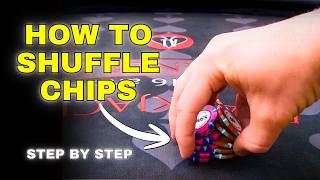
This video is a detailed tutorial on how to shuffle poker chips with one hand, a skill often used at poker and blackjack tables. The instructor breaks down the technique step-by-step, starting with basic finger placement and progressing to shuffling three, four, and five chips. The video emphasizes practice and offers tips for troubleshooting common mistakes, such as flipped chips.
The video is about shuffling poker chips with one hand. It is not for beginners; it requires learning specific finger placements and techniques.
The pinky and thumb work together on the right side of the two piles. The pointer and middle fingers are on the other side, and the ring finger pulls up on the far side, in the middle of the two piles.
Begin by pulling up on the right pile with the ring finger while simultaneously pushing together with the pinky and thumb, and the pointer and ring fingers. The ring finger mainly pulls on the right pile.
Slowly tip the chips up. The bottom chip of the right pile stays on the felt, allowing the other chips to interlace naturally. The tilt creates a weave effect.
When the chips are fully interlocked, use the pinky and thumb, and ring and pointer fingers to pull them together. This completes the shuffle.
Start with three chips, then add a fourth, and then a fifth. Even numbers of chips may be easier. Practice is essential; mistakes are common.
If the top two chips are flipped, simply flip them back. This is a common mistake, especially with five chips. It's okay to start over if needed.
If five chips are too difficult, stick with four to avoid looking foolish. The video also promotes Casino Supply chips with a discount code A1BJ.
Mastering the one-hand chip shuffle requires patience and practice, starting with three chips and gradually increasing the count. The video provides a clear, step-by-step guide to help you achieve this impressive skill.
Which fingers are used on the right side of the two piles during the one-hand chip shuffle?
The pinky and thumb are used on the right side.
00:41
What is the role of the ring finger in the one-hand chip shuffle?
The ring finger pulls up on the far side, in the middle of the two piles, mainly on the right pile.
00:54
What happens to the bottom chip of the right pile when you tip the chips up?
The bottom chip stays on the felt, allowing the other chips to interlace.
02:20
What should you do if the top two chips are flipped during the shuffle?
Flip them back to correct the mistake.
05:09
What is the recommended starting number of chips for practicing the one-hand shuffle?
Three chips.
04:13
Finger placement technique
Provides a clear, actionable breakdown of where to place each finger, which is the foundation of the skill.
00:41Interlacing mechanism
Explains the physics behind why the chips interlace, helping viewers understand the movement rather than just mimicking it.
02:20Progressive practice method
Recommends starting with three chips and gradually increasing, a practical approach to learning complex motor skills.
04:13Troubleshooting common mistakes
Addresses a frequent error (flipped top chips) and offers a simple fix, saving learners from frustration.
05:09[00:01] table, a blackjack table, or what have you. All right, it's going to be pretty the idea, this might not be the right video for you as I'm going into where to put every single finger, how to pull them up, and
[00:13] so on. And to get these chips nice and shuffled. So eventually like this. We'll even do it with four and five chips later, where, you know, you start with maybe a couple different colors like this, and after a few
[00:27] shuffles they come back together into their respective piles. All right, that putting my fingers and things? [music] How is this supposed to work? Kind of basic finger placement is your pinky and your thumb are going to work
[00:41] together on the right side of the two piles, if you kind of think of it that way. Um your If I hold it like this, your pointer finger and middle finger are going to be on the other side, and then
[00:54] your ring finger is going to be the one that kind of pulls up on the far side from you, all right, but in the middle of those two piles. So just kind of practice maybe grabbing the chips like that. Uh it's a little weird as, you
[01:09] the way back, and your other two fingers on the front side, and then you have to two piles with your ring finger. So just practice that for a few maybe grabs, all right, before you start pulling and so
[01:25] on to try to get those to shuffle together. All right, then what do we do? So if I have my position grabbed accordingly, we can kind of see it in this frame here. All right, then I'm going to start
[01:38] by sort of grabbing on this red pile here with my ring finger, and I'm going to slightly pull up on it. But at the same time, I am pushing together same time, I am pushing together with my pinky and thumb, and these other
[01:53] two fingers, my pointer and ring, those are going to be kind of forcing together this way, while my ring finger is pulling up on this red pile, the pile on my right. Okay?
[02:07] Um it does sort of rest This other pile does rest against, you know, my ring finger, but it's mainly pulling on that right pile. Okay? After that, I'm going to slowly tip them up. In so doing, you'll notice
[02:20] that both piles kind of go up. However, because I'm mainly pulling on the right uh if you look at kind of that stack of $5,000 chips, the bottom one sort of stays on the felt, which is good because we need We
[02:36] on the bottom, right? And then naturally they're going to want to start to kind of shift together. Now because you are pulling all of these ones up, but that bottom one's being left on the
[02:50] felt, the other the first one on the bottom of the red pile is going to want to start to interlace just like this. All right? Now the tilt that it makes is going to kind of make a
[03:05] weave. If you think of like how your fingers would naturally come together, if one goes above the other one, they're going to be offset, and so they're going to naturally kind of come together like that. Same thing is true with chips,
[03:19] okay? Now slowly pull up and they'll start to come together. Now this takes lots and lots of practice. You probably will not get this right away. Now as you come up just like this,
[03:33] then when you get to this stage and they're all sort of interwoven like that, uh they will just sort of fall apart if you don't do anything. And so what we want to do instead is use
[03:48] our pinky and thumb, and then our ring and pointer finger to pull those together when they are fully interlocked. So right here, see how they're all interlaced how they should be. Once you
[04:01] get to the top of how many chips you're shuffling, then you can start sort of together just like that. All right? Um once you get the hang of it with three chips,
[04:13] so I'm going to do it here until I can get them all back in their same colored piles, just like that. Then you might want to try adding a fourth chip. Okay? So let's do that here.
[04:29] takes to come back together with four. One, two, and just three. Three. So because it's probably a even number of chips,
[04:43] um it doesn't take that long. Okay? What about five chips now? still. So if you struggle, if you start to mess up, just fix it, all right? This We're We're just learning this together, right? So
[04:56] um like right there. See? I messed up. So instead, I'm going to take those top two and just flip them. That's how they should be. doing this several times, it might be kind of frustrating.
[05:09] fix it. Like there I did it again. For me, if I mess up, it's going to be those top two always get flipped. All right, so I'm pretty good at four. I'm still working on five. No by no means a pro. You can also go
[05:23] them all interlaced, then squeeze them together like that. Whoop, and there, see, I was going to apart, and we'll try that step again. Okay? It's okay if you're
[05:37] fine. Just try again. Just try again. There we go. So I might go kind of slow. And then eventually you can go faster.
[05:50] mess up, but since they're all the same color, doesn't matter a whole lot. colored piles. I'll try to go a little faster this time.
[06:05] And do it all together. So that time it was good. Whoop, there I messed up. Those two should be switched.
[06:17] slow. And there we go.
[06:29] Right there. together, then sometimes you might realize that you did something wrong. You have to start over again.
[06:43] So might have to separate these. Again, the point of this video is to kind of get good practice. So I'm probably not quite ready for four. I'm probably ready just or for five, I should say. I'm probably ready just for
[06:56] All right, I can usually get four pretty easily. And if you don't want to look like an idiot at the poker table or blackjack table or whatever, uh just do what you're comfortable with, all right? If five is too many for you,
[07:09] like an idiot. Uh maybe stick with four if that's your back in the right piles. Real quick, I want to show you guys this. This is Carlo chips that I was talking about. Here's a full chip set. You can also buy
[07:26] just uh these kind of individual stacks of them. price. Uh in fact, if you use my code A1BJ, you get 10% off your entire order there at casinosupply. Uh it's also good for
[07:40] cards, shoes, discard trays, things like that. Anything that you need custom poker night, or if you want to build your own blackjack table like I did. So your own blackjack table like I did. So use code A1BJ to get 10% off your entire
[07:54] All right, if you made it this far in the video, I want to know how many chips each pile? Is it three and three, four and four, five and five? Maybe you're a Let me know that down below in the comments. Also, [music] before you go,
[08:08] thumbs up. Until next time, remember, this is A1 Blackjack.
⚡ Saved you 0h 08m reading this? Transcribe any YouTube video for free — no signup needed.