
Stick Figure Channel Hits 67K Subs in 43 Days
50sThe incredible success of a simple stick figure channel with no face or camera in just 43 days is a shocking and inspiring proof of concept for aspiring creators.
▶ Play Clip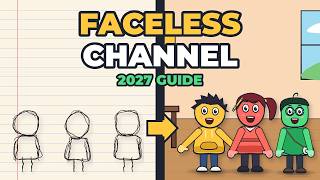
"The title promises a guide to starting a faceless cartoon channel, and the video delivers exactly that with actionable steps, examples, and tools, though it could be trimmed by 20%."
This video provides a comprehensive guide to starting a faceless cartoon channel on YouTube in 2027, covering everything from channel examples and monetization requirements to tools, budgets, and creative strategies. The creators illustrate the process by animating themselves live during the video.
The video starts with the hosts being drawn as stick figures, introducing the concept of faceless cartoon channels. They highlight a new channel 'Nobody Gets In' that gained 67k subscribers and 10.6 million views in 43 days.
A faceless channel is one where the creator never appears on camera. This video focuses on 2D cartoons, which are the cheapest to start and run on a normal computer.
Showcases successful channels like Kurzgesagt (25.8M subs), The Infographics Show (15.5M subs), Pencilmation (20.5M subs), and Psych2Go (13.2M subs), noting their simple art and strong writing.
Highlights newer channels like Dumb Doggo (846k subs, 114M views from 18 videos), EverythingProfessor (709k subs in under 2 years), and Historically (1.65M subs), proving the model still works.
Successful channels share: one clear character, one repeatable idea, videos 10-16 minutes long, and a consistent main color for easy recognition.
Uses vidIQ to estimate monthly ad earnings: Infographics Show ~$2k, Kurzgesagt ~$122k, Dumb Doggo ~$16.7k. Emphasizes these are estimates, not actual figures.
RPM (revenue per thousand views) varies by niche. A study of 300 channels found the median RPM is ~$2.30, with education/science channels earning ~$10 and kids content only ~$0.33.
Beyond ads, channels earn from shops, Patreon, memberships, and sponsors. For many, these streams are more lucrative than ad revenue.
To join the YouTube Partner Program, new creators need 1,000 subscribers and either 4,000 watch hours or 10M Shorts views in 12 months. Starting Feb 1, 2027, this doubles to 8,000 hours or 20M Shorts views.
In YouTube Studio, go to the Earn tab, fill two progress bars, then apply. You need to accept terms, connect AdSense, and enable two-step verification. A human review takes about a month.
YouTube removed 16 big channels for 'inauthentic content' (mass-produced, template videos). They won't pay for template videos, shock content, or AI characters without human decisions. Hand-made is now a selling point.
Creators must answer if a video is 'made for kids'. If yes, personalized ads, comments, and notifications are turned off, drastically reducing revenue (RPM ~$0.33 vs ~$10 for education). Answer honestly to avoid penalties.
Decide your audience first. Ask: What could you talk about for 100 videos? Who is it for? Use YouTube search suggestions and sort by 'Popular' to validate ideas. Look for small channels with viral videos to see what works.
Don't draw copyrighted characters, re-upload clips, or use copyrighted music. Use stories from your own culture or public domain folk tales.
Free tools: Krita (drawing), OpenToonz/Blender (animation), DaVinci Resolve (editing), YouTube Audio Library (music). Paid: Moho (animation, ~$60), ElevenLabs (AI voices, from $6/mo). Budgets: $0, $6/mo, or ~$28/mo.
AI helps with brainstorming, tightening scripts, licensed voices, and translating. It hurts when it writes the whole script (sounds generic) or generates every picture (inconsistent characters). Avoid mass-generating and uploading.
Write the first 15 seconds last. Aim for ~150 words per minute. Record voices before animating. Design characters with separate layers. Create a rough storyboard. Animate with small movements. Edit with voice, music, and sound effects.
For voices, generate each line separately for easy fixes. For rigging, use bones in Moho/Blender. Use a small set of mouth shapes (closed, open, 'oo', 'ee', M/B). Edit in Resolve using Edit, Fairlight, and Deliver pages.
Thumbnails should have one character, one big emotion, and 3-4 words max. Track click-through rate (CTR) and retention in YouTube Studio. Low CTR means fix title/thumbnail; low retention means fix the opening.
Use Shorts for discovery, not income. Cut two short clips from each long video. Add extra audio tracks for other languages, which is easy for cartoons with no lip-sync issues.
AdSense requires matching ID, verified address, tax form, and a bank account. Other income: memberships, sponsors, affiliate links, and your own products. Sponsors care about audience specificity, not just size.
Days 1-14: Pick your one-line idea, design characters. Days 15-45: One video a week (5-8 min). Days 46-90: Keep weekly videos, add Shorts, analyze what works, and make more of it.
Avoid copying another channel's style, uploading ten weak videos a day, using the free voice plan for monetized channels, marking the kids setting wrong, and quitting at video six (most people do).
The video summarizes 20 channels with 125M subscribers and 37B views, eight of which started in the last three years. Success comes from free software, a normal computer, and an original idea.
vidIQ
tool
Krita
tool
OpenToonz
tool
Blender
tool
Moho
tool
ElevenLabs
tool
DaVinci Resolve
tool
YouTube Audio Library
tool
Claude
tool
ChatGPT
tool
AdSense
service
YouTube Partner Program
service
Kurzgesagt
person
The Infographics Show
person
Pencilmation
person
Psych2Go
person
Cyanide and Happiness
person
OverSimplified
person
Sam O'Nella Academy
person
CGP Grey
person
Casually Explained
person
Escaping Ordinary
person
Simple History
person
IMR Scary Tales
person
Dumb Doggo
person
EverythingProfessor
person
Historically
person
Crayon Capital
person
StoryBox Animated
person
Paint Professor
person
The Life Outline
person
Nobody Gets In
person
New channels prove the model still works
Shows that success is possible for new creators, countering the 'it's too late' argument.
04:09RPM varies wildly by niche
Understanding RPM is crucial for choosing a profitable niche.
08:08YouTube's crackdown on inauthentic content
Highlights the importance of originality and human input, a key trend for 2027.
10:37The 'Made for Kids' switch is a revenue killer
A single setting can reduce earnings by 30x, making audience targeting critical.
11:33AI is a tool, not a replacement
Clarifies the right and wrong ways to use AI, aligning with YouTube's policies.
16:07[00:00] You don't. None of us do yet. We're scribbles. Because by the end of this video we're going to be finished cartoons, and the Before that. Can I show them the thing?
[00:17] This channel is called Nobody Gets In. Stick figures. One little guy in a red cap. Look at the join date. October first, 2026. Forty-three days. Sixty-seven thousand subscribers. Ten point six million views.
[00:35] With stick figures. With stick figures. From Egypt. No face, no camera. And here's the other end. Thirty-three videos in the whole channel, one point
[00:48] So today: how these channels work, what tools they use, what it costs, how the And somewhere in the middle, there's a setting, one little switch, that decides
[01:01] whether a cartoon channel earns ten dollars or thirty cents for the same With receipts. This video is brought to you by PartsPlain.
[01:16] First step of any cartoon. Rough shapes. Don't get attached. Let's define the thing. A faceless channel is a channel where the creator never appears on camera. It doesn't mean lazy and it doesn't mean robot-made.
[01:29] And we're doing one kind: 2D cartoons. Flat drawings, simple characters, a voice. It's the cheapest kind to start, it runs on a normal computer, and the characters My rule for this video. Subscribers, views, and the date a channel joined are
[01:45] public. We opened every page ourselves and took the screenshot. Those are facts. Income is not public. Nobody outside a channel can see what it earns. So any dollar figure you see today is somebody's estimate, and I'll say the word "estimate"
[02:01] Every time. You'll get sick of it. Kurzgesagt. Science in flat colourful animation. Twenty-five point eight million
[02:13] subscribers, four billion views, three hundred ninety-nine videos. That's about ten million views a video. Their banner says "Quality over quantity." Receipt. The Infographics Show. Opposite plan. Six thousand three hundred eighty-nine videos,
[02:30] fifteen and a half million subscribers, seven billion views. Their description Pencilmation. Cartoon comedy, almost no talking. Twenty and a half million
[02:42] Billion with a B. Psych2Go. Soft little characters talking about psychology. Thirteen point two Cyanide and Happiness. Began as a web comic. Twelve point nine million, five
[02:59] Some are. Now look at who isn't. OverSimplified. History with round-headed people. Nine point six nine million subscribers from thirty-three videos. Receipt.
[03:13] Sam O'Nella Academy. Look at the profile picture. That is the art style. A stick figure with hair. Four point eight million subscribers, sixty-nine videos. He looks better than you right now.
[03:27] CGP Grey. Stick figures. Seven million subscribers, a hundred ninety-five videos Casually Explained. Drawn like it was made in Paint, on purpose. Four point two
[03:40] Escaping Ordinary. Animated book summaries. Sixteen videos. One point seven five million subscribers. The owner writes in his own description that he has a Simple History, five point one million.
[03:56] And IMR Scary Tales, animated horror stories, one and a quarter million. See the pattern? Simple art, strong writing. A beginner can learn to draw any of these in a few weeks. What you can't fake is a good idea told well.
[04:09] Fine. But I can already hear the comment. "Those channels started ten years ago. Every channel in this part joined YouTube in 2023 or later. Dates on screen.
[04:22] Dumb Doggo. A dog drawn with about six lines. Joined March thirtieth, 2024. Eight hundred forty-six thousand subscribers. A hundred fourteen million views.
[04:34] Eighteen videos. About six million views each. Twelve minutes long on average. That dog is six lines and a red collar. I want everyone to sit with that.
[04:48] EverythingProfessor. A stick figure in a graduation cap. Joined January second, 2025. Seven hundred nine thousand subscribers in under two years. And see the Join button? That's paid memberships. You only get that button inside YouTube's
[05:04] Historically. Joined March 2023. One point six five million subscribers, five hundred seven million views, eighty-five videos. And read the first two words of their
[05:17] They put it in brackets at the front. Hand-made is a selling point now. Crayon Capital. Their line is "Big finance, drawn small." Joined March
[05:29] thirty-first, 2025. Three hundred five thousand subscribers from thirty-four StoryBox Animated. Animated stories. Joined September 2025. Two hundred sixteen
[05:41] thousand subscribers and sixty-two million views in under fourteen months. Paint Professor. From Sweden. Says "hand animated stuff" in the description. Joined
[05:53] February 2025, two hundred eight thousand subscribers. This one's my favourite. The Life Outline. Joined January 2026. Sixteen videos, ninety-two thousand subscribers, twelve million views. Now read the description.
[06:08] "Help me reach one thousand subscribers. Help me reach ten thousand. Help me reach You can watch the channel grow in three lines of text. And the one from the start. Nobody Gets In. Forty-three days old. Ten point six
[06:24] million views on videos about fourteen minutes long. I can't see inside their account, so I won't say they are. Here's what I can do. Say every one of those views lasted only one minute. That's ten point six million
[06:40] minutes. A hundred seventy-six thousand hours. The requirement is four thousand. On the lowest guess I could make. And look what they all share. One clear character. One repeatable idea. Videos ten
[06:54] to sixteen minutes long. Not one of them uploads ten times a day. Eight receipts say it isn't. Colour. One main colour each, so the viewer always knows who's who. Do the same
[07:10] Some screenshots show a panel from a tool called vidIQ. It guesses a channel's ad earnings for the month. For The Infographics Show it says about two
[07:22] Kurzgesagt, about a hundred twenty-two thousand a month. Estimate. Dumb Doggo, the six-line dog, about sixteen thousand seven hundred a month.
[07:34] Crayon Capital about eight and a half thousand. StoryBox about ten thousand You weren't kidding about saying it every time. Pencilmation. Twelve billion views. Same tool says a few thousand dollars this
[07:51] month. Their videos average about one minute. Short videos earn very little per And The Life Outline, twelve million views total, about nine hundred dollars this month. Because they haven't uploaded much lately. No new videos, the money slows
[08:08] Views are not money. There's a number called RPM. It means what you actually receive per thousand views. One study of three hundred channels this year found the middle channel gets about two dollars thirty. Education and science channels,
[08:24] And at the bottom? Last thing. Ads are one stream. Look at the links on these About pages. Shops,
[08:36] Patreon, memberships, sponsors. Historically has a sponsor right there under their top video. For many channels that's where the bigger money is. A handful at the top probably do. Most make a living. All of them started at zero
[08:54] Maya. What does a brand new channel need before it earns anything from ads? This is YouTube's own help page, not a blog. Two roads. Road one: a thousand subscribers and four thousand hours of people watching your videos in the last
[09:07] twelve months. Road two: a thousand subscribers and ten million Shorts views And the grey box underneath. Shorts views don't count toward the four thousand Now the change. Also YouTube's own page. Starting February first, 2027, new
[09:25] creators need eight thousand hours, or twenty million Shorts views. Still a Doubled. If you're already in the program, nothing happens to you. It's for new Eight thousand hours in plain numbers. Ten-minute videos, people watch half. Five
[09:41] minutes a view. You need ninety-six thousand views in a year. About two Dumb Doggo gets that every few minutes. But for a normal new channel it's months,
[09:55] There's also an early door. Five hundred subscribers, with three thousand hours or three million Shorts views. No ads yet, but it opens memberships and fan support. Say I hit the numbers. What do I click?
[10:09] YouTube Studio, the Earn tab. Two progress bars. When they're full, an Apply button appears. You accept the terms, connect an AdSense account so they can pay you, and turn on two-step verification on your Google account. YouTube's page lists all
[10:22] Then a real person reviews the whole channel. That usually takes about a month. Which matters for the deadline. Hitting four thousand hours on January thirtieth Now the scary headline. "YouTube is deleting faceless channels."
[10:37] Half true. YouTube has a rule against what it calls inauthentic content. Mass-produced, copy-paste, same template every day. In January this year sixteen big channels were removed for it. Thirty-five million subscribers between
[10:49] This summer YouTube named three things it won't pay for. Template videos where every upload is interchangeable. Videos made to shock or upset. And AI characters giving And what's safe?
[11:03] Your own script, your own characters, a story somebody couldn't get from a template. YouTube has said plainly that using AI tools is fine. An AI voice is fine. A channel where no human made any decisions is not.
[11:15] Look back at the new wave. "No AI." "Hand animated stuff." "Every film is written, researched, animated and scored for this channel." They're telling YouTube and the Okay. The switch. I've been waiting.
[11:33] Every time you upload, YouTube asks one question. Is this video made for kids? Yes or no. Cartoon creators get this wrong more than anyone, because people assume By law, YouTube turns off personalised ads on that video. It also turns off comments,
[11:50] And the money. Same study I mentioned. Kids and teens content, the middle channel receives about thirty-three cents per thousand views. Education and science,
[12:03] Thirty-three cents against ten dollars. For the same number of views. About thirty times less. Estimate, from a sample of three hundred channels. But the So I just say "not for kids" and collect the bigger number.
[12:19] No. And this matters. You answer honestly. If your cartoon really is aimed at small children, you must say yes. Saying no to dodge the rule can get the channel in real The real decision comes earlier. It's who you write for. Kurzgesagt, OverSimplified,
[12:33] Dumb Doggo, Crayon Capital. All cartoons. None of them are for small children. Which is most adults, apparently. A hundred fourteen million views on a dog.
[12:45] So decide your audience first, then the switch answers itself. Three questions. What could you talk about for a hundred videos? Who is it for? And Real ones from today. "Big finance, drawn small." "Complex things, simply
[13:02] explained." "I animate what it's like to be." How do I know anyone wants my idea? Go look. Type your subject into YouTube search and read the suggestions. Real
[13:15] people typed those. Then open a few channels in that space, go to Videos, and sort by Popular. In ten seconds you'll see which topics got ten times the views. And look for a small channel doing well. If a channel with twenty thousand
[13:28] subscribers has a video with half a million views, the topic did the work, not You never copy the video. You take the question it answered and answer it your While we're here. Copyright. Three rules. Don't draw somebody else's characters. Not
[13:45] the famous mouse, not the famous cat. Don't re-upload clips. And don't use music Stories from your own culture are the safest gold there is. Old folk tales belong to everybody, and nobody else has your grandmother's version.
[14:00] Then pick a length and keep it. Look at the new wave again. Eleven, twelve, Shopping list. And can I get a mouth soon? It's weird talking without one. Writing. A notes app is enough. An AI assistant like Claude or ChatGPT helps you
[14:16] outline and tighten, and both have free versions. Use it as an editor. You stay Drawing. Krita. Free, made for artists. Characters and backgrounds get drawn here. Animating, free. OpenToonz, free and open source. Or Blender, which has a 2D tool
[14:31] Animating, easier. Moho. You draw a character once, give it a skeleton, and pose it. The beginner version is about sixty dollars, one time. Pro is about four Still works, but Adobe put it in maintenance mode this year. No new
[14:48] Voices. Your own voice is the strongest choice. If you want AI voices, ElevenLabs is the common one. Read the pricing page carefully. There's a free plan, but the commercial licence starts on the six-dollar plan. For a channel you want to
[15:02] Six dollars is about thirty minutes of speech a month. Twenty-two dollars is Editing. DaVinci Resolve. The free version does everything you need.
[15:14] Music and sound effects from YouTube's own Audio Library. Free and safe. Thumbnails 2D is light. Minimum: Core i5 or Ryzen 5, sixteen gigabytes of RAM, a graphics card
[15:26] with four gigabytes, an SSD. Comfortable: thirty-two gigabytes and something like an RTX 3060. A gaming laptop from the last few years is fine. Nice. Not required. People start with a mouse.
[15:39] Three budgets. Zero: Krita, OpenToonz or Blender, Resolve, your own voice. Six dollars a month: the same plus licensed AI voices. About twenty-eight a month plus That's the whole business?
[15:55] Let's be honest. Half the people watching want to type one sentence and get a Where AI really helps. Brainstorming titles. Tightening a script you wrote.
[16:07] Voices, with a licence. Rough background ideas. Cleaning up audio. Translating your Where it hurts you. Letting it write the whole script, because it sounds like everyone else's. Generating every picture, because your character looks different in
[16:21] every shot. And pressing "generate" forty times a day and uploading all of it. That last one is the exact pattern YouTube removed sixteen channels for. At first. Then it flips. Once your characters exist, you reuse them forever.
[16:37] Same dog, same six lines, eighteen videos, a hundred fourteen million views. The AI-only channel has to roll the dice again every single shot. And the audience has started rewarding it. Two of the eight new channels we showed
[16:50] put "no AI" or "hand animated" in their description, unprompted. That's actually good. Yes.
[17:02] You've been rigged. That's what the pins are. Let's walk through one episode. One idea. Write the first fifteen seconds last, because they decide who stays. About a hundred fifty words a minute, so ten minutes is fifteen hundred words. Read it
[17:16] out loud. If you run out of breath, the sentence is too long. Record the voices before you animate. Always. Animation follows the voice. Design characters once. Head, body, a few mouth shapes, a few eye expressions. Every
[17:28] part on its own layer so it can move by itself. You watched us go through this. Rough storyboard. Ugly little boxes, one for every sentence or two. This is where Animate. Bring in the voice. Pose the character on the important words. Move the
[17:44] mouth. Then one small movement per shot. A blink, a head tilt, a slow push-in. You How long for a beginner? Your first one-minute scene might take a full day. By video ten it's a couple of
[17:57] Edit. Voice, then pictures, then quiet music, then sound effects. Sound effects Title and thumbnail. Make them before you finish the video, not at midnight after.
[18:11] Upload. Write the description yourself, add it to a playlist, and answer the kids Everybody says "just use the tool." Show me. Voices first, there are three of us. In a voice tool you pick a voice, paste a line, generate, listen, download. Do it
[18:27] speaker by speaker. All Sam's lines in Sam's voice, all Noah's in Noah's. Because you'll redo single lines. A joke that falls flat. A number read wrong. One file per line means you fix one line. Name them in order. Zero-zero-one Sam,
[18:42] Two tricks. Write numbers the way you want them said. And put a comma where you'd Rigging. Same idea in Moho, Blender or OpenToonz. The character is a stack of
[18:55] layers. You add bones, like a paper puppet with pins. To wave, I rotate one bone, move a few frames along, rotate it again. The software fills the middle. A small set of drawings. Closed, open, "oo", "ee", and one for M and B. You swap
[19:09] them in time with the voice. Moho can do a first pass from the audio, and you fix the How many mouths do the big channels use? Go watch the stick-figure ones. Some use two. Open and closed. Nobody has ever
[19:22] Editing. Resolve has pages along the bottom. You need three. Edit, for the timeline. Fairlight, for sound. Deliver, to export. Voice on track one, music on two and turned right down, sound effects on three, pictures on top. Export at
[19:37] 1080p. That file is your episode. Backgrounds last. And now the part nobody likes: a great video nobody clicks is a Look at these four. One character each. One clear feeling. Their thumbnails work
[19:52] the same way: one character, one big emotion, three or four words at most. Two numbers in YouTube Studio tell you if it's working. Click-through rate: of the people who were shown your thumbnail, how many clicked. And retention: how much of
[20:06] Low clicks, the problem is the title and thumbnail. Good clicks but people leave in How do I fix an opening? Start in the middle of the interesting thing. Don't introduce yourself. Don't say
[20:19] We started with me not having eyes. What about Shorts? Shorts are for being discovered. Long videos are for earning. The estimates I've
[20:33] seen put Shorts at a tiny fraction of long-form pay per view. And remember, So cut two short clips from every long video, and point them at the full episode.
[20:45] One more. Other languages. YouTube lets you add extra audio tracks to a video. A cartoon is perfect for it, because there are no real lips to match. Through AdSense. It's Google's payment system. Four things to get right. The name
[21:02] on the account matches your real ID. You verify your address, they post you a code. You fill in the tax form they ask for. And you add a bank account that can receive Check one thing before you spend six months on this. YouTube's page says you
[21:15] must live in a country where the partner program is available. Look yours up on Memberships, that Join button. Sponsors, a brand pays you for a mention. Affiliate
[21:27] links, you recommend a tool you use and get a small cut. And your own product. Escaping Ordinary sells mind maps of the books. Kurzgesagt has a shop. Sponsors can arrive earlier than you'd think, because brands care about the
[21:40] audience more than the size. Small and specific beats big and vague. Days one to fourteen. Pick the one line. Design two characters. Make a
[21:52] Days fifteen to forty-five. One video a week, five to eight minutes. Expect very Days forty-six to ninety. Keep the weekly video, add two short clips from each. Find
[22:08] the video people watched longest and make more like it. One, copying another channel's style or script. Two, ten weak videos a day instead of one good one a week. Three, the free voice plan on a channel you want to
[22:22] monetize. Four, marking the kids setting wrong. Five, quitting at video six. Everyone quits at video six. The Life Outline has sixteen. Dumb Doggo has eighteen. Count how far that is from six.
[22:36] Shapes. Colour. Bones. Mouths. A room. That's a cartoon cast. You just watched And everything that made us is on the list.
[22:48] Twenty channels today. A hundred twenty-five million subscribers. Thirty-seven billion views. Eight of them started in the last three years. One Free software, a normal computer, and an idea that's yours.
[23:03] Every link and every number is in the description. Tell us your one-line idea in Go draw something.
[23:26] We're a small team of people who take machines apart in 3D, piece by piece, to bring you knowledge you won't find anywhere else. If you enjoyed it, hit like and subscribe, and we'll see you in the next one.
The video opens with the hosts being drawn as stick figures, immediately creating a visual curiosity gap. The promise of revealing 'how these channels work' and the mention of a 'switch' that determines earnings hooks viewers into watching to uncover the secret.
You don't know [SECRET], but by the end of this video you will. [CHANNEL] gained [NUMBER] subscribers in [TIME]. Here's how.
AI-generated clip ideas for Shorts based on the transcript
The incredible success of a simple stick figure channel with no face or camera in just 43 days is a shocking and inspiring proof of concept for aspiring creators.
▶ Play ClipRevealing a single setting that can multiply earnings by 30x is a controversial and highly actionable tip that creators will want to learn and share.
▶ Play ClipThe absurd contrast between a ridiculously simple drawing and massive view counts is both humorous and motivating, challenging the need for complex animation.
▶ Play ClipA major policy change that doubles the barrier to entry for new creators is urgent news that will spark discussion and concern among the creator community.
▶ Play ClipThe fear of channel deletion is a hot topic, and clarifying what is safe versus what gets removed provides crucial, reassuring information for faceless creators.
▶ Play ClipSnapshot 2026-11-18
Every observation TubeSum recorded, plotted as measured.
The vertical axis starts at 17, not zero, so later observations stay readable.
Based on 3 observations · last observed Nov 18, 2026 · solid lines connect consecutive measurements (≤2 days apart); dashed lines span days TubeSum did not measure. · vertical axis focused on the observed range (starts at 17)
Based on 3 observations · last observed Nov 18, 2026 · solid lines connect consecutive measurements (≤2 days apart); dashed lines span days TubeSum did not measure. · vertical axis from zero
Exact daily observations; gaps mean no observation was taken that day.
| Date | Views | Avg views / hour | Channel median |
|---|---|---|---|
| 2026-11-18 | 22 | 0.3 | — |
| 2026-11-17 | 18 | 0.4 | — |
| 2026-11-16 | 17 | 0.5 | — |
Audience reaction — separate from the performance metrics above.