

Digital Products: The Ultimate Beginner's Guide
55sClear, actionable definition of digital products with examples, perfect for beginners seeking a quick overview.
▶ Play Clip"Delivers a solid beginner tutorial with actionable steps, though it includes some promotional content for Hostinger and .store."
This video is a comprehensive beginner's guide to selling digital products, covering everything from understanding what digital products are, to validating demand, creating, selling, and marketing them. The creator emphasizes solving problems and using niche-driven products to ensure sales, and provides practical tips on platforms, SEO, and marketing strategies.
The video covers what digital products are, how to know they have demand, how to create them, where to sell them, and how to market them. Digital products are created and sold online, delivered via download or subscription, with no shipping.
Digital products include templates, e-guides, e-books, courses, printable wall art, and more. They are delivered virtually and can be used immediately after purchase.
To avoid wasting time, create digital products that solve a problem or have demand. Instead of random planners, create niche-driven products like ADHD planners or social media calendars.
Think of things you're good at, problems you've solved, or skills like Excel or recipes. Use ChatGPT to generate profitable digital product ideas based on your inputs.
Competition indicates demand. Search social media and Google to see if similar products are already selling, which validates the market.
Creating a digital product once can generate consistent passive income. For example, a $20 product sold 10 times yields $200, covering your time investment.
More complex products like e-books can be priced higher than simple templates. The more time and effort put into creation, the more you can charge.
Options include standalone storefronts or marketplaces like Etsy. A standalone store offers long-term scalability, higher pricing, and more customization.
Hostinger is recommended for its AI website builder, making it easy to create a professional store and upload digital products.
Choose a relevant store name and custom domain to improve SEO and organic traffic. A .store domain is proven to increase visibility and trust.
Use tools like Canva or Kittl for e-books, templates, and guides. Canva offers customizable templates for various products, and you can export as PDF.
SEO is crucial for organic traffic. Use keywords in website copy. Free marketing includes Pinterest, social media posts with direct links, and content creation.
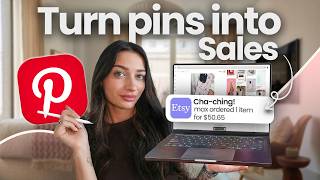
Pinterest is a search engine where users find ideas and purchase directly from pins. Use keywords and direct links to your store for conversions.
For faster scaling, run low-budget ads on Meta (Facebook/Instagram) targeting people looking for solutions. Start with $10-$20 to test clicks and gather data.
Research and create products that solve problems, take time in creation, ensure good branding, and stay consistent with SEO and marketing. Digital products can be sold infinitely.
The video emphasizes that selling digital products is a viable passive income stream, but success requires research, problem-solving, and consistent marketing. It encourages starting despite not feeling ready, as you can always improve later.
What is a digital product?
A product created and sold online, delivered virtually via download or subscription, with no shipping.
00:39
Why is it important to create a digital product that solves a problem?
To avoid wasting time and ensure there is demand, as people buy products that have a purpose or solve a specific issue.
01:10
How can you validate demand for a digital product?
Check if others are already selling similar products on social media and Google; competition indicates demand.
03:28
What is the passive income potential of digital products?
Creating a product once can generate consistent income; e.g., a $20 product sold 10 times yields $200, covering your time.
03:54
What are the pros of a standalone storefront over a marketplace like Etsy?
Long-term scalability, ability to charge more, less competition, and more customization.
05:16
What tool is recommended for creating digital products?
Canva or Kittl, which offer customizable templates for e-books, planners, and more.
08:40
Why is a .store domain beneficial?
It is proven to increase traffic and visibility on Google, and signals to customers that you sell products.
07:03
What is the recommended low-budget ad strategy?
Start with $10-$20 on Meta Ads to test clicks and gather data before scaling.
13:34
Solve a Problem
Emphasizes that successful digital products address a specific need, not just random items.
01:10Passive Income Example
Illustrates the financial potential with a simple calculation, making the concept tangible.
03:54Standalone Storefront Advantage
Highlights the long-term benefits of owning your store versus relying on marketplaces.
05:16.store Domain SEO Boost
Provides a specific, actionable tip for improving search visibility and customer trust.
07:03Pinterest as a Search Engine
Explains a unique marketing channel where direct links can drive conversions.
11:50[00:01] everything you need to know about selling digital products as a beginner. I'm going to cover everything so you can do this even if you've never sold anything online before. We're going to go over what exactly digital products
[00:13] are, how we can know that the digital products we're creating have a demand and that they'll actually make money, how to create our digital products, where to sell them, and how to market them to the right buyer. So, first, what
[00:25] is a digital product? Because a lot of times when people are new to this, they no idea what that actually means or classifies for. And honestly, there are a lot of products that can fall under the digital product category. So, in
[00:39] simple terms, a digital product is a product that is created and sold online and does not require any type of shipping. It is all delivered virtually by a download or a subscription where someone purchases it and immediately can
[00:55] use the product. And some examples of digital products can be templates, e-guides, e-books, different types of courses, downloadable printable wall art or templates. There's honestly a lot of different options. Now, with knowing
[01:10] what digital products are and types of products, something that is extremely important and often overlooked or skipped is knowing that you're creating a digital product that is actually going to sell. So, the best thing you can do
[01:24] to avoid wasting your time is to create a digital products that solve a problem or have a demand. Now, when I say solves a problem, you don't have to necessarily overcomplicate this, but essentially, what would someone have a purpose of
[01:39] buying this item, right? So, instead of just listing and creating a random just listing and creating a random planner or a random invitation template, it needs to have a reason as to why someone would purchase it. So, for
[01:52] example, instead of listing a again digital planner or calendar, it would need to be something that's relevant to maybe ADHD or a social media planner, a social media calendar. Um you know, something like that where
[02:07] it's more niche-driven and can solve someone's problem. It could also be if you want to create something more extensive like an e-guide or an e-book that can help someone with something or teach them how to do something or suit
[02:20] simple solutions to something. You'd be surprised how many people will actually buy the product versus if you're just creating something random. We have to make sure that someone is wanting it and that it does something that makes them
[02:33] range, but I like to tell people to think of things that they're good at, maybe a problem that you've solved, maybe you know how to create different printables or games for your kids or maybe you're really good at creating
[02:46] different social media stuff. Maybe you know how to use Excel spreadsheets or create recipes without seed oils. There are so many things that we're good at or that we've done that people will pay for your knowledge or for different tips.
[03:00] So, what I would do is I recommend writing down some things that maybe come to mind when you think of this or you know, past jobs you've done or things you've done and even just type them into ChatGPT and ask for profitable digital
[03:14] products that people are looking for or that could solve a problem for that specific thing that you type in. Next thing I want you to do is to check and see if people are already selling a product like that. So, why this is so
[03:28] important is sure, you may think, "Okay, but then there's competition." Yes, but competition means that there is a demand. There are people looking for that product or other people wouldn't be selling it as well. So, what I recommend
[03:40] for you to do is after you have your product ideas is take that to social media, to Google. Type it in and see what comes up. Now, with digital products, when we do create it one time, the income that starts coming in is
[03:54] you take two to three hours to create this product, maybe, you know, it costs whatever it is that you're creating, but then you're selling it for let's say $20. If you sell 10 of those, you've just made $200 and you already bought
[04:10] your time back. And then as that keeps selling, it's consistent passive income versus you having to factor in profit versus loss, right? It's already you're just paying yourself back for that. Now, typically, digital products
[04:25] that take longer to create or are more complex, you will tend to make more money on. So, for example, you can't charge the same amount for an e-book that's loaded with information as you can for a downloadable, you know,
[04:39] template, right? A one-page template. You can't charge the same price for able to price your product, the more just something I want you to think about when you're actually getting into this.
[04:51] Once you have an idea of what types of digital products you want to create, then we can think about where we want to sell our digital product on. Now, luckily, there are actually a lot of options online where you can sell your
[05:03] digital products, which is really cool. Now, there's the option to create your own standalone storefront or sell your digital products on a marketplace such as Etsy. Now, both have their pros and cons, but what I will say is that the
[05:16] you want a long-term scalable digital product business, I would definitely consider creating your own standalone storefront. Now, why I say this and why I think it's best to create a website is you have a more long-term strategy with
[05:30] it. You can typically charge more cuz you're not going up against all the competition that's on Etsy and is like showing all these different prices. And you're just a standalone store, so any traffic you bring in has a interest in
[05:42] that product that you're selling. And then you can also customize it a lot more when doing this. So, for this, I actually do recommend a site called Hostinger. This is because it's very easy to upload your digital products to
[05:55] and I like to use Hostinger because they actually have an AI website builder. So, and it will create you a website. This is an example of a Aligned and Online website that I was creating and like I said, I literally just added in some AI
[06:09] prompts and it created the site for me and multiple pages for the site and also can create AI blogs and add your products on here at very easily. Now, when you're setting up your store, I recommend you to look into names that
[06:21] going to be selling. This goes back to when we were doing our research and solving. How can we create a relevant name and almost storyline to our digital product business? And one of the things I recommend when you set up your
[06:36] website, when you do this, is to get a custom domain. So, what a domain is is how you would type something into a URL to find a site. So, when you're picking your store name, if it's relevant with what you're selling, it can really help
[06:50] you to get organic traffic through search engines like Google, like Instagram because when people type in the problem or solution into Google, your site can come up easier. Now, I personally like to use what's called a
[07:03] dot store domain. This is because it's proven to get you more traffic and visibility on Google because of the fact that it says dot store. [music] This selling products. So, it's really great for e-commerce and digital products
[07:18] sites because it lets not only the customer know that you are selling it can really help with your searchability. So, to do this, all you have to do is go to dot store and type in your brand's name or your website's
[07:32] name and select your dot store domain. I also have a special code in the description to get you a limited time offer for a 99 cent domain, which is really great. And then it overall is going to make your store look more
[07:46] professional and again, let people know that they can actually purchase from you. Lots of big brands have been using dot store because of how great it is, including myself as I am noticing higher traffic after making this switch. So, to
[08:00] a link in the description along with that code for the special offer so that you can go ahead and set it up and easily integrate it onto your online your branding to make it look professional and look better than having
[08:14] a generic URL [music] that people aren't going to trust. We purchase from us. And so, these are all small things that really do add up in the success of your store and for a long-term passive income stream. Now,
[08:28] let's talk about how to create our product now that we have our vision going, we know who we're selling to, and we know how we're going to actually sell and list the product. So, creating your digital product can be different
[08:40] depending on what type of product you're creating, but if we start from the basics, a lot of digital products like e-books, templates, guides [music] can be created in apps like Canva or Kittl, which is essentially where you
[08:52] can create different types of art or outlines online. [music] When you go to Canva, there's a template tab here and you can type in pretty much product you're trying to create. So, let's [music] say we wanted to just do planner
[09:05] as an example, you can search that and then all these different templates come up, which you can then go ahead and create to make and look as your own. Everything's all customizable on here, but there's so many templates depending
[09:17] So, if you wanted to create like an e-book, you could also do an e-book template and these sell really well. And again, what you would do is go in here and just add in your own information. So, it's laid out for you and you just
[09:31] own. And that's why you can utilize ChatGPT putting in [music] all of your here. So, if you just hit customize template, then you can go [music] in, switch out the photos and all of that and then you can export it as a PDF for
[09:46] purchase. And keeping in mind what I mentioned earlier about the more time you put into it and how full your digital product is can be more that you can eventually charge. So, maybe don't rush this process of the actual
[10:00] creation. Now, once your product is [music] created, the next thing that's going to be important is to market our products. Now, full transparency, when we're selling on our own storefront, we're not going to have right away
[10:15] traffic. Now, of course, with SEO, which stands for search engine optimization, this is something that's important. We talked about that in our domain and our store name, but it's also important in the copy and such that we use on our
[10:27] website because the more keywords we can use, the higher chance of getting organic traffic through search engines like Google, Bing, Yahoo, and all the other ones that are out there that people use, right? So, it's important to
[10:40] use a lot of keywords in the copy on our website. This doesn't have to be super we can make sure we're filling in our descriptions, and giving full instruction to what the product is. So, it's important that we get eyes to our
[10:55] actual product and store. So, there's a lot of ways to do this for free. Huge benefit of having things like Pinterest and social media marketing because they are free to do. Anybody can post a video or a photo on TikTok, Pinterest,
[11:08] Facebook, um Instagram with a direct link to go directly to your product, right? We see this with people doing Instagram and having people comment for a link and sending them the link directly to their inbox. Also do this on
[11:21] Facebook, creating content with a direct link, and utilizing you know, content to bring in free traffic. This method does work. Sure, it can be time-consuming, this is an income stream that we're really going to scale, these things do
[11:36] matter, especially if you don't have the capital up front to run ads. So, don't be intimidated by social media marketing. The best advice and strategy that I choose to do is to pick one platform first and master that platform.
[11:50] I always recommend Pinterest as well because it's such a unique platform, and it's different than social media. So, on Pinterest, it's a search engine, so people come here for ideas and inspiration and purchase pretty much off
[12:03] of a photo. So, on a pin, when you're creating one, you can use your keywords and your SEO and in your description, and then add a direct link to your store. So, when someone clicks on your pin, they're redirected automatically to
[12:17] your store, which can be really helpful in conversions. So, if someone clicks on their photo, they will see that they can click and go directly to your site purchase versus having to click your profile, go to the link in your bio, or
[12:29] comment. They can just directly click and go to that link to purchase. So, I the option, if you are somebody that likes to create content, and maybe you are creating your digital product business around, you know, major
[12:42] whole brand, that's when content can be really great. You can build out a TikTok, Instagram, or Facebook account where you're really talking about how to not for everyone. There's ways to do it faceless. There's a lot of different
[12:56] options, but these are all things to consider when you want to do free marketing strategies. [music] Of course, they take time, but you really can see the result. It really takes one video to get a lot of reach, and you'd be
[13:09] surprised as to how many sales can come from that. And [music] it is not saturated. There is room for everyone to succeed on social media. It is our future, so it is something that I do recommend you take some time into
[13:21] learning because it can definitely be beneficial and actually necessary down the line. And of course, you can run paid advertisements on your product, and if you're going to do this, I recommend picking a low-budget ad strategy, and I
[13:34] recommend doing it through Meta Ads, which is Facebook and Instagram, and targeting people who are again looking for a solution to your problem. What I mean by low budget is setting something on the lower end, like a $10 or $20
[13:48] budget to see if there's actually clicks and people [music] coming to your product. This can give you a lot of data and quickly. Ads are always going to be a faster scale strategy, but of course, it is going to cost money up front.
[14:01] yourself if that's the route you want to go and maybe [music] experiment. So, all in all, with digital products, it's important to remember a few key things >> We want to make sure that we're doing research and creating digital products
[14:15] that will actually sell and that we know have a problem or a reason why someone would purchase them. They're not just random. We also want to take our time in product creation, whether you're making one digital product or multiple on your
[14:28] store, take your time creating them. I promise that this will come back to you in your actual revenue. Doesn't mean to over-perfection it. You're never going to be fully ready, but it is a good thing to [music] take your time so you
[14:40] products. And we want to make sure [music] that our store looks good and that our branding is great and that our prices can reflect that for our actual much more you can charge [music] if your store looks and feels luxury or more
[14:55] high-end. Also want to make sure that we're doing our SEO and picking a marketing strategy that we can stay consistent with, whether that is social media or through paid advertisements. Reminder that digital products can be
[15:08] sold again and again infinitely. There's no limit on how many you can sell, [music] so it is something that is worth the time you put into it. And I want to just say that you're never going to feel ready to start. It's never going to be
[15:20] like, "Oh, now I want to start this." You have to put yourself into it. You can always come back and make it better. You can always add to it, but that started and get you going in a digital product business. Thank you so so much
[15:33] for watching. I'll leave any helpful videos I have in the description below, play next because YouTube [music] thinks that you will like it. Thanks so much. see more videos like this, and I hope to see you in the next one.



⚡ Saved you 0h 15m reading this? Transcribe any YouTube video for free — no signup needed.