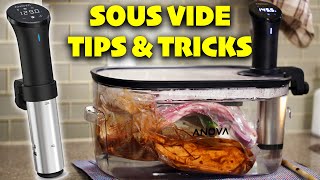
Top Tips for Sous Vide Beginners
40sIntroductory tips are highly searchable and shareable for beginners starting sous vide.
▶ Play Clip Kind of Cooking - Recipes You Can Make At Home!
"The title accurately promises tips and tricks for sous vide beginners, and the video delivers exactly that."
This video provides a beginner's guide to sous vide cooking, covering essential equipment, techniques, and safety tips. The host explains how to set up a sous vide system, prepare food, and achieve perfect results.
Use a container large enough to submerge food, such as a pot or polycarbonate container. Avoid styrofoam coolers as they absorb water and leak.
Cover with saran wrap, foil, or a fitted lid to reduce evaporation, retain heat, and save electricity.
Use heavy-duty freezer bags or vacuum sealer bags. Vacuum sealers are optional but helpful for high-temperature or long cooks.
A heavy-bottomed pan, like cast iron, is recommended for searing meat after sous vide. It retains heat for a quick, even sear.
Double bag or double seal for peace of mind to prevent water from entering and ruining the meal.
For vacuum bags without a sealer, cut the roll longer, use water displacement, and clip edges. Freeze liquids like marinade before sealing.
Ensure food is completely submerged for even cooking. Use weights like a fork, knife, or wire rack to keep food down.
Suggested temperatures are guidelines; cook to your preference but ensure pasteurization. Thicker cuts or multiple pieces require longer times.
Avoid temperatures below 125°F for extended periods to prevent bacterial growth. If in doubt, throw it out.
Sous vide allows extra time without overcooking, except for eggs and fish. Extremely long cooks (48-72 hours) may not improve texture.
Sear hot and fast to avoid overcooking. Chill meat in an ice bath or freezer for a few minutes to buy time for a thicker crust.
Save juices from the bag for pan sauces, gravies, or soup bases—referred to as 'liquid gold'.
Cook dishes at the same temperature (e.g., sous vide mashed potatoes and vegetables at 185°F) to save time.
Use cold water and set sous vide to 32°F (0°C) to circulate and defrost meat quickly.
Plan ahead and be patient for perfect sous vide results.
Sous vide cooking requires proper equipment and technique, but with patience and experimentation, you can achieve consistently excellent meals.
What type of container should you avoid for sous vide?
Styrofoam coolers, because they absorb water and leak.
0:28
Why should you cover the sous vide container?
To reduce evaporation, retain heat, and use less electricity.
0:35
What are the two recommended types of bags for sous vide?
Heavy-duty freezer bags and vacuum sealer bags.
0:51
What is the water displacement method?
A technique to remove air from a vacuum bag without a sealer by submerging the bag and clipping the edges.
1:53
How can you keep food submerged in the water bath?
Use weights like a fork, knife, or wire rack to hold it down.
2:32
What is the 'danger zone' temperature for sous vide?
Below about 125°F (approximately 52°C), where bacteria can grow.
3:31
Why should you chill meat before searing after sous vide?
To buy extra time for a thicker crust without overcooking the inside.
5:13
What can you do with the juices left in the bag after cooking?
Use them for pan sauces, gravies, or soup bases.
5:50
How can you cook two dishes at the same time with sous vide?
Choose dishes that require the same temperature (e.g., 185°F for mashed potatoes and vegetables) and cook them together.
6:01
How can you use a sous vide machine to defrost meat?
Fill a bucket with cold water, set the sous vide to 32°F (0°C), and circulate the water around the meat.
6:24
Container Selection
Emphasizes the importance of using a non-absorbent container to avoid leaks and mess.
0:18Double Bagging for Security
A simple but effective tip to prevent water damage to food.
1:42Experiment with Temperatures
Encourages personal preference while stressing food safety.
2:50Overcooking Tolerance
Highlights sous vide's forgiving nature for most foods except eggs and fish.
3:54Liquid Gold
Promotes using bag juices to enhance flavor in other dishes.
5:50[00:00] you got to be now what well let's get
[00:02] started here are the top tips for the CV
[00:04] beginner if you need to kind of cooking
[00:06] with your logs to the recipes and all
[00:08] that experiments as well so hit that
[00:10] subscribe button and make sure to click
[00:11] that notification bell so you get all
[00:13] our new videos so the first thing you
[00:18] need is a container so it can be a part
[00:21] it can be a cooler it can be a
[00:22] polycarbonate container I just make sure
[00:25] it's large enough to submerge your food
[00:26] and fit the sous-vide but one thing you
[00:28] should not use is a styrofoam cooler
[00:30] those absorb water and eventually you're
[00:33] going to water all over your floor you
[00:35] should also cover the container because
[00:37] it will help with the evaporation it
[00:39] keeps in the heat so it uses less
[00:40] electricity you can use saran wrap foil
[00:43] or you can get specially fitted lids and
[00:46] no actually makes a container that comes
[00:47] with the lid but there are many options
[00:49] out there for you to choose so the next
[00:51] thing you're gonna need our bags you can
[00:53] use freezer bags that thick heavy-duty
[00:55] ones you can get them in multiple sizes
[00:58] but these are the best or you can use
[01:00] vacuum sealer bags you can never rolls
[01:02] that you can cut yourself or you can get
[01:04] pre-cut ones and with the vacuum sealer
[01:07] bag this is not a necessity but you can
[01:09] also get a vacuum sealer and it will
[01:11] make some of your things much easier
[01:12] especially of cooking things at higher
[01:14] temperatures or for a long period of
[01:16] time and the last thing that you need in
[01:19] your starter pack is probably something
[01:21] to finish off your meat to sear it off
[01:22] and that is a heavy bottomed pan here's
[01:25] our cast iron pan they're relatively
[01:27] inexpensive and the last you a lifetime
[01:28] this helps to retain the heat and get
[01:31] you a really quick sear there are many
[01:33] different options and equipment that you
[01:34] can get to finish off your food we will
[01:36] have a video in the future going through
[01:39] that as well
[01:42] no matter what kind of bag you're using
[01:44] I always like to double bag or double
[01:46] seal and that's just so I have a peace
[01:48] of mind and waters not gonna get in and
[01:50] ruin my meal and if you do have a vacuum
[01:53] bag you don't always have to seal it
[01:54] with a vacuum sealer you can have the
[01:56] roll cut a little bit longer and then
[01:58] use the water displacement method then
[02:00] clip the edges to the side so this is
[02:03] especially helpful with things to have a
[02:05] lot of liquid and bonus tip if you do
[02:08] have something with a lot of liquid like
[02:09] fur marinade you can always freeze it
[02:12] and it makes it much easier to seal
[02:13] after that and if you are using a
[02:15] ziplock bag make sure that the zip is
[02:18] above the waterline you'll want to make
[02:20] sure your food is completely submerged
[02:22] in the water that way you can make sure
[02:24] water circulates and everything cooks
[02:25] around evenly and that's also because
[02:28] air is a very bad conductor or heat and
[02:31] there are multiple ways to keep your
[02:32] food down one of the ways that we do is
[02:34] that when we don't bag it we put weight
[02:36] in there we put fork knife whatever we
[02:40] find that's heavy enough to spider a
[02:41] knife not as sharp attack you can also
[02:44] use a wire rack or use pot lid holders
[02:46] to hold everything down as well
[02:48] [Music]
[02:50] now don't be scared to experiment with
[02:53] everything even the temperatures that we
[02:56] give you are really just suggestions
[02:57] there are so many to different opinions
[02:59] out there and you do you as long as you
[03:02] like it it's good to go
[03:03] that being said you want to make sure
[03:05] your food at least reaches a
[03:06] pasteurization point so for example the
[03:09] thicker the cut the longer you're going
[03:10] to need to cook it if you're cooking
[03:12] more than one piece of meat in the bag
[03:13] and you have two steaks maybe one inch
[03:15] each and you have them back-to-back it's
[03:17] not counted as one inch it's counted as
[03:20] two inches so make sure your temperature
[03:22] and your timing is for two inches a good
[03:25] reference that I use is from Douglas
[03:27] Baldwin and we've included the link in
[03:29] the description below you'll want to
[03:31] avoid the danger zone and those are
[03:33] temperatures that are below about 125
[03:35] give or take you'll want to avoid
[03:37] extended periods in that zone because
[03:40] that's when bacteria can grow and if in
[03:43] doubt throw it out if it ever balloons
[03:46] to it like something really big or if it
[03:49] smells off obviously don't go for it
[03:51] it's better safe than sorry one Pro for
[03:54] the sous-vide is that you can leave
[03:56] something in the water without
[03:57] overcooking it if you leave it in there
[03:59] an extra hour or two it's not going to
[04:00] make a huge difference except for eggs
[04:02] those suckers are really hard to master
[04:06] so anything else is okay not eggs and
[04:08] probably fish we've done I love Stevie
[04:10] experiments with eight and we've made a
[04:12] video about it as well so check that out
[04:14] now I've said that you can keep things
[04:16] in there longer but longer is not always
[04:19] better and I'm talking about those
[04:20] extremely long cooks 48 hours 72 hours
[04:23] we try to find a balance between the
[04:26] temperature and time because who really
[04:30] wants to wait that long for their food
[04:31] also the longer you keep it in there yes
[04:34] the more tender gets but some things can
[04:36] also become emotional all the times that
[04:38] we talk about that starts when the water
[04:40] reaches temperature it's always better
[04:42] to start with hot water from the top
[04:44] since you can save on your electricity
[04:45] bill and save your Suvi but also it can
[04:48] help you get to your cook faster by
[04:50] getting to temperature faster
[04:54] one thing about the Suvi is that when it
[04:57] comes out of the bag things are ugly
[05:00] some things are gray they don't look
[05:03] very appetizing and to fix that you're
[05:05] gonna want to sear it you want to sear
[05:07] it hot and fast
[05:09] since the meat has already been cooked
[05:10] you don't want to overcook it and keep
[05:12] it in there too long
[05:13] so the best way to get a longer sear and
[05:16] a better crust is to chill your meat put
[05:18] it into an ice bath or into the freezer
[05:20] for a couple of minutes and that way
[05:22] you'll buy some extra time for a nice
[05:24] thick crust does everything have a crust
[05:27] not everything has a crust some things
[05:29] don't need a crust now for some dishes
[05:32] you have to take extra steps after the
[05:34] Seabee to finish off the dish you'll
[05:36] want to do them in a very hot grill hot
[05:39] oven or hot pan and that's so it doesn't
[05:42] overcook the meat on the inside all the
[05:45] extra steps afterwards it's really to
[05:48] add an extra color and some extra flavor
[05:50] you want to keep your juices from the
[05:53] bag those are excellent for pan sauces
[05:55] for gravies for soup bases for your next
[05:58] dish I call liquid gold now we try to be
[06:01] efficient when we do our cooks we try to
[06:03] pair things up but that's under the same
[06:05] temperature for example the sous-vide
[06:08] mashed potato and CV vegetables they're
[06:09] both 185 degrees Fahrenheit so we put
[06:12] them together we make sure that both are
[06:14] submerged but now you have cut off your
[06:16] cook time by half and you have two
[06:18] beautiful dishes done at the same time
[06:20] so fine dishes that you can cook at the
[06:22] same temperature another great use for
[06:24] the sous-vide is to defrost your meat so
[06:26] I fill up my bucket with cold water I
[06:28] put my Suvi inside to zero Celsius or 32
[06:31] fahrenheit whatever the lowest it's
[06:33] going to go I put my meat in and let it
[06:35] circulate around and that will cut your
[06:36] defrost time by a lot and finally be
[06:40] patient it takes time but as long as you
[06:43] plan ahead you will have a perfect meal
[06:46] if you liked this video please give us a
[06:48] thumbs up it will help our video a lot
[06:49] and if you have any questions or
[06:51] feedback put it in the comment section
[06:54] down below
⚡ Saved you 0h 06m reading this? Transcribe any YouTube video for free — no signup needed.