
The #1 Mistake Beginner Digital Product Makers Make
45sHigh relatability and fear of failure hook viewers who are starting out in digital products.
▶ Play Clip"Delivers a solid, actionable validation process with a real example, though some filler and self-promotion pad the runtime."
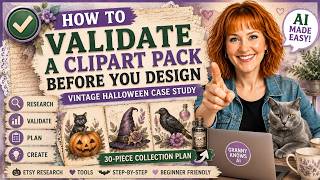
Fiona from Granny Knows AI demonstrates a step-by-step process for validating a digital product niche before creating clip art. Using vintage Halloween clip art as a real example, she walks through research on Etsy, Pinterest, and Creative Fabrica, then shows how to brainstorm, narrow a cohesive style, and plan a balanced 30-piece collection. The video emphasizes that research prevents wasted effort and leads to products that actually sell.
Beginners create products first and only later discover low demand or saturated markets. Validation before creation is essential.
The video uses vintage Halloween clip art to demonstrate the validation process, aiming to determine demand, customer preferences, style, and collection planning.
Research is about understanding the market, not copying others. It's like a gift shop owner finding out what customers want before buying inventory.
On Etsy, search the niche and look for repeated elements: colors, illustration styles, subjects, bundle sizes, and cover photo presentation. These patterns reveal customer expectations.
Pinterest shows what people save and are inspired by. Focus on mood, colors, and style rather than products. For vintage Halloween: autumn tones, faded creams, dusty oranges, aged papers, black lace, ravens, apothecary bottles, dried florals, Victorian decor.
Creative Fabrica shows designer-created assets. Look for gaps or areas less explored. Opportunity can be a better, more cohesive collection with stronger branding, not just a new niche.
Use ChatGPT to generate ideas for a cohesive collection, e.g., 100 clip art ideas for a Victorian vintage Halloween theme. The goal is completeness, not using every suggestion.
Avoid mixing everything (pumpkins, ghosts, skeletons, candy, etc.). Narrow to a specific style, like Victorian vintage Halloween: soft watercolor, muted colors, tea-stained elegance, old books, vintage florals, antique apothecary objects, black cats, ravens, beautiful pumpkins.
For a 30-piece pack, plan categories: 5 pumpkins, 5 black cats, 5 ravens, 5 witches, 5 apothecary objects, 5 florals. This keeps the collection balanced and consistent.
Use Clip Art Architect to refine prompts, Artistly to generate artwork, Photo P to clean up and export transparent PNGs, Canva for cover/preview images, Etsy Listing Writer for titles/descriptions/tags, and Bloom and Cell planner for tracking.
Vintage Halloween clip art is worth making: clear demand, customers understand the style, successful products exist, and there's opportunity for a cohesive premium collection with a unique aesthetic.
Validating a niche before creating digital products saves time and increases the chance of success. By researching patterns, narrowing a cohesive style, and planning a balanced collection, you can create premium products that meet customer expectations.
What is the biggest mistake beginner digital product makers make?
They create products first and only later discover low demand or saturated markets.
00:07
What is the purpose of research in digital product creation?
To understand the market, not to copy others. It helps you create products that customers actually want.
01:06
What patterns should you look for on Etsy when validating a niche?
Repeated colors, illustration styles, subjects, bundle sizes, and cover photo presentation.
01:38
What is the role of Pinterest in niche validation?
To see what people save and are inspired by, focusing on mood, colors, and style rather than products.
03:07
What is the opportunity on Creative Fabrica?
Sometimes it's not a new niche, but creating a better, more cohesive collection with stronger branding.
04:08
How should you use ChatGPT in the validation process?
To generate ideas for a cohesive collection, e.g., 100 clip art ideas for a Victorian vintage Halloween theme.
04:55
Why should you narrow your collection direction?
To make the collection feel like it was painted by one artist for one purpose, avoiding a mixed, incoherent style.
05:25
How do you plan a balanced 30-piece clip art collection?
Divide into categories: 5 pumpkins, 5 black cats, 5 ravens, 5 witches, 5 apothecary objects, 5 florals.
06:20
What is the role of Clip Art Architect in the workflow?
To refine prompts and organize the collection, saving time by thinking about the collection as a whole.
06:50
What is the final verdict on vintage Halloween clip art?
It's worth making because there's clear demand, customers understand the style, and there's opportunity for a cohesive premium collection.
08:03
Research is Understanding, Not Copying
Reframes research as market understanding, a key principle for beginners.
01:06Look for Patterns, Not Perfect Listings
Highlights the importance of identifying repeated elements to gauge customer expectations.
02:05Narrow Your Direction to Avoid Mixing
Emphasizes that a cohesive style is what makes a premium collection, a common beginner pitfall.
05:25Plan a Balanced Collection
Provides a concrete method for structuring a collection to ensure variety and consistency.
06:20Verdict: Worth Making
Summarizes the validation outcome, showing how research leads to a confident decision.
08:03[00:07] everyone and welcome back to Granny Knows AI. I'm Fiona and today I wanted to show you one of the biggest mistakes I see beginner digital product makers I see beginner digital product makers make. They get excited about an idea,
[00:20] spend hours creating a beautiful clip art pack, and only then discover that hardly anyone is searching for it, or that the market is already flooded with almost identical products. I've been guilty of doing exactly the same thing.
[00:37] So these days, before I create a single image, I always validate the niche first. Today we are going to do that together using a real example.
[00:49] Our niche is vintage Halloween clip art. By the end of this video, we'll know whether it's worth creating, what customers are looking for, style we should choose, and how I'm planning my own 30piece clip art collection. Let's
[01:06] get started. Before we open Etsy, I want to explain something important. Research isn't about copying other people's work. It's about understanding the market. Think about opening a little gift shop. You wouldn't buy hundreds of products
[01:22] without first finding out what your customers actually want to buy. The better your research, the better your products, and the less time you'll waste making things that don't sell. The first place I always start is Etsy. I'm
[01:38] searching for vintage Halloween clip art because I want to answer a few simple questions. Is anyone buying this style? What kinds of products appear on the first page? How are successful sellers presenting
[01:53] their collections? What colors and illustration styles keep appearing? I'm not looking for one perfect listing. I'm looking for patterns. As I scroll
[02:05] through the results, I can already see several things repeating. Muted vintage colors, watercolor illustrations, illustrations, old-fashioned pumpkins, black cats,
[02:17] old-fashioned pumpkins, black cats, witches, ravens, potion bottles, vintage labels. Those repeated elements tell me what customers already expect from this niche.
[02:29] I'm also looking at bundle sizes. a seller's offering 10 images, 30, 50, or 100. That helps me decide what customers see as good value. I also pay attention
[02:42] to the listing cover photos. The best ones usually make it very clear what's included, and they're clean and easy to understand. Presentation matters
[02:54] easy to understand. Presentation matters just as much as the artwork itself. Pinterest is one of my favorite places to research because people save ideas
[03:07] they're inspired by. When lots of people are pinning similar styles, that's often a good sign that a particular aesthetic is resonating. Here, I'm not thinking about products. I'm thinking about mood. What colors
[03:22] keep appearing? Are the illustrations whimsical or spooky? whimsical or spooky? Bright or muted, cute or elegant. For vintage Halloween, I'm seeing rich autumn tones, faded creams, dusty
[03:37] autumn tones, faded creams, dusty oranges, aged papers, antique books, black lace, ravens, old apothecary bottles, dried florals, and Victorian inspired decorations. These images help me build
[03:53] a visual direction before I even think about creating the artwork. about creating the artwork. Next, I like to visit Creative Fabrica. Creative Fabrica gives me another perspective because it's full of digital
[04:08] assets created by designers from around the world. Again, I'm not looking for something to copy. I'm looking for opportunities. Are there lots of similar bundles? Are they professionally presented? Do they all contain the same
[04:23] subjects? Or are there areas that haven't been explored very much? Sometimes the opportunity isn't finding a brand new niche. Sometimes it's simply creating a better collection with stronger branding and a more cohesive
[04:38] style. So now it's time to brainstorm. This is where I bring in chat DPT. Rather than asking it what will sell, I ask it to help me generate ideas for a cohesive collection. For example, I'll
[04:55] cohesive collection. For example, I'll ask for 100 clip art ideas that all fit within a Victorian vintage Halloween theme. The goal isn't to use every suggestion. The goal make sure my collection feels
[05:09] complete. Very quickly I can build a list of objects, florals, decorations, animals. Now comes the most important decision. This is where many beginners go wrong. They try to include everything like
[05:25] pumpkins, ghosts, skeletons, candy, monsters, haunted houses, bats, cute characters, scary characters. Everything ends up mixed together. Instead, I want
[05:38] my collection to feel like it was painted by one artist for one purpose. So, I'm narrowing my direction to Victorian vintage Halloween. Soft
[05:50] watercolor, muted colors, teastained elegance, old books, vintage florals, elegance, old books, vintage florals, antique apothecary objects, black cats, antique apothecary objects, black cats, ravens, beautiful pumpkins. Everything
[06:04] belongs together. That's what makes a premium clip art collection. Now I can plan my pack. Rather than randomly generating images, I decide exactly what I want to include. So for my 30 piece collection, I might create five
[06:20] collection, I might create five pumpkins, five black cats, five ravens, five witches, five vintage apothecary objects, and five coordinating florals. Planning like this keeps the entire collection balanced and gives customers
[06:36] plenty of variety while maintaining a consistent style. Once my planning is complete, I move on to clip art architect to refine my prompts and organize the collection. This saves a huge amount of time because I'm thinking
[06:50] about the collection as a whole rather than creating one random image after another. After that, I'll generate the artwork inside Artistly, keeping the prompts consistent so every piece looks like it belongs in the same set. When
[07:05] the artwork is finished, I clean everything up in Photo P. This is where I remove backgrounds, tidy up rough edges, and export clean transparent PNG files that are ready for customers to use.
[07:20] And finally, I'll bring everything together in Canva to create my Etsy together in Canva to create my Etsy cover image, preview images, and promotional graphics. At that point, I'll use my Etsy listing writer to
[07:34] I'll use my Etsy listing writer to create my title, description, and tags before tracking the product launch inside my Bloom and Cell Etsy planner. Each tool has its own job and together they create a complete workflow from
[07:48] idea to finished product. So is vintage Halloween clip art worth making based on everything we've researched today? I think the answer is researched today? I think the answer is yes. There's clear demand. Customers
[08:03] already understand this style. There are successful products selling which tells us buyers exist. and I can already see opportunities to create a more cohesive premium collection with my own vintage shabby chic aesthetic.
[08:18] Most importantly, I now have a clear plan before I spend hours generating artwork. That's exactly what validation is all about. If you've enjoyed following this process, in my next video, I'll actually
[08:32] create this 30piece vintage Halloween clip art pack from start to finish using clip art pack from start to finish using Artistly Photo PE and Camber. If you'd like access to the planning worksheet, prompts, and extra resources, they're
[08:47] available inside the digital design club. If you found this video helpful, I'd really appreciate it if you gave a thumbs up, subscribe to the channel, and left me a comment telling me which niche you'd like me to validate next. Thanks
[09:02] so much for watching, and I'll see you in the next video.
⚡ Saved you 0h 09m reading this? Transcribe any YouTube video for free — no signup needed.