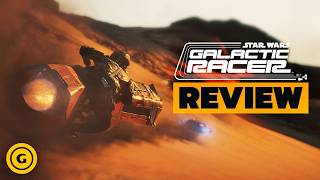

Star Wars Racer is ABSURD (and that's great)
52sChallenges expectations by highlighting the game's silly premise, sparking curiosity and debate among Star Wars fans.
▶ Play Clip"The title promises a review and delivers exactly that, though the content is padded with personal anecdotes and repetitive praise."
This video is a review of the Star Wars game 'Galactic Racer', highlighting its roguelite structure, absurd racing fantasy, and the tension between its engaging gameplay and lackluster story presentation.
Unlike recent Star Wars games that emulate science-fantasy drama, Galactic Racer embraces silliness and absurdity, focusing on a racing league rather than moral battles against an evil empire.
The protagonist Shade returns to racing for revenge against Testar Bull. The story's mystery setups are intriguing but the payoff is disappointing, with stiff voice acting and emotionless character models.
The game is structured as a roguelite: players must qualify across planets, and crashing or losing sends them back to the start. This creates a rewarding loop of repeated attempts and progression.
Each run randomizes two or three paths with different event types (races, trials, mysteries, eliminations), adding risk-versus-reward tension and variety.
There's no guiding line or rewind function, placing full responsibility on the player's quick decisions at high speeds, enhancing the sense of danger and immersion.
Tracks feature narrow tunnels, obstacles, and sharp turns, encouraging tight maneuvering and making players feel faster, with some planets offering alternate narrow routes for safety.
Players earn points and cash to upgrade stats and buy parts. The game encourages experimentation, with no entirely bad parts, and losing a run forfeits upgrades but unlocks permanent starting stats.
Over 15 hours, players unlock new play styles, ally favors, and vehicles, keeping runs exciting. The roguelite framing makes repeated playthroughs deeply rewarding.
Later acts add more planets, hazards, sponsors, and a betting system, turning short runs into lengthy gauntlets that test all honed skills.
Some tracks have confusing signposting, and the lack of an in-universe soundtrack is a missed opportunity, with repetitive racer dialogue becoming grating.
The game captures the exhilarating joy of high-speed racing, described as 'an absolutely perfect 10 minutes expanded into a full game', and is the reviewer's favorite racing game in years.
Galactic Racer successfully translates the absurd fantasy of Star Wars racing into a tense, rewarding roguelite experience, despite its narrative and audio shortcomings. The gameplay loop of risk, reward, and progression keeps players coming back for more.
Absurdity as authenticity
The review argues that embracing the ridiculousness of racing is what makes the game feel true to the Star Wars fantasy.
Roguelite racing loop
The roguelite structure is a novel approach for a racing game, creating tension and replayability.
02:48No hand-holding
The absence of guiding lines or rewind functions heightens the sense of speed and personal responsibility.
04:27Encouragement of experimentation
The game's design rewards trying new strategies, avoiding the trap of a single 'best' build.
06:21Perfect 10 minutes expanded
The reviewer's analogy captures the game's core appeal: pure, exhilarating speed without unnecessary complexity.
11:21[00:00] I felt such a sense of whiplash jumping into Star Wars Galactic Racer after playing Zero Company. Unlike Zero Company and plenty of the other Star Wars games we've gotten in recent years, like Survivor and Squadron, Galactic Racer isn't trying to emulate the science-fantasy drama
[00:16] that defines the majority of the Star Wars movies and other assorted fiction. Instead, it's silly. We're not making morally great decisions in a fight against an evil empire here. No, we're trying to win a racing league in order to dethrone the comically evil rich competitor,
[00:33] mounting some kind of hostile takeover of the league. Oh, and we have an infinite number of chances to qualify, and protagonist Shade can walk away from the most violent of wrecks without a scratch. It's such a ludicrous situation that makes no sense if you think through the logistics of it for even a moment.
[00:52] And yet that very absurdity is exactly what racing in the Star Wars universe is all about. It sees competitors strapping themselves into barely functioning death machines to jockey against each other at breakneck speeds,
[01:04] while soaring past lava through narrow desert canyons, over acid-filled valleys, and alongside icy cliffs to the cheers and jeers of a bloodthirsty audience. Everything about the competition is comically ridiculous.
[01:17] And by leaning into that irrationality, Galactic Racer not only feels authentic to that fantasy, but it's also hilariously good time.
[01:31] You race through the game as Shade, a former racer turned cargo pilot who finds themselves brought back into the sport as both a favor to an old friend and as a means of seeking revenge against Testar Bull, an arrogant champion who longs Shade in the path.
[01:46] Galactic Racer doesn't do too much to set up the stakes for this plot, framing Shade's revenge through a lens of a mystery. However, while the mystique surrounding Shade, her relationship to Kessar, and ramifications of the racing league at large for the galaxy are all intriguing setups that drive much of the drama in the early hours of Galactic Racer's story, the payoff to these questions is disappointing.
[02:09] The story eventually tells us the answers, but they're often hand-waved off in brief conversations, while Shade and the rest of the cast barely show any emotion. The direction for the voice acting is pretty good, but the final result sounds a little stiff,
[02:21] and the character models barely move and don't seem to change expression at all. That was some fine racing, Shade! The crowd couldn't believe it! Thanks. Just all need a gun for now. Indeed.
[02:33] These shortcomings don't ruin the experience of playing Galactic Racer, but they do detract from any sort of emotional depth that might be provided by the story. The best part about the story is how it's framed. Galactic Racer's story is a rogue-lite, not a traditional single-player campaign.
[02:48] To face off against Testar, Shade has to first qualify to participate in the racing league, and to qualify they need to win qualifier matches across a number of different planets. If Shade is knocked out by crashing one too many times or losing an important race,
[03:02] among other disqualifiers they forced to fly back to the starting planet of Jakku and attempt to run again This is a fantastic gameplay loop for a racing game While the order of the plans doesn initially change the path shape takes across each one is up to you With every run Galactic Bracer randomizes
[03:19] two or three paths to progression, with each crossing into another at specific points that sometimes narrow down to only one way forward or ballooning out to multiple options, and each stop along the path is a different type of event. You might just be competing in a
[03:33] simple race, for example, or get asked by one of the other characters to help them test pilot a specially made vehicle through a trial. Some of my favorite events are mysteries, in which Shade meets up with a friend or a foe to talk. The mystery is you don't know
[03:46] which until you've already chosen the event. Most dangerous of all events are eliminations, which slowly knock out the racers who are falling behind one by one. Make it to the end, you'll earn extra rewards, but fail to keep up and you'll just lose the race,
[03:58] you'll be thrown back to the start of the coup. The limited choices of what you can do next creates this thrilling sense of risk versus reward. Aiming for harder challenges can mean earning enough improvements to your speeder to finally win that final qualifier,
[04:12] a very tough race on all but the lowest difficulty. Or it could be the one setback that sends you back to the chart. There's a palpable tension to the campaign, enforcing the narrative stakes in a way that the dialogue between races never manages to. That tension carries
[04:27] into the moment-to-moment action as well. There's no guiding line in Galactic Race, or no voice in your ear telling you where to go or what to do, and no rewind function to correct a mistake. This puts the entire onus of individual decisions in your hands,
[04:39] and you have to make them at breakneck speeds because you go fast. Between the rumbling of your speeder through your controller, the escalating blurring of the environment, and the use of sound to emulate flying top objects, you feel like you're hurtling forward at speeds that should kill you,
[04:54] and it's only your quick thinking that can keep you from a multitude of career-ending crashes with every laugh. This isn't a roguelite where you take stock of your options and make measured decisions. This is the slow accruement of muscle memory and honing of reflexes over repeated attempts
[05:08] to handle a rocket-propelled hover car. The design philosophy of each track leans into this idea, too. While each planet offers its own unique environmental challenges to deal with, almost all of the tracks feature narrow tunnels, obtrusive obstacles, and exceptionally sharp turns.
[05:24] While there are a few outliers, each track regularly pushes you into positions where you're jockeying against other racers for room and making quick judgment calls without a ton of space to maneuver. The tracks on some planets even encourage you to aim for the most narrow routes.
[05:38] You can temporarily escape a crew's burning sun in some places by avoiding the open fields of sand and speeding through the wreckage of a Star Destroyer, for example. If you want to keep your engines from freezing on Andor Prime,
[05:50] you can thread the needle through the dastardly cramped heat lamps scattered about each track. These tight spaces make you feel like you're going even faster, as you need to regularly squeeze past obstacles in the blink of an eye to get ahead.
[06:02] Managing to do so is exhilarating, and forcing or tricking an opponent into succumbing to their own speed and crashing is even more fun.
[06:21] Succeeding at events earns you more points to upgrade your vehicle stats like more powerful acceleration or tighter cornering, as well as cash to buy parts for your speeder for that particular run. I always loved purchasing parts that could maximize how much of a boost I could gain
[06:35] by drafting off opponents, or increase how long it could safely push a speeder's limited but extremely powerful ramjet into the red before it exploded and took me out with it. Anything to get that extra push.
[06:47] But I was never afraid to try something else and discover a brand new favorite strategy. I'm sure plenty of tier lists will come out in the wake of Galactic Racer's release, that will tell you exactly which parts you should purchase, and which you're better off avoiding,
[06:59] but I don't think there's actually an entirely bad one. This game encourages you to experiment, and doesn't punish you for trying something new, or adopting a different kind of racing strategy. As long as you get to the end, that's all that matters.
[07:11] If you don't make it to the end, you lose all the upgrades and parts that you put into your speeder. But you can take all the points you accrued based on your performance and individual events to unlock stronger starting stats for your vehicle. You can also use these points to purchase other types of vehicles.
[07:26] Start off with only the well-balanced land speeder, but the exceptionally fast speeder bike or quick-to-turn knife edge might be more your speed. There's a separate pool of points for buying visual upgrades, none of which do anything beyond ensuring your ride looks how you want it to.
[07:39] It was tough for me to move away from my starting line of speeder after all the effort I put into customizing its aesthetic appearance and starting stats that my speeder always began around looking and handling just as I wanted, but Clockwork Racer has a generous respec mechanic,
[07:53] so trying out the other two doesn't risk much beyond the time you used to test them out. In addition, fulfilling specific requirements or proving your worth to other characters during a run can unlock more starting play styles and ally favors for all future attempts.
[08:06] Play styles let you determine what starting equipment you have, like better shielding to take hits or an ion blaster to stun opponents, while favors give you even more bonuses, such as starting a run with a do-over if you disqualify
[08:18] or earning extra money for making other racers crash. Over 15 hours in the Galactic Racer, I'm still unlocking something new with each run. While this consistent sense of progression presumably can't last forever,
[08:30] Lasting this long has kept every run filled with excitement. It can be such a bummer to crash and burn just one or two events away from the final goal, but at least I know I'll have a bunch of cool new stuff to try out next time around. And man, do I just want to keep going for that next time around.
[08:44] The framing of a racer within the looping nature of a roguelike is so deeply rewarding to keep playing through again and again. Ultimately qualifying for the race is merely act one of the game's story.
[08:57] With each subsequent act, more planets are added, and the order in which you race across them changes. New types of tracks are added, as well as more environmental hazards like mines or storms or darkness.
[09:09] Sponsors start weighing in, asking you to complete challenges within a single run to curry favor and fortune, and a betting system lets you wager your cash that you'll beat a specific racer in a single event, allowing you to form brief rivalries for profit As the amount of features and mechanics grow the number of events you need to complete just to get to the next act keeps growing too What starts as a simple road racer where every run is 20 minutes eventually glows into a gauntlet where every
[09:37] skill you've honed is put to the test in a lengthy, planet-hopping adventure that can go for well over an hour on just one run. You can't save your progress within a run idle, beyond just letting the game idle and putting your console or PC into standby, which
[09:51] I often had to do, because racing near flawlessly for 60 minutes straight is pretty brutal. Every mistake I made near the end of my final run to the story filled me with a spike of dread, but reaching the end of a run and hitting a milestone in the plot always filled me with
[10:05] a rush of adrenaline and accomplishment. I still have yet to complete Galactic Race's final challenge. I choked on the second to last event of the run and had to sit down to write this review so that I could calm down, but all I can think about is trying again.
[10:21] Granted, it's not all perfect.
[10:33] While Galactic Racer has a good variety of tracks, a few of the tracks, especially those on the 2, have weird signposting that can make it irritatingly easy to get turned around and accidentally go the wrong way. And I can feel the lack of an excellent soundtrack as I continue to play.
[10:49] A few of the more recent Star Wars games have begun to dip into the culture of the galaxy far, far away, and a big part of that has been getting to hear what in-universe music and radio stations sound like. So I'm baffled Dr. Racer doesn't give me anything to listen to while racing,
[11:04] save for the general ambient noise of each planet, a brief triumphant or defeated score to mark any of my victories or defeats, and the recycled shouts, quips, taunts, and proclamations made by the assortment of racers You hear whenever Shade passes them, gets passed by them, wins against them, or loses against them.
[11:21] Around hour 8 or so, their prediction gets a little braiding, and having something else to listen to might have alleviated that shortcoming. Playing Galactic Race reminds me of my favorite parts of the most recent Forza Horizon game,
[11:33] the first 10 minutes. That initial drive sequence that introduces a new setting, gets you acclimated to the gameplay basics, and moves you from one track to another to let you play around with different vehicles in a bunch of different environments is so fun.
[11:47] It's all about hearing the roar of the crowd and the excitement in the announcer's voice, not needing to rely on the rewind mechanic, and just feeling the rush and exhilarating joy of going really, really fast in a cool vehicle
[12:01] as the world around you becomes a blur. Galactic Racer is an absolutely perfect 10 minutes expanded into a full game. Every moment feels joyfully fast.
[12:13] Every decision carries the weight of tension, and every run is a rewarding chance to learn, improve, tinker, and adapt, whether it ends in success or failure. I can't wait to keep playing what's been my favorite racing game in years.


⚡ Saved you 0h 12m reading this? Transcribe any YouTube video for free — no signup needed.