Cooking Steak with Lightning
45sThe absurd premise of cooking steak with lightning immediately grabs attention and sets up a high-stakes, unique experiment.
▶ Play Clip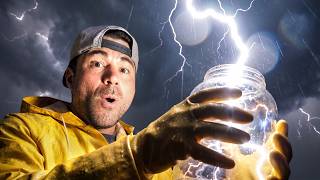
"Delivers exactly what the title promises — a steak cooked with lightning, plus a bonus car charge. High entertainment value with real science."
This video documents a multi-year engineering project to capture lightning in a bottle and use it to cook a steak and charge an electric vehicle. The team builds a rocket-triggered lightning capture system, tests various Faraday cage concepts, and ultimately succeeds after numerous failed attempts.
The goal is to capture lightning in a bottle, cook a steak with it, and potentially unlock unlimited free energy. The project takes over three years.
The project starts with a bet to recreate Ben Franklin's kite experiment. They learn that Franklin's goal was to prove the electrical nature of lightning, not to capture it.
With 4 million lightning strikes daily, capturing them could provide unlimited free energy. They set up an indoor lab with 500 kovt Tesla coils to test theories.
Static electricity from socks on carpet is analogous to storm clouds. Electrons build up until the air breaks down, creating a spark. In clouds, ice crystals rub together, building charge at the bottom.
Planes do get struck by lightning about once a year per plane, but passengers are safe because the metal shell acts as a Faraday cage, directing the current around the outside.
Chain mail, used for 2500 years, acts as a Faraday cage. They test a chain mail suit with a helmet against Tesla coil lightning, confirming it protects the wearer.
The crack of lightning is hundreds of sonic booms per second. The electricity heats air, causing rapid expansion. This is also why a door knob shock makes a snapping sound.
Rubber rain boots do not protect from lightning. The lightning runs down the outside of the boot and jumps to the ground, bypassing the rubber entirely.
To capture lightning, they need a lightning rod taller than everything else. Instead of building one, they plan to send a rod to the lightning via a rocket.
They visit the Laymir Lab, the only mountaintop lightning lab in the US. The lab uses rockets with trailing wires to trigger lightning strikes.
The rocket uses a bobbin with copper-coated steel wire that unspools to create an 11,000 ft tall lightning rod. The bobbins are over 75 years old from WWII army surplus.
The lab uses sensors like a noramorphic camera, vertical scanning radar, and a field mill to feed a lightning prediction algorithm. They aim to launch just before a natural strike.
The capture device includes a transformer, diodes (as one-way doors), and a super capacitor bank to store the captured lightning energy.
The first storm results in several failed launches. The team learns that timing is critical, with only about 2 seconds for the rocket to climb before the storm fires its own bolt.
They attempt to cook a steak using the lightning, but it gets a hole blasted through it. The electricity takes the path of least resistance, bypassing the high-resistance steak.
They successfully trigger lightning, but the capture device is overwhelmed and fails. The oscilloscope goes black, and the diodes are destroyed.
After failure, they learn and rebuild. They add snubber caps to the diodes to cushion the initial hit and build a lightning machine to test the new design.
After a year of work, they successfully capture lightning and charge a model car. The final mission involves charging a Rivian R2 with lightning power.
After 3 years, 28 failed attempts, and two rebuilds, they finally capture lightning in a capacitor bank. They charge the Rivian and move it 6 inches.
The project was impractical, but it was done to prove it could be done. The engineer admits he would not do it again.
The video demonstrates that while capturing lightning is possible, it is not a practical source of free energy. The project's success was a testament to persistence and engineering ingenuity, but the outcome was minimal (moving a car 6 inches).
Unlimited Free Energy Concept
Highlights the ambitious goal of capturing lightning for free energy, setting up the entire project.
01:38Faraday Cage Explanation
Provides a clear, practical explanation of why planes are safe from lightning, a common misconception.
03:38WWII Bobbin Reuse
Shows an innovative reuse of 75-year-old military technology for a modern scientific purpose.
08:20Engineering Iteration
Emphasizes the value of learning from failure, a core principle in engineering.
17:04Impracticality of the Project
Honest conclusion that the project was not practical, but was done to prove it could be done.
24:51[00:02] about to cook with actual lightning from this thunderstorm. >> Today, we're here to make history. Not only by shooting a rocket into a storm barbecuing my steak, but we're also going to be taking a portion of that
[00:16] Meaning, if everything goes according to plan, we'll be the first humans in recorded history to have captured lightning in a bottle. And we're not this up, we'd unlock the ultimate life
[00:28] hack of unlimited free energy from the sky. I knew from the beginning this would be an ambitious plan. What I didn't know is this would take over three grueling years to accomplish, leading to some of the coolest footage
[00:40] we've ever captured. >> By the power of Thor, what just happened? Now, all this started a few years back with a lunchtime bet between Eden and I on whether we could recreate Ben Franklin's famous kite experiment.
[00:54] to take advantage of some bad weather, >> honor, you're literally holding ONLY THE TAIL. SO, >> we were ready to get some answers. >> Come on, mother nature. >> Contrary to popular belief, Bren
[01:07] lightning. That was never the goal. The goal was to be the first to prove that shock you feel when touching a door handle. just scaled up a billion times. electrically charged storm clouds, he touched his knuckle to the key and
[01:22] triumphantly felt that familiar zap. And so after he flew our kite through some >> this is exhilarating. >> Utilizing 250 more years of scientific advancement plus a sick RC car, when we touched our key, our results
[01:38] >> were less extraordinary. But that got me thinking. Since there's 4 million lightning strikes a day worldwide, if you could somehow capture all that hack. And we would have unlocked unlimited free energy all around the
[01:52] world. So to test this bulletproof Shark Tank pitch, we turned Crunch Labs into our very own indoor lightning lab with a pair of 500 kovt Tesla coils. [music] zone, it's important to point out whether you realize it or not, you've
[02:07] walked around with socks on, you're basically scraping electrons off the want to stay there. But they're around you keeps them from leaving until you do something like reach for a metal door knob. And eventually, you get so close,
[02:21] the air loses, and all the electrons jump the gap, creating a little spark. And that little spark you feel is actual lightning. Because in a storm cloud, instead of socks and carpet, you have millions of tiny ice crystals all
[02:33] rubbing electrodes off on each other, where they then build up on the bottom of the storm cloud. And the air once again blocks them until the pressure gets so high the air eventually loses the battle and they jump to the ground
[02:45] jumps from your finger to the doororknob. Now our Tesla coils plug instead of [music] using wool socks or ice crystals, giving us lightning on demand to test questions I've always had, such as if planes are metal and way
[03:00] up in the sky, why don't they get struck by lightning? So to test this, I put a metal plane on a stand to see what the lightning thought of it. All right, there's our lightning source. This is a tall mountain. Let's see what happens.
[03:12] Plane gets struck by lightning. Three, two, one.
[03:24] So, it turns out planes do get struck by like like a lot to the tune of averaging one strike per year per plane. But if that's true, why everyone on it? And it comes down to the fact that the planes are basically a
[03:38] giant metal shell that we call a Faraday cage. And that essentially means all the lightning hits one end of the plane and all the electrons pass through the metal resistance exiting on the other side, leaving the passengers on board
[03:51] completely unaffected and safe. So the plane is sort of an inconsequential middleman. Just like if you put a spoon in between your charged up finger and a doornob. So, if a Faraday cage makes you immune to lightning, what if I made a
[04:04] human Faraday cage? Well, these actually exist, and they've existed for 2500 years. Chain mail. It's actually very flexible and stylish, but a good Faraday cage wouldn't be complete without a helmet.
[04:20] Guess it's more of a bird cage than a helmet, but it should do the job. Ian, out of curiosity, what happens if this helmet falls off? You will perish from this earth. >> Like reals.
[04:33] >> Yeah. Don't take the helmet off. >> So the physics says I'll be fine. Problem is physics isn't the one wearing the suit.
[04:47] >> You won't feel a thing. >> I'm feeling a lot of things. Okay. This is probably a good time to say I hate getting shocked. You got say I hate getting shocked. You got this, Rover.
[05:03] I'M ALIVE. [screaming] WOW. BY THE POWER OF GRACE.
[05:19] from the Tesla coils is actually hundreds of sonic booms happening per second. The electricity heats the air so hot the air expands quicker than the the exact same reason lightning causes thunder. And that little snap you hear
[05:33] when you shock yourself on a doororknob is also the exact same thing, just on a tiny scale. So you've not only conjured lightning, you've personally unleashed sonic booms. Now the only thing cooler than just conjuring up a half a million
[05:47] volts is doing it to a sick beat. It's those sonic booms happening hundreds of times a second. Speed that
[06:01] up or slow it down, and the frequency you hear changes, creating the different notes, effectively turning the whole room into a sonic boom box. [music]
[06:23] >> WHILE WE'RE HERE, I wanted to answer one more burning question I've had since I was a kid. Would rubber sold rain boots protect you from a lightning strike? All right, so I've got my umbrella. It's [music] time to see if wearing super
[06:36] thick rubber rain boots protects you from lightning. Kids, do not try this at home. >> Three, two, ONE.
[06:48] Turns out absolutely not because lightning doesn't even bother to go through the boot. It just runs down the outside and jumps to the ground like you see here. And by the way, even if the boots were 30 ft tall, it would do the
[07:01] what that is, but it smells like burning things. Now that we understood how about harnessing free unlimited electricity from the sky, we had one big strike the same place not just twice, but every time. And thanks to our buddy
[07:17] solution. Because right after running his kite experiment, he invented the lightning rod. But in order to attract every lightning strike, we need to have a lightning rod taller than everything else on Earth. Which made us realize,
[07:30] what if instead of attracting lightning to the rod, we sent the rod to the lightning by slapping it [music] on a rocket traveling 500 mph straight into the heart of a thunderstorm. And after doing some research, we found some folks
[07:43] who had a little experience doing just that. What's up, boys? >> This is Tobler and Broden, and they're college students working at the Laymir Lab, the only mountaintop lightning lab in the United States. Basically, they
[07:55] study storms, and instead of chasing them, they build really fancy equipment, on this mountaintop. >> Why am I so winded right now? it's pretty high up. The air is thinner.
[08:08] >> Actually, the concentration of oxygen is the same. It's just there's less air in >> These were clearly my kind of people. So, I asked to see some rockets. much like this. >> No, they look very different.
[08:20] rudimentary model rocket powered by off-the-shelf hobby rocket motors, but the real magic is right here at the bottom. It's called a bobin. And inside it has copper coated steel wiring that unspools behind the rocket when it
[08:33] launches 1,000 ft into the storm, creating what's essentially an 11,000 ft tall lightning rod. But what's really cool is the problem of spooling out wire at 500 mph without it snapping was already solved in World War II when the
[08:47] army needed to rapidly deploy telephone lines to span battlefields and cross rivers. Which is why every single one of their bobbins is over 75 years old and has [music] been cleverly secured from an army surplus store. Then they enclose
[09:00] with foil to protect them from the elements and wait for the perfect moment to fire. And that's where the main observation building on the neighboring mountaintop comes [music] into play. >> Hey,
[09:13] demonstrating all the super cool technology. >> Noramorphic camera >> used as sensors to predict lightning. >> Vertical scanning radar. Soapia field mill. High-speed spectroscopic [music]
[09:25] >> Oh yes, this is a salad bowl. Thank you for asking. >> And all those sensors then feed into one fancy lightning prediction algorithm. Some storms have regular pulses. Right before it's going to do it by itself, we
[09:37] >> We steal the thunder. >> We steal the thunder. >> Now that we knew how they were going to trigger the lightning, it was time for us to set up our device that would [music] capture the lightning to usher
[09:49] from the sky. >> Time to get a tool >> Time to get a tool >> with a 6second build montage.
[10:05] parts. The transformer is what touches the lightning. It grabs a slice of the strike and passes it through the diodes, which you can think of as one-way because electricity from a lightning strike actually wobbles back and forth
[10:18] like [music] AC current from the ground to the clouds and back again as many as [music] 20 times in one strike. So, all those one-way diode doors only let electricity through in one direction. From there, it lands in the super
[10:31] capacitor bank, which is where we store everything that we capture. So, all there was left for us to do was head home and wait for the first storm of the >> Campers, welcome to Crunch Labs. >> But, as I learned while shooting [music]
[10:43] the season 3 finale of Camp Crunch Labs, we didn't have to wait long toothpaste called to let me know a giant storm was coming >> No. >> Hey guys, I have good news. We're about
[10:58] to do something the first time in human history, which is capture lightning. >> Uh, I mean, it's like a royal we. I just had to tie up one loose end before had to tie up one loose end before hitting the road
[11:19] >> Good. >> Let's go. Time to catch flight. Coming through. This is NOT A DRILL. BACK TO WORK, DANIELLE.
[11:39] >> The weather's looking bad, which is good. US. >> MINNOW, [screaming] YOU IN?
[11:52] >> YEAH. YES, LET'S GO. >> I'LL BE watching with binoculars. >> And from the observatory, >> things look promising. over us. >> Hey team, doc said we're good to go.
[12:09] >> DOC, >> 3 2 1 >> Oh, I SAW IT. I SAW IT. >> WAIT, NOTHING. A
[12:21] >> and after four more failed launches over the course of the day, the storm had passed and we had to throw in the towel and head back home with no lightning to show for it. But a few weeks later, the next storm was on approach. So we headed
[12:33] back to New Mexico. Only this time, I'd be in the lightning bunker while Bam was calling the shots. And as you can imagine, while waiting for lightning to imagine, while waiting for lightning to strike, 152, 154, 156, 158, there's 12.
[12:46] >> there's two phases. >> You have to be pretty creative on how >> Oh, the hook. >> 10 11 12.
[13:01] >> All right. I didn't use >> Oh my god. >> Oh, I'm so sorry.
[13:14] something earlier. Now, the bad thing about being stuck 10,000 ft on a mountaintop is Door Dash can't get to us. But the good thing is you as you don't mind your steak cooked extra well because the lightning can do
[13:27] for our dinner to be cooked, they explained to me that they use air filled syringes to pneumatically press a button outside the bunker instead of using a typical electronic button to trigger the rocket because any sort of wire directly
[13:40] dangerous path for the lightning to make its way into the bunker. >> When's the right time? >> I think anytime now. >> It'll be very loud. >> Launching in
[13:54] >> Launching in >> 3 2 1. >> No lightning. >> All right, we're used to that.
[14:07] >> We had two more attempts that day before sadly the weather began to improve. And to be clear, what we were trying to do was really hard. All those sensors on the ground can tell you if the field is strong, but they can't see inside the
[14:20] cloud. And ultimately, the cloud [music] is the only thing that decides. And even if you guess right, you've got about 2 seconds for the rocket to climb before the storm fires its own bolt and the whole thing resets. And even though we
[14:32] knew all that going in, I just really thought this was going to be the day. [sighs] another day and no luck,
[14:44] which just sucks cuz it's like so much effort. [music] We're just going to keep trying. It's literally all we can do. We got this, I think. >> So, we headed back to Crunch Labs once again with no lightning to show for it,
[14:58] only to be called out to New Mexico a few weeks later for another round. >> Buff kiss >> of failed attempts and knowing I'd not be able to return for the rest of the summer. All I could do was leave them
[15:11] with the most scientific pep talk I could muster. All right, team. I have to go. So, the fate of humanity rests on your very capable shoulders. This is for science. This is for history. This is for mankind. This is so I didn't waste
[15:25] my whole summer. But most importantly, yeah, like the mankind, the history, and >> Bring it in. Bring it in. Bring it in. With the entire [music] mission now resting completely on their capable shoulders, they had 12 more failed
[15:38] rocket attempts over the next two weeks until finally on what was essentially the very last storm of the season, this glorious moment happened. glorious moment happened. >> Three, two, one.
[15:57] [laughter] >> Oh my god. >> And what's really cool to see is this bright straight portion here is actually
[16:11] the vaporized rocket wire as all the cloud electrons rush down from the lightning bolt. But what's not really cool to see is the oscilloscope screen going black the moment the lightning strikes, [music] which didn't bode well
[16:25] for our capture device. And sure enough, after further inspection, we discovered completely overwhelmed by the sheer power of the real lightning bolt, which meant while they were successful in triggering lightning, we had ultimately
[16:38] failed to capture any of it. And perhaps worst of all, the lightning hit the only tube that didn't have a stake attached. And since I knew this would be our last chance of the season, hearing all this news for the first time made for a
[16:50] pretty bummer of a phone call. >> So what? We just have to try again like in a full year. >> As badly as the stung, my favorite part about being an engineer is that when you fail, you're really just learning one
[17:04] more way not to do the thing. In this case, now that we had a whole year to those one-way door dodes failed because they got hit with a thousand times more the lightning dumped its electricity so
[17:18] fast. So, the fix was to bolt a snubber cap right onto each diode to cushion that initial hit, which keeps them working as one-way doors and lets the capacitors do their job of storing the lightning. To test the new design, along
[17:30] verification simulations, we built our own lightning machine using a bank of giant surplus capacitors that we slowly charge off a wall outlet and then dump all at once, hitting the lightning capture device with the same 30,000 amps
[17:44] enough, it took the hit without a problem. The same can't be said, however, for the bushel of fruit we just so happened to have lying around.
[18:10] practical objective. Of course, we were still looking to cook a steak. But city from this lightning bolt, we would start by just fully charging up my lab to verify our new design would work. And sure enough, after completely
[18:24] draining the battery on a model car, we were able to demonstrate that we could charge it back up simply through electricity from the sky. This just might work. Now that we were ready to go, all we had to do was wait.
[18:38] And in this case, we did have to wait long, but we kept ourselves pretty busy long, but we kept ourselves pretty busy in the offse.
[19:09] our offseason engineering, I was incredibly optimistic that infinite free energy was just within our reach. So, I loaded up my brand new Rivian R2. Who needs to drive when you could just do this all day. Let's go and headed up the
[19:23] mountain. And after a quick rebuild of the system, I left the team with one final pep talk. >> Okay team, it's your two. This is the part of video where we're gonna cue emotional music. We're gonna punch a
[19:38] little tight on me. And I say >> we're doing it for science. >> We're doing it for history. >> For history. >> FOR THE CHILDREN. >> WE'RE GOING to show up 5 days a week.
[19:52] >> Seven days a week. >> We've renegotiated the seven. Okay. If this team. Bring it in. >> All right. >> Let's go. >> All right. All right. 3 2 1.
[20:06] [laughter] >> I LOVE IT. OKAY. SEVEN DAYS A WEEK. YOU >> SO, I headed back to Crunch Labs, confident this year would be different. And on the first storm of the season, after 3 years of work, 28 failed rocket
[20:20] attempts, two full design rebuilds, eight uncooked stakes, and one RC car, this glorious moment happened. >> Please observe the path of this rocket. 3 2 1 >> [groaning]
[20:44] >> Oh my god. Oh my god. greatest voicemail I've ever received. >> We got lightning. We triggered. And
[20:57] there is lightning in your capacitor bank. You're welcome. So, I hopped on my final flight to see if we'd actually capture lightning and cook the steak. >> We got it. >> I want TO SEE THE FOOTAGE.
[21:12] >> BUT FIRST things first, I needed to see all the beautiful slow-mo shots for >> Tell me though before I even Is it cool? >> It's so cool. Without further ado.
[21:33] Like the air is on fire. >> What? BY the power of Thor. What just happened?
[21:48] Look at the sparks come off. It's like a shield. It's like >> Look at this steak. [music]
[22:05] >> I forgot about the stakes. >> Wow. Look at that shot. shots aside, it was now time to charge up our capacitor and make history by
[22:19] >> It's going to be like this. >> There it is. >> MARK, WE GOT IT. >> THAT tiny cylinder in Ian's hands was actual lightning bolt. So, all that was
[22:32] >> For the first time in history, WE ABOUT TO ACTUALLY CAPTURE LIGHTNING IN a bottle. Three, two, one. All right, let's open for a countdown.
[22:47] >> Next up was to see what kind of damage the lightning bolt did to our 12 oz ribeye steak >> on the right. That one got cooked. >> What do you MEAN IT GOT COOKED? >> UH, it got a hole blast through.
[22:59] hindsight, this sort of makes sense because just like with the metal airplane, electricity is kind of lazy and wants to take the path of least resistance. And the metal rocket tubes are a way easier path to the ground than
[23:11] the high resistance ribeye steak, which left us with the final question. Can we charge up my Rivian with pure lightning power? WE ARE ABOUT TO POWER a car with make history. >> Let's do it.
[23:24] >> I'm going to go get in the car. >> Okay, Ian, are you ready? What? This time I want to countdown. Here we go. In three, two, one.
[23:43] and >> Oh, [screaming] here it is. We got it. We got a signal. >> All right, Ian, let's go. >> All right, Ian, let's go. >> All right,
[23:58] the car situation. Buckle up. This is a drive two years in the making. We have our lightning in a bottle. We have a lightning powered Rivian. Let's get off >> I better hold on. >> Here we go.
[24:17] jewels. >> That's like a percentage on your phone. >> This was like sticking a straw into Niagara Falls and taking one sip. We should have gotten about 6 to 12 in. And I think we did.
[24:38] LET'S [screaming] GO. >> OKAY. WELL, let's go home. Okay. >> Sometimes as an engineer, you do a thing not because you should >> but simply because you can. >> I'll drive.
[24:51] >> So, is it practical to spend 3 years of my life to use lightning to move a car 6 my life to use lightning to move a car 6 in? No. [music] But would I do it again? in? No. [music] But would I do it again? Absolutely not.
The opening promises a historic first—capturing lightning in a bottle—which immediately piques curiosity. The mention of 'unlimited free energy' adds a compelling stake, making viewers want to see if it's possible.
We're about to [IMPOSSIBLE-SOUNDING GOAL] for the first time in history. If it works, we'll unlock [HUGE BENEFIT]. Here's how we did it.
AI-generated clip ideas for Shorts based on the transcript
The absurd premise of cooking steak with lightning immediately grabs attention and sets up a high-stakes, unique experiment.
▶ Play ClipThe near-death experience and humorous reactions create suspense and emotional engagement, perfect for viral clips.
▶ Play ClipEducational content explaining how lightning works with relatable analogies (door handles, socks) is highly shareable and informative.
▶ Play ClipThe visual of a plane getting struck and the human Faraday cage experiment is visually spectacular and sparks curiosity about safety.
▶ Play ClipThe triumphant moment of achieving a historic goal after years of failure is emotionally rewarding and highly satisfying to watch.
▶ Play ClipSnapshot 2026-11-29
Every observation TubeSum recorded, plotted as measured.
Based on 3 observations · last observed Nov 29, 2026 · solid lines connect consecutive measurements (≤2 days apart); dashed lines span days TubeSum did not measure. · vertical axis from zero
Exact daily observations; gaps mean no observation was taken that day.
| Date | Views | Avg views / hour | Channel median |
|---|---|---|---|
| 2026-11-29 | 13,187,956 | 313,999.0 | 9,059,732 |
| 2026-11-28 | 6,682,110 | 417,631.9 | 9,059,732 |
| 2026-11-27 | 72,008 | 72,008.0 | — |
Audience reaction — separate from the performance metrics above.