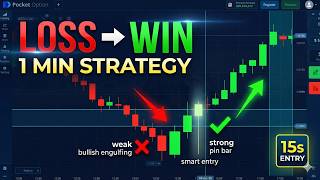

1-Minute Strategy That Actually Works
44sThe promise of a simple, effective trading strategy hooks viewers immediately, common in viral trading content.
▶ Play Clip"The title promises a simple, effective strategy, and the video delivers exactly that—with real examples and honest losses."
The video presents a simple 1-minute trading strategy that combines candlestick reversal patterns with the stochastic oscillator for high-probability entries on 15-second charts. The creator, Sam, explains the setup, shows real chart examples including both wins and losses, and emphasizes the importance of following rules and avoiding strong trends.
The strategy uses 15-second candles with a 1-minute expiry, and only one indicator: the stochastic oscillator set to 14, 3, 3.
For a buy, look for a reversal candle (pin bar, doji, or bullish engulfing) at the bottom of a move, with the stochastic at or below 20. For a sell, look for a reversal candle at the top with the stochastic at or above 80.
Combining momentum (stochastic) and candle patterns overcomes the blind spots of using either alone, giving a stronger edge.
In the first example, a weak engulfing pattern led to a loss, but a subsequent clean pin bar entry with the stochastic still oversold resulted in a profit.
In the second example, a clean bullish engulfing with the stochastic at 20 led to a profitable trade, showing the strategy working as intended.
Two golden rules: skip trades if the stochastic has been stuck below 20 or above 80 for a long time, and avoid strong trending markets with no pullbacks.
In the third example, two dojis formed at the top, but the market was in a strong uptrend with the stochastic above 80 for a long time, leading to a loss. This broke both golden rules.
What timeframes are used in the Stochastic Momentum Pin Bar strategy?
15-second candles with a 1-minute expiry.
00:01
What indicator settings are used in this strategy?
The stochastic oscillator set to 14, 3, 3.
00:54
What are the two confirmations for a buy entry?
A reversal candle (pin bar, doji, or bullish engulfing) at the bottom of a move, with the stochastic at or below 20.
01:10
What are the two confirmations for a sell entry?
A reversal candle at the top (inverted hammer, doji, or bearish engulfing) with the stochastic at or above 80.
01:37
When should you skip a trade according to the two golden rules?
If the stochastic has been stuck below 20 or above 80 for a long time, skip the trade—it's a strong trend, not an overbought/oversold condition.
05:30
What market condition should you avoid trading in?
Avoid strong trending markets with no pullbacks or pauses; the strategy works best when price gets exhausted and reverses.
05:46
In the first live example, what happened to the two trades taken?
The first trade based on a weak engulfing pattern closed at a loss, but the second trade based on a clean pin bar closed in profit.
03:41
Why did the losing trade in the third example fail?
The trade broke both golden rules: the stochastic had been above 80 for a long time, and the market was in a strong uptrend with no pullback.
07:26
The Core Setup
Defines the exact parameters (15s candles, 1m expiry, stochastic 14,3,3) that make the strategy actionable.
00:54Why Combining Signals Works
Explains how stacking momentum and candle patterns overcomes the blind spots of using either alone.
01:51Be Honest About Patterns
Highlights the importance of not forcing imperfect signals, a key discipline for traders.
04:09Two Golden Rules
Provides concrete filters (avoid stuck stochastic, avoid strong trends) that can prevent many losing trades.
05:30Learning from Losses
Demonstrates that losses are part of trading and that following rules is more important than being perfect.
07:26[00:01] to combine two powerful signals, candlestick reversals and momentum into one clean entry using 15 second candles and a 1 minute expiry. No clutter on your chart, no confusion, just a stochastic, a candle pattern and a
[00:15] decision. I call it the stochastic momentum pin bar strategy and by the end of this video, you'll know exactly when to enter, what to look for and why this works so well on fast time frames. Plus, I'll show you real chart examples at the
[00:28] end, so make sure you stick around. Let's get into it. Before we begin, quick but important reminder. Trading involves risk and past results don't guarantee future performance. Always practice on a demo
[00:41] line. All right, here's the setup. We're on 15 second candles with a 1 minute expiry, so you're reading fast price action and giving the trade just enough room to play out. For indicators, just one. The
[00:54] stochastic oscillator set to 14 3 3. That's it. And alongside that, we're patterns forming on those 15 second candles. Let me break it down. For a making a low and then printing a reversal candle at the bottom. That
[01:10] could be a pin bar with a long lower wick, a doji or a bullish engulfing candle that swallows the previous red one. Now, check your stochastic. If it's below 20, you're in the oversold zone. That's your entry. The candle says
[01:23] buyers are stepping in. The stochastic confirms momentum is stretched. Two confirmations, one entry, one minute expiry. For a sell, exact opposite. Price pushes up, prints a reversal at the top inverted hammer, doji or bearish
[01:37] engulfing. Stochastic above 80? That's overbought. You take the 1 minute sell. Now, here's what makes this combination powerful. Most traders rely on indicators alone or candles alone and both have blind spots.
[01:51] The stochastic might scream oversold while price is still falling hard. A pin bar might form in the middle of nowhere and mean nothing. But when you stack them together, momentum says exhausted and the candle confirms the reversal
[02:03] hats when you have an edge. And with a 1 minute expiry, you just need that quick bounce or rejection to do its job. I've also put together a free PDF guide that breaks down the setup and confirmation rules step-by-step. Link's in the
[02:17] description if you want it. Now, let's jump to the chart and see how this actually plays out in real market conditions. So, here's the chart. 15 second candles, stochastic at the bottom set to 14 3 3.
[02:31] You can see price made a strong move down, big red candles dropping hard. That's a solid push to the downside. Now, look at the stochastic. It's deep below the 20 level, oversold. So, I'm already on alert for a reversal candle
[02:44] and right here, I see what looks like a bullish engulfing pattern forming at the bottom. Green candle swallowing the previous red one, stochastic below 20. That takes both boxes. So, I take the buy with a 1 minute expiry. But here's
[02:58] the thing and this is important. Very quickly after entering, I realize this engulfing pattern isn't clean. The body isn't fully covering the previous candle the way a textbook engulfing should. It's not a perfect setup and in fast
[03:11] with yourself when a candle doesn't look right. Now, what happens next is key. Instead of panicking, I keep watching. And just a few candles later, look at this. A pin bar forms. Long lower wick, small body near the top. That's a much
[03:27] cleaner reversal signal. Stochastic is still sitting in the oversold zone. So, without wasting any time, I take a second buy. Same expiry, 1 minute. Now, I have two trades running. The first one, the one based on the weak
[03:41] engulfing, that one closes at a loss. Price didn't bounce fast enough within that 1 minute window and that's okay. Not every trade will be a winner. But the second trade, the pin bar entry, look at what happens. Price starts
[03:55] pushing up, green candles forming and by the time the 1 minute expiry hits, the trade closes in profit. The strategy delivered. So, what's the lesson here? Two things. First, be honest about your candle
[04:09] patterns. If the engulfing isn't clean, don't force it. Second, if the market gives you another opportunity and the setup is better, take it. The stochastic was still below 20, a proper pin bar formed and that second entry was the one
[04:22] that worked. That's the stochastic momentum pin bar strategy in action on a real chart in real time. Not a perfect textbook example, but a real one and that's more valuable. Now, let me show you another trade and this one is a
[04:35] clean example of how the strategy works when everything lines up. Look at the chart. Price has been dropping, red candles pushing lower and lower. But right at the bottom, a bullish engulfing candle forms on the 15 second chart. A
[04:49] strong green candle that completely swallows the previous red one. That's my first confirmation. Buyers just showed up. I check my stochastic. It's touching the 20 level. That's my oversold zone. That's my second confirmation. Two
[05:03] signals, both agreeing. So, I take the buy with a 1 minute expiry. Now, after entering, price doesn't shoot up immediately. It builds slowly, small green candles one after another gradually climbing. This is normal. You
[05:17] don't need a massive spike. You just need price to be above your entry when need price to be above your entry when that timer runs out. Stay calm. Let the trade breathe. Now, two quick tips that will save you from bad trades. First, if
[05:30] the stochastic has been stuck below 20 or above 80 for a long time, skip the trade. That's not oversold or overbought anymore. That's a strong trend and you don't want to fight it. Second, avoid strong trending markets altogether. No
[05:46] pullbacks, no pauses, no trade. This strategy works best when price gets exhausted and reverses, not when it's running full speed. Keep these two rules in mind and you'll filter out a lot of losing trades. And look, by the time the
[06:00] expiry hits, price has pushed up nicely. Trade closes in profit, clean, exactly Now, I want to show you a trade that didn't work because if I only showed you winners, I wouldn't be teaching you anything real. So, here's the setup.
[06:15] Price had been pushing up strongly, big green candles climbing one after another. Then at the top, I spot two doji candles forming back-to-back on the 15 second chart. Small bodies, wicks on both sides, signs of hesitation. And the
[06:29] level. Overbought. So, I think reversal candles plus overbought stochastic, that's my sell signal. I take the sell with a 1 minute expiry. But here's where I made the mistake. Look at what was happening
[06:44] before those dojis. Green candle. Another green candle. Price was making higher highs with almost no pullback. That's not a market getting tired. That's a strong bullish
[06:57] move with serious momentum behind it. Those two dojis, they weren't reversal catching its breath for a moment before continuing up. And that's exactly what happens. After I enter the sell, price pauses briefly and then pushes right
[07:12] back up. More green candles. The bulls weren't done. By the time my 1 minute expiry hits, price is above my entry. Trade closes at a loss and this is the perfect example of what I warned you about earlier. Remember the two tips?
[07:26] This trade broke both of them. The stochastic had been sitting above 80 for a long time. It wasn't a fresh move into overbought. It was sustained bullish momentum. And the market was in a strong uptrend with no real pullback.
[07:40] I should have stayed out. So, that's the stochastic momentum pin bar strategy. Simple, clean and effective when you follow the rules. >> Let me quickly recap what we covered. You're using 15 second candles with a 1
[07:53] minute expiry. One indicator, the stochastic set to 14 3 3. For a buy, look for a reversal candle like a pin bar, doji or bullish engulfing at the bottom of a move with a stochastic at or below 20. For a sell, reversal candle at
[08:10] the top with a stochastic at or above 80. And remember, avoid trading when the stochastic has been stuck at extreme levels for too long and stay away from strong trending markets. You saw it all today. Winning trades, a trade where I
[08:24] corrected my entry and even a loss. Because real trading isn't about being perfect, it's about having a system, following your rules and learning from every trade you take. If you found this helpful, do me a favor. Hit that like
[08:37] turn on the bell so you don't miss the next strategy video. And don't forget, I've put together a free PDF guide that breaks down this entire strategy step-by-step. The download link is in the description. If you have any
[08:51] questions or you want me to cover a specific strategy next, drop a comment below. I read every single one. This is Sam Trading Strategies and I'll see you Sam Trading Strategies and I'll see you in the next video.




⚡ Saved you 0h 09m reading this? Transcribe any YouTube video for free — no signup needed.