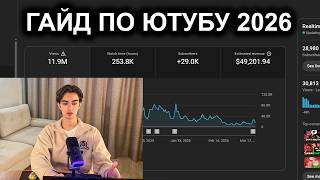

YouTube is not a trend, it's a business
44sChallenges viewer mindset by framing YouTube as a scalable business with no income ceiling, which is controversial and motivational.
▶ Play Clip"Title promises a guide to earning $50k+ from YouTube, and the video delivers a detailed, actionable guide, though the specific $50k claim is personal and not universally replicable."
The creator shares their experience earning over $50,000 from YouTube and provides a comprehensive guide to making money on the platform in 2026. The video covers niche selection, content creation, monetization pitfalls, and tools, emphasizing YouTube as a scalable business.
The creator made $14,000 from one channel and is developing a network with channels in hype niches, AI-generated content, and gaming. Some channels generate good revenue, while others are just monetized or have no views.
YouTube is a full-fledged business with no income ceiling. It requires no initial investment or team, and you can scale from $5,000 to $100,000 per month with the right system.
You don't need a VPN or antidetect browser for a new channel. Use an old channel with history for better trust. Avoid disposable phone numbers for verification.
Warm up a new channel by subscribing to competitors, watching videos, liking, and commenting for 1-2 weeks to build trust with YouTube.
90-95% fail due to information overload, fear of wasting time, lack of discipline, and chasing overcrowded niches from open sources.
Break down into direction (e.g., Roblox), niche (e.g., a specific game), and sub-niche (e.g., survival format). Focus on sub-niches with low competition and high views.
Hype niches offer quick monetization (1-3 weeks) with lower RPM but high views. Long-term niches take 1-3 months to monetize but provide stable income. Beginners should start with hype.
Search for keywords on YouTube, sort by last month, and use VidIQ to check subscriber counts. Look for channels with low subscribers but high views to find winning ideas.
Copy ideas from competitors that are 2 weeks old and add your own twist. Example: a channel got 722k views by creating intrigue about characters; the creator copied and improved it.
Three criteria: video dynamics (match or exceed competitor), video length (make it longer to boost retention), and frequency (publish more often than competitors).
YouTube prioritizes retention, CTR, and audience activity. Longer videos increase retention. CTR should be 8-16% for hype niches, 3-8% for long-term. Likes and comments boost recommendations.
Thumbnails should evoke emotion (shock, curiosity), feature large objects, and have readable text. Example: a good thumbnail shows a character in an unusual situation with clear accents.
Stage 1: Warm up channel while searching for sub-niches. Stage 2: Collect competitors, build a content plan from their recent ideas, and create content with competitive advantage. Stage 3: Analyze CTR and retention, and adjust.
Avoid content with children, pregnant women, injuries, or compilations with mostly old footage. Template content with slow-changing AI images may be demonetized. Use disclaimers to protect monetization.
Use Google Gemini for scripts, Google VO3 for video generation, and Midjourney for images. Save money by buying accounts from services like GSL or Funpay.
YouTube remains a viable business with scalable income, especially with AI tools. The creator offers mentoring for those who want faster results, but emphasizes taking action immediately.
What are the three criteria for competitive advantage on YouTube?
Video dynamics, video length, and publishing frequency.
21:04
What is the recommended CTR range for hype niches?
8% to 16%.
25:44
How long should you warm up a new YouTube channel?
About 1 to 2 weeks.
08:03
What is the difference between a niche and a sub-niche?
A niche is a specific area within a direction (e.g., a game), while a sub-niche is a narrow format within that niche (e.g., survival in that game).
12:17
Why should you avoid using disposable phone numbers for YouTube verification?
Because they can cause problems with two-factor authentication and channel recovery.
06:20
What is the main reason 90-95% of people fail on YouTube?
Information overload, fear of wasting time, lack of discipline, and chasing overcrowded niches.
09:23
What is the recommended video length strategy to beat competitors?
Make your video slightly longer than your competitor's to physically increase retention.
21:43
What should you include in a disclaimer to protect monetization?
State that all content is based on original ideas and AI is used as a tool, and that all characters are over 18.
37:47
What is the recommended approach for copying video ideas from competitors?
Take ideas that are about 2 weeks old and add your own twist to improve them.
20:50
What are the three main metrics YouTube uses to promote content?
Retention, CTR, and audience activity (likes and comments).
23:54
YouTube as a Scalable Business
Emphasizes that YouTube has no income ceiling and can be scaled from $5k to $100k per month.
01:26Niche Selection is 90% of Success
Highlights that finding the right sub-niche with low competition and high views is critical.
12:04Three Competitive Advantage Criteria
Provides a clear framework for outperforming competitors: dynamics, length, and frequency.
21:04YouTube's Business Model
Explains that YouTube prioritizes retention and CTR to maximize ad revenue, not creativity.
23:10Monetization Pitfalls
Lists specific content types that risk demonetization, such as children, injuries, and compilations.
35:09[00:03] . I made $14,000 from this YouTube channel . And at the moment I am developing my channel network, which is connected with various formats. There are channels that are created in hype niches, there are channels that
[00:16] channels that are run using neural networks, and there are some that just have some games plus editing. And in general, my YouTube channel network contains completely different content. Some channels are already bringing in good revenue, some channels have only just
[00:30] reached monetization, and some channels aren't getting any views at all. And today I have prepared a complete YouTube guide on how to make money from YouTube in 2026, based on my experience. And here I laid down all the necessary foundations to start
[00:45] doing something. Well, here is literally step-by-step, structured information that will help you achieve income. At the same time, I took into account all my mistakes here, I'll tell you about the tools I personally use to create content.
[00:59] Today, I'll also take a more detailed look at content monetization and monetization on YouTube in general, including what content is monetized, what isn't, and some pitfalls worth paying attention to. I've
[01:12] broken the information down into chunks for you, creating three parts for this video where we'll go through each piece of information step by step . Let's get right to the point, well, to what extent are there prospects on YouTube,
[01:26] activity, why I don't view it as some sort of, well, passing topic, but as a full-fledged business with its own specific structure, and also, in general, as the best niche for earning money at the moment. To start,
[01:40] I've prepared a graph for you so you can see how YouTube's reach is growing. Here are the statistics up to 2024. And as you can see, there is only positive dynamics here. And in general, the
[01:53] content sphere is only developing. And this is not even the peak. This means that this this point, YouTube is completely up to date. He has been living, as you can see, for more than 20 years. And it is, in fact, only growing. It grows because it
[02:08] follows certain trends and constantly catches some kind of hype. But at the same time, unlike other social networks, on YouTube you can create both long and short content. In short, he has a lot of possibilities. So, in
[02:21] general, what criteria should you look at when you're just starting out on YouTube? To understand the prospects, firstly, YouTube doesn't require investments or a team at the start. That is, working alone, when choosing a
[02:34] specific niche, you can start completely alone and easily reach $351,000 there and then look at whether you want to scale up further. And in general, there are a huge number of topics on YouTube that
[02:47] in general, there are a huge number of topics on YouTube that can start from scratch here. Well, if you want to scale up, it’s worth understanding that in this particular area of business there is no income ceiling. Here you can
[02:59] earn $5,000, $10,000, or scale your network to $ 50,000, or even $100,000 per month if you have a certain structure and a certain understanding of how YouTube works. Well, yes, and the third point
[03:13] relates precisely to this. That is, it is easy to make money on YouTube if you have the knowledge and a certain system. That is, at the moment, even before launching a channel, with the information that I have, by analyzing the same
[03:26] subniches, I can determine whether it is worth entering a particular niche on YouTube even how promising it is. Well, as I said earlier, for me personally, YouTube is a full-fledged business with a specific system, where you
[03:41] can scale and earn essentially as much as you need. And popular questions that I have collected, especially among beginners, so that these questions are also answered once and for all and so that you do not return to them again.
[03:55] So, the very first one of the popular questions is how to create an American channel. That is, in general, it is important to understand that an American YouTube channel is a YouTube channel, on the most ordinary, essentially created YouTube channel, you
[04:10] can produce content for both American and European audiences. And even on my YouTube channels, it’s clear that not only America watches, but also European countries, and perhaps Asian
[04:23] countries. And in general, content in different languages also generates income. And so to speak, I have compiled here a list of problems and questions that newbies ask themselves. Is it necessary to create a YouTube channel with a VPN? No, this will
[04:36] not help you at all. This is absolutely not necessary, because you are designing a YouTube channel specifically for a certain audience, be it in English, Spanish, or Russian. That is, it makes no
[04:48] difference. Here, the design and content of the videos will play a greater role. I would like to say the same about the antidetect browser. That is, when you are just starting out, there is no point in worrying about connections or
[05:01] channel bans. That is, on average, you don’t need an anti-detect browser. Well, if you run somewhere up to three YouTube channels there. There are other ways to distribute accounts across different devices, including
[05:14] granting manager access, and then the anti-detection browser will generally not be needed. The very essence of the anti-detection browser is that each profile is considered a separate device, and the proxy allows you to change IP addresses. And
[05:27] so, if one channel goes down , the rest of the network won't catch up because there are no connections. If you don't have this network of channels, then in general, initially you don't need an antidefect browser plus a proxy, well, essentially. That
[05:40] is, while you are a newbie and creating your first YouTube channel, you can do this either on your old YouTube channels, even where you uploaded videos. The main thing here is not to hide or delete them, follow certain criteria when
[05:52] changing niches, or simply create an account and start running a YouTube channel on it . There is no problem with that. That is, it is clear that if you have some old YouTube channel, you can, of course, use it, and it will even be
[06:06] better to use it, because this channel will have some history, with a some trust from YouTube. I also wanted to say regarding phone numbers that I don't recommend using disposable numbers,
[06:20] because recently there was a massive problem where people filled out and confirmed two-factor authentication or the second channel function with a disposable phone number, and then that phone number popped up somewhere. That is, at
[06:33] Russian numbers can also work if you are from can easily confirm with your phone numbers or the phone numbers of your relatives. Also, regarding the functions, I would like to note
[06:47] that, of course, it is better if you have all the functions enabled. In terms of promotion , this essentially doesn’t matter. This plays a bigger role when applying for monetization. This means that without the third function, you will not be able to apply for monetization.
[06:59] Therefore, if you are entering, so to speak, a hype niche, it is better to have a channel with a long term, then you can enter this sub-niche with the second function. We'll discuss the hype and long-term perspective a bit later.
[07:12] Well, and about the design of the YouTube channel itself. As I said, it should be in the language you have chosen to use for your niche. Well, if you're a complete newbie, then what settings should you enable, what checkboxes should you tick, how to
[07:25] properly create a description, tags, and the like? I recorded a more detailed video guide on my Telegram channel. You can go and take a look. Well, it's just a pretty basic thing now, and overall there's nothing complicated about it.
[07:38] Next, the second popular question is channel warm-up. Is it necessary to warm up the channel? Does it play any role and so on. What I want to say here is that, of course, it’s better to warm up the YouTube channel. It doesn't matter whether it's hype or a long-term
[07:50] niche, because this is how you build trust from YouTube. But if you suddenly find a very good potential niche related to hype, then you can generally start doing it on a new channel that is not yet warmed up. So,
[08:03] how do you do this correctly? For a few days, you can simply subscribe to competitors, watch various videos, like, comment, and subscribe to channels. Well, that is, in general, to show some
[08:15] activity over the course of several days. Well, that is, about a week or two weeks. And overall, this way your YouTube channel will more or less warm up. Next, the third question, which is also quite popular among beginners. How can I
[08:27] make money if I'm from Russia? I want to tell you right away that while you are a newbie, and if you haven’t created YouTube channels yet, or you are already doing something and don’t know if it’s possible , of course, it can be done, even if you are in Russia. But I don't advise
[08:41] this issue right now, because there's not much point in it if you haven't yet reached monetization, if you haven't reached income. There are various affiliate programs and verified people that you can connect to and withdraw through. That is, there is no
[08:56] problem here. And the fourth question, probably a very popular one right now, is whether the content is monetized. That is, I will discuss this topic in more detail later today, but I will get ahead of myself and say that yes, content is monetized
[09:09] if it is not some kind of trash or silliness. And here the main thing is for YouTube to understand that the content is created by humans. I'll go into more detail; Now I want to address this question: why don't 90-95% of
[09:23] people succeed in making money from YouTube, and perhaps won't succeed in doing so at all? And this question, let's say, needs to be understood and comprehended at the very start. This means that a whole range of excuses, fears, and so
[09:37] on emerge, due to which people either simply don't start creating a YouTube channel, or fail time and time again. I understand that most people will just watch this video, and not everyone will go and accept this information. This is
[09:51] already the first factor why people fail. That is, people try to collect as much information as possible. This is the so-called exhaustive search of information, and they constantly test this information , because one said
[10:03] one thing, another said something else. A person makes some kind of verdict out of all this , goes, tries, and fails. So people waste time more and more and more. Because of this, a fear of wasting time
[10:17] when creating new channels develops. People make constant attempts to test information and, in essence, waste their time. This is where burnout and the fear of making mistakes arise. People are becoming less and less aware of the audience
[10:32] they are working for. Also, one of the most important factors on YouTube is discipline. Well, that is, simply posting videos according to a certain schedule. I also want to say something about niches from open sources. That is, people
[10:44] are trying to find a golden niche either from YouTube channels, from Telegram channels, from Privat, it doesn’t matter. That is, remember one simple rule: you need to be able to find niches yourself. And any niche that is unloaded somewhere, that is, even if
[10:59] it is an open space, then a lot of people are looking here and a fairly large percentage of people go to make these niches. If a niche is uploaded to a private site, then there are also quite a large number of people there who have potentially
[11:12] paid money to obtain that very niche. And, accordingly, such niches very quickly become overcrowded due to the large influx of people. And if you find yourself in such a niche, you are essentially working here on luck. Yes, you may
[11:24] have one breakthrough, but after that breakthrough, the channel usually collapses due to lack of knowledge and high competition. Therefore, if you look at the long term, this one shot will essentially give you nothing. That is, the
[11:37] main thing from this video is for you to apply this information, because I structured it, it is based on my experience, and I know what I am talking about in general. So, we've covered the basics, and now
[11:49] we'll move on to some very important sections, like the basics and any pitfalls you might encounter. And the most important point is, of course, finding a niche plus analysis. About 90% of whether your channel will take off and whether
[12:04] you will earn money from YouTube depends on this. And now I’ll, well, roughly explain to you how this whole thing works. So, how do you find a niche in general? You should keep a certain structure in your head , such as direction, niche,
[12:17] sub-niche. Direction is something big. Here's the example of Roblox. That is, Roblx is one large direction, where a huge number of different niches and a huge number of different sub-niches are collected. This is a huge
[12:30] audience. If you just go out and make Roblox content, well, it won't lead you to anything good . From the direction you need to narrow your circle and decide on one thing. For example,
[12:43] there are various games in Roblox as Roblox. And each such game is essentially a niche. As an example, this is 99 nights in the forest. One of the very popular games that held the top spot on Roblox for quite a long
[12:55] time. And overall, people made a lot of money from it. But this is a very large space where different formats are filmed. And your task is to find this one narrow format and find your sub-niche. That is, as in the
[13:08] Roblox example: "You found a niche in the form of the game 99 Nights in the Woods and found a format where there will be survival specifically, which is related to the number of days." That is, this will be a narrow sub-niche with its own target audience, and it will be easier for algorithms
[13:24] to understand where to recommend you if you are filming a specific narrow sub-niche. The same thing applies to my channel, from which I earned $34,000. That is, there is such a direction as animated series. There are a
[13:37] lot of them. Each animated series has its own target audience. And in general, well, this is, in essence, one big direction. From here there is a niche of amazing digital circus. This is the animated series that was the subject of much hype and on which I basically built my
[13:50] channel. That is, it is a niche. But there are different formats in this niche . My format was theory and easter eggs. From here I just expressed this sub-niche and flew there. That is, my entire channel is built on the basis of this sub-niche. And this is also
[14:04] important to understand. So let's consolidate this entire structure once again. There is one big direction. There are several niches in this area. And within each of these niches there are rather narrow directions, that is, sub-niches. Your
[14:18] job is to find sub-niches with little competition and high views, so you can get in there, establish yourself as one of the main competitors, and garner a significant amount of views.
[14:30] Now I will also explain how to do this. That is, initially, of course , you go to YouTube to make money. And there are two ways here. Or you want to make money quickly, build up a channel, earn a decent amount of money from it
[14:42] , and after some time, about one dash-3 months, the channel will die. Or you want to develop, so to speak, a little for the future. At the same time, you will have a more or less stable income for several months or
[14:55] even several years. That is, you need to choose the path you are willing to take. Let me say right away that if you want to make money quickly, you need to look for hype niches. and hype-nishes mostly get good views
[15:09] because of some popular characters. Moreover, such sub-niches have a children and teenage audience. Yes, they have lower RPM. RPM is, by the way, the price per 1,000 views. But this is compensated by the fact that there are quite a lot of views here.
[15:24] Also, hype niches are much faster to promote, meaning you can reach monetization in about a week or even three weeks without any problem. Well, and also, well, essentially, you will reach your first income much faster. And also in
[15:38] hype niches it is easier to identify certain sub-niches, easier to analyze and easier to navigate ideas in general, as opposed to long-term ones. Yes, the long term is more about the future, but at the same time, it
[15:54] to three months to promote the channel to monetization. And this is only before monetization. And as a beginner, I would advise you to fly into hype niches, earn your first money from there and then scale up, move on, uh, including to long-term sub-niches, but at the same time it is
[16:08] possible to run hype niches. The only thing I want to tell you is that if you've promoted a channel on HireNish and made money from it, you can change it to suit your niche in the future. This way, your channel will be monetized and
[16:21] will generate a constant income from various sub-niches. The same thing applies to the long term. That is, in the long term, the channel may also die in a few years or a few months, but the channel will still be monetized, and
[16:34] you can just as easily change it to a different niche and make money either in a different niche or in a . Well, also, as I said, if you already have some old channels where some videos were released, you can use these channels
[16:49] . That is, you are essentially changing it here to suit your niche. I recorded a full, standalone guide on my Telegram channel, which lasted a few minutes and covered the key metrics to consider when changing subniches, as well
[17:02] as some pitfalls. That is, this is a slightly different topic, which is currently almost unrelated to the Guide, so in general you can watch it on my Telegram channel. Well, you've decided on a sub-niche,
[17:14] now you need to look for ideas. Ideas that will come to you on how to do it correctly. Because ideas will play a key role in the future. It is precisely through these ideas that YouTube will direct you to your target audience. And in
[17:28] the future, this target audience will bring you income. What is the right way to look for ideas that work? To do this, go to YouTube, clear your viewing history, or create a new YouTube channel. In principle, there is no difference in this
[17:42] . And I can show you this using Roblox as an example. That is, you take the key direction that you decided to look for, that is, Robl, enter it into the search, sort it by the last month. Well
[17:57] , essentially, you will have regular videos here. You can also filter by popularity or relevance. There is no difference here overall . I'll tell you right away that I advise you to install VD IQ, because it
[18:10] shows the subscribers on the channel. And this way you can immediately compare the number of views and subscribers. But I'll warn you that there's no point in looking at this tab with search volume and competition, because it's
[18:23] better to search for such ideas and analyze them manually, because you'll be simultaneously gaining insight. And so, you insight. And so, you just start scrolling through the search, looking
[18:36] number of views. So, you're scrolling through the search and you might come across an interesting video where the channel only has 9,000 subscribers, but 730,000 views in 8 days. Then this person started
[18:52] filming some crazy stuff, but the fact is that he used a very interesting idea here, combining it with Roblox. And here is the same idea he has, which also gained views. And this way you can watch videos either by direction
[19:07] or by niche and select some interesting ideas for yourself. This way, you will essentially have one sub-niche. And as part of your analysis, I advise you to at least gather all your competitors so you can understand
[19:22] how many people are filming your sub-niche. It is clear that if there are too many competitors there, then it is not worth flying into it. Now we'll dive a little deeper into content creation. That is, I will explain to you how you can repeat similar ideas and collect
[19:36] views from them, using the example of my channel and the channel in the K-pop theme Demon Hunters. So, for example, a person has come up with some intriguing ideas about what will happen to the characters in an amazing digital circus. They have garnered 722,000
[19:51] digital circus. They have garnered 722,000 views and 1,00,000 likes. I essentially copied these ideas, that is, I also created intrigue in my videos. And as you can see, there are fragments of abstracted characters here. If here there are
[20:05] abstract characters, then here I made them, essentially, full-length, as if it had actually already happened, and collected quite a lot of views on this . People did the same thing with the K-pop Demon Hunter theme. So, a
[20:21] person took one idea, with a certain byte, like a character from K-pop Demon Hunters was doing something, let's say , and another channel repeated this idea with a girl, that is, also with a character from K-pop Demon Hunters, and
[20:35] got even more views than the competitor had originally. This means that you can copy ideas and add a little of your own to them. And this way you can either get a little less views on this idea, or even
[20:50] more. The only thing is, it is important to take ideas that are about 2 weeks old, so that the idea itself does not lose its relevance. And once you've decided on an idea and are already creating the content itself, it's very important
[21:04] to maintain a competitive advantage. There are three criteria in total on which everything is essentially based. The first criterion is the dynamics of the video. This means that your video dynamics should be the same as your competitor's, or even
[21:18] better. And most likely, you won’t be able to compare the video with a competitor’s on your own. Well, that means, in your eyes, the video that you created will seem too awesome. But to clarify this
[21:30] situation, just open a competitor's video, your video and compare literally every 5 seconds to understand whether the video has the same dynamics or not. The second criterion is the length of the video. This means that the video length
[21:43] should be either the same as your competitor's, or even better, if it 's longer, because this way you'll physically increase retention on your parameter for how much it costs to shoot a video. That is, well, roughly if
[21:59] a competitor does 1 minute, you need to do 2 minutes. If a competitor does 8 minutes, you need to do 10 minutes there. If it's a long-term project and the video is an If it's a long-term project and the video is an hour long, you need to make it somewhere around 10.20, that
[22:13] is, literally a little longer than your competitor. And the third criterion is the important for you to understand that when you enter a sub-niche, you are not the first one. There are already people who have posted a certain number of videos before you. They release
[22:27] this number of videos at a certain frequency. And this is where the discipline parameter comes in, because you need to produce either the same number of units even more. That is, if, for example, a competitor makes a video every other day, you will
[22:43] need to make a video every day to catch up with your competitors in terms of the number of videos and still meet the other two criteria for competitive advantage. And this way you will be able to gain a foothold in the sub-niche. That is, based on
[22:56] this, it is very important to clarify what is important for YouTube and what is not important for it. That is, initially, YouTube itself is a huge business that makes a lot of money. And YouTube, YouTube's algorithms, do everything to
[23:10] earn even more. That is, YouTube doesn't look at how much time you spent on a video, why you didn't upload a video today, how creative your content is, whether your content is useful, and so on. That is, YouTube does not look at these
[23:23] factors from a business point of view . It is very important for YouTube to track how long a viewer stays on the platform, how long they consequently, the advertising that YouTube displays. And from a
[23:39] business point of view, it’s, well, obvious. And especially for this YouTube. YouTube has certain metrics that help it understand whether your content is worth promoting at all, or whether your competitors are doing it better. And plus these
[23:54] indicators give you a huge boost if you understand how to improve these indicators , or, well, in general, keep these indicators high. It's not for nothing that YouTube has analytics. This is one of the most important tools you will consider
[24:08] when creating content. And it's very important to look at analytics to see when your impressions started, even the first few views, because these metrics directly impact your number of views and how you can generally
[24:22] outperform your competitors. Well, that is , of course, retention. That is, the more and longer a viewer watches your content, the more ads YouTube will be able to cram into it, accordingly. And when collecting analytics,
[24:37] YouTube pays attention to retention factors for both your channel and your competitors' channels. And, of course, if your competitors have higher retention rates— meaning the viewer stays on the platform longer thanks to your competitors—YouTube
[24:51] will naturally recommend them over you. This is why it's important to create over you. This is why it's important to create slightly longer videos to physically boost retention on your channel. The second indicator is CTR. CR
[25:04] initially determines whether a viewer will click on your video. And the CTR should also be higher than the competitor's. This means that it is very important to work on previews . And now I will also discuss this topic a little later. And the preview plays a very
[25:19] important role, because you might have made a really awesome video. You have amazing editing, amazing creativity, but at the same time, if the picture is bad, this video as a whole won’t even be watched. Well, in general, what is CR? It is
[25:32] the ratio of impressions to views. That is, if, for example, your video has 1,000 impressions and you have 100 views, then the CTR will be 10%.
[25:44] no specific characteristics of Stir. That is, it is clear that the higher, the better. But, as a rule, in hyped niches the CR is higher, that is, from about 8 to 16%.
[25:57] Over the long term, CR can vary from 3 to, say, 8 percent. This means that each sub-niche is different, but you should create the most clickable previews that your audience will enjoy. The third important
[26:11] indicator by which YouTube generally looks at your YouTube channel and the YouTube channel of your competitors is activity in the form of likes on videos and comments. That is, if your video gets more reactions,
[26:24] then this also gives a certain boost. YouTube sees that the audience likes this content. And not only did the audience watch it, they also reacted. Therefore, being active is also a very important factor. And you need to
[26:39] understand that in order to collect views and be above your competitors, you need to combine all three of these indicators. And this will give you views, and, accordingly, income. Because the more views, the more income. These are
[26:54] directly, well, two interconnected things. And then I just wanted to discuss the topic of previews. That is, the preview is very important. How do you know if a preview is good or bad? That is, as I already said, the Steer indicator is responsible for this.
[27:08] Initially, the preview should evoke some kind of emotion. So, I gave an some kind of emotion. So, I gave an example of a preview from my video, as well as two other channels that are related to K-pop: Demon Hunters and Popy Playtime.
[27:22] So how should a preview evoke emotion? Firstly, one of the indicators is shock or the question, how did this happen? That is, something that the viewer may not have seen. Well, using this preview as an example. So, characters from the K-pop
[27:37] Demon Hunters universe ended up in a squid game. So how did this happen? How did this the video? That is, it is quite interesting to the audience. And thanks to this question, how did this happen and what will happen next, the person clicks on
[27:52] the video and watches it for quite a long time. You may also notice that all previews feature large objects that are emphasized. That is, there is an emphasis on the transformation of the character, and he looks quite large. There are
[28:08] three main characters. They look pretty big too. My preview also shows two characters, just in different guises. And they also look very large. Plus, you can add elements that draw the viewer's attention. Well, here's an
[28:24] I am transforming this character into this one. Well, and, accordingly, if text is written on the preview , it should be easy to read and large. So remember that the preview, yes, it should evoke emotion.
[28:39] Now let's look at an example of a bad preview and an example of a good preview. That is, as you can see, firstly, there is very little lighting here, and
[28:52] the picture looks very dark. Plus, proportionally, the characters here are very small relative to the entire preview as a whole. In terms of emotions, it’s also unclear here. That is, here the character simply smiles. This character is smiling too. It's completely
[29:07] smiles. This character is smiling too. It's completely which is good. That is, here a person immediately has a problem. A person immediately has a problem. A sinking ship, although there were no ships in the
[29:21] K-pop movie Demon Hunters. The characters are standing on an iceberg. This character is happy and he is very big. It takes up half of the preview. And this character, he is a little smaller, but he is indignant. he shows some kind of
[29:35] emotion, and in general some extremely non-standard situation occurs. That is, a person experiences shock and how this happened. Plus, accents are placed,
[29:47] that is, large objects that are used in the preview. That's why this preview is bad, but this preview is good, and it got quite a lot of views. This video got almost no views at all. So,
[30:02] if you've made it this far, I'll now give you a complete step-by-step action plan, including where to start and how to launch your YouTube channel. There will be three stages here. And the first step is to
[30:15] is, I will briefly tell you again how to do this. So, you have a YouTube channel on which you will continue to create content. And on this channel you will be looking for a niche. And the warm-up begins
[30:28] exactly from the moment when you start looking for this sub-niche. This means you sub-niche. Now you know how to do it. And while you're watching your competitors' videos, liking them, leaving
[30:41] comments, and watching other videos, your YouTube channel is essentially warming up. And so you are at the stage of selecting the this channel, you can collect several
[30:54] different subniches and choose from them what you like best. And after you have chosen this relevant sub-niche, you should collect all the competitors in this sub-niche. That is, there we are already moving on to the second stage.
[31:07] That means you have to have a certain structure. You create a YouTube channel, start looking for a relevant sub-niche, then choose the one you like best, and begin, essentially, some kind of analysis. To do this, you gather all the
[31:19] competitors who are working in this sub-niche and begin to build a plan, a content plan based on these very competitors. That is, you create this content plan from the ideas that your competitors have come up with recently, about one or two,
[31:33] maximum two weeks ago. Once you have built this content plan, you can start creating content. Here it is essential to apply the competitive advantage parameter so that your videos gain reach,
[31:46] impressions, and subsequent views. If you provide a good competitive advantage, you will have good indicators, and then in the future you . That is, the main indicators are CTR and
[32:02] retention. That is, these are two important indicators. The third thing is activity to add some bytes for subscriptions and likes, if competitors do this . But still, there are two main indicators. It will be the CR who is
[32:16] responsible for the current and good topic. That is, if you chose a good topic and made a good preview, you will have a high CTR. And also, if you have provided a good competitive advantage in the form of dynamics and in the form of video length, then
[32:31] you will have higher retention than your competitors. I also advise you to analyze the retention chart when statistics on it become available. That is, it is important to look at the indicator of how many viewers remain watching you in the
[32:44] first 30 seconds. It is important to understand this so that in the future, for example, you need to give a more dynamic start. Then you look at the entire video retention graph as a whole, and you might have either, like here, slightly
[32:57] declining stats, or more even ones. And you may also have some jumps, for example, on the chart, for example, the retention may increase sharply upwards and then fall sharply downwards. That is, in these moments it is important to analyze why
[33:11] this is happening. And as you can see on this graph, at the very end I have a sharp decline in retention. It's because I stretched the end credits there. And in general, people move on to other videos from this end screen. And in
[33:24] general, this is what the entire step-by-step action plan looks like. If you stick to this structure, there is essentially nothing complicated. I also wanted to clarify this point: when you build a content plan based on your
[33:36] competitors and begin to follow that content plan, later, when you get a head start and begin to understand your YouTube channel's audience— that is, when you understand the metrics and figure out which topics are most
[33:49] popular—you can begin to offer unique twists in the form of your own ideas, your own concepts. But the main thing is to emphasize that these ideas are interesting not to you, but to your audience. And in the future, thanks to uniqueness,
[34:04] viewers can continue to watch your content; your content will be unique and will continue to collect views. Perhaps you haven't tried launching channels yet, or you've only just heard about American YouTube
[34:17] , or you've been running your YouTube channels for several months and haven't seen any results, or you've had some one-time failures and don't know how to consistently earn money from YouTube. That is, in the video description, I will leave a form for
[34:30] the opportunity to work and interact personally with me in a mentoring format. That is, at the moment I am looking for several people in whom I will invest. I want to do this in a format that will allow us to achieve a concrete
[34:42] result. And until you achieve this result, the work, in essence, will not stop. There will also be a limited number of seats, about 10-12 people. There will be a very thorough selection process,
[34:56] because I won’t be ready to work with everyone and I will select only the most adequate and motivated people. The link to the questionnaire will be in the description. Well, now let's continue. We still have to analyze the third block. Let me remind you
[35:09] that the third block is about pitfalls and tools that you can use when creating content. And the first step is to look at content monetization in general, that is, what content is not monetized to a
[35:23] greater extent, and what content is not monetized. And, as you know, recently there have been various monetization rejections related to the use of other people's content, inaccurate content, dangerous content featuring
[35:36] minors, and so on. So what points should you pay attention to? First of all, I strongly advise against using children in your videos, because YouTube algorithms detect this. And especially if
[35:48] someone sits down to check your content and even the slightest clue reveals that there are any dangerous actions involving children, your monetization will be removed. And, most likely, this monetization will never be restored. The
[36:01] same applies to content featuring pregnant women, whether it involves dangerous activities or just general content. That is, I do not recommend filming such content , because it is under threat. And essentially, at any moment, your
[36:14] monetization can be removed or your channel can be blocked entirely. This also includes content that contains any kind of physical injury, such as wounds, blood, and so on. Such content may also be rejected for monetization, or
[36:27] monetization may be removed in the future. I'd also like to draw special attention to compilations, that is, videos that contain approximately 3-4 minutes of new content, while the rest of the running time is
[36:39] made up of old videos. And thus you get a long video with a timing of 20-25-30 minutes. It is important to know how to work with such content and not just upload it. If this is a one-time compilation, then you wo
[36:54] n't be in any particular danger. But if these are constant compilations on every video, you will need to know how to fight off demonetization and all the related reasons that may be associated with the compilation. I also advise you to pay
[37:07] attention to more template content. This is where photos in a video that are generated by a neural network are used. And essentially one photo follows another, after another, after another. And as a rule, these photos change quite infrequently. This
[37:20] can be classified as template content. And such content may also either be rejected for monetization, or the channel may be demonetized in the future. There are certain ways to bypass these blocks, but if you don't know how to work with them
[37:33] , it's better to choose something less risky and more promising. Also, to further protect yourself from demonetization, if you create content, include a disclaimer in the video description,
[37:47] channel description, and possibly in the video itself. So, this is roughly how it sounds: all the content of the video is based on your original idea and artificial intelligence is used as a tool to visualize your ideas.
[38:02] And it's also worth pointing out that all the characters in your story, well, they're over 18. This will protect you during verification, when your YouTube channel is checked by the YouTube neural network itself, that is, the algorithm itself. If you create content, I recommend you
[38:17] use this script, describe it in a little more detail, and highlight the points subniche, and insert it into each video, as well as in the channel description. I also want to share with you the tools for creating content
[38:32] that I personally use. So this is Google Gemini, which I use for writing scripts. He writes more humane scripts. There are also little more detail. We also
[38:46] use Google's VO3 neural network for video creation and generation, because it produces fairly high-quality generations. Well, in general, VO3 is suitable for most of the niches that we do. You can also use the wedge net
[39:00] , because it also creates quite high-quality generations and it can also be used very well.
[39:12] photos, they can then be animated using CLН or VO3. That is, this is the main set of neural networks that we use. Well, to save money, you can also take them from services like GSL. or Funpay. That is, there are
[39:26] certain sellers who sell these accounts much cheaper and you can save a lot. I also wrote a detailed list of neural networks that can be used additionally and how they
[39:38] can be narrowed down in my Telegram channel, so you can go take a look. And now I want to say that you have been given a very big opportunity, which you can take advantage of, absorb all this information and try to create your own
[39:52] successful YouTube channels and build an understanding that YouTube is a business. Because for me, YouTube is precisely this business. I understand that here you can scale up and generally increase your income without limit. And
[40:05] now, more than ever, it’s quite easy to make money on YouTube if you understand the issue and get to grips with the topic. Moreover, now most content can be created using neural networks, and you literally
[40:17] have all the tools to try it out. So you can start absorbing all this information right now and testing it out. And this is the formula by which you can achieve a minimum income from YouTube. Well, if you
[40:31] want to save yourself time and go through this process much faster by working with someone who has already been through it all, who knows essentially all the pitfalls and problems you might encounter, then I will tell you again that
[40:45] at the moment I am recruiting several people for mentoring, that is, with a limited number of places specifically so that I can personally devote my focus, my time, and my attention to each person, so that they can
[40:59] achieve results. Well, I repeat once again that we will work until a specific result is achieved, without any time limit. That is, until you achieve this result , we will not stop working together. But I also want to say that the time
[41:12] for the questionnaire is limited. Not everyone who wants to will be able to start interacting with me. If, for example, you didn't have time to fill out the form, you can go to my Telegram channel, where I provide a lot of valuable information, and
[41:26] apply the information from this guide. And perhaps after some time I will recruit a very small number of people there for interaction, but this is not certain. At this point, I advise you not to waste any time at all in applying the
[41:40] information you have received. After all, now you have absolutely every opportunity to succeed on YouTube in 2026.
⚡ Saved you 0h 41m reading this? Transcribe any YouTube video for free — no signup needed.