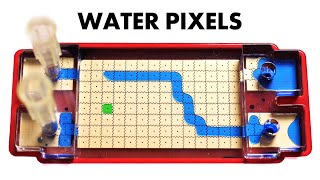

I Played Snake With Water Droplets
43sUnique demo of classic games using water physics is visually captivating and shareable.
▶ Play Clip"Delivers exactly what the title promises — a fun demo of Snake on water with added physics explanation."
This video demonstrates how to play classic arcade games like Snake, Pac-Man, and Frogger using water droplets controlled by an OpenDrop device, which uses electrowetting to move droplets. The host explains the physics behind electrowetting, shows his coding process (with help from AI), and highlights the device's medical applications.
The host uses arrow keys on a laptop to move real water droplets to play Pac-Man, Snake, and Crossy Road on an OpenDrop device.
The OpenDrop device costs nearly a thousand euros, but the host justifies it as tax deductible for making a video.
OpenDrop is Arduino compatible and accepts 256-bit binary strings sent via USB to control an array of electrodes. The existing code uses Processing and Java.
Water is attracted to charged surfaces due to its polarity. A dielectric coating on electrodes allows controlled wetting, enabling droplet movement.
By turning on an electrode, the water droplet is attracted to it; turning it off and powering a neighbor moves the droplet one square at a time.
If two droplets touch, they merge permanently due to surface tension. This is used as a game mechanic in Frogger (merging means game over).
Snake is ideal because it conserves mass: eating a fruit makes the snake larger by exactly that fruit's volume, mimicking real-world physics.
To create snake shapes, water is sandwiched under glass, constraining surface tension to only the thin edge, allowing elongated shapes.
The hardest part of coding Snake was delivering new fruit from a reservoir without touching the snake, requiring a pause during delivery.
All hardware and software for OpenDrop is open source, including custom electrode arrays. Pre-made devices are available from Gaudi Labs.
The video successfully combines physics, coding, and gaming to showcase the potential of electrowetting devices, while emphasizing that all resources are open source for anyone to replicate or build upon.
What is electrowetting?
The use of electricity to control how much a water droplet wets a surface, making it more hydrophilic when charged.
04:35
Why is water attracted to charged surfaces?
Water is a polar molecule; the positive hydrogens are attracted to negative charges and the negative oxygen is repelled, creating an overall attraction.
03:13
How does the OpenDrop move a droplet?
By turning on one electrode to attract the droplet, then turning it off and activating a neighboring electrode to move the droplet there.
04:51
What happens when two droplets touch on OpenDrop?
They merge permanently due to surface tension and cannot be separated.
05:18
How is Snake made possible on water?
By sandwiching water under glass, which constrains surface tension to only the thin edge, allowing water to be shaped into elongated forms.
08:04
What is the main advantage of using glass in OpenDrop?
It allows shaping water into extended forms like a snake by reducing the influence of surface tension over the overall shape.
08:04
Why is Snake a better game than Pac-Man for water droplets?
Snake conserves mass (the snake grows by the volume of fruit eaten), whereas Pac-Man droplets grow larger when eating ghosts, creating an unwieldy blob.
07:23
Electrowetting Explanation
Clearly explains how voltage controls hydrophilicity using dielectric coating, a key physics concept.
02:09Proper Name Electrowetting
Gives the technical term for the effect, reinforcing scientific vocabulary.
04:35Snake Conserves Mass
Highlights why Snake is ideal for water droplets, tying game mechanics to physical reality.
07:23Glass Sandwich Solution
Demonstrates a clever workaround using glass to shape water, turning a limitation into a feature.
08:04Fruit Delivery Challenge
Shows the complexity of coding a game on a physical device, especially handling droplet merges.
09:23[00:02] something, but it's not. It's actually real droplets of water that I'm controlling with the arrow keys on my laptop. This is a medical research device, but I'm using it for something much more important, Pac-Man.
[00:15] And Snake. And I might have got Crossy Road working on it as well. You might be research device. Well, it's simple, really. I saw it on the internet. And I had to have it. It's nearly a thousand euros. Yeah, but if I make a
[00:28] video about it, it's tax deductible. So, it's called OpenDrop, and frustratingly, it doesn't play video games out of the box. Instead, it's got this little joystick that you can use to move the water droplet around. And with this
[00:40] sequences and paths and things like that. It's cool, isn't it? But if, like me, you wanted to play Snake on it, then you'd have to write your own code. And I really wanted to play Snake on it. And the problem was, I didn't know how to
[00:53] like So, I went to Switzerland. This is Urs Gaudenz, the inventor of OpenDrop. Not only did he show me around Gaudi Labs, showed me the various layers of code that make the device work, and a couple
[01:08] of easy entry points if I want to make changes for myself. Okay, so basically, what I learned was, it's this Arduino compatible device. So, you can change the firmware if you want to, but the firmware that comes with it allows you
[01:21] firmware that comes with it allows you to just send 256-bit strings of binary digits to the device via the USB cable. And that corresponds to this array of electrodes being on or off, depending on those binary digits. It uses a platform
[01:35] called Processing, and the existing code is written in the Java programming language. So, all I need to do is write some Java code to play Snake. The problem is, I don't know Java. So, it's going to take a while.
[01:54] God, five lines is quick. I Are we screwed? Is society screwed somehow? code. Now before I show you cottonmouth, that's what I'm calling the game by the water snake. Before I show you cottonmouth, let's talk about how this
[02:09] device actually works. Like how are the droplets moving around like that? Well, and hydrophobic surfaces. Like here's a droplet of water on a hydrophobic water hating surface. The water is hardly
[02:21] attracted to the surface at all, which means there's nothing really to oppose the surface tension of the water. So it beads up like that. But when you put water on a hydrophilic water loving surface, the surface attracts the water
[02:34] to it and so the droplet flattens out. But what if you could control exactly how hydrophilic a surface was with the electricity? So look up close, you can see all these tiny metal squares. Each one of those is an electrode that we can
[02:47] apply a voltage to. The water doesn't sit directly on the electrodes. Instead, there's a thin dielectric coating. Dielectric means that it's insulating. It doesn't conduct electricity, but it also means that it becomes charged in
[02:59] the presence of a voltage. So when I turn on this electrode, the dielectric And that's the key because water is attracted to charged surfaces. But why though? Why is water attracted to electric charge? Well, water is a polar
[03:13] molecule, which is to say the hydrogens are slightly positively charged and the oxygens are slightly negatively charged. That's because the oxygen pulls on the shared electrons more strongly than the hydrogen do. So what happens to a polar
[03:26] molecule like water in the presence of a negatively charged surface, for example? Well, the positively charged hydrogens are attracted to the surface and the negatively charged oxygens are repelled from the surface. The result is that the
[03:40] water molecule goes nowhere, but it does swing around to face the charge. Think about what that means for the surface of the droplet closest to the charge. It's going to just be all positively charged hydrogens facing outwards with no
[03:56] negative charge to cancel it out. And the opposite surface of the droplet is going to be all negatively charged oxygens facing outwards. So the droplet will have a positively charged surface and a negatively charged surface. The
[04:09] positively charged surface is attracted to the negative dielectric and the negatively charged surface is repelled from it. But thanks to the inverse square law, the attraction here is stronger than the repulsion here. So in
[04:22] conclusion, water is attracted to charged surfaces. Or to put it another way, charged surfaces are more hydrophilic. The proper name for this effect is electrowetting because scientists talk about the degree to
[04:35] which water can wet a surface. Like water doesn't wet polypropylene as much as it wets glass, for example. And because we're using electricity to control how much the surface is wetted by the water, we call it electrowetting.
[04:51] But for our purposes, all we really care about is the fact that water is attracted to charged surfaces. So look, at the moment this electrode is turned on and so the water droplet is attracted to it. But if I turn that electrode off
[05:05] and turn on the neighboring electrode, the water scoots over to that one. And that's how it moves one square at a time. The next step would be to get time. Like with this interface, I can set up all sorts of little dance
[05:18] patterns, which is cool. One challenge is that if two drops ever touch, they merge into one and can't ever be pulled apart again because the surface tension of water is so strong. This sounds like a drawback, but actually it's perfect
[05:31] for a game like Crossy Road or Frogger as my fellow Gen Xers would call it. Because if the frog ever touches a car, well, that's it. The car and the frog are joined forever. Getting Frogger working was interesting because the
[05:44] display is just 8 by 16 electrodes, so it naturally had to be a pared-down version of the game. I figured there was room for about four or five cars in total, and I needed to modify the game so that the cars didn't disappear off
[05:59] because Actually, that reminds me of when my kids asked me, "Where does all the writing go when you scroll upwards on a phone?" But anyway, I wrote some code,
[06:12] sorry, Copilot wrote some code. So, the cars move in a kind of conveyor belt fashion. And then there's some separate code to control the frog. Unfortunately, control the frog because the device doesn't report the state of the joystick
[06:27] back to the computer where the code is running. I could change the firmware on the device to expose the joystick to the PC, but I got scared about bricking it because I don't trust Copilot not to screw it up. Like, I'm sure I could have
[06:41] figured it out for myself given enough time, but for now you just have to use the arrow keys on the laptop. It's cool, isn't it? The code doesn't detect an end game state. So, after your frog droplet is enveloped by a car droplet, you can
[06:56] display up here. Pac-Man was a bit easier, actually. Look, this yellow droplet is Pac-Man, and it's eating different colored ghosts. Now, Pac-Man doesn't quite translate to droplets of water because in the original game, when
[07:09] Pac-Man eats a ghost, he doesn't get any bigger. But when the Pac-Man droplet eats a ghost droplet, it becomes larger by exactly one ghost droplet. And becomes unwieldy, which is a fun gameplay mechanic in some ways, but it's
[07:23] not a faithful recreation of the original. Snake, on the other hand, is the perfect game because it conserves mass just like in the real world, which is to say, when the snake eats a fruit, it becomes larger by exactly one fruit.
[07:36] So, we shouldn't have to worry about making water disappear or anything like We are, of course, assuming that snakes don't poop, which I believe is correct. Can we fact-check that? No. But here's the problem. It doesn't matter how many
[07:49] electrodes you turn on or how big you make the droplet, it's still going to be roughly droplet-shaped because the surface tension of water is just so powerful. But I needed to make snake shapes. The solution is to sandwich the
[08:04] water under glass. So now surface tension only affects this thin outer edge, meaning it doesn't have as much influence over the shape of the water, shapes. This is where it really comes into its own as a medical device, by the
[08:18] way. You've got these four reservoirs here that you can draw different liquids from. So if I've got some sample and I want to test it at different concentrations, look, I can automate the dilution of it like this. Here I'm
[08:30] delivering a pH indicator to different concentrations of acid, but this could be a much more sophisticated test like a COVID test or whatever. Or I could automate the testing of the efficacy of a new type of test at different sample
[08:43] concentrations. Or a single sample could be tested for multiple things. See how this cartridge has ports for tubes, so you can integrate the device into a larger system, or you can create different channels on the fly. So maybe
[08:55] I want to link up these two tubes, but then later on I want to switch to these two tubes being linked up. How cool is that? But the main advantage of the glass is that you can now shape the water into a snake. There are some
[09:07] challenges like in the original game when fruit is eaten, new fruit appears instantly in some random position. Whereas we need to draw the new fruit from a reservoir and deliver it to its location without it touching the snake
[09:23] along the way. That was the hardest part of the code, actually. Like Co-pilot was incredibly quick at coming up with something that didn't work at all. And then we spent about a day debugging it. Did I just say we?
[09:36] Co-pilot and me, that's weird, isn't it? So anyway, here it is. I've coded it so that the game pauses whenever a new fruit is being delivered. And because the player can't really know when the delivery sequence is finished, the game
[09:48] stays paused until you press one of the arrow keys to continue. So there you go, snake running on water. This is all open source, by the way. All the information you need to make one for yourself, all the information for how to make the
[10:01] tools you need to make it for yourself, all the software, it's all open source, which means you can do really cool things like custom arrays of electrodes like this one. Or you can just buy a pre-made one from Gordy Labs, link to
[10:13] their online store in the description. So here's the plan. At some point in the future, I will make another video in which I run your code on my OpenDrop [email protected]. Link in the description for all the current source
[10:29] description for all the current source code. First person to send me a working you projecting code onto your face? Tax deductible. Tell you what, this five
[10:41] coding is amazing. I might use it for my SAS project. That's a scary thought software that's meant to keep your data safe and secure is written by AI. Like at least these days software is well written and you don't get data breaches.
[10:57] there'll just be more of them in the future. Here's the crazy thing, you know about loads of companies that have your data because they're consumer facing, like your social media account, your e-commerce account, but there are an
[11:10] don't know about because they're business-to-business. They're called data brokers and they're buying and selling your data and storing it. These data breaches over the years. I might speculate that because they're not
[11:24] incentivized to write the most secure code. But anyway, when your data is in a breach, you're more vulnerable to identity fraud. For example, someone when these companies aren't breached, it's still annoying for them to have
[11:39] your data. Like those robo calls you get sometimes are typically facilitated by data brokers. And then of course there's email spam and physical mail spam. Data anymore and they don't need to be a problem for you either thanks to the
[11:54] sponsor of this video Incogni. So look, you could write to these data companies legally they would have to do it. But there's hundreds of them? Like I thought I might do it. I didn't do it. You're
[12:07] not going to do it. It's too many. But what if one company figured out how to contact all of them and how to deal with all their BS? It's a huge undertaking but now we get to reap the benefits by signing up to Incogni. It works in three
[12:20] steps. You sign up. You give Incogni just enough information so they can find permission to act on your behalf. It just kind of happens in the background. Like you can log on to the dashboard and you can see whenever you want. Look,
[12:35] here, look, these are all the data brokers that no longer have my data. subscription because my data just keeps popping up in these places. So with the Incogni subscription, they're always just stamping it out for me. The offer
[12:50] incogni.com/science, you'll get 60% off and there's a 30-day money back guarantee so you can try it risk-free. The link is also in the I hope you enjoyed this video. If you did, don't forget to hit subscribe and
[13:06] the algorithm thinks you'll enjoy this video next.
⚡ Saved you 0h 13m reading this? Transcribe any YouTube video for free — no signup needed.