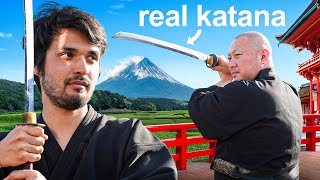
Samurai vs. Ninja: The Truth Revealed
45sDebunks a common pop culture myth, sparking curiosity and debate among fans of samurai and ninja.
▶ Play ClipThe video follows the host as he visits a traditional dojo in Fukushima Prefecture to learn about samurai culture from a modern-day practitioner. He explores the history, misconceptions, and techniques of the samurai, culminating in hands-on experience with real katana swords and cutting practice.
The host visits a dojo in Fukushima run by a YouTube channel focused on katana sword techniques. The practitioner, Waki-san, has been doing kendo since childhood and also makes swords.
Only about 130 people in Japan have a license to make swords, and only around 30 do it full-time. Waki-san makes sword handles and fittings but needs a license to make the blade itself.
Samurai were originally public officials serving a lord, while warriors (bushi) is a broader term. The word 'samurai' came later, and even non-samurai like merchants carried swords.
Samurai used various weapons depending on the era. In the Sengoku period, spears and bows were more common. The iconic two-sword style (nihonzashi) became popular in the Edo period.
Ninjas were more like secret intelligence agents (similar to the CIA) who gathered information and sometimes fought, but direct samurai vs. ninja battles were rare.
Seppuku (ritual suicide) was a way for samurai to prove innocence by cutting the stomach, showing inner purity. It was not common and could only be done once in a lifetime. Execution by beheading was different.
In the past, a katana was sometimes included in a bride's dowry when she married and moved to her new home.
The host examines a handmade katana with a long tip (ora-zukuri) and a beautiful hamon (temper pattern). The sword is made with hard iron on the outside and soft iron inside, folded and forged.
Swords vary widely in price. It's better to see the actual sword before buying, even though many are sold online.
When holding a katana, the thumb must be placed on the tsuba (guard) to prevent the sword from slipping. The host learns proper drawing and sheathing techniques.
The host practices cutting tatami mats. Key points: spread legs, lower hips, cut straight without leaning forward. A proper cut makes a whooshing sound.
The host tries the reverse cut (like Sasaki Kojiro's Swallow Reversal) and learns chiburi (shaking blood off the sword) after cutting.
The host attempts to cut a tatami mat into as many pieces as possible, achieving several clean cuts.
The host tries to cut a bamboo sword (fiver) in a final challenge, successfully cutting it after a few attempts.
The experience deepened the host's appreciation for samurai culture, highlighting the intricate movements, respect, and dignity behind each technique. He encourages viewers to try such an experience at least once.
"The title is slightly exaggerated as 'Japan's Last Samurai' is a romanticized term, but the video genuinely features a modern samurai practitioner."
How many people in Japan have a license to make swords?
About 130 people.
05:33
What is the difference between a samurai and a warrior?
Samurai were originally public officials serving a lord, while warriors (bushi) is a broader term.
06:03
Why did samurai carry two swords (nihonzashi)?
To distinguish themselves from merchants and ronin.
08:40
What was the purpose of seppuku?
To prove innocence by cutting the stomach, showing inner purity.
13:09
What is the correct way to hold a katana to prevent slipping?
Place the thumb on the tsuba (guard).
26:34
What is chiburi?
The motion of shaking blood off the sword after cutting.
33:03
In which period did the two-sword style become popular?
The Edo period.
08:26
What is the difference between seppuku and execution?
Seppuku was a voluntary act by samurai to prove innocence; execution was beheading by authorities.
13:24
Rarity of Sword-Making License
Only 130 licensed sword makers exist in Japan, highlighting the exclusivity of the craft.
05:33Samurai Weapon Misconception
Corrects the common belief that samurai primarily used swords; spears and bows were more common in certain eras.
07:13Seppuku as Proof of Innocence
Explains the cultural significance of seppuku as a demonstration of inner purity, not just suicide.
13:09Katana Craftsmanship
Describes the intricate process of making a katana with hard outer and soft inner iron, folded and forged.
15:14Experiential Learning
Emphasizes that hands-on experience with a real katana is vastly different from watching movies or anime.
44:02[00:01] knowsandlovesWhen Theythinkofjapanese abolishmentInthe late19thCenturyThey andastaplein JapaneseMediathat
[00:14] MODERNtimesbutDeep inthemountainsof keepingtheSAMURAI SpiritALIVEandwell ArtformAndToday goingtobeSpendinga
[00:26] learnmoreaboutWhat MakesSAMURAI Historybutalsototry torecreatethemyand SpiritMyselfwhich LetbeRealprobably
[00:39] andbringShametomy entire MoveonWithTheVideo LikeToGiveAShoutout OversakthisGUbeen sponsoringMENOWfora
[00:53] KnowbynowWhoTheyare butincaseyouknowsak LOCALJapaneseSnack MakerseachBOXcomes Japanesesnacks includingJapanese
[01:06] JapaneseTableand thismonthWehavea collaborationwith theishikawa prefecturewehavethe HeartofishkaFor
[01:18] earlierin2024the ishkaprefecturewas widespread devastationand Citiesstrength Beautyandresilience
[01:31] prefectureaswellas raisingawareness ishkaprefectureto giveyouguyslocally ISKprefecturefor exampleyoucanhave
[01:44] riceCRACKERSyouknow meIamafiendforSandI AfiendforYUZUOhWOW veryYUZUohWOW veryYUZUdelicious
[01:56] thisCuteLittleBAG RightHereThisisBoA thekanazawaareain ishkakindofamixture andactuallyveryvery niceEspeciallywhen
[02:09] TableWearforthis monthissomewasaka chopsticksfromthe ichcprefecturelook alwaysthatnotONLY givesYOUinfoabout
[02:22] importantstufflike allergeninformation sakurakoforbringing awarenessto happenearlierthis yearandtryingtogive
[02:34] soifyouliketodoso Yourselfaswellas BitofJapaninyourownHome then make sure to below. In the description below, and use my coupon
[03:27] code on the screen right now to get a LittleBitofa discount at checkout. Thank you for sponsoring today's video now on to the show in the spacious and serene landscapes of Fukushima Prefecture. As Single DOJO Home To Our person in question runs a YouTube channel specifically about KATSWORD techniques and else that will have any SAMURAI enthusiast frothing at the mouth but before I could start wielding real katanas around Myself. I thought it was only right to expand my art from CIprof. Well, it's a channel that often deals with swords and such, but what kind of killing is involved up to the Wakibuki Festival? Well, I've been doing kendo for a long time, yes, yes, I've been doing kendo since I was in the what kind of killing is involved up to the Wakibuki Festival? Well, I've been doing kendo for a long time, yes, yes, I've been doing kendo since I was in the
[03:39] but I When I first saw Wakiwaki-san's channel, the first thing I thought was, "This channel name is definitely
[03:54] Ruroke, isn't it?" And you're right, it's definitely Kiriba. Yes, that's right. If I were to cut someone, I'd get arrested, so, well, what I actually
[04:08] cut was a tatami mat, yes, yes. In Battodo, they call it Wa or something like that, oh, I see. And of course, there are Battodo, they call it Wa or something like that, oh, I see. And of course, there are swords that you swing around, but Waki-san actually makes swords, right? Yes, well, I ca
[04:22] actually makes swords, right? Yes, well, I ca n't make a sword that's the same size as a real sword, oh, I see. In short, you can't make anything but a sword, so I want a license. I want a license to make swords. That's right. It's a national qualification, so oh, it's quite
[04:38] high level, it's high level. What I make is not the sword itself, but other things that don't require a license, oh, I see, like the handle and the make is not the sword itself, but other things that don't require a license, oh, I see, like the handle and the
[04:51] part that you use, yes, Baggi-san. By the way, I would like a license to make the sword part, the sword itself, if possible, I'd like to try it.
[05:04] But to be able to immerse yourself in it, well, in order to do that, there are also aspects of your life, and the main thing is that while you're getting your license, you have an income, uh, I see, so you income, uh, I see, so you
[05:33] do part-time jobs or something? Yes, that's right. How many people in Japan currently have that license? It's said that there are currently 130 people, about 100. That's a small number, a small number, uh, I see. And among them, there are about 30 people who make only swords and do it full-time. Wow, so that seems extremely rare. So there are also
[05:50] know. There are samurai, right? There are samurai, and there are also warriors, right? What's the difference between a warrior and a samurai? uh, warriors and samurai are the same, right? uh, they're the
[06:03] uh, warriors and samurai are the same, right? uh, they're the same, right? In short, a warrior was same, right? In short, a warrior was originally, to put it simply, like a public official in today's terms. In short, there was a great lord. So, there was a lord in the castle, and his subordinates were
[06:17] called samurai. I see, so a samurai is one type of samurai, is that right? Yes, the samurai is one type of samurai, is that right? Yes, the
[06:30] word "samurai" probably came about later. Yes, yes, even people who carry swords, in the past, were only samurai or warriors carrying swords? Actually, it seems that wasn't the case, as witnesses also carried swords. Oh, I see. Yes, and then there are witnesses also carried swords. Oh, I see. Yes, and then there are
[06:46] n't he? That's right. I live overseas, and of course, samurai culture is featured a lot in the media, and it's
[06:58] incredibly popular overseas, isn't it? So, I have a few things that are often said about samurai culture overseas, and I'd like you to judge whether they are true or false. I understand. I may not be an expert,
[07:13] but I think I'm probably qualified compared to people overseas. The idea that samurai only samurai only use swords... Ah, well, this has changed over time. use swords... Ah, well, this has changed over time. So they are divided into quite large categories, and well, the
[07:28] So they are divided into quite large categories, and well, the swords themselves are really from around the 3rd or 5th century, they are really
[07:41] beginning, and as we went on to the Heian and Kamakura periods, swords started to appear, and then swords with curves like the ones we see Heian and Kamakura periods, swords started to appear, and then swords with curves like the ones we see
[07:55] that time, for example, the easiest to understand is, for example, the Sengoku period, in which people wore these kinds of armor and fought, and the most common weapon was apparently the spear, and also
[08:11] bows, as there were hardly any projectile weapons other than bows, yes, yes, so, well, in the but before that there was really only the bow, so for example, in the
[08:26] Edo period there were fewer spears, yes, yes, yes, on the contrary there were a lot of swords, and Samurai used to Samurai used to carry two swords, called Nihonzashi, and I think that's probably the image of a samurai that most people can imagine. You see it a lot in
[08:40] movies and stuff, so that's something that started after they entered Edo. So why did they carry two? Apparently, it was to Apparently, it was to distinguish them from witnesses and ronin, as I mentioned earlier. I see, so
[08:53] samurai used Nihonzashi. Ah, I see, that's how it is. I Nihonzashi. Ah, I see, that's how it is. I but was two-sword style actually possible in reality? The most famous example of two-sword style is
[09:07] Miyamoto Musashi. Yes, yes, I think he's famous, and I actually tried it myself in front of a tatami mat, and it was really hard. It's hard to get used to, I guess. Yes, yes, it's like
[09:19] hard. It's hard to get used to, I guess. Yes, yes, it's like YouTube shoot, so I guess I put one in my mouth and it was just a simulation. Yes, yes, yes, yes, once you
[09:32] put one in your mouth it's no use at all. I do use at all. I do
[09:44] n't know how this information got around, but it's a misunderstanding, or rather, I don't know how this information spread, but there's this information that samurai often fought often fought ninjas. Ah, I see, there is this information, but I think samurai and ninjas are probably the two top groups in Japanese history, so I
[10:06] think this strange information spread that samurai and ninjas were fighting each other because they were around at the same time, but what was the reality? Well, I do n't really understand what they were fighting for, but basically ninjas are stealthy, right? In other words, they
[10:18] ninjas are stealthy, right? In other words, they can't show their faces in public, right? And, like the can't show their faces in public, right? And, like the CIA today, for example, you know, like a secret intelligence agency, yes yes, and they were involved in intelligence gathering, and
[10:33] intelligence gathering, and even though we say ninjas, they weren't walking around with swords on their backs, right? That's right, and of course there were some like that, but for example there were groups that hid in the streets and gathered information by blending in with townspeople, and there were also groups that actually
[10:50] actually fought, so there were quite a few. Apparently so, but when I actually
[11:03] say, "So you're a ninja," and they nod along, I think it's a little different, don't you think? Well, I but, by the way, my father is Australian, and he really Australian, and he really likes samurai culture, and he really
[11:18] likes samurai culture, and he really picked up some strange Japanese words, and his favorite word is Tsujigiri. I see,
[11:40] could you explain what Tsujigiri is? Tsujigiri is a word that isn't used anymore, but yes, Tsujigiri is like hiding and cutting people, isn't it? Well, to put it simply, yes, so, put it simply, yes, so, normally, when samurai fight each other, they introduce themselves, saying "I'm so-and-so" and "I'm so-and-so" before fighting,
[11:53] normally, when samurai fight each other, they introduce themselves, saying "I'm so-and-so" and "I'm so-and-so" before fighting, hide and cut people from behind as they walk by, and also, when you
[12:12] next most well-known is probably seppuku, right? Yes, ah, seppuku, and so on. Even foreigners who can't speak Japanese at all
[12:24] know the word seppuku, and they know seppuku, and seppuku, and so on. My dad also really likes the word seppuku, but there's this strange information that samurai used to do seppuku a lot, or rather, they did it a lot. I see, I see, there is. It's seppuku a lot, or rather, they did it a lot. I see, I see, there is. It's
[12:44] only done when you take responsibility for yourself, right? For example, if I do something bad, I'll do For example, if I do something bad, I'll do seppuku today and tomorrow I'll do it again, like, "I did seppuku today." You seppuku today and tomorrow I'll do it again, like, "I did seppuku today." You
[12:57] can only do seppuku once in your life, right? So it's seppuku, right? Not all of them died by seppuku. In the end,
[13:09] cutting your stomach is to prove your innocence. Cutting your stomach, ah, I see. It's like saying, "I'm pure on the inside." That's right, that's it. I see.
[13:24] By the way, was seppuku also used for executions? Uh, what's the difference between execution and seppuku? difference between execution and seppuku? This is probably difficult for foreigners to understand, but only samurai could wear katanas. Oh, I see. Yes. For example, when a criminal or bad person is
[13:40] For example, when a criminal or bad person is caught and executed, they are brutally beheaded. caught and executed, they are brutally beheaded. Only the head is cut off, so samurai can kill themselves. Yes, people cannot kill themselves. I see.
[14:00] Finally, time to come face to face with a real katana. Most certainly seen. Real ones in museums and played with fake plastic ones as a child but actually getting to hold
[14:29] protective sword. Yes, for example, when a woman gets married and goes to her new home, it's one of the items in her dowry. Did brides actually have them? Yes, they did.
[14:42] brides actually have them? Yes, they did. For example, at weddings, or Japanese-style weddings, here is a replica, but you stab with it. Yes, yes, yes, there. Oh, so that's how it is. Ah, I see. It's my absolute favorite sword. Wow, it's beautiful. Even the scabbard is beautiful. Mmhmm. Is it
[14:59] okay? Yes, please be careful. Yes, this one too, is made through repeated training and practice. It's the same with this one. This one is also handmade, so it's not made by machine. That's right, it's made by a craftsman.
[15:14] made by a craftsman. Can I draw it? Ah, then I'll draw it a little. First, yes, please. I'm scared to do it myself. I'm scared to do it myself. This one has a special part. Wow, that's cool.
[15:27] Among the parts, this one is called "ora-zukuri," and it has an extremely long tip. Yes, yes. Ah, the hamon is nice. The extremely long tip. Yes, yes. Ah, the hamon is nice. The hamon and the hamon and the texture of the iron are amazing, aren't they? Yes, it's
[15:41] incredibly beautiful. This was made by Tanaka- Tanaka-
[15:54] ji, who runs a YouTube channel called Hoi-dan TV. Oh, would you like to see it? Yes, yes. Wow, that's scary. And it's heavy too. Even the parts are quite heavy. Yes, even the parts are incredibly heavy. And what about the
[16:08] parts and Japanese swords? but what's it really like? Is the sharpness really the best? I think so. It's
[16:23] This is a relatively new sword, but for example, there are swords that are 500 years old that remain in this condition on shelves. Wow, so I for example, there are swords that are 500 years old that remain in this condition on shelves. Wow, so I
[16:40] think Japan is probably the only place where things that are 500 years old remain as if they were made just now. That's right. But I think that kind of amazing and attracts foreigners as well. So, for example, if you just wanted to
[16:54] make a weapon that could kill, there would be no need to make it this beautiful. Well, that's true. need to make it this beautiful. Well, that's true. But the Japanese really value the "B" part, which is unique to them. That's why you can see the hamon (temper pattern), the But the Japanese really value the "B" part, which is unique to them. That's why you can see the hamon (temper pattern), the
[17:10] curve, and the texture of the iron. Yes, yes, you can really see the texture, can't you? Oh, that's true, everyone's eyes are drawn to the hamon. It's true, but this side of the ripple, this is called the skin, yes, the surface of the metal, this
[17:25] called the skin, yes, the surface of the metal, this skin is amazing, oh, amazing, basically, you put it in the fire and hammer it, and the skin is amazing, oh, amazing, basically, you put it in the fire and hammer it, and the iron iron changes, right? You fold the iron and
[17:40] forge it, so this Japanese island is made with hard iron on the outside and soft iron in the middle, oh I see, that's right, and that's how it with hard iron on the outside and soft iron in the middle, oh I see, that's right, and that's how it
[17:55] intimidating, so I'm sure this one will break too, probably, yes, this is a sword, so please show us the sword as well, oh kake, this is something everyone sees often, yes, it's an
[18:10] orthodox um katana, that's right, it's not that heavy, is it, yes, that's right, oh kake, but you're such a heavy, is it, yes, that's right, oh kake, but you're such a
[18:22] look at something like this and think it's cool, your eyes are sparkling, aren't they? No, actually, yes, I've
[18:34] fit properly into the sheath? Um, this cord is called a "sage," and nowadays it's attached cord is called a "sage," and nowadays it's attached to the hakama like this to prevent the sword from being drawn, but in the past it was said to be a handy cord. For example,
[18:50] when tying up criminals, if there was no cord, oh, there's one here, ah, I see, so I tie it here so it doesn't come out unexpectedly, yeah, because it's dangerous, yes, and this sword, um, this one
[19:03] dangerous, yes, and this sword, um, this one here, the person in charge of making it, the sword Nakaji's older brother made it, oh yes yes, the brothers who run the sword Nakaji, yes yes, brothers who run the sword Nakaji, yes yes, two of the 130 people are brothers, their grandfather
[19:16] also made swords, oh wow it's really good, oh, you know, when I look at the sword I feel like I'm going to drool, oh, but I
[19:29] understand, well, yes excuse me, please, wow, wow, would you like to hold it? heavy, but this is one of the lighter ones, oh this is light, this is light? It's like a dream come true, it's rare to find
[19:41] this is light, this is light? It's like a dream come true, it's rare to find someone who can actually hold a light sword like this, it's quite a valuable experience It's an experience, I think so. And it's really beautiful, it's beautiful. The texture is completely different from the original. Yes, yes. Let's take a look at a replica.
[19:57] Yes, this is a straight one. Yes, please. Yes, ah, I see. It's definitely different. The texture of the iron is completely
[20:10] different. The way it shines is different, isn't it? Yes, that's right. It feels different to hold too. I don't know, this one feels more like a feels different to hold too. I don't know, this one feels more like a real sword. Yes, you can tell just by holding it. When you're a beginner, you use a replica like this, yes, yes, yes, you
[20:25] beginner, you use a replica like this, yes, yes, yes, you practice. I see. When I think about practice. I see. When I think about actually swinging this and cutting something afterwards, I can't actually swinging this and cutting something afterwards, I can't stop smiling. By the way,
[20:38] stop smiling. By the way, want to buy one today, you can buy it and take it home. Really? Yes, will you buy one? Yes, how much is it? It's on a wide range.
[20:50] Swords are expensive, after all. Yes, from cheap to expensive. There are also sword from cheap to expensive. There are also sword shops that I've been to. Yes, yes, yes, they have them. Okay, then I'll shops that I've been to. Yes, yes, yes, they have them. Okay, then I'll
[21:07] buy swords on the internet these days, but I think it's definitely better to see the actual product before buying it. And this is the sword I've been using for my main test cuts, so the hamon (temper pattern) is
[21:19] gone. Yes, yes, there is n't a beautiful hamon like before. Hmm, this one is a bit n't a beautiful hamon like before. Hmm, this one is a bit heavy. This one is, uh, this one is really heavy. This one is also, uh, but this one is also kind of... Oh, it's really different from the previous one. And since I've been
[21:36] cutting with it, there's no hamon anymore, and of course the sharpness has decreased, so there are still some traces of sharpening left. That's fine, but this one is also kind of nice, and it's like I'm getting a pension. But it must have been this one is also kind of nice, and it's like I'm getting a pension. But it must have been scary, I mean, being
[21:50] scary, I mean, being attacked with something like this. But when you get cut with a sword, it does n't hurt. Oh, really? No, it n't hurt. Oh, really? No, it must hurt. I mean, even I have accidentally
[22:03] must hurt. I mean, even I have accidentally twice. Yes, yes, I don't know what the first time I got cut. Ah, it was just that it was really too sharp. Yeah, I saw a dojo that was covered in blood and when I
[22:18] Yeah, I saw a dojo that was covered in blood and when I looked, I saw that it was pretty looked, I saw that it was pretty bad, so I went straight to the hospital and took off my jacket. I got pretty cut, I did it quite a bit, oh, it's bad, so I went straight to the hospital and took off my jacket. I got pretty cut, I did it quite a bit, oh, it's
[22:35] this day and age, I think you're probably the only one who's really, because cutting someone would be a crime, so you
[22:49] cutting someone would be a crime, so you tried to test the sharpness on yourself, tried to test the sharpness on yourself, yeah, that's psychopathic, I see, that's good, yes yes, thank you, as you can see, each and every sword has a
[23:03] sword has a different expression, so, although, as you can see, your eyes tend to be drawn to the proportions, but I also like the exterior, like, yeah, the metal parts, each and every sword has its own individuality, so I want to be particular about
[23:18] that too, that's right, that's right, misconception TRANSFORM had
[23:34] thatallsseenFilmandtelionbeforeandwith DADDYKITT pull my pants up it was time to start swinging
[23:48] swords though finished finished I've become a samurai yet I don't have a sword so I don't have a become a samurai yet I don't have a sword so I don't have a
[24:12] sword so round Okay then, from here we will practice the swords so that's right before that we will do some warm-up exercises so that's right so that's right we will do some warm-up exercises so that's right instead of using a sword so that we will use a bamboo rolled up in the river as a sword and play a little sword fighting Yes, ah then please please I will do it with the that in mind please please go ahead Oh yes then please please please it's
[24:36] scary I thought this was a real sword so yes No if it was a real sword I would probably do this This is what makes it different from kendo so that you can create and that's right if you fight If this gets cut it is the end so that's the end Yes I can't see the
[25:00] gaps so leave it there my little finger hurts this time I'm done with this time
[25:18] 2 Wow, my hand is like this so basically where should I look Is this okay? Is this the tip of the sword? I guess with swords, it's the hand movements around here, right? Yeah, yeah, if it's done like this, you have no choice but to dodge, right? That's example, when it's swung back, is it also possible to block it like this? I'll try it once. Yes, that's it,
[25:34] block it like this? I'll try it once. Yes, that's it, but if you block it with your teeth, your teeth will
[26:14] stop painting, I want to land one hit, one hit,
[26:34] humandWarmOUTwasfor learnBASICTECH need, so the string hangs loose, so put it on your thumb, when you hold the sword, always put your thumb on your spit, otherwise, if you point it downwards like this, it will slip out, ah, like a stopper, that's right, yes yes yes, and you
[26:50] usually tie it like this, ah, the sword slipped out, yes this, ah, the sword slipped out, yes Yes, if you grab it like this, it will cut you right here, so I've
[27:02] seen quite a few people do that, seriously, so when you hold the sword, you must hold it with your thumb and your saliva, otherwise it's dangerous. Okay, okay, now you have the base in your hand, so from here I'd like to ask you to explain how to
[27:17] cut. Yes, please. Please. First of all, the sword starts at 0 and ends at 0, so there is a shelf here, so let's start by making a bend towards the shrine. Okay, okay, so please make a bend towards the shrine,
[27:33] and um, yes, make a bend at about 30 degrees. Okay, now switch the sword from your right hand to your left hand, and
[27:58] start from there. Okay, so now how to draw the sword, yes, um, hold the base with your right hand like this, and draw the sword, yes, um, hold the base with your right hand like this, and not from above, but from below, like this. That's right, when you grab the sword, it's like a praying hand, not like praying, um, it's the
[28:11] praying hand, not like praying, um, it's the same as this hand, ah, right. Yes, that's right. Ah, yes, yes. You same as this hand, ah, right. Yes, that's right. Ah, yes, yes. You press the scabbard with your left hand, and it comes out, right? Yes, yes. Then you hold the scabbard and with your left hand, you pull the scabbard like this, backwards, and
[28:27] scabbard and with your left hand, you pull the scabbard like this, backwards, and
[28:49] sword will fall here, right? Yes, yes, and you put it right in. Well, your fingers are close, so it's fingers are close, so it's okay, but doing this with a real sword would be
[29:02] too scary. Pull it straight like this, right? That's right, like this, and the sword is at an angle so it definitely won't go in like this, right? Yes, ah. So it's from quite low down, right? That's right, and you put it back. And your thumb stays like this, and your from quite low down, right? That's right, and you put it back. And your thumb stays like this, and your
[29:17] thumb is like this, like this, like this, right? Mmhmm, that's right, that's right, yes. Yes, it's easy to do the opposite. Ah, that's right, that's right, ah, good, good, uh
[29:40] Just inserting and removing, just inserting and removing, it doesn't make a video, it's not interesting at all. Okay, so what's the second one? Okay, let's start with the Shinko-giri. The doesn't make a video, it's not interesting at all. Okay, so what's the second one? Okay, let's start with the Shinko-giri. The easy way is to spread your legs straight out to the side. Okay, just like this,
[29:56] lower your hips and cut straight. Do n't lean forward, keep your posture like this, that's right, that's right, that's right. Okay, that's good, isn't it? It makes a whooshing sound, that's good. If you do n't lean forward, keep your posture like this, that's right, that's right, that's right. Okay, that's good, isn't it? It makes a whooshing sound, that's good. If you do
[30:10] n't touch it straight, it won't make that sound. Yes, that's right, if your posture is bad it won't sound like that. But, oh, I see, this will make your arm hurt. Shall we try the cut now? The cut is this line, ah, yes, yes, just like that, yeah, it's
[30:27] this line, ah, yes, yes, just like that, yeah, it's diagonal like this. And, diagonal like this. And, when you swing to the left, lower your left foot. Okay, if you swing with this foot out, you might end up cutting your own foot, ah, I see, yes, lower this foot. Okay, like this? See, there's no
[30:43] cutting your own foot, ah, I see, yes, lower this foot. Okay, like this? See, there's no difficult. Here too, the Here too, the sound is really different. Ah, okay, okay, yes, yes, yes, yes, it's
[30:58] sound is really different. Ah, okay, okay, yes, yes, yes, yes, it's lean forward. I lean forward. I
[31:14] good. I do play baseball. Yes, I do. In baseball, for example, when you hit, you don't grip the club tightly, right? You grip it tightly only at the moment of impact when the ball comes, right? It's the same thing. It's just the only at the moment of impact when the ball comes, right? It's the same thing. It's just the
[31:31] now let's try the opposite. Put your right foot forward and pull it back this way. opposite. Put your right foot forward and pull it back this way. This way, right? Yes, that's good. That's good.
[31:46] sounds better. That's right. Are you left-handed? right. Are you left-handed? Next is the reverse cut-up. Like this. Yes, that's good. That's pretty Next is the reverse cut-up. Like this. Yes, that's good. That's pretty
[32:04] here to like this, right? That's right, that's right. Wow, amazing. amazing. For example, Sasaki Kojiro's
[32:16] Swallow Reversal is a famous technique, isn't it? That's the same combination as this morning. It's the reverse combination. Ah, shun shun. That's right. This is the claw grip. Ah, it's
[32:29] This is the claw grip. Ah, it's not that difficult to return it, is it? Ah, I see, that's really not that difficult to return it, is it? Ah, I see, that's really educational. When I educational. When I watch it on video or something, I
[32:41] think it's just cutting, but when you actually try it, it's difficult, extremely difficult, this might be the hardest part. After you cut, there's something called "chiburi," which is when you shake off the blood that gets on the sword. That's right, you can
[33:03] various ways to do this " chiburi" motion, so Baraki, which is your favorite? Well, in my style, we often do a big chiburi, but yes, yes, so you cut while sitting down, right? And then you
[33:23] stand up from here and do a big chiburi like this, and then you make a note, yes, yes, yes, that's the flow. So it's like this, ah, that's right, and then you go and note, yes, yes, yes, that's the flow. So it's like this, ah, that's right, and then you go and
[33:38] grab the sheath, and then you do a note, ah, this is amazing, you did it, you're good, you did it さぎんやってました。 English:
[34:24] [music] Over, I'd like to do the same thing, please [ music] Wow, it's
[34:41] surprisingly, there's really no sound at all. I unskilled person cuts, that's the sound you get. Ah, then I think I'll make that sound.
[34:54] [music] PERhave
[35:11] [music] Ah, this is it, just pull it out as is. Yes, so difficult Ah, this is it, just pull it out as is. Yes, so difficult
[35:24] though, one more time, one more turn. Wow,
[35:41] a little curved. That's right, it's not straight, it's like this, so it would be good if it was straight all the way down. That's right, as have have, have, have, and because not cutting in straight line where as you look at just, perfect, flat line. So I want to be able to get to that point. Again you have to remember that the reason why these have been sitting in that big watertub right. There is one make it so that the tatamidoes
[36:20] damage the actual blade but Two apparently it makes it feel like cutting through fluffs and that hands I
[36:43] GOD Let's try cutting it as thinly as possible and see how many times you can cut it with just this one tool Yes, yes please Yes, here we go Yes, like this, it's big, maybe cut it with just this one tool Yes, yes please Yes, here we go Yes, like this, it's big, maybe
[37:03] 7 times? Maybe 8 times Yes, go
[37:36] but it's hard to aim That's right I wanted to aim as high as possible but Yes, it's difficult It's aim as high as possible but Yes, it's difficult It's
[38:14] lower your hips What I was talking about just now Oh, you did it, good job, thank you Maybe you're better than me Ah, that might be the prettiest one today Mine was better than me Ah, that might be the prettiest one today Mine was thank you
[38:29] thank you NEXT My Sasaki Kojiro Swallow Reversal Please, please Let's try NEXT My Sasaki Kojiro Swallow Reversal Please, please Let's try
[39:01] Reversal one more time If the solitary confinement cell appears, you can't cut it Yeah, that's right, it doesn't become nothing, and why, why, I wonder, I was
[39:19] but if you look at this, you can see it's going in sideways, right? Ah, a little higher, see, yes, yes,
[39:33] one more time, yes, yes, yes, that's how you should cut it, I see, I think, it fell, it feels good, amazing, I did it, time, yes, yes, yes, that's how you should cut it, I see, I think, it fell, it feels good, amazing, I did it,
[40:11] thank you, for the final ONE We have a little Bofan exhibition you guys SAW How much absolute was mediat Cutting SHOW some of the final ONE We have a little Bofan exhibition you guys SAW How much absolute was mediat Cutting SHOW some of the
[41:12] [music] that okay this is the final EVENT ify your guys Play it before you might have seen this thing Right here FIVER can cut ONE Please, it's so cool, I guess I should scream, I guess I have to scream, I guess I have to put in some effort, I guess, yeah, I can't, I ca
[41:57] Net Challenge Next Challenger I'm going Oh no, it's Challenger I'm going Oh no, it's step down, down Like this, aim up from here to about this
[42:14] [Music] Yes, there's no good, so let's go with two, two That's right, let's start with go with two, two That's right, let's start with two Again, I'm
[42:35] swinging to the side I think my problem is that Little Bass, we just say, right, the getting kind of like Scared to cut straight down and actually ending up, cutting more horizontally Which is making it more
[43:04] cut the first one Ah, so close, so close, so close, so close That's how it felt, it's good practice, it's good practice
[43:24] [Applause] Oh, you did it, it turned into a bit of a mess, but it's okay, you got it right, it feels good, doesn't it? It feels good, you did it
[43:38] to Waki I think I have turned into a samurai Waku I have turned into a samurai Waku
[43:50] experience, thank you so much. Before I came, I thought samurai were cool, but that feeling has increased a hundredfold.
[44:02] but that feeling has increased a hundredfold. Actually experiencing it is completely different from just watching movies or anime, and seeing, touching, and
[44:16] swinging a real sword in person is completely different from what you imagine. It doesn't seem easy, and it's not just about swinging it around, but it's like a set of really intricate movements, it was an amazing experience, a intricate movements, it was an amazing experience, a great experience, it was good,
[44:30] but I had good technique so I was able to cut from the start, it was amazing, I'd like to come back to train, it was really like training today, that's right, more like I'm an training today, that's right, more like I'm an apprentice than an experience, that's right,
[44:45] thank you for this valuable experience, thank you very much, have say EXP, try something like this at least once in your life because I mean you know you guys know experience, a lot of things from this channel meeting, all sorts of people doing
[45:07] soAgainABIGThankyou toforlettingmespend filmedAnotherVideo ThatisupONTHESECOND whereWeGetamodern DayJapanesesamurai
[45:20] SAMURAIswordsin animesoifinterested ifyouguysarealittle moreintouchwithyour alsodoneAcollab Videowithaswell
[45:34] leavethatDownin descriptionbelowas watchinghopeyouguys enjoyeditandseeyou enjoyeditandseeyou allintheNext
[45:50] managedtofulfilla lifelongDreamOfMine KATANAandCUTsome ShitupbutindoingSoI ManyNewandCool Thingsaboutthis
[46:03] everyMovethe absolutely behinditallandthe Respectanddignity thesebeautiful beautiful
[46:16] beautiful [Music] creationsH [Music]
⚡ Saved you 0h 46m reading this? Transcribe any YouTube video for free — no signup needed.