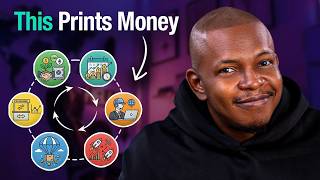

Crypto Money Map: 9 Ways Ranked
49sThe opening segment introduces a clear, visual framework for ranking crypto methods, which is highly shareable and educational for beginners.
▶ Play Clip"Title promises 9 skills to get rich, but the video delivers a solid map of 9 paths with realistic risk/reward — mostly delivers, though 'rich' is oversold."
This video presents a comprehensive 'crypto money map' that ranks various cryptocurrency income strategies by profitability, difficulty, and risk. The creator guides beginners through nine distinct paths, from low-risk staking to high-reward building, helping viewers identify the approach that best fits their capital, skills, and goals.
The video introduces a 2D map with difficulty on the x-axis (low, medium, high) and profitability on the y-axis (low, medium, high). Risk is color-coded: green (low), purple (medium), red (high).
Staking involves holding a coin and earning yield for locking it up, similar to earning interest. It's low risk only if you choose the right coin; chasing high-yield coins (30-100%) often leads to losses. The creator primarily stakes stablecoins (e.g., USDT) on Bybit for 5-6% annual return.
Dollar-cost averaging (DCA) means investing a fixed amount monthly regardless of price. The creator cites a personal example: investing 20,000 naira monthly for 3 years grew to ~14 million naira by year 4 (20x), versus ~720,000 naira in a bank. Beginners should stick to top 5 coins.
Airdrops reward early users of new projects. While historically profitable (e.g., Uniswap gave $2,000, some made $100k in 2021), most airdrops are now less lucrative. They require time, research, and carry smart contract risk. Categorized as medium risk and not a long-term wealth strategy.
Crypto industry offers both technical (developers, auditors) and non-technical roles (community managers, content creators, translators). Starting roles pay a few hundred dollars/month; skilled roles up to $3,000+. Difficulty is medium due to competition. Platforms: cryptojobs.com, cryptojoblist.com, web3.career, LinkedIn.
Creating educational content on YouTube, TikTok, Twitter, etc., can generate income via exchange affiliates, sponsorships, courses, and ad revenue. It's higher difficulty than a job due to consistency and patience needed, but profitability can be high. Most quit after 3 months.
Spot trading involves buying a coin and selling when price rises. No leverage means no liquidation, but holding a weak coin bought at a peak can lead to permanent loss. Requires analysis, patience, and timing. Opportunities reduce during bear markets.
Futures trading allows profiting from both upward and downward price movements using leverage. It sits at the top-right of the map (high reward, high difficulty, high risk). Beginners should graduate to this after mastering risk management, position sizing, and emotional control.
Copy trading mirrors another trader's moves. In theory, if the master profits, the copier should too. In practice, gaps exist. The creator is building 'CopyMeCrypto' to structure this better. A Telegram group link is provided.
Building a crypto project (exchange, tool, etc.) requires an idea, team, and funding (often millions). Major crypto names built something rather than just trading. It creates value within the ecosystem.
The video concludes by matching strategies to user profiles: small capital → airdrops/skill development; time but no capital → crypto jobs; skill and discipline → futures trading; capital and patience → staking; vision and team → building. The creator invites viewers to share their choice in the comments.
What is the risk color code for low, medium, and high risk on the crypto money map?
Green for low risk, purple for medium, red for high.
00:49
What annual return does the creator get from staking stablecoins on Bybit?
5 to 6% annually.
01:47
What is dollar-cost averaging (DCA) in crypto?
Investing a fixed amount of money monthly into a coin regardless of its price, without trying to time the market.
02:12
What was the approximate 20x return example given for DCA over 4 years?
Investing 20,000 naira monthly for 3 years grew to about 14 million naira by the end of the 4th year, versus ~720,000 naira in a bank.
02:40
What is the main risk of chasing high-yield staking coins (30-100%)?
Those coins always drop in value, leading to an overall loss.
01:33
What was the Uniswap airdrop example and its value at the time?
Active users received 400 UNI tokens worth about $2,000 at the time.
04:19
What are two non-technical crypto job roles mentioned?
Community managers, Telegram/Discord moderators, content creators, social media managers, graphic designers, customer support, video editors, translators.
06:12
What is the key difference between spot trading and futures trading?
Spot trading has no leverage and you can't get liquidated; futures trading uses leverage and allows profiting from both up and down movements but carries higher risk.
09:58
What is the main problem with copy trading according to the creator?
The master trader may make profits while the copier barely makes anything or even loses, due to structural gaps.
11:41
What is the recommended path for someone with small capital?
Go for airdrops and skill development.
12:52
Staking is low risk only with the right coin
Clarifies a common misconception that all staking is safe; warns against chasing high yields.
01:02DCA example: 20x return over 4 years
Provides a concrete, compelling real-world example of DCA's power versus traditional savings.
02:40Uniswap airdrop: $2,000 to $100k+ outliers
Illustrates the historical potential of airdrops while cautioning that most are now less profitable.
04:19Crypto jobs: stable income without trading
Highlights an often-overlooked path for beginners to earn in dollars with lower risk.
05:47Copy trading gap: master profits, copier loses
Reveals a critical flaw in copy trading that many beginners don't realize.
11:25[00:01] I am new to crypto. Where do I even start? The thing is crypto is not just one path. Some ways are simple, some are advanced, some are safer, and some are very risky. And if you start in the
[00:18] wrong [music] place, you can easily get overwhelmed. So in this video, I want to overwhelmed. So in this video, I want to show you the crypto money map. crypto ranked by [music] profitability,
[00:33] difficulty, and risk. And by the end of the video, you'll know exactly which one fits you. Let's build the map. On the x-axis we have a difficulty [music] level, so low, medium, high.
[00:49] On the y-axis you have the profitability. >> [music] >> Again, low, medium, high. And for the risk colors, green is for low risk, purple for medium, and red for high
[01:02] risk. Let's start from the bottom left of this map. Lowest difficulty, lowest risk, least stressful way to make money in crypto is staking.
[01:15] It is very simple. You hold a coin and you earn a yield for locking it up. In other words, [music] you're earning interest on your crypto. You'll notice this is green. It is low risk, but it's only stays green
[01:33] low risk if you choose the right coin. >> [music] >> Some people chase coins that yield 30, 40, or even 100%. But the thing with those type of coins is that they always drop in value and lead you to an overall
[01:47] loss. So, don't do that. The way I [music] primarily use staking is with stable coin. Instead of leaving USDT doing nothing in Instead of leaving USDT doing nothing in my wallet, I put it into Bybit and earn
[02:00] an annual 5 to 6% annually on the coin. It's not exciting. It won't make you rich overnight, but it is [music] steady and steady compounds over time. Now,
[02:12] let's move slightly up the map. This one is still beginner-friendly, but with more upside. It's DCA. Dollar-cost averaging. It simply means this. Every month you
[02:26] take a fixed amount of money and [music] you buy a coin regardless of the price. You don't try to time the bottom. You don't try to predict the market. You don't try to predict the market. You just stay consistent. Now, back in 2020,
[02:40] I made a video showing how I invested 20,000 naira monthly for 3 years, and by the end of the 4th year, it had grown to about 14 million naira. If that same money sat in my bank
[02:55] >> [music] >> it's about being around 720,000 >> it's about being around 720,000 naira. So, imagine 720 to 14 million. naira. So, imagine 720 to 14 million. That's about 20x. I have helped a lot of
[03:07] people set up the same thing and achieve the same results after that video. The good thing now with DCA is that many exchanges like Bybit automate the DCA process [music] and even stake the coin you DCA with
[03:23] and even stake the coin you DCA with for additional interest. That said, the coin you select for DCA matters a lot. If you DCA into a weak coin, you lose money instead of making money. So, if
[03:35] you are a beginner, don't go below the top five coins. Just stick with that. Staking protect your capital. DCA builds your capital. DCA builds your capital. But neither of these two is designed for
[03:48] fast money. So, let's get into that. Which will take us slightly to the right on the map. This one requires little to no capital. It is airdrop. The real question with airdrop in 2026 is that
[04:05] is it still relevant? And the answer is yes, but not in the >> [music] >> Projects use airdrop to reward early users and attract attention to their ecosystem. That is how airdrop is
[04:19] It became popular when Uniswap rewarded active users with 400 UNI tokens, worth active users with 400 UNI tokens, worth about $2,000 at the time. In 2021, some
[04:32] users made over $100,000 >> [music] >> This is one of the biggest airdrop we've ever experienced in crypto. [music] But this
[04:47] is actually an outlier. Most airdrops nowadays are nowhere as profitable as this. Airdrop can be a good starting point if time. But understand this.
[05:03] It is effort-based. You spend hours researching, interacting with platform, filtering through noises, and there is no guarantee of reward. There is also smart contract risk. If you connect your wallet to a malicious platform, your
[05:19] money in that wallet. This has happened to a lot of people. So, because of that, I categorize So, because of that, I categorize airdrop as medium risk, as you can see
[05:32] on the map. Airdrop are good for learning ecosystem, but they are not a learning ecosystem, but they are not a long-term wealth strategy in 2026. Now, before we talk about trading, which most people rush into and lose, let's
[05:47] talk about something more stable and most beginners completely overlook. Earning from the crypto industry without trading. And you can earn in dollars.
[06:00] Crypto is not just coins. It's [music] an industry, and like every industry, it Now, when people hear crypto jobs,
[06:12] they immediately think about coding, blockchain, and all that stuff. It is not only [music] that. There are many non-technical roles in crypto. For example, we have community managers, Telegram and Discord moderators, content
[06:25] >> social media managers, graphic designers, customer support, video editors, even translators. And of course, yes, we still have the developers, the smart contract auditors, and the blockchain engineers,
[06:38] if you're a technical person. Now, on the map, Now, on the map, crypto jobs sits higher in profitability than staking or DCA and lower in risk than trading.
[06:51] experience, crypto jobs can pay for starting roles a few hundred dollars a month. The more skilled roles earn up to 3,000 plus a
[07:03] month. So, how do you actually get this job? This how do you actually get this job? This is why the difficulty is medium because it is not easy to get. First, you have to acquire the skill. There are
[07:17] thousands of people applying for these roles. And just like traditional jobs, >> [music] >> You can check platforms like cryptojobs.com, cryptojoblist.com, web3.career, and even on LinkedIn to
[07:32] apply for these jobs. Also, be active in the communities, Discord, Telegram, Twitter, you know. Sometimes visibility and activity actually brings these opportunities to your doorstep. Working a crypto job also exposes you to the
[07:48] industry. It can open doors for investment, partnership, and even traveling globally. Now, if you don't want to work for someone else, there is another path to earn in crypto.
[08:03] Build your own audience. Content creation. Like I'm doing right now with you. This is not [music] fast money. It's not easy money, but if done properly, it can be
[08:18] >> a very powerful way to earn in crypto. Content creation simply means you educate, you share insights, you simplify complex you share insights, you simplify complex things through YouTube, TikTok, Twitter,
[08:32] Instagram, or even newsletters. So, how do creators actually make money? >> It is not from views alone. So, we have exchange affiliates, sponsorships, courses, private communities, signals, consulting, and ad revenue.
[08:48] consulting, and ad revenue. On the map, content creation sits higher in difficulty than getting a job because you need consistency, communication skill, and patience to
[09:02] build an audience. But profitability is higher if you know what you're doing. one video can work for you for years. One post can bring opportunities you didn't [music] expect. But a thing with content
[09:16] it [music] quit after 3 months. They post five videos, get low views, and they stop. And that is why most people never see >> [music] >> If you understand crypto
[09:31] and you can explain it clearly, there's always room for you as a content creator in [music] this crypto space. Now, let's talk about the path most people actually
[09:43] Trading. But we need to separate this properly because spot trading, copy trading, and futures trading are not the same thing. They don't sit in the same place in the money
[09:58] map. Let's start with spot trading. Spot trading is simply you buy a coin, if price goes up you sell and you make money. If it goes down >> and you sell you lose money. The good thing about spot trading is
[10:12] this. There is no leverage. You can't get liquidated. If price drops, you can decide to hold. But holding only works if you bought the right coin. If you buy a weak coin at the peak of the bull run,
[10:28] a weak coin at the peak of the bull run, price can drop and never really recover. You're still holding, but the value is gone. So on the money map, spot trading >> [music] >> It requires analysis, patience and
[10:42] timing. Now the downside of spot trading is that during the bear markets the opportunities to trade reduces because price is mostly declining. So what if you want to make money whether price is going up or down? That is where futures
[10:57] trading come in. In futures, you are trading price movement, not just buying and holding a coin. This sits at the top right of the map. So high reward, high difficulty and also high risk. As a beginner you don't start here, you
[11:12] graduate to this point because futures requires risk management, position sizing, emotional control and discipline. Without this, it becomes expensive quickly. And maybe you are now thinking that, you
[11:25] know futures trading is not for me right now. I'm not ready for that level yet. This is where copy trading comes in. Copy trading means your accounts mirrors the trades of another trader. When they
[11:41] enter, you enter. When they exit, you exit. In theory if the trader makes money, you should make money, too. But in reality, it's not always that smooth. I've tested copy trading across different exchanges and I've seen
[11:57] situation where the master trader makes profits, but the copier barely makes anything or even lose. This gap is exactly why I'm building CopyMeCrypto. A system where you just choose your risk
[12:10] per trade and everything else is structured properly. and I'll leave the link to that Telegram group in the description of this video. the map the highest difficulty
[12:25] but also the highest ceiling which is building. It's difficult because you [music] need to come up with the idea, get the right team and raise fund which sometimes run into millions of dollars. Every major
[12:39] into millions of dollars. Every major name in crypto didn't get wealthy just by trading. They built something. Exchanges, tools. When [music] you build, you are not just
[12:52] participating in crypto, you are creating value inside it. So out of what I've mentioned so far, which one do you choose? If you have small capital, then go for airdrop and skill development. If you have time but no
[13:05] crypto jobs. If you have skill and discipline, futures trading. If you have capital and patience, staking. If you have vision and a team build it, too. Let me know your choice
[13:18] build it, too. Let me know your choice in the comment section.



⚡ Saved you 0h 13m reading this? Transcribe any YouTube video for free — no signup needed.