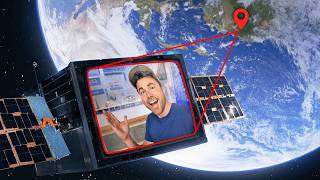

Your Selfie in Space with Earth!
42sThe concept of taking a selfie with Earth in the background is unique and highly shareable, sparking curiosity and wonder.
▶ Play Clip"Title accurately reflects the content: a detailed, step-by-step guide to building and launching a satellite."
This video provides a six-step crash course on building and launching a personal satellite, using the creator's own satellite SATGUS as a case study. It covers everything from digital design and analysis to construction, testing, launch, and operations, emphasizing the use of CubeSat standards to reduce costs.
The creator outlines six steps: design in CAD, analyze for space survival, build, test, launch, and operate. These steps mirror the process used for SATGUS.
CubeSats are standardized satellite units (1U, 2U, 3U, etc.) that reduce development costs by 100x. They use common hardware for basic functions, leaving room for a custom payload.
SATGUS has a phone and camera for taking selfies with Earth in the background. It includes solar panels, batteries, reaction wheels for orientation, torque rods, GPS, IMU, star trackers, sun sensors, UHF and S-band radios, and a flight computer.
Three reaction wheels (flywheels) oriented 90 degrees apart allow precise satellite orientation by spinning up or down, using conservation of angular momentum.
Satellites must survive rocket vibrations. Finite element analysis (FEA) ensures all components have resonant frequencies above the rocket's shake frequency to avoid amplification.
In orbit, temperatures swing from 212°F to -150°F. Thermal analysis determines where to place heaters and radiators to protect electronics.
Space radiation is intense; an hour in space equals a year on Earth. Critical electronics are shielded with aluminum (6mm thick) and glass based on radiation testing.
Vacuum can cause outgassing and expansion of materials. Components are tested in vacuum chambers to ensure they don't release gases that could damage equipment.
Despite crowded diagrams, space is 1 million times less crowded than skies with airplanes. Collision probability is extremely low; active tracking of 44,000 objects is done.
After design and analysis, the satellite is built and undergoes hardware-software tests, including solar panel deployment, camera tests, and full selfie transmission tests.
The satellite is shaken on a shake table and baked in a vacuum oven to simulate launch and space conditions, ensuring it survives vibrations and temperature extremes.
SATGUS launches on a SpaceX Falcon 9 from Vandenberg, chosen for polar orbit. The launch sequence includes booster separation, fairing deployment, and satellite deployment after about 9 minutes.
After deployment, SATGUS communicates, deploys panels, and starts taking selfies. Its orbit decays over 1-3 years, and it burns up on re-entry, disintegrating spectacularly.
Building and launching a personal satellite is now accessible to civilians thanks to CubeSat standards and commercial launch providers like SpaceX. The entire process, from design to fiery re-entry, is a testament to human ingenuity and the democratization of space.
SpaceX Falcon 9
service
CrunchLabs
service
Space Selfie
service
Mark Rober
person
CAD software
tool
Finite Element Analysis (FEA)
tool
Shake table
tool
Vacuum oven
tool
Reaction wheels
tool
Torque rods
tool
Star trackers
tool
Sun sensors
tool
GPS
tool
IMU
tool
UHF radio
tool
S-band radio
tool
Flight computer
tool
Google Pixel phone
tool
Redwire camera
tool
T-Mobile
service
Starlink
service
What is a CubeSat?
A standardized small satellite design that uses common hardware for basic functions, reducing development costs by 100x.
01:26
What are the four main ways space tries to kill a satellite?
Vibration, temperature extremes, radiation, and vacuum.
06:16
How do reaction wheels orient a satellite?
Three flywheels oriented 90 degrees apart spin up or down, causing the satellite to rotate in the opposite direction due to conservation of angular momentum.
03:58
What is the purpose of torque rods?
They create a magnetic field that interacts with Earth's magnetic field to change satellite orientation, and also help unspin reaction wheels when they reach max speed.
04:24
What is finite element analysis (FEA) used for in satellite design?
To divide the structure into small chunks and calculate resonant frequencies, ensuring all parts have frequencies above the rocket's shake frequency.
08:02
How hot and cold can a satellite get in orbit?
Up to 212°F in the sun and as cold as -150°F in the shade.
08:59
Why is space radiation more intense than on Earth?
An hour in direct sunlight in space equals an entire year of standing in sunlight on Earth due to lack of atmospheric protection.
10:01
How thick is the aluminum shielding on SATGUS?
Six millimeters thick.
10:38
What is the collision risk for satellites in orbit?
Extremely low; space is 1 million times less crowded than skies with airplanes.
12:30
How many objects are actively tracked in orbit?
44,000 satellites and objects.
12:42
What happens to SATGUS at the end of its mission?
Its orbit decays, it burns up on re-entry, disintegrating spectacularly.
22:05
CubeSat Standardization
Explains how CubeSats reduce costs by 100x, making space accessible to civilians.
01:26Reaction Wheel Orientation
Demonstrates a clever physics principle for satellite control without fuel.
03:58Finite Element Analysis for Vibration
Shows how engineers use simulation to ensure hardware survives rocket launch.
08:02Radiation Shielding
Highlights the extreme radiation environment and need for protective enclosures.
10:01Space is Not Crowded
Debunks the common misconception of crowded space with statistical comparison.
12:30[00:00] And in about a month, she'll be zooming by way up in space at five miles per second. But what makes SATGUS so special is that she's got a phone right here and a camera right here,
[00:13] and her sole purpose is to take your selfie in space with the earth photo bombing you. And it gets even cooler because if you tell me the city you live in, when you upload your picture to the satellite will not only take the selfie over your city, but we'll tell you precisely when that
[00:27] It's incredible we live in a day and age where just an everyday civilian like you and me can just So today I'm going to give you a six step crash course that will tell you all you need to know to
[00:42] And these six steps are very near and dear to my heart because these are the exact same six steps I So for step one right out of the gate, you got a first design your creation digitally in CAD, and
[00:58] And it's really the first step for anything that gets made and manufactured these days. From Mars Rover to an iPhone to a hammer to a shampoo bottle cap. CAD is critical for visualizing what it will look like and helping make design decisions about what
[01:13] In our case, after a few months of the design phase, we landed on something that looked like this and it might look really impressive and in many ways it is, but we sort of cheated and saved ourselves a lot of time and money because this is something called a CubeSat.
[01:26] About 25 years ago, a couple of Stanford professors realized every satellite that goes to space needs all the same basic elements like solar panels, radios and computers. So instead of everyone having to start from scratch and re-invent the wheel every time they
[01:39] Of of the most common sizes used, the smallest is a 1U satellite which is just a little bit bigger And then there's the 2U which is just two Rubik's cubes, so double that, then the 3U, the 6U and the 12U.
[01:53] The way it works then is all the hardware necessary for the basic functionality of the But then that leaves all this extra room for the payload.
[02:06] In our case, that would be a camera and a screen for taking the pictures. I highly recommend you make it a CubeSat because that will reduce your development costs 100 times
[02:20] So I want to talk about what's actually on SATGUS, because you'll need a lot of the same hardware yourself. But first, let's talk about what makes it unique, which is our payload or how we're going to take
[02:33] Once we get to space and everything's looking good, these two spring loaded panels rotate open and then on the other, we've got a camera that's specifically been designed to withstand the harsh
[02:45] So once we beam your picture up to the satellite, we'll display it on the phone and then the camera And you'll notice there's actually an identical setup of a phone and camera on the other side of
[02:58] That's basically a full backup system since we can't go to space and fix things if there's a For power, it's not feasible to run an extension cord all the way up to space, so she's got two fixed solar panels that dump their power into some 120 watt hour batteries.
[03:12] The solar panels provide enough power to fully charge your phone nine times every 90 minute orbit But this actually creates a big problem for us. but then we have to point this way at the earth to send and receive pictures and then this way down
[03:29] So how do we move around in space when there's no fuel or thrusters and there's no atmosphere to Well, here's a hint, see this cube, it's just hanging by the swivel mount and it doesn't have
[03:41] And yet when I push this button, and then stop. Well, if we take off the panels to take a look, the trick is this spinning disk or flywheel.
[03:58] If the flywheel starts spinning one way, physics says the cube must rotate the other way to So if you orient these three flywheels we call reaction wheels all 90 degrees apart from each
[04:11] other, then you can spin them up and down to orient the whole satellite to any direction you And just like you could see here, they're incredibly precise. Now because rotating the satellite is critically important, for a backup, and to help unspin these
[04:24] flywheels once they get to their max rotation speed, we've also got three torque rods again, all These are super genius and such a simple design. You can even make yourself where you just run a bunch of wire around a $2 piece of crystalline iron.
[04:39] You can see proof of that here because when we turn it on, it moves this compass. But that new magnetic field, will want to line up with earth's magnetic field just like how normal
[04:51] So you can see here, simply by turning it on and running current through the wire, seemingly by magic, you can change the orientation of this little floating platform. Another challenge we have is SATGUS needs to know exactly where it is at all times relative to the
[05:05] earth, so it knows when to snap your selfie as your neighborhood is passing underneath along with To solve that, we've got a GPS on board, but that only tells us our location, not our orientation. So for orientation, we've got an IMU just like your phone does when it knows you've rotated it as
[05:20] well as two star trackers that take pictures of the stars and match them against a catalog of star But sometimes they can't see the stars because the sun's blinding them. So there's also two sun sensors that locate the brightest spot in the sky and just assume it's the
[05:35] For the penultimate critical piece of hardware, we need to be able to talk to it. There's a UHF that has low data rates and that's for basic commands and telemetry communication and
[05:50] then an S Band which is for higher data rates like actually transmitting the pictures. And the final piece of hardware on SATGUS that you're also going to need for your own space build This is the brains of the satellite and it takes all the inputs from the sensors and radios and
[06:04] For step two of building and sending something to space, we need to analyze our design because there So we need to investigate each of these and make sure we're protected.
[06:16] Technically, this actually happens on the launch pad before you get to space. But the rockets necessary to escape the earth's gravity are so massive and powerful the violent rumble inside the rocket is strong enough to break most items we use on a daily basis here on earth.
[06:32] And here's what I mean by that. You know how if you push someone on a swing at just the right time, they go higher and higher. Fire!
[06:47] But then if you push at the wrong time, you actually mess up their swinging and they slow down. - Everything has a resonant frequency from your phone right after it hits the ground to your house - To illustrate, I've got three masses here that all weigh the same.
[07:01] So as I increase the shaking of this base plate, see if you can spot when we hit a resonant frequency. It becomes like the swing because we're adding more and more energy with each shake...
[07:18] And now once again, if I increase how frequently the space shakes or its frequency and we go past Now, the longer rod is fine but the middle one hits its resident frequency
[07:32] Now, if I do this once more and maybe pause at the first resonant frequency, and maybe I pause at the second, and then I crank it all the way up,
[07:47] we get close, but we never quite hit the resonant frequency of the small one. The shaking base plate represents the rumbling, shaking rocket. We have to make sure all of our hardware has a resonant frequency above the rocket's just like
[08:02] But how do we do that? - Well, remember that CAD model we created in step one to organize and package everything we put it This means we take the whole structure and divide it into a lot of little chunks called a mesh.
[08:19] Each chunk is small and simple enough where we can use really basic physics equations to see how it So now the computer just has to solve lots of really simple equations that are all connected as
[08:31] opposed to one single impossibly difficult equation to make sure that the resonant frequency for the whole satellite and each individual part are all higher than the rocket shake frequency. After that, even though we know we won't overlap with that low resonant frequency where things will
[08:44] So we use that same finite element model to make sure all the pieces on the satellite are still The second way space tries to kill you is it wants to both burn and freeze you to death.
[08:59] Here on earth, we've got a nice cozy atmosphere that acts like a giant blanket that both holds in heat from the sun and then moves it around through wind which keeps the temperatures relatively stable. So in a single orbit, parts of the satellite can it get as hot as 212°F in the sun and then as cold
[09:18] That's like going from nearly twice the hottest temperature ever recorded in a desert on earth to If we don't protect against it, those temperature swings would freeze or overheat the electronics
[09:33] Only now we investigate how heat spreads through the metal structure when it's in direct sunlight And once you've done that, you now know where to place the heaters such as near the flight
[09:45] and then surface coatings as radiators to make sure it doesn't get too hot in the sun. The third way space is trying to kill you is to sunburn you to death. An hour in direct sunlight in space is equal to an entire year of standing in the sunlight on earth.
[10:01] So we need to effectively put sunscreen on the satellite by placing critical electronics behind a thick enough piece of metal or glass or else the extreme harsh radiation from the sun and other
[10:13] Because we have a very tight weight budget, we can't afford to make an enclosure thicker and Well as an example of how we figured that out, we took our Google Pixel and placed it in a radiation
[10:26] chamber that mimics the harsh space environment, then blasted it with radiation and it actually And so now that we know exactly what amount of radiation causes phone screen failure, we can
[10:38] calculate how thick the aluminum and glass enclosure needs to be to make sure we stay well In our case, the necessary of sunscreen ended up being aluminum, that's six millimeters thick and a Speaking of super advanced phones in space, we partnered with both Google Pixel and T-Mobile to
[10:55] Google pixel was the obvious choice to take the first ever selfie from space because of its specifically tested durability, bright high resolution display and the real tone technology that accurately displays all skin tones and then T-Mobile, because they're already partnering with
[11:09] Starlink to provide satellite coverage to keep you connected in places you never thought possible. So they were experts when exploring how to communicate with our selfie satellite. And the fourth and final way, space is trying to kill you is to vacuum you to death.
[11:21] We don't always realize it, but we're at the bottom of a huge dog pile of air molecules, which means our body is constantly pushing back against all that collective weight, we call air pressure. But if you remove all that air pressure to mimic space conditions by sucking it out with this
[11:35] vacuum chamber, you can see exactly why and astronaut needs to wear an air pressurized suit when they're out in space that pushes in all around them as if they're on earth. Now, of course, our satellite isn't carrying marshmallows, but it does have some rubber and
[11:48] foam and lithium batteries that one put in the vacuum of space can all puff out or release gasses that could damage other equipment if we don't take all the necessary precautions. But those are the four main ways space is trying to kill your future space creation.
[12:04] But you'll notice, I didn't say you need to worry about crashing into other satellites orbiting in space. - This might come as a surprise if you've ever seen this picture that accurately represents the number of satellites and other objects currently orbiting our planet because it looks really, really crowded.
[12:18] The problem is those satellites aren't drawn to scale just as the airplanes and this SATGUS doesn't even need thrusters to avoid another satellite because the chances of a
[12:30] In fact, if you calculate based off volume of usable space occupied in orbit in a given day, space is 1 million times less crowded with satellites than our skies are with airplanes.
[12:42] And then things about how rare it is to ever see even two airplanes close to each other in the sky. Just to be sure though, as humans, we actively track all 44,000 satellites and objects orbiting And there's international rules now, if you put a satellite up in orbit, it needs to burn up and
[12:59] So before we move on to step three of our mini space program and actually build the dang thing now is a good time to point out SATGUS will only be alive and orbiting anywhere from 1 to 3 years
[13:12] So if you want that space selfie, you're gonna wanna get yours now by visiting spaceselfie.com or Once you're on the site, it's pretty straightforward. You just upload the selfie you want and then choose things like if you want the daytime or
[13:27] You, you can also select if you want to take the picture over your hometown and then we'll tell you So don't forget to go outside and wave at that very moment. When you submit your picture at spaceselfie.com, not only will you get this free super cool mission
[13:42] patch in the mail, but it means you also have a chance to come out and watch the rocket launch in And of course, all of this is free if you're a current CrunchLabs subscriber or if you just become one now, if you want to give that perfect holiday gift.
[13:57] Otherwise, all you gotta do is just sponsor one box for a kid who can't afford it, either one's a But I'll just point out if you're like me and one of your favorite things in life is experiencing those moments where you learn something new, like maybe even had a couple of those watching this
[14:11] Or the CrunchLabs Hack Pack if you're a teen or adult. In both cases, they get delivered right to your door where we build them together, learn all the For example, box subscribers already learned all about the flywheels we talked about earlier in the
[14:28] video because the first mechanical toy we put together is this super fun mini disc launcher where the physics principle we discuss in the exclusive video for me is flywheels. And for Hack Pack, we take it up a notch with a really cool robot that will work right out of the
[14:40] But that is a fun incentive to dig in and tweak the code. We make it easy to level up the robot's capabilities using the online coding module. Nor is there a better gift to give and an investment in the future of that favorite person
[14:57] in your life as you watch their confidence, understanding and resilience grow. On top of that, I promise you'll be guaranteed to be the first person that has ever gifted them a So to get all that just go to crunchlabs.com or use the link in the video description or to say
[15:12] thank you, we're giving away either one or two free boxes as a holiday special. Alright, so now that we've completed step one, the design of our satellite and then step two by doing all the math and analysis to make sure it will survive the brutality of space,
[15:24] And as is tradition here, we're just gonna knock it out in a 15 second build montage.
[15:46] Once your space hardware is all put together, you're gonna want to run through a full hardware-software test to make sure everything is working exactly how it was designed to. So for us that includes things like unfurling and then testing the solar panels, test-deploying both
[15:59] our camera and our screen and running a full selfie upload and transmission test. I mentioned earlier, SATGUS actually has two screens and two space hardened Redwire cameras. Now, hopefully we never end up using the redundant backup set, but it's just in case the first one
[16:13] stops working for any reason because we can't exactly just go up to space and fix it. This is actually pretty common when designing things for space, especially for mission critical items. Both these doors could open and accept an individual dirt sample from the rover arm, even
[16:29] So once everything looks good, all you need to do now is sign the thing and then add some Googly eyes. Now that it's officially built and everything seems to be working, it's time for step four,
[16:45] Basically, when we analyze the design in step two, we predicted how SATGUS would respond to the extreme vibrations and temperature fluctuations from launch and space.
[16:57] Now it's time to run some tests by shaking it and baking it to reassure ourselves that our For the shake part, we attach SATGUS to a shake table and shake it in all three directions for one minute. Also shake it at a bunch of different frequencies to make sure there aren't any unexpected resonant
[17:12] Now, the intensity of the shake is a little bit more than what it will see on the launch pad. So if she survives this, we now have both analytical and actual proof, she'll survive the For example, if you don't glue your fastening hardware down, as you can see here, all the
[17:29] For the bake part, we put sack gus in a vacuum oven just like space and then cycled it to the maximum and minimum temperature three times and even operated the satellite at these temperatures
[17:41] for extra peace of mind that once again, both analytically and practically with the test, when she gets to space, she'll have no problems with the vacuum and she won't freeze or burn to death. So once you're done with the shake and bake and you use some final tests to confirm everything's
[17:54] still working perfectly, now you can load it into its launch dispenser and pack it up. When you get to orbit, the dispenser will stay attached to the rocket, but the ejection spring Another nice feature of this dispenser is that it has rubber isolation dampers where it attaches to
[18:10] This serves to further limit the amount of shaking the satellite will feel. It's the same kind of thing tall skyscrapers use to limit how much shaking they feel from an earthquake. But if we separate it with rubber pads, now you can see the shaking is greatly reduced.
[18:27] So now with everything packed up and ready to go, the next stop is step five - the launch pad. SATGUS will be launching on a SpaceX Falcon 9 from Vandenberg Space Force Base in California. Now when you launch your own creation to space, I recommend SpaceX because they're currently the
[18:41] Also when you book a spot on the rocket, the website makes it feel like you're just ordering a pizza as you select all the options you want, such as which orbit, launch date, interface plate Now, Vandenberg might seem like an odd choice to launch from, but it's really strategic.
[18:58] Because we want to take satellite pictures over every spot on the earth we don't want an orbit We need an orbit that circles this way, so we have full coverage of every spot as the earth rotates Fun fact: spy satellites also have orbits like this so they can also take pictures anywhere on earth.
[19:15] So to get this kind of orbit, we need to launch to the south and for safety reasons, it needs to be Now, if you're sending something to Mars and you need to escape earth's gravity, for that, you want
[19:29] to be as close to the equator as possible because you save fuel by taking advantage of the fact that you're already moving 1000 MPH hour to the east as the earth rotates versus 0MPH to the east If you This is why in the United States, those missions either launch from here or here because they're as
[19:47] Now, SATGUS won't be alone on this trip. There will be be anywhere from 50 to 100 others hitching a ride all contained up in the nose part That portion that carries the thing you care about putting a space is called the ferry.
[20:02] Below that at the bottom, you've got a big liquid and oxygen fuel tank that power nine engines and then a smaller identical set near the top with a single engine because these two parts will
[20:15] So after a very dramatic and very powerful liftoff sequence, with the equivalent energy of setting The Falcon 9 launches off the coast.
[20:28] It takes about 2.5 minutes before it's traveling at 3700 MPH. Now it's time for the main booster to separate straight from the top portion where SATGUS is What's really cool though is that it falls back to earth and then eventually flies itself
[20:42] autonomously back to a landing pad so it could be used for another flight. This is one way SpaceX is able to fly things so much cheaper because boosters used to not be reusable and you'd have to build a new one for every single flight.
[20:54] Now, the remaining single engine fires itself up for the first time to keep building up some speed and 30 seconds later, three minutes after launch, the ferring splits in two and peels off, exposing It then continues accelerating for an additional five minutes.
[21:10] Getting up to a speed of five miles per second, which is about 10 times faster than a bullet at which point just nine minutes after launch, it cuts off the engines. Now it'll just silently coast for close to an hour after which it will take about two hours to deploy
[21:25] each of the satellites including ours one by one as it completes an orbit around earth. And this brings us to our sixth and final step of our bootstrapped program which is operations. Once SATGUS ventures off on her own after a couple hours, we should hear back from her saying
[21:39] After that, she'll stretch out her solar panels and then deploy the screening camera. And after a couple weeks when everything is confirmed to be in perfect working order, she'll
[21:52] And she'll keep taking selfies every single day until she reaches her honorable end in And this might seem sad but there's no way around it because as her orbit decays over time, she
[22:05] starts bonking into more and more air molecules as the atmosphere gets thicker and thicker, slowing And because she has the energy of a 55 pound cannonball traveling 10 times faster than a bullet, heat builds up dramatically from so much air friction and she disintegrates spectacularly in a
[22:21] And to give you a sense of just how much energy this actually is, this is a model of our satellite subjected to only 5 sticks of dynamite, or 1/100th the re-entry energy,
[22:35] which honestly is a pretty epic way to mic drop a mission fully accomplished. I've been working on creating the satellite with my team for over three years. And after all that, we're currently right here in our six step space program with launch happening
[22:47] Go visit spaceselfie.com, upload your picture and I'll send you the free mission patch and maybe Since I was a kid, gazing up at the night sky has filled me with such wonder.
[23:02] Seeing all the stars and even our own galaxy and thinking about our place and potential as humans That wonder sparked my first love for science and eventually led me to Mars. So in some small way, sharing that wonder with all of you feels really special and fills me with hope
[23:18] for the next generation of big problem solvers. With the holidays right here, what about getting or giving a different way to think?
[23:37] That's awesome! Well, in either case, CrunchLabs has you covered because every Hack Pack has a chance to contain If yours has it, college tuition is free for you or someone you love.
[23:52] As for the thinking part, of course, you get that for kids with the build box, but for teens and adults, if you always wanted to make and build cool stuff, but just haven't figured out that Because you're getting a series of really fun programmable robots that get delivered right to
[24:07] your door where we build it together and learn step by step the kinds of engineering skills that And they work with no programming required. But since my goal is to take you from wherever you're currently at and then level you up, you can
[24:19] easily hack the micro controller brains of any of these robots in a bunch of ways to completely There's also a community where you could share your bills and post your questions as well as an AI chatbot named Mark Robot that will check your code and even help you implement your most
[24:33] So no matter what your age, this holiday season, if you want to grow your brain in really fun ways and get or give someone their actual picture from actual space, just go to crunchlabs.com or use the we're giving away either one or two free boxes as a holiday special.
[24:49] Thanks for watching.



⚡ Saved you 0h 24m reading this? Transcribe any YouTube video for free — no signup needed.