
Why Starting Small is Your Best Protection
44sChallenges the common myth that you need a lot of capital to start investing, which is a major barrier for many.
▶ Play Clip"Delivers exactly what the title promises: a clear, actionable strategy for swing trading with small capital."
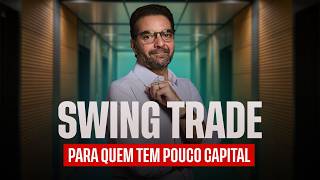
This video debunks the myth that large capital is required for swing trading. André explains how starting with small capital can be an advantage, using fractional shares, ETFs, and the US market to build wealth intelligently. He provides a simple strategy focusing on trend following and risk management.
Many believe you need R$50,000 to R$200,000 to start trading, but this is a myth that holds back progress.
Starting small allows making cheap mistakes, learning quickly, and building processes without emotional risk.
The market doesn't care about account size; it rewards following a plan. If you can't manage R$3,000, you won't manage R$300,000.
On the Brazilian stock exchange, fractional shares allow buying 1, 5, 10, or 20 shares instead of lots of 100, enabling gradual diversification.
ETFs like BOVA11, SMAL11, and IVVB11 solve diversification, simplicity, and cost. They are ideal for trend trading with little capital.
BDRs and local ETFs (e.g., Nasdaq, QQQ) provide exposure to cleaner trends and stronger sectors in the US market.
Choose up to 5 assets, use 17 and 72 period moving averages, divide capital into installments (entry, reinforcement, exit), and risk 1-1.5% per trade.
Starting small is a competitive advantage. The goal is to survive and learn, not get rich quickly.
Starting small in swing trading can be the best learning experience. Fractional shares, ETFs, and the US market provide tools to build wealth. The secret is in execution, not when you start.
What is the myth about starting swing trading?
That you need large capital (e.g., R$50,000+) to start.
00:01
What does the market reward according to André?
The market rewards execution, not account size.
01:00
How do fractional shares help small capital traders?
They allow buying fewer shares (e.g., 1 or 5) instead of lots of 100, enabling gradual diversification.
01:53
Name three ETFs mentioned in the video.
BOVA11 (Ibovespa), SMAL11 (small caps), IVVB11 (US market).
03:15
What are the three beginner pain points solved by ETFs?
Diversification, simplicity, and cost.
03:03
What moving averages does André recommend for trend following?
17-period and 72-period moving averages.
05:18
What is the recommended risk per trade for beginners?
Between 1% and 1.5% of capital.
05:47
What is the key to success according to the video?
Execution, not when you start.
06:16
Execution Over Account Size
This principle is counterintuitive and central to the video's message.
01:00Small Capital Forces Discipline
Highlights a key advantage often overlooked by beginners.
01:26ETFs Mitigate Specific Risk
Practical advice for avoiding single-stock disasters with small capital.
02:36Simple Strategy Blueprint
Provides a concrete, repeatable method for beginners.
05:05Competitive Advantage of Starting Small
Reframes small capital as an asset, not a limitation.
06:01[00:01] money to start swing trading, I need to tell you something important. That's a myth that's holding back your progress. Many people believe that it's only worth trading or investing when you have R$50,000, R$100,000, or R$
[00:15] investing when you have R$50,000, R$100,000, or R$ 200,000. And because of this way of thinking, he spends years standing still . Meanwhile, those who understand a method and start small, learn small and grow consistently. And here is the great truth. Having little
[00:29] capital is not a disadvantage. Most of the time it's even a form of protection, because with little capital you can make mistakes cheaply, learn quickly, and build processes without running the risk of breaking down emotionally. Today I want to show you how to do swing trading
[00:45] Let's talk about fractional shares, ETFs, the American market, and especially how to use limited capital as a tool for growth. I see a lot of people saying, "André, when I have more money, I'll start." This
[01:00] thinking seems prudent, but in practice it's a trap, because the market doesn't reward account size, it does n't care about that at all. The market rewards execution. If you can't follow a plan with R$3,000,
[01:13] you're unlikely to follow that plan with R$300,000. Moreover, with more money, the problem tends to get worse. The emotional toll becomes heavier, each fluctuation seems bigger, each setback hurts more. That's why I like the idea of starting small. Having
[01:26] little capital forces you to be selective, forces you to think about risk, forces you to choose higher quality trades, and that makes you a
[01:38] career, I've seen many people fail despite having large accounts because they never learned to respect the process of managing small accounts. The market is almost poetic in that sense. He tests your behavior before rewarding your wealth. If you want to do swing
[01:53] trading with little capital on the Brazilian stock exchange , the fractional share market is one of the best entry points. Many people forget this. In the standard market, some stocks require lots of 100, but in the fractional market you can buy one, five,
[02:07] ten, or twenty shares. This completely changes the game. Let's imagine an expensive stock that's trading at R$50. In the standard lot size, you would need R$5,000 to get in. With fractional shares, you can build a position with R$50, R$
[02:22] build a position with R$50, R$ 500, or R$300. This allows for gradual diversification. You can start by buying small positions in a good company, testing technical entries, using moving averages, support levels,
[02:36] breakouts, and learning how to manage exits. For swing trading, this is excellent because you don't need leverage or to force trades. Sometimes traders with little capital think they need to look for the miracle trade.
[02:50] No, the game here is about building brick by brick. A good position in the fractional market can teach me more than I know about random day trading operations. If I had little capital today and wanted to
[03:03] do swing trading with less specific risk, I would also look very specific risk, I would also look very closely at ETFs, because ETFs solve three beginner pain points: diversification, simplicity, and cost. Instead of
[03:15] choosing a single action, you buy an entire set. For example, BOVA 11 is the set of stocks that make up the Ibovespa. Small 11 tracks small-
[03:27] Ibovespa. Small 11 tracks small- cap stocks, and VVB11 gives you exposure to the American market. And this is powerful because with little capital, making a mistake on a specific stock can seriously damage the portfolio. ETFs, on the other hand, mitigate this risk. Furthermore, for
[03:41] swing trading, they pay close attention to trends, averages, and technical regions. So, for beginners, trend trading in ETFs is almost like learning to read the ocean before facing bigger waves. I really enjoy teaching
[03:54] Luno to start with the index movement. First learn broad flow, then move on to specific risk. Now comes a part that many people still underestimate: the American market. Today you can access stocks and ETFs abroad with little
[04:08] capital, including through BDRs (Brazilian Depositary Receipts). These are foreign stocks that are also traded here in Brazil. It has local ETFs and eventually international accounts. And here lies a huge advantage. Assets with cleaner trends, stronger sectors
[04:23] with cleaner trends, stronger sectors , companies that lead really like the idea of using American ETFs or technology-related assets , for example, exposure to the S&P 500, Nasdaq, or specific sectors
[04:39] like semiconductors. In Brazil, this can be done through local ETFs such as can be done through local ETFs such as Nasdaq, QQQ via a national account or local alternatives. The point isn't even to try and find the next stock that will
[04:51] double. The point is to ride the wave of structural trends. Having little capital in the American market can mean access to much more organized movements. Sometimes it's not the size of the capital that limits the outcome, it's the size of the time
[05:05] horizon. If I had to start today with little money, I would do something simple. Let's go. I would choose a maximum of five assets. Avoid overspraying. five assets. Avoid overspraying. Secondly, I would focus on trends, I would set
[05:18] a 17-period moving average, a 72- period moving average, and focus on the trend of those averages. price above, although. I'll always be thinking about buying; if the price drops and the stock falls, I'd only think about selling. Something simple and
[05:32] think about selling. Something simple and straightforward. And third, I would divide the hand into installments: initial entry, reinforcement during correction, and partial exit at the target. And, most importantly, a small operating risk of between 1 and 1.5% of the capital.
[05:47] Because in the beginning, the goal isn't to get rich, it's to survive and learn. Small capital needs to grow like a tree. Strong roots first, the crown comes later. If you have little capital, don't use that as an excuse. Use it as a
[06:01] competitive advantage. Starting small in swing trading can be the best learning experience you'll ever have. Fractional shares, ETFs, and the US market give you enough tools to build wealth intelligently. The secret isn't in
[06:16] when you start, it's in how you execute. Those who learn to operate well with little capital are ready for bigger things when their capital grows. Tell me in the comments, if you were
[06:28] starting today with little capital, would you choose fractional shares, ETFs, or the understand how you're thinking about this game. By the way, if you want to learn more about the American market, there's a free e-book for you below.
[06:43] free. If you enjoyed the video, don't forget to give it a like.
⚡ Saved you 0h 06m reading this? Transcribe any YouTube video for free — no signup needed.