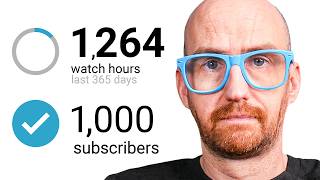

YouTube Monetization Rules Just DOUBLED – Here's What to Do
43sThe announcement of doubled requirements (watch hours and shorts views) is alarming and immediately grabs attention, prompting creators to seek solutions.
▶ Play Clip"Delivers on the promise with actionable tactics, but the title oversells urgency—the six-month deadline is clearly stated, yet the video could be shorter."
YouTube has announced significant changes to its Partner Program monetization requirements, doubling watch hours and Shorts views thresholds. However, existing members are grandfathered in, and the new rules don't take effect until February 1, 2027, giving creators a six-month window to hit current targets. The video provides four practical tactics to boost watch hours and secure monetization before the deadline.
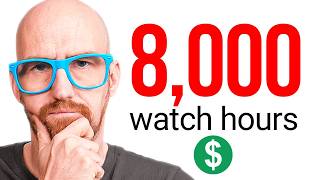
To qualify for ad revenue, you need 1,000 subscribers and either 4,000 watch hours in 12 months or 10 million Shorts views in 90 days. Under new rules, this doubles to 8,000 watch hours or 20 million Shorts views, but subscriber count remains at 1,000.
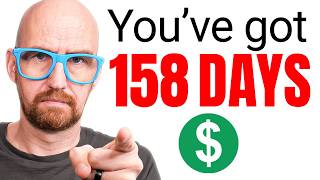
Creators already in the YouTube Partner Program are unaffected by the changes. The new requirements don't kick in until February 1, 2027, giving current creators six months to hit the old 4,000-hour bar and get grandfathered in.
YouTube's watch hour metric counts total session time, not just individual video views. With over 200 billion Shorts viewed daily and 1 billion hours of TV watch time, YouTube encourages binge behavior. Group videos into playlists by topic or series to keep viewers watching automatically.
Private, unlisted, or deleted videos earn zero watch hours. Check YouTube Studio's content tab for any videos set to private or unlisted and make them public to recover lost watch time.
A single 2-hour live stream with a modest concurrent audience can generate more cumulative watch time than several regular uploads. Viewers tend to stay longer during streams, making them a valuable tactic during the six-month window.
End screens on every video, including old ones, encourage viewers to watch more content and subscribe. Many videos lack end screens, causing viewers to leave the channel. Adding them is free watch time.
YouTube can revoke monetization if a channel is inactive for six consecutive months (no uploads, community posts, etc.). Post a community post to keep the channel active while planning a comeback.
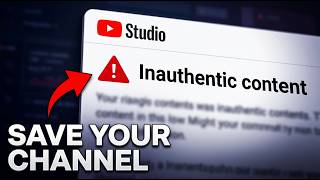
YouTube is tightening rules against generic, templated, or AI-slop content. Focus on creating authentic, valuable content that people would notice if it disappeared.
Creators have six months to hit the current 4,000 watch hour threshold before stricter rules take effect. By implementing playlists, auditing public videos, using live streams, and adding end screens, creators can boost watch hours and secure monetization. Authenticity remains key to long-term success.
What are the new watch hour and Shorts view requirements for YouTube monetization?
8,000 watch hours or 20 million Shorts views, with 1,000 subscribers.
00:15
When do the new YouTube monetization rules take effect?
February 1, 2027.
01:09
Are creators already in the YouTube Partner Program affected by the new rules?
No, they are grandfathered in and unaffected.
00:43
What is the 'inactivity trap' on YouTube?
YouTube can revoke monetization if a channel is inactive for 6 consecutive months.
06:23
Why are playlists recommended for increasing watch hours?
They encourage binge-watching, increasing total session watch time.
03:28
Grandfathering Protection
Clarifies that existing monetized creators are unaffected, reducing panic.
00:43Binge-Watching Insight
Explains YouTube's watch time metric and how playlists leverage binge behavior.
02:08Live Stream Efficiency
Highlights how a single stream can outperform multiple uploads in watch time.
04:36Authenticity Over Volume
Warns against low-effort content and emphasizes the importance of genuine value.
07:05[00:01] have announced a massive changes to what you need to get monetized. And I've seen But, I just want to get straight into this. I'm going to show you four dead simple tactics you can adopt on your channel today so that you can make that
[00:15] race to 4K before everything changes for good. So, here are the headline numbers your channel for ad revenue, which is what everybody wants, right? You need 1,000 subscribers and either 4,000 watch hours in 12 months or 10 million shorts
[00:30] views in 90 days. Under the new rules, that becomes 8,000 watch hours or 20 million shorts views over that same time period. Subscribers stay the same at 1,000. There's no time limit there, but everything else has
[00:43] basically doubled. Now, what I'm going to say next is perhaps the most important sentence of this entire video because I don't want you to miss it in all the panic. These changing requirements do not affect anyone
[00:56] already in the YouTube Partner Program. If you're already monetized today, relax, you're good. Go touch some grass. You don't need to find another 4,000 hours or 10 million views under a mattress or anything. And now for the
[01:09] second most important sentence. None of these requirements kick in until February the 1st, 2027. That's a little under 6 months from now. So, let's say thousand watch hours and grinding towards the old 4,000 watch hours bar.
[01:27] You're not now racing for a new number. You're still racing towards that old one on the old clock for the next 6 months. If you hit 4,000 watch hours before February the 1st next year, you're grandfathered in under the rules you
[01:41] trying to start a creator movement right now. #racetofourk. So, if there is one, do this now. Go to your analytics and check your actual they are in the comments below. We don't need to know your subscriber
[01:56] accounts, or your view counts. It's watch hours that you need to know right now. And whatever that number is, this is the 6-month push, grind, hustle, and
[02:08] is the 6-month push, grind, hustle, and create moment. This isn't a time to think about it. Now then, let's actually talk about how you move that number. you need to know that YouTube's watch hour metric doesn't care that somebody
[02:21] clicked your video. It cares how long they stayed across your whole channel session after session. And here's the thing, YouTube themselves basically told us why this matters. In their own announcement about these changes, they
[02:33] with their own growth. And the two numbers they used to back this up are over 200 billion shorts viewed every single day, and more than a billion hours of watch time on television screens every single day. So, that is
[02:47] YouTube telling us, in their own words, that a massive chunk of people now watch content on the platform in exactly the same way they watch Netflix, letting one who's sat on the sofa watching television watches one episode and turns
[03:01] it off. They finish an episode, and the next one just starts. And then, 2 hours wondering how all of this happened. It's called binge-watching. Now, YouTube isn't guessing that this behavior exists on their own platform. They just told
[03:16] all of us, in their own numbers, that it's already happening at scale. So, a it's already happening at scale. So, a single great video of yours gets you one views worth of watch time, like watching one episode and switching off.
[03:28] A well-built playlist turns your channel into that same binge experience. That video, plus whatever auto plays next, and the one after that. So, if your channel right now is just a wall of individual videos with no playlist
[03:42] people get up and change your channel themselves after every single video. So, group videos by topic, group them by series, put your best next video right after your most watched one and let the platform do the binge building for you
[03:57] the same way a streaming service does. The second thing to do is to audit what's actually public on your channel. Private, unlisted, and deleted videos earn you a big fat zero of watch time hours. So, go to the YouTube studio and
[04:10] check the content tab for any videos that are currently in a private or reason to be like that. It could be an embarrassed about at the time, a video you unlisted years ago and completely
[04:24] forgot about. I bet some of you have hours of watch time sitting behind a setting you flipped once and never thought about again. Thirdly, if you haven't done this already, now is the time to embrace live streams. If you've
[04:36] never tried one, this is your 6-month testing window. A single 2-hour stream with even a modest concurrent audience can add more cumulative watch time than several regular uploaded videos combined because people tend to sit through a
[04:50] stream in a way they don't always sit through a video. Often, they'll have they're doing something else. Now, I'm not telling you that you have to commit to being a hardcore streamer. You just have to run the experiment a couple of
[05:03] times to see what it does to your numbers. And number four is end screens, although this is more like two steps. Honestly, it is so frustrating seeing how many genuinely good videos I watch that don't have an end screen at all.
[05:16] So, step one, starting today, if you're not adding end screens to your uploads, start now. Every single new video from here on gets an end screen. But, even more importantly, step two is to go back and do this to all of your old videos in
[05:31] your back catalog. I promise you, there are definitely some in there. Old uploads from years ago, stuff you've posted before you had a system, videos you just forgot about. All of it sitting there with no suggestive video next, no
[05:44] subscribe prompt, nothing. Right now, every one of those videos is a dead end leaves your content, leaves your channel, and goes somewhere else. So, go on and add end screens to everything that's missing one. That alone is free
[05:58] watch time you've been leaving on the table this whole time. And for all of those videos that you're going to make in the future, address the end screen. Tell them what the video is about and why they should watch it. Now, none of
[06:11] the things I've suggested to you today are really that hard to do. But, they are things most creators forget to do during the hectic upload stage of the video. However, there are a couple of things to watch out for while you're
[06:23] channel that's monetized already, but you've gone quiet on it for a while, YouTube can pull monetization access entirely if a channel sits inactive for 6 straight months. That's no uploads, no community posts, and so on. That is a
[06:38] separate trap from the watch hour math altogether. So, if that's you, the real do this now thing isn't a full video. It's a community post today just to keep the lights on while you plan your comeback to your channel properly. Now,
[06:53] more broadly, I know that some of you are in panic mode looking for an easy way out. But, if you're thinking of pumping out 10 videos a day hoping something sticks, remember this. YouTube has been tightening up what it actually
[07:05] counts as authentic content alongside all of these new monetization requirements. What we're talking about here is generic templated videos, here is generic templated videos, low-effort filler, AI slop with no real
[07:17] watch hours, whatever they are, to get monetized and still get flagged if the channel doesn't feel like it's made by an actual person doing actual work. So, underneath everything I've just talked about, playlists, live streams, auditing
[07:32] your channel, there is a simpler question worth asking yourself. Would anyone actually notice if this channel disappeared? If the answer is yes, you'll probably find any tactics that
[07:45] I've talked about today will get you there faster. If, on the other hand, your channel is so generic that it's instantly forgettable, that needs fixing all. So, here is where I'm going to leave it for today with some quick wins.
[08:00] We'll get to the more complicated stuff later. If you're already monetized, the new monetization policies when they show up in the studio. If you're close to the old 4,000 watch hour bar, you've got 6 months and now you know what moves
[08:15] the needle. And if you are just starting out, genuinely, please, don't get discouraged by all of this. By the time you've reached only a thousand hours, you'll have built something real that matters to both your
[08:29] audience and you. And that, truly, is the point of YouTube. And if you are still a little unclear on all of these new monetization requirements, there are a lot of them, the complete guide is over here. Yes, that's my end screen to
[08:42] keep you watching. I'll see you in there.
⚡ Saved you 0h 08m reading this? Transcribe any YouTube video for free — no signup needed.