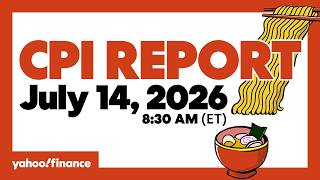

CPI Crashes 0.4% — What It Means for You
42sThe moment inflation data unexpectedly drops, driving immediate market and consumer impact.
▶ Play Clip"Title asks the 'so what' question and the panel delivers, though typical newsroom filler keeps it from being exceptional."
The video covers the June Consumer Price Index (CPI) release, which came in cooler than expected, and its implications for Federal Reserve policy, markets, and the economy. Panelists from RBC Capital Markets and Morgan Asset Management discuss sector-level inflation trends, the bond market reaction, and the fixed income outlook.
Chris Waller's comments suggest a hot CPI could push the Fed to hike in July, putting the report under extra scrutiny.
Kelsey notes the market assigns about a 40% probability to a rate hike in July, making the CPI release a coin flip.
Consensus expected headline CPI to fall 0.1% month-over-month, core to rise 0.2%, with year-over-year at 3.8% headline and 2.8% core.
Headline CPI dropped 0.4% month-over-month, core was flat at 0.0%. Year-over-year headline inflation was 3.5%, core 2.6%—both below forecasts.
Kevin Warsh's testimony to Congress reaffirms the Fed's commitment to price stability, even as the latest data shows cooling inflation.
Energy fell 5.7%, but apparel, medical care commodities, transportation services, and medical care services also declined; shelter rose just 0.1%.
Two-year yields fell roughly 10 basis points as the soft print reduces pressure on the Fed to act imminently.
Mike expects the Fed to remain on hold, citing slower payrolls and the cooler CPI. Another report arrives before the September meeting for confirmation.
Yields around 5–6% make fixed income attractive, offering income even without rate cuts; credit investors are content with the Fed on hold.
The panel describes a segmented economy where some groups benefit from fixed income and AI investment, while others are squeezed by inflation and energy prices.
AI infrastructure investment is boosting the economy and jobs, but the long-term return on this capex remains uncertain.
The June CPI report, while a single print, provides the Fed with breathing room and supports the case for holding rates steady. However, rebounding energy prices and an uncertain labor market mean the inflation fight is far from over.
What was the month-over-month change in headline CPI for June?
-0.4%
05:05
What was the month-over-month change in core CPI?
0.0% (flat)
05:05
What was the year-over-year headline CPI inflation rate?
3.5%
05:17
What was the year-over-year core CPI inflation rate?
2.6%
05:17
What probability of a July rate hike was the market pricing before the report?
About 40%
01:26
How did two-year Treasury yields react to the CPI release?
They fell about 10 basis points.
08:32
Which components showed declines in the June CPI beyond energy?
Apparel (-0.6%), medical care commodities (-0.2%), transportation services, and medical care services; shelter rose 0.1%.
06:40
What did Kevin Warsh say about the Fed's stance on inflation?
The Fed has no tolerance for persistently high inflation.
05:31
What yield range does Mike call a 'sweet spot' for fixed income?
Around 5–6%.
13:46
How does Mike describe the current economy?
Stable but increasingly segmented (K-shaped).
16:02
Inflation cools more than expected
Headline CPI fell 0.4% M/M and core was flat, beating estimates and shifting the Fed's policy calculus.
05:05Bond market signals patience
Two-year yields dropped ~10 bps, showing investors believe the Fed can hold rates steady.
08:32Fixed income offers a sweet spot
Yields around 5–6% make bonds attractive for income even if the Fed doesn't cut rates.
13:46K-shaped economy emerges
The economy is stable but segmented, with AI and fixed income benefiting some while inflation hurts others.
16:02AI capex boosts growth, ROI uncertain
AI infrastructure investment is supporting jobs and growth, but the long-term returns are still unclear.
18:33[00:03] coverage of the June CPI report. I'm Julie Hyman um and I've got some folks with me on set to help me out as well. Michael Reed, RBC Capital Markets head [music] Morgan Asset Management fixed income portfolio manager, and Yahoo
[00:17] Finance's Jay Conley. Thanks guys all for being here. Um [music] so there's some trepidation around this CPI report and it was perhaps made even more important when one of the Fed officials, Chris Waller, gave a speech
[00:30] yesterday and said he's watching this report really closely and it sounds like if it's hot, he's more inclined to recommend a hike in rates. Mike, what >> Well, certainly we're looking at all the
[00:44] to some of the uh rise in CPI of late. Uh importantly, we think the shelter component uh is going to continue to moderate. You do have a bit of pressure coming from hotel prices given uh the demand that has been
[00:59] driven by the FIFA World Cup here. Uh but outside of that, there are some sectors that have seen relief. Uh importantly, when you look at the overturn of AEPA, there's been a big divergence in the goods space between
[01:11] those that are still impacted by uh tariffs, i.e. section 232, and those uh should help uh in our eyes provide a more modest print. >> Kelsey, the the market setup has been interesting cuz rates have been creeping
[01:26] up. >> Right. Exactly. So the market right now is priced for about a 40% probability of a rate hike in July. So I mean that's you know, a 50/50 split. It could go either way and it was interesting to
[01:42] watch the market reaction to Waller's speech yesterday, which you mentioned, because at the same time that Waller was speaking and he was bringing up the probability that the Fed could hike in July if this CPI report is hot, oil
[01:57] prices were also moving higher. So, it's a little bit hard to disentangle, but I meeting and the market is treating it that way. of the equation cuz I know you watch that really closely, Jake.
[02:10] because obviously we saw prices coming down for several weeks as things seem to be cooling down. Now that prices are coming back up, Brent at 84 this morning, WTI at 80. If we're going to see that in this
[02:23] probably going to see that in the next month's report as this comes back. So, report? They're going to look to see those energy prices coming off, some of that heat slowing down. This report may look like respite, but I'm not convinced
[02:38] up in next month's report. move back higher. By the way, the sort of backdrop this morning that we should mention is that a bunch of the big banks are reporting this morning as well. And
[02:50] a couple of themes just sort of emerging early, equities trading revenue is just killing it in the first quarter. So, that's something to watch. I know you guys don't watch the banks specifically, right? But just something
[03:03] that we are watching here in the background. And our David Hollerith who covers the banks had said, are we going to see the talk of resiliency in these statements again? We're seeing it some. Um Jamie Dimon did talk about resiliency
[03:15] a little bit, but it's not quite as being hammered over the head as a theme. conference calls. >> Yeah, that's right. We look at Jamie strength in the market, strong business investment and hiring, AI CapEx in the
[03:29] investment boom there, fiscal stimulus, efficient regulation. Also flagging some potential tail headwinds, excuse me. Geopolitical tensions and wars, sticky inflation, huge global deficits, elevated asset prices. Essentially
[03:43] and bad on both sides of the ball and where this is going it's going to be very hard to predict." I keep thinking about, you know, David Solomon back in June saying, and I quote, "There's more greed than there is fear in the
[03:56] >> And I keep thinking to myself, how long can we keep saying that? Does that still in 6 months? >> Okay, Kelsey, you got 30 seconds. Does that still apply now? Is there more greed than fear in the markets?
[04:09] >> Well, I would say that there is fundamental reasons for credit spreads, for example, to be tight and for people to be optimistic about particularly the business investment outlook. And, you know, when I think about what the JP
[04:22] Morgan Bank is doing, it's not just investing in AI. There's a broader set of areas of interest to the security resiliency initiatives, energy, um cybersecurity. There's a lot there, um and I think that is what the banks are
[04:35] >> Yeah, so we're just coming up on the report in about 20 seconds here. Just to run through the estimates. A June CPI predicted to have a fallen by 0.1% month-over-month, but if you look at the core to have risen 0.2% year-over-year
[04:51] predicted at 3.8% headline and at the core level consumer price index seen at core level consumer price index seen at rising by 2.8%. So, um we'll see here if indeed this is what happens. We're getting the number 0.4% drop in headline
[05:05] CPI month-over-month. It is flat on a core basis, 0.0%. Year-over-year headline inflation up 3 and 1/2%. And core CPI year-over-year
[05:17] and 1/2%. And core CPI year-over-year rising by 2.6%. So, all together more benign than had been estimated. Again, want to emphasize that drop in headline CPI of zero of 0.4%. At the same time, by the way, we are
[05:31] getting the testimony of Kevin Warsh. He is going to be testifying before Congress today. Um that is the the annual testimony. And in that testimony, he says the Fed has no tolerance for persistently high inflation. Of course,
[05:45] in this report, we're not seeing that high inflation. So, let's uh get some this. It's just 1 month, Mike. I know that. >> You know, so how how are we to take this, especially given the backdrop of
[05:59] what's happening with oil prices? >> So, it's certainly going to provide some relief for consumers. Oil prices coming down, you know, prices at the pump definitely help there. Importantly, moving forward, there is still some
[06:13] downward pressure in the good space. So, your your core goods not providing that upward pressure that we would have expected had IEA still been in play. At the same time, there's still some persistent inflation that that we think
[06:27] we've been highlighting is the structural forces, aging of the population, medical care services is something to keep an eye on, especially health insurance premium space. >> I just want to say I'm looking through
[06:40] more of granularity in some of the items that you're talking about. And I'm struck by how many declines we see outside of energy, which is interesting outside of energy, which is interesting here. So, energy overall down 5.7% after
[06:53] having risen pretty sharply in the prior 3 months here. But, it's not just limited to that. So, I'm looking here, for example, if you go down to apparel, down 0.6%, medical care commodities, not service,
[07:07] but commodities, down 0.2%, shelter still up 0.1%, but transportation services down because of energy, you might imagine. Medical care services down 0.1%. So, again, interesting to see those
[07:22] broad declines outside of just what's happening with energy. So, will those underlying declines continue? >> You know, the the big question is how And and certainly in the good space, it's all about transport margins, so
[07:38] that can show up in the wholesale space. We do still see a lot of pressure showing up in PPI. We get that later this week. Uh, we had a very hot print in the prior month. That is a leading indicator for some of these components
[07:50] of CPI. So, just something to consider there. Uh, even with what's going on with respect to energy prices where they are now, I think you still have some amount of that pressure that needs to be passed along the supply chain.
[08:04] I think I heard you say "Wow." under your breath. reaction here? >> Yeah, I mean, on the core, the expectations were for 0.2, and it was flat month over month. I think actually
[08:19] unrounded, it was slightly negative. So, that's a pretty big miss from a standard deviation perspective relative to market expectations. And you're seeing the reaction in the bond market, particularly in the front end of the
[08:32] yield curve. You know, I see two-year yields about 10 basis points lower. And, you know, I think that is the way that Waller set up this market heading that Waller set up this market heading into CPI, which is you get a hot print,
[08:47] If we don't get a hot print, it's not that hikes may not come later in the year, but we're going to at least be patient. And, and you know, this report certainly was not a hot report. We're going to have to go through the details,
[09:01] figure out how much of it is sustainable versus not sustainable. But, overall, you know, this is much softer than people were anticipating. >> Yeah, I mean, it's sort of easier for Kevin Warsh to say "We're going to slay
[09:14] don't actually have to do anything to slay the dragon of inflation. >> laying down. >> Right. So, I mean, Mike, do you think at this point, what are you expecting the Fed to do this this year?
[09:27] >> Yeah, I certainly think this report buys them time. When you look at the combination of what we saw in the employment report, payrolls slowed a came down. I think there's a question
[09:39] around the uh sustainability of payroll growth. And now you have this print uh certainly outside of consensus uh surprising to the downside. We can now get another report before their next meeting in September uh to
[09:53] really see how they're thinking about uh what to do for the remainder of this year. Our view is that they remain on hold uh for two reasons. One, we think sideways. The unemployment rate will hold steady.
[10:06] And we're going to wait to see how uh energy prices uh impact uh consumer >> Yeah. Kelsey, I want to bring you in on this as well. The market's still looking >> Yep. >> Where it's seeing the CPI, seeing what
[10:20] is your head at right now on that? >> So, we're also in a similar camp in terms of expecting that the Fed will be able to uh thread the needle and keep the policy rate on hold, but it's still a fine balance and one report isn't
[10:35] a fine balance and one report isn't going to be enough uh to convince anyone um really that uh the Fed may not need to hike later this year. You know, really, when you think about what has changed the Fed's tone, yes, we had an
[10:49] energy shock. That has caused inflation to go up. people to think about well, is it really a problem that inflation has been above target for so long? But really, I think what has changed on to the surface is people's views around the
[11:03] balance of risk of the labor market. And unless you start to see material weakening in the labor market, I think that the market will continue to price in some probability of rate hikes in the future. Um and so, this is still a dual
[11:19] mandate, Fred. I know a lot of people are really focused on price stability, and even in the statement, um they removed that mention of of the dual mandate and really focused in on price stability. And I think the reason that
[11:32] they did that is right now the labor market is stable. A month ago, the concern was is the labor market reaccelerating? Now we've gotten a cooler report, you know, the the view is back to the labor market is
[11:44] stable, and the question is does it remain stable or does it start to kind of flip to the other side, which is the pattern that we've seen the last few years where the Fed stays on hold for the most of the
[11:56] year, the labor market data tends to stop in the second half of the year, and don't think that that is the case this year, but it it could be what causes the Fed ultimately to stay on hold this year. It's not just the inflation data,
[12:11] >> You know, what I'm struck by I mean I keep thinking about Kevin Warsh saying don't the market shouldn't trade off of >> Right. >> Like habits are hard to break, man, cuz
[12:25] going to do cuz that's what we do, right? That's what you know, and that is important to the market whether the what the Fed's going to do. So, I mean, have you tried to change your thinking at all in terms of how you
[12:37] approach analyzing the data given that Warsh has said don't pay attention the kind of I mean, it's hard to do that. >> Yeah, I mean, our approach is always one where, you know, we focus on the fundamentals. And so, we're going to
[12:52] continue to focus on the fundamentals, continue to focus on, you know, our interpretation of the data and ultimately what that means for the rest that either the economy is slowing or the economy is picking up. But I would
[13:04] say, you know, if I want to take a step back more more from a portfolio management perspective, I think the bigger takeaway is we're debating if they're going to hike once or twice or stay on hold, but more
[13:18] broadly we're in a higher yield environment, one that we haven't seen in a number of years. And actually for most of our fixed income markets, a stable yield environment where the Fed funds stays on hold or even if they hike a
[13:32] little bit, but we're not talking about the hikes of 2021 or 2022, it's actually a great environment for fixed income because most people think about fixed income from the perspective of downside protection if equity markets draw down,
[13:46] your fixed income is going to protect you. That is one scenario, but the other scenario is that things are stable and you collect income. And right now you have yields in fixed income around 5 to 6%. That's actually a sweet spot,
[14:01] especially when you talk to credit investors. Um, you know, they're very interested at all in yields around these levels and they don't necessarily even want the Fed to be cutting rates right now. Staying on hold is a great outcome.
[14:13] from that. Today we're going to hear Kevin Warsh testify before the House he'll testify with the Senate Banking Committee. What are you going to be focusing on in his testimony? What are you listening for and looking to see
[14:25] >> Certainly we're going to see if there's any shift in his tone and their attitude towards inflation. I think certainly this print buys them some time, but it's very clear that this Fed under Warsh is going to be much more focused
[14:40] on the inflation side of that mandate. That being said, you do have to see if he does start to talk about the labor market. As Kelsey mentioned, you know, market show up in the summer months and that
[14:53] tends to be a seasonal trend. One thing we're thinking about and one thing I'm curious if Warsh men- mentions is if there's any additional weakness when the World Cup wraps up. If we do see layoffs that perhaps we haven't seen in the
[15:06] past. So, that'll be something that would add to the unemployment rate and and just be interesting to see if they start to bring that higher in terms >> And that World Cup number would come after we saw leisure lose, what was it,
[15:19] 60,000 jobs last month, which was already a bit of a sort of an anomaly, now. >> Certainly was. We were not expecting that given that it was in the midst of the World Cup. That being said, it
[15:33] perhaps did signal to us that maybe some of the demand for hotels and restaurants over-hiring being done. >> Overall, how would you sort of assess this economy? And and it's and it's
[15:46] well, the consumer confidence numbers have not been good. So, you continue to get this vibe session or whatever you want to call it, this disconnect. >> We're categorizing it really as a stable economy, but one that is increasingly
[16:02] segmented. That is I eat the K-shaped economy. So, you do have many folks that are benefiting from things like fixed income benefiting from things like fixed income portfolios, retirees who are are
[16:14] benefiting from non-labor income. And what we've seen in the labor market is past few months below headline inflation. So, real wage growth certainly hurting. So, there are pockets of folks out there who are really
[16:27] impacted by inflation. The run-up in gas prices hasn't helped. that are doing quite well that aren't impacted by credit, by debt. And those are the folks that are really driving a lot of the strength. And at the end of
[16:42] the day, we have very strong demand for AI infrastructure investment. That's something that will continue through next year and help support growth in >> Yeah, sure. Kelsey, what are the bond market signals you're going to be
[16:55] looking for in the next, call it, two, three months? What are you looking for those numbers to tell you? >> Yeah, so there's a couple couple parts to that, I would say. You know, one is what the market is pricing for the Fed,
[17:07] but also more broadly, credit spreads. So, thinking beyond the government bond market, thinking about where corporates are are getting their funding right now. and we are seeing an increase in corporate supply and that is somewhat
[17:22] associated with the pickup in data center build outs all of that. >> Yeah, and what I want to be looking for is how is that issuance being received? So far it's been received well and not not every deal has necessarily done as
[17:38] well as another but at a high level at these all in yield levels like we spoke these all in yield levels like we spoke about before 5 to 6% you are seeing a fair bit of demand for those investments and right now while we have seen
[17:51] volatility in government bond markets where things have been really stable is an investment grade credit where that spread on the index at least which is around 70 to 80 basis points has just been trading in this very very steady
[18:06] range and I think I think that's an indication of that stable economy that we have right now and that really is what I would be watching is not only what the Fed is going to do but how the corporate outlook is shifting and so far
[18:21] it's been pretty pretty robust. >> Mike I'm curious from your perspective and we got to wrap up soon but the AI economy do you have any concerns at all about the pace of spending about business
[18:33] >> Look it's it's great for the economy right now what it is is investment in buildings and you know we're talking roads we're talking HVAC systems we're
[18:45] talking electrical systems and that does benefit the economy we see some of those spillover effects for the domestic economy you need folks um providing jobs to those local economies.
[19:00] If that does slow that does risk you know seeing those jobs go away but for now I think there's a lot of potential in AI lot of benefits but as far as the actual ROI
[19:15] of these investments, it's going to take a little bit longer to see the the true return once we start seeing the full capability of AI. And we're just not >> Yeah, it feels that way. Well, again, we're seeing this report this morning
[19:29] come in much more benign on the consumer inflation level than had been anticipated. So, on to the next. We'll see what happens with these now rebounding energy prices. Uh thank you so much, Michael Kellsley.
[19:42] Jake's Jake's going to be back with me in about 15 minutes. And speaking of That's at 9:00 a.m. Eastern. We'll have more coverage on today's top headline.
⚡ Saved you 0h 19m reading this? Transcribe any YouTube video for free — no signup needed.