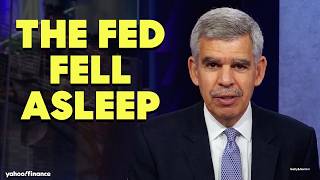

El-Erian: Fed will NOT hike this year
60sA top economist makes a bold, contrarian call on interest rates while Wall Street is split.
▶ Play Clip"Genuine Fed warnings delivered with substance — though the title undersells the broader AI and market analysis."
Mohamed El-Erian discusses the unusual divergence over whether the Federal Reserve will hike rates this year, arguing the central bank will likely do nothing. He explains how new Fed chair Kevin Warsh is trying to break the market-Fed feedback loop, why the Fed's balance sheet and framework need a rethink, and how tech and AI overinvestment should be interpreted.
Strategists are divided: one says no hike this year, while Diane Swonk of KPMG says the Fed has to hike. The disagreement reflects different readings of inflation and the economy.
Bank of England and Bank of America expect three hikes, but El-Erian says he is in the 'no change' camp and expects the Fed to do nothing this year.
El-Erian's strong expectation is no rate action this year. The more important focus is the five areas new Fed chair Kevin Warsh has identified as needing work.
Warsh is trying to break the unhealthy feedback loop between markets and the Fed, which reduced the Fed's room to maneuver and made markets short-term and data-dependent.
El-Erian is not in favor of endless new inflation measures. The real issues are whether data is concurrent or stale, and the monetary framework. The 2020 framework was backward-looking, and the 2025 framework never was established.
Warsh wants a theory underpinning the balance sheet, like r-star for interest rates. The balance sheet swung from $2 trillion to $9 trillion and back to $6 trillion without clear analytics.
El-Erian says the Fed went to sleep on policy, forecasting, communications and balance-sheet management, including calling inflation transitory in 2021. A major revamp is urgently needed.
The economist in El-Erian loves that capital markets fund innovation at scale; the financial side calls it a rational bubble. Investors must spread bets because it's unclear which platform will prevail.
Fundamentals remain sound, but valuations got out of whack after fundamentals, valuations and technicals aligned. Technicals now undermine the tech trade.
There is a ton of excessive leverage, but the spillover to the economy is limited. Tailwinds include low energy prices, a strong labor market and lower borrowing costs, helping the bottom of the income distribution.
Short term, there is an air pocket between AI build-out and monetization. Long term, every transformative innovation — the Industrial Revolution, railroads — overdoes the first phase. Overinvesting beats Europe-style underinvesting.
Public resistance is slowing the build-out. AI firms need to tell stories like rural Malawi clinics, crop-disease detection and personalized tutors before the backlash turns political.
El-Erian expects the Fed to hold rates this year while Warsh focuses on a structural revamp; meanwhile, tech and AI carry short-term risks but are best judged through a longer-term lens.
What is Mohamed El-Erian's strong expectation for Fed rate moves this year?
The Fed does nothing — no rate change — this year.
01:35
According to El-Erian, what did the Fed get wrong in 2021?
It called inflation transitory, a major policy mistake.
04:58
What did the Fed's balance sheet grow from and to before falling back?
It increased from $2 trillion to $9 trillion, then came back to $6 trillion.
04:31
Who is the new Fed chair identified in the interview?
Kevin Warsh.
01:49
How does El-Erian describe the tech bubble?
A rational bubble — you have to spread your bets across platforms because it's unclear which one will prevail.
05:51
What are the economy's tailwinds mentioned by El-Erian?
Low energy prices, a strong labor market and lower borrowing costs.
07:40
What short-term risk does El-Erian see with AI build-out?
An air pocket between build-out and monetization, such as data centers sitting vacant if demand drops.
08:49
Which historical innovations overdid it in their first phase, according to El-Erian?
The Industrial Revolution and railroads.
09:15
What is El-Erian's view on overinvesting vs. underinvesting in AI?
Overinvesting in a fundamentally transformational technology is better than underinvesting, as Europe is doing.
09:29
Why does El-Erian say the 2020 Fed framework was 'dead on arrival'?
Because it was so backward-looking.
03:49
Fed no-change call
A clear, contrarian forecast amid a deeply divided market debate.
01:35Breaking the Fed-market loop
Explains the core policy goal behind Kevin Warsh's structural reform effort.
02:28A rational bubble
Balances economist and financial perspectives on tech valuations in one useful frame.
05:51Overinvesting beats underinvesting
A contrarian principle for evaluating transformational technologies like AI.
09:29AI's PR problem
Warns that technology backlash can become political without visible real-world wins.
09:45[00:01] perhaps an unusual difference of opinion on whether the Federal Reserve is going to raise rates or not this year. And let's talk more about that. Joining me in studio is Mohamed El-Erian, Allianz chief economic advisor and professor at
[00:14] the Wharton School. Always great to have you, especially to have you in person. Thanks for being here. Um it does feel unusual how how divided you know, I just talked to a strategist a few moments ago who said, "There's no
[00:28] think the Fed is going to hike this year." And then I talked yesterday to Diane Swonk of KPMG who said, "Yes, they have to hike this year." Um is it is it because we are not getting more of a framework from the Fed? Why is
[00:42] arguing about this right now? >> And it First, thanks for having me. And it is amazing. Bank of England says Bank Bank of America says three hikes. >> Yeah. >> I'm in the no change, so that you know
[00:56] where I am. Um look, there there are differences that relate to a few things. One is how people interpret the inflation numbers. So, last Yesterday we had the PCE inflation viewed as the Fed's favorite inflation measure.
[01:09] You have those who said, "You know what? In line to somewhat softer and will come down. In fact, we may be at peak inflation." You have those who said, "Absolutely not. Look at core is going to continue to go up."
[01:21] And people are wondering what that change means. And then you have different interpretation about the economy. Some see it as extremely strong. Others see it as strong in certain places, but weak elsewhere. I
[01:35] think if we put everything together, my strong expectation, not weak, strong expectation is the Fed does nothing this year. And the most important thing to year. And the most important thing to focus on is the five areas that the new
[01:49] Fed chair, Kevin Warsh, has identified as needing work because they really >> The task forces because they really do need work. And the long-term effectiveness of the Fed will depend on addressing these issues,
[02:03] which have translated into major mistakes over the last 5 years. >> But it also means we'll have to wait to get more clarity. It sounded like from at least till the end of the year until those task forces really start to come
[02:15] out with some findings from their work. And so in Fed doesn't do anything in the meantime, but it also means the market has to sort of keep wondering, right? >> Yeah, and I think that what Kevin Warsh
[02:28] is trying to do, and I think it's the absolutely right thing, is break this very unhealthy interdependency that developed between the markets and the Fed. And it resulted in the Fed seeing its
[02:42] room for maneuver reduced. That's not a good thing. And it resulted in in the markets being very data-dependent, very short-term. And we've seen significant changes in expectations of of rates. I think
[02:55] breaking that interdependency is in the interest of the economy longer >> There's a lot of debate among other things, and this is one of the things address, how do we measure inflation? And there's
[03:08] some talk about trimmed mean inflation as one of the ways to measure it, but measure as well that it doesn't anticipate sort of changes, regime anticipate sort of changes, regime changes in inflation. Um, and so what is
[03:21] How should the Fed be doing it? How should we be doing it? >> Yeah, I I'm not in favor of let's come up with a whole host of inflation numbers. I think there is a more basic issue, which is the sources and uses of
[03:35] data. What data we're actually looking at. Is it concurrent data? Is it really stale data or not? And the second issue is is the monetary framework. You know, very few people talk about the fact that the 2020 framework was dead on
[03:49] arrival cuz it was so backward-looking. And the 2025 framework was never this is a Fed that's going to be And I think that is more important than whether they they keep rates unchanged,
[04:03] cut, or hike. That is going to be determined of where the economy goes and >> Um where does the balance sheet size fall know, there's been talk that even okay, maybe even if they don't change rates
[04:18] that Walsh, as he has talked about before, might try to shrink the balance >> My understanding is what he wants to do is to have a theory underpinning balance >> Anything. You know, whether you like it
[04:31] or not, we talk about our star, some sort of equilibrium interest rate. on the analytics of an equilibrium balance sheet. And we've increased the balance sheet from 2 trillion to 9 trillion, back to 6 trillion. These
[04:45] are massive moves. Um and we we've done that without an sheet should how should it should be managed. I think it's striking if you look at the Fed of the last 6 years, it went to
[04:58] sleep, of course, on policy, making the big mistake in 2021 calling inflation transitory. It went to sleep on forecast. It went to sleep on officials. It went to sleep on balance sheet
[05:11] And I think what you're seeing is a major revamp of the Fed. one. >> I think it's not just necessary, I think it urgently.
[05:24] tech stocks recently. We've been talking a lot about this. Um and and sort of whether it is a bubble. Um and if it even if it's not a bubble, like what do we need to worry about when we're looking at how how these things
[05:38] >> So, the economist in me thinks it's the most wonderful thing in the world that the capital markets are willing to fund innovation at the scale that they're willing to fund it. That makes the US unique in the global
[05:51] economy. The financial side of me says it is a bubble, but it's a rational bubble. In the sense that if you don't know which of these platforms, which of these applications
[06:05] is going to prevail. You have to have a venture capital You have to spread your bets hoping that the one that works >> Enough to make up for the losses elsewhere.
[06:18] >> will because what's at stake is huge. Which means that when when we're going did we really invest that much in this company? Um I think more generally we lived in a period where fundamentals,
[06:31] valuations, and technicals were all aligned for tech. And we saw the most amazing run. That put valuations out of whack. When got out out of whack and that's what we're seeing today. It's technicals that
[06:45] are undermining the tech trade. Fundamentals remain sound. >> Yeah. >> So, I think this is more a temporary setback than a permanent one and it comes from the fact that the valuations
[06:58] >> How concerned are you about sort of speculation and leverage in the system >> Mhm. >> You know, we don't talk about it there. >> Yeah, Korea and Japan. I mean, if you look at what's been happening in those
[07:14] >> Your worry. So, the bad news is I think there's a ton of leverage that is excessive. The good news is that the spillover is going to economy. And that's really, really important. You
[07:28] know, we're living in a world where we concerned about markets. But actually the economy for once has lots and lots of tailwinds including
[07:40] as someone spoke about in the recent segment for the bottom part of the cake. >> You have low energy prices. You have a strong labor market. You have lower borrowing costs. It's really nice to have these headwinds turn
[07:55] into tailwind for such an important segment of the population. Um you know, fine, the bottom bit of the economy wasn't. It's good to see the bottom bit of the economy doing well. >> When we are so reliant though on
[08:08] back to the economic front, we're very reliant there on the AI build-out as percentage of of GDP than it was in the past. So, how worried are you about something there going, you know, even in the
[08:22] losses in one place you you can be made up for by gains. But economically it you've got a data center that you're building and then the demand for that data center drops, for example, you know, do you have somebody else to come
[08:36] and take it over? Does that just sit vacant? Is do you have that sort of economic um you know, build-out that then goes bust >> So, I I think you have a short-term issue and a long-term issue. The
[08:49] short-term issue you captured perfectly when you called it the knives. The notion of an air pocket between build-out and monetization. The longer-term issue is every single innovation
[09:02] ends up overdoing it in the first phase. And the behavioral aspects are very very simple. When you suddenly reduce the barriers to entry to something that's really exciting, we humans
[09:15] happened in the Industrial Revolution. It happened with railroads. It happened >> Mhm. >> Every single time that happens. So, yes, are there going to be some data centers that are going to not monetize the
[09:29] investments? Yes, there are. But again, I'd for the longer-term economic well-being, I'd rather we overinvest in it fundamentally transformational than do what Europe is doing and under invest. Because longer term, the over
[09:45] mistake of under investment. >> And there's a concern now that because of public resistance to the build-out that we may be slowing down. >> Yeah, I mean AI has a massive PR
[09:58] >> Massive. Okay, and they've they've got to realize they're systemically important. And they have to be out there with says, "Look, I can change the health sector.
[10:11] >> Mhm. >> Farmers now can have in their hand a tool that identifies much better whether their crop has disease or not forward. You go to developing countries, it's
[10:27] amazing that in rural Malawi, you can have a clinic that now has access to world-class medicine. You can have a school where someone a student has a
[10:39] personalized tutor. I think AI need the AI industry needs to tell these stories because the backlash is starting to build up in a major way. >> Yeah, absolutely. And it's going to become political as well.
[10:52] >> Yes, definitely. Muhammad, thank you so much. It's great to see you.


⚡ Saved you 0h 10m reading this? Transcribe any YouTube video for free — no signup needed.