
AI Summary
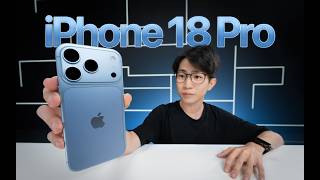
This video is a comprehensive review of the iPhone 18 Pro and Pro Max, covering design changes, the new variable aperture camera, the A20 Pro chip's performance, battery life, charging speeds, and the new iOS 27 software. The reviewer also discusses the impact of AI on Apple's strategy and the broader tech industry, expressing mixed feelings about the company's direction.
Chapters
The iPhone 18 Pro retains the previous year's metal and glass design, but the color difference between materials is less noticeable. New colors include glacier blue and a deep burgundy, which resembles red wine. The camera bump is thicker, and the Pro Max weighs 449g, making it the heaviest iPhone ever.
The Dynamic Island is smaller because the infrared camera is now under the display. Apple reduced pixel density in that area by half and increased pixel brightness to help the camera see through. This allows for 130 more pixels of screen space, enabling three active live activities to be displayed simultaneously.
The main camera now has a variable aperture ranging from f/1.48 to f/4.0. This allows for manual control over depth of field, letting users blur backgrounds for portraits or increase sharpness for group shots. The aperture also affects video motion blur and can be adjusted automatically for document scanning.
The new camera system exhibits significant lens flare, especially at wide apertures. A curved flare band appears at f/1.48, and at f/4, petal-shaped spots form around light sources. This reduces contrast and can ruin shots. A 3D-printed lens hood can partially mitigate the issue.
The iPhone 18 Pro uses Apple's first in-house modem, the C2. In strong 5G signal areas, it is slower than the Qualcomm modem in the 17 Pro (download speeds ~20MB/s lower). However, in weak signal conditions, the C2 performs better, with faster speeds and lower latency. Reconnection time after signal loss is slower (5.2s vs 1.5s).
The A20 Pro chip shows a 23% increase in single-core and 20% in multi-core Geekbench 6 scores. GPU performance is up nearly 50%. In Death Stranding at 1080p, the 18 Pro Max achieves 40 FPS, a 10 FPS improvement over the previous generation, with no thermal throttling during extended gaming.
The 18 Pro has a 4000mAh battery, lasting 6 hours 38 minutes in a stress test, 1 hour 51 minutes longer than the 17 Pro. The Pro Max has a 5390mAh battery, lasting 7 hours 57 minutes. Charging is faster, reaching 52W, with 0-50% in 15 minutes and full charge in 69-78 minutes.
The 1TB and 2TB models use QLC flash memory instead of TLC, which is cheaper but has a shorter lifespan. However, even QLC is durable enough for 100GB of writes per day for 10 years. Users concerned about longevity can opt for smaller storage models that still use TLC.
iOS 27 focuses on speed and stability, with fewer hangs than iOS 26. AirDrop speeds improved by 2.4 MB/s on average, though still under 20 MB/s. The 'liquid glass' design effect has been simplified, with static lighting and less transparency, which some may find less visually appealing.
The Photos app has an AI-powered outpainting feature. Siri is now more capable, with a dedicated app and the ability to perform cross-app actions, like checking flight details and setting reminders. However, it still lags behind ChatGPT and Gemini in logic and math tasks, and its AI features are limited to Apple apps.
Apple has been slow in AI investment compared to competitors, but its market share in China grew despite lacking AI features. The company is facing rising component costs due to AI-driven demand for memory, leading to price increases. The 18 Pro is $100 more expensive, and the 1TB Pro Max is $500 more.
The reviewer reflects on how the iPhone is no longer the center of the tech industry, with AI evolving rapidly. They express a sense of being overwhelmed by the pace of change and nostalgia for simpler times. The video ends with a one-take shot, a deliberate act of 'stubbornness' in an AI-driven world.
The iPhone 18 Pro offers meaningful hardware upgrades, particularly in camera flexibility, performance, and battery life, but it also introduces issues like lens flare and storage downgrades. The reviewer's mixed feelings stem from Apple's slower AI progress and the broader industry's rapid, sometimes unsettling, evolution.
Mentioned in this Video
💡 Key Takeaways
Variable Aperture is a Game Changer
This is the most significant camera upgrade, offering manual control over depth of field, a feature previously unavailable on iPhones.
02:30Lens Flare is a Real Problem
The new camera system has a noticeable lens flare issue that can degrade image quality, a significant drawback for photographers.
05:03A20 Pro is a Performance Beast
The chip delivers massive performance gains, especially in GPU, and maintains high frame rates without thermal throttling.
08:32Battery Life is Surprisingly Good
Despite a modest battery capacity increase, real-world endurance improved significantly, a key selling point.
10:09AI is Reshaping Apple's Strategy
Apple's slow AI investment is leading to price increases and strategic shifts, highlighting the industry-wide impact of AI.
16:05Full Transcript
[00:00] The Apple 18 Pro is finally here. It has things that may surprise you. A smaller dynamic island, faster charging, and a variable aperture. So is this variable aperture actually useful? How much faster is the A20 Pro?
[00:12] And what other surprises does this phone have? Let's talk about it in one take.
[00:30] First, design. The iPhone 18 Pro haven't changed much. They keep the metal and glass design
[00:46] from last year, but the color difference between two materials is less now. Still, the uneven seam issues from the 17 Pro are really fixed. For colors, beyond classic silver and black, kind of like the 13 Pro's Sierra Blue, but the fuel color is definitely burgundy.
[01:03] It got a dark purple honor tone and looks just like red wine. Not recommended for minors. Around the sides, thickness is unchanged, but the camera bump is even thicker. The 18 Pro Max is now 403mg, heaviest tycoon ever.
[01:17] The Pro is up to 111g too, which is pretty heavy for a 6.3 inch phone. But the most interesting thing is the new Dynamic Island. How did they shrink it? On older iPhones, the dynamic island housed a illuminator, a dot projector, an infrared camera, and a front camera.
[01:33] When you unlock, the dot projector casts thousands of dots onto it. The infrared camera reads those dots, checks it for gas-based data, and unlocks. But on the iPhone 18 Pro, the infrared camera now sits under the screen.
[01:45] If you look through a microscope, this is how the screen's pixels normally line up. But this area has not as many pixels, so the camera underneath can see through. Apple also made the pixels over the camera brighter and slowly packed the pixels closer
[01:58] together towards the edges until they matched the rest of the screen. So at a normal viewing distance, this area bends in pretty well. As for the unlock speed, it's about the same as before. So what do we gain from this model cutout? As you can see, the new Dynamic Island has a whopping 130 more pixels.
[02:14] You can squeeze in one more icon to show three live activities. Most importantly, when you hold the screenshot, your friends can tell you changed to the new iPhone. Beyond the dynamic island, the screen hasn't changed much. The full screen brightness is still at just over a thousand nits, the same as before.
[02:30] So, what about the camera? The biggest camera upgrade this year is this variable aperture, which can go from f4 to f1.48. So, what are the benefits? For example, there is Alpaca right behind me.
[02:42] If the camera focus on my face, his face gets blurry. If the camera focus on his face, my face gets blurry. That is because with the fixed camera settings, only a limited range can look sharp. This range is called depth of field.
[02:55] We are too far to fall within that range. How do you fix it? Meh. I tried calling him over, but he won't call. So we can change the camera's aperture from f1.4 to f5.6,
[03:08] so the blurry spots are smaller and both our faces are sharper. But there is also a downside to this. As the blurry spots get smaller, we lose this beautiful background blur. So in filming, if you want to shoot a big scene and an audience see everything, you gotta use a small aperture.
[03:24] If you want to bring out someone's feelings and create a dreamy mood, use a large aperture. But in practice, steps or feels change just a little from wide open to a four. Take a look at these sample shots. You may have noticed in those temple shots that background lights look like stars.
[03:49] That is because they have a smaller aperture. Light bends more around the blade edges, turning point of lights into bright rays. But this year's iPhones and Cs full of lights like this just close out to F1.8 to get these
[04:01] starship, but on 4, the stars stand out more. Do you guys like this look? If you like this look, this $10 star filter will have the same effect. With those tricks,
[04:14] we changed our photo looks. But in videos, aperture also affects our motion videos. When you shoot videos in bright light, I call brightness and brightness to be lighted in as light, but that makes moving objects look very choppy. So now, you get the aperture smaller and brightness
[04:29] and bring shutter speed back to normal. That will make the movement feel natural again. But in order to use shutter speed aperture like that, you can manually control them. That's where the 1812's new feature comes in, Pro Controls.
[04:43] You can now set shutter speed, aperture, focus, and white balance, and use a histogram to check exposure. It brings in lots of features from third-party apps, and it's really handy. Sadly, this feature is only on 1812.
[04:57] Also the aperture can adjust itself When you are shooting a document it gets smaller to get sharper details When there is a point of light in the frame it gets bigger to reduce flare which brings us to this year iPhone major problems
[05:10] After the event, Apple organized some tech stops for press, including a scene that looked like a bar. While shooting, I was like, why is the lens flare so bad? So once we got back, we took some quick tests.
[05:22] Right open at f1.48, as we increase the light angle, a curved, streaked flare appears on the iPhone 18 Pro. At the smallest aperture, f4, that curved flare is still there, with paddle shaped spots
[05:34] around the light. Flare is pretty noticeable on this year's iPhone, so we also tested it against the 17 Pro on location. With the aperture set to f1.8, close to the 17 Pro, at the same right angle, the 17 Pro
[05:47] also shows flare, but overall it looks less severe. So how does flare affect your shots? It makes the image look washed out, lowers contrast, and those paddle shaped spots at small apertures can really spoil the shots. So how can we fix this? First, avoid shooting into
[06:02] bright light. And second, we 3D printed a lens hood. With that on, the flare is reduced to some degree. And we've uploaded the full 3D model to Nature World. The 18 Pro gives photographic style
[06:15] 3 as new control for texture and grain. It can make your photo look better. This film effect adds a layer of grain, plus a red glow around the bright lights, giving it a pretty nice film look. The most useful feature has to be skin smoothing.
[06:27] It smooths the skin very naturally, keeping its texture so it still looks pretty real. Now that iPhone's all grown up, its image quality is really good. But better image quality doesn't always mean a better shot.
[06:39] A lot of people actually love the retro look of the old phones, so we took the same video with Akin Pro and iPhone 5. Which one do you like more? Tell us in the comments.
[06:54] Thank you.
[07:24] Now, let's talk about the signal. The 18 Pro uses Apple's own C2 model. It handles your mobile data. It's Apple's first model to the Pro iPhone, so it's better than Qualcomm. They tested it again with the 17 Pro.
[07:37] With a strong 5G signal averaging 10 speed tests, the 18 Pro's download was nearly 20 ms slower than the 17 Pro's. Upload was 30 ms slower and latency was 1.4 ms higher, so Apple's model still seemed a bit behind Qualcomm's.
[07:51] When in an underground garage with a weaker signal, the 18 Pro came out ahead, beating last year's model in both download and output speeds with latency also lower. So Apple's own model they handle weak signals better. They also tried making calls in an elevator with very poor signal, and both the Apple
[08:07] 18 Pro and 17 Pro could connect, but the cell kept getting cut out on both with little difference between them. Finally, we put both phones in a box that blocks all signal, wait it until they lost connection, then open it and repeat this 10 times.
[08:19] The 18 Pro took 5.2 seconds on average to reconnect, while the 17 Pro took 1.5 seconds. Overall, the 17 Pro did a bit better than the 18 Pro with Apple's own model. Sitting right next to the C2 is the 2nm A20 Pro.
[08:33] Its raw performance is monstrous. In Geekbench 6 at a 25 degree room temperature, single-core scores broke 3700 at 23% jump, multi-core jumped 20%, and GPU gains approached nearly 50%, a genuine big leap.
[08:48] Does that translate to real-world gaming? We unlocked the 1080p mode in best trending. The 18 Pro Max managed to hit 40 FPS, before 10 FPS higher than the previous generation, shifting experience to something reasonably playable.
[09:01] Estimated package power peak at 6.3W, with a draw that high, can the thermals actually keep up? Strangely, yes. From start to finish, the 18 Pro Max pinned its 35 FPS ceiling without flogging.
[09:14] The 17 Pro Max started dropping frames to 7 minutes in as its big cores fluttered back, a sign of heat saturation. In earlier iPhones, the processor and RAM chips were stacked right on top of each other,
[09:26] generating two major C-forces. On the 18-core series, the memory is laid out beside the 820 Pro, lowering concentrated thermal density. On top of that, the vapor chamber is three times more larger than the 17-core.
[09:38] That dual upgrade gives the cooling a massive lift, recording 4K 120fps video for 30 minutes. The 16 Pro Max hit 43 degrees, the 17 Pro Max hit 41.3 degrees, and the 18 Pro Max stayed
[09:50] under 40 degrees. Of course, even with shared thermal upgrades, the larger 18 Pro Max still holds an average over the standard 18 Pro. But in daily use it actually very hard to push these phones to their limit compared to getting more speed which shapes our experience day to day with battery The 18 Pro packs a 4000 mAh battery a tiny bump over last year Real world endurance however is far better than expected In our heavy drink
[10:17] battery stress test from 100 to dead, the 18 Pro lasts 6 hours and 38 minutes, 1 hour and 61 minutes longer than the 17 Pro. Most of the credit goes to the 2nm A20 Pro and the more efficient LTVO Plus display. The 18 Pro Max sees an even bigger jump.
[10:32] Its 5,390 million hour cell pushed the round times to 7 hours and 57 minutes, 2 hours and 60 minutes longer than the 17 Pro Max. We can pretty much leave power banks at home now. Charging speeds finally got a long overdue bump.
[10:45] Using Apple's official 40 to 60 watts dynamic charger, peak power to 52 watts. In our test, both the 18 Pro and Max ran from 0 to 50% in just 15 minutes. With the full charge clocking in in 69 and 79 minutes, they're genuinely fast for an
[11:00] iPhone. Also, some bad news this year. Our 1TB i-Planeting Pro had its bus storage downgraded from TLC to QLC, and we expect the 2TB Pro models to use TLC too.
[11:12] Here's how it works. Bus storage is made up of huge numbers of folding gate transistors. To store data, you put electrons in these gates, and to read it, you check how many electrons are inside. TLC stores 3 bits in each gate, using 8 states based on the number of electrons.
[11:29] TLC stores 4 bits in each gate. With 16 states, it's left the same gate for more data, playing custom. But with more gates, reading and writing need to be more precise, which shortens the life of flash storage.
[11:41] But luckily, even TLC is enough for us. With writing 100GB a day for 10 years straight, still wouldn't vary out. Since it bothers you to pick the lower storage model, they still use TLC.
[11:53] That's it for the hardware, the iOS 6 was new in this year's software. On the software side, last year's local glass looked nice, so it can have plenty of lag and bugs. So with iOS 27, Apple's new focus is speed.
[12:05] Even AirDrop is faster. They can use AirDrop a lot, you know it's been getting worse. So does this new system help? We tested it in our office and compared it to iOS 26. its average speed ran up by a whopping 2.4MBps.
[12:19] On both iOS 26 and 27, AirDrop's average speed stayed below 20MB, so there's still a lot of room to improve. By the game interface, across the system, you saw far fewer stutters than 26,
[12:31] so if you held off because you feared lag, you can now go ahead and update to 27, but at what cost? If you care about design, you'll notice Liquid Glass in iOS 27 has been seriously toned down. The highlights and moves as you tilt your phone now fulfill.
[12:45] The light scattering around the edges is gone, and the glass looks less clear than before. On dark screens, the glass is still to adjust as per your needs to match the background. But in the new system, no matter how you scroll, the glass stays the same color.
[12:59] There's a slider in the settings to adjust it, but you can't get the feel back. Like mine here, after I told the barber just to trim. Beyond the city booth and the small design changes, the biggest update is AI. The photo fact that lets you expand an image, giving it a wider view.
[13:12] I tried it 10 times in a row and it felt like falling into a wormhole. But the more close you shoot, it's spatial reframing. It lets you change the camera angle after taking a photo. So if I keep turning, can I see my own back?
[13:26] You can. But it looks like you've turned into another world. If you don't want to shoot anything at all, there is a built-in AI image app, Image Playground. But the image it makes, let's just say, they are so stuck in 2023. The old Siri wasn't too bright. When you asked it to do something, it just handed you a webpage.
[13:42] The second Siri added the glow on the screen, but only went from 5-year-olds to 80-year-olds. And now, Siri has turned into a glass of water living inside the island. You can pull it up from any interface and have a conversation with it using text. So how capable is it?
[13:56] Can you replace those AI apps on your phone? I brought in chat GPT and Gemini to see how they respond. The car wash is only 50 meters from my home, where I drive or walk. GPT and and Gemini both spotted logical traps, only Siri told me to walk to the car wash.
[14:11] Next one, I just learned my parents didn't invite me to their wedding. I'm really upset. What should I do? They were all pretty good at comforting me, but I wasn't even born when my parents got married. And finally, a math problem. Can a 6 meter pool fit through a door 4 meters high and 3 meters wide?
[14:28] Chelsea, Betty, and Gemini both got the right answer, while Siri gave up twice. But Siri isn't even just about having competition anymore. Like other AI, it now has a dedicated app of its own, where you can take the tree and access it across your Mac and iPad.
[14:42] So, if you use it just to chat, it may soak in 2024. But as an AI going through the system, it can do things others can't. For example, Siri, check my latest fly-in, Tenerife.
[14:54] Text your friends to speak me up with my arrival time and terminal. Have my first meeting after I land to my calendar and remind me to bring my passport before I head out. I already taken care of that for you I sent the text to Leo That command took a while but it just worked plus five apps I got installed for me This is where Siri really shines It knows our personal details can use apps and truly am a personal assistant
[15:19] But now it only works within Apple's own apps. Apple has opened up Siri to third-party apps, while rather developers want to share data with Siri. That's another story. At the end of last year's Apple 17 video, we made a little skit showing the AI system he trained on.
[15:34] Siri got a lot smarter this year, but it's still pretty far from the AI system we've been training up. Which brings me to a bigger problem. Does AI actually matter to Apple? Since the test certificate came out, Apple's own models haven't appeared on any leaderboards.
[15:48] It hasn't made big investments on leading ad companies. Its AI spending doesn't even get a separate line in its reports. Meanwhile, Google, Microsoft, and Amazon each spend nearly $100 billion. Better by choice or because it had no choice, Apple has been moving very slowly.
[16:04] But it's okay to be slow. For three years, iPhones sold in China had no Apple intelligence. Yes, Apple's market share has grown rather than fallen. It turns out, few users care about built-in AI as well as they can install their choice of AI apps.
[16:18] And whichever model wins in the end, it still needs a screen to reach the user. Apple has a billion of those screens. It doesn't need to build the best model to have a strong place in this new era. But this year, AI still hit Apple.
[16:30] In a way everyone can feel. Higher prices. From the first iPhone to iPhone 17, starting price slowly rose from $499 to $799, raising 2.65% a year, close to the 3% yearly growth income of this year that balanced both.
[16:45] Tech giants are rushing to build data centers, driving up the cost of parts. Samsung, FJ Hynix, and Micron face major memory shortages. even spy-chain expert Tim Cook in his 40-year career says he's never seen anything like it.
[16:58] To cope, Apple delayed the base iPhone 18 onto the next spring, saving limited memory for the pricier Pro and Duo models, and cutting costs wherever possible, bringing screens from $110 down to $70 and downgrading larger storage options from KLC to QLC.
[17:13] But even then, the 1TB iPhone 18 Pro Max cost compared with last year's model nearly $300 more to make. So in the US, the 18 Pro now starts at $100 higher, and the top terabyte model is up a full $500.
[17:27] And this is just the start. In 2027, memory and storage prices are set to rise again, taking up nearly half of the phone's total parts cost, making iPhones even more expensive. Apple may be able to watch the AR revolution from the sidelines, but it can't escape its impact.
[17:43] Every time I think about this, I feel a little uneasy. If even a company as big as Apple can't Let's stay out of the harm's way. What about us? AI changing our lives is no longer a prediction but a fast-moving reality.
[17:56] Coding agents have changed the way we write code completely. AI videos are almost impossible to tell from the real ones. Reinforcement learning lets robots improve at record speed. Every two months, a new model transforms an industry, and skills took years to learn years
[18:10] today may need just one prompt tomorrow. So while making this video, I often feel a bit lost. We used to review the new iPhones and call Apple's launch the biggest show in tech. CQC was the most advanced technology that most people could actually get their hands on.
[18:23] Every small change showed us where tech was going. Today, we still review new iPhones, comparing two photos up close, checking how much faster it shifted just like 10 years ago. But times have changed. The iPhone is no longer the center of tech,
[18:36] and the world outside moves at a different speed. That speed both amazes and scares us. How can we keep up with this world, will the future still have place for us? In a parody video a decade ago, the iPhone 18 was an absurdly long stick, which was a
[18:51] joke, but also showed how we make sense of the world. The iPhone 5 was longer than the 4, so by linear logic the 1812 should be this long, but now the iPhone 18 is here. The steel screen we hold in our hand, though the world outside the screen has moved far
[19:06] beyond simple linear logic, growing and racing in ways we can't imagine. But no matter how powerful AI gets, there's still one thing it can do, generate a single shot longer than 30 seconds.
[19:18] That's right, even the best video models today can only generate 30 seconds in one shot. So in this video, we decided to try one continuous shot. It was a painful process, we messed up countless times, take countless retakes, and there are
[19:32] hidden cuts in between. So it is really more of a fake one take, but in the end, we managed to fit the 18 pro parts into one unbroken shot. It's a slow act of stubbornness in the age of AI, but more importantly, we wanted to
[19:44] put in the effort to give you something different, tight, less tight, that are plenty of flaws, but we hope you enjoy it. Saying this won't change anything, but sometimes I really feel that keeping up with this world is so tiring.
[19:56] Sometimes I really wish the world were cleaner, and sometimes I really miss the days when we could hold the future in our hands. Okay guys, that's it for this video.
[20:09] another year and another iPhone review. If you liked it, please give us a like. Thank you so much for watching to the end. See you next time.