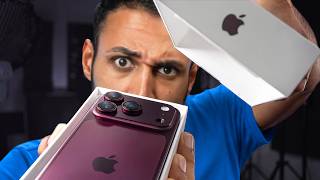

The $2,500 iPhone 18 Pro Max!
60sThe staggering price tag and the blackest iPhone ever will spark curiosity and debate about Apple's premium pricing.
▶ Play Clip"The title promises a deep dive into 'boring' changes, and while the review is detailed, the focus on the variable aperture's underwhelming performance might not match the hype of a 'deep dive'."
This video is a detailed review of the iPhone 18 Pro and 18 Pro Max, focusing on the real-world impact of their new features. The reviewer, who has spent a week with the devices, breaks down which changes are genuinely useful, which are overhyped, and which might even be a step backward. The review covers design, camera performance, and the new variable aperture system, offering a critical take on Apple's latest flagship.
The package includes the iPhone 18 Pro (2TB, burgundy) and 18 Pro Max (2TB, black). The Pro Max is described as the 'blackest' Pro ever, and the total cost is noted as a staggering $2,500, making it the most expensive iPhone to date.
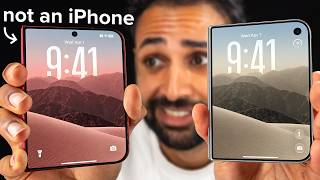
The Dynamic Island is smaller on the 18 Pro. To achieve this, Apple moved the infrared camera behind the screen, creating a pixel-free gap. They halved the pixel density in that area, increased brightness, and added a gradient to hide the seam. The reviewer finds this 'cool' but notes it's visible from certain angles when the screen is off.
Apple's flagship feature is the variable aperture (f1.4 to f4.0). The reviewer explains that a wider aperture (like f1.4) is generally better for depth and character. However, the phone defaults to f1.8 most of the time, only opening to f1.4 in low light and closing to f4.0 for group shots. The reviewer argues this makes the feature underwhelming, as the phone rarely uses its widest setting.
In dark conditions, the aperture blades open to their widest, providing a noticeable improvement in brightness and detail compared to the iPhone 17 Pro and Samsung. However, the reviewer notes that Samsung consistently performs worse in low light. The reviewer concludes that Apple could have achieved 96% of the benefit by simply widening the aperture and dropping the variable part.
The reviewer highlights ESR's Zyklonar MagSafe charger, which offers 25W charging with CryoBoost cooling, resulting in 28% faster charging. They also mention the Xtend plug, a compact 60W charger with a retractable cable. These are presented as practical accessories that complement the phone.
The iPhone 18 Pro's variable aperture is a technically impressive but practically underwhelming feature, as the phone rarely uses its widest setting. The reviewer suggests that simpler upgrades, like a wider fixed aperture, might have been more effective. Overall, the phone offers some improvements, but the headline feature doesn't live up to its hype.
Variable Aperture is Underwhelming
The flagship feature rarely uses its widest setting, making it a gimmick in practice.
08:39Low-Light Performance is a Clear Win
The aperture opens to f1.4 in the dark, providing a significant improvement over competitors.
10:35Simple Upgrades Matter
The reviewer suggests a wider fixed aperture would have been more effective than the variable one.
11:31[00:00] Inside this package is a brand new iPhone 18 Pro, iPhone 18 Pro Max, as well as every key accessory. And I've spent the last week deep diving into these devices. The changes that seem boring, but have actually made a huge difference.
[00:13] The changes that seem huge, but have actually made almost zero difference. And the surprising way that new can be worse. So, I managed to get the 18 Pro in 2TB in this burgundy colour that everyone seems to be after.
[00:30] The phone's on top. There's the braided USB-C cable plus Cinejecta, and then Apple's little free book. Not a page turner.
[00:42] And then for the 18 Pro Max, I got the black. And, as far as to say, I actually prefer it. This is the blackest that a Pro has ever been,
[01:02] and it's also 2TB. Which makes what I'm holding in my hand the most expensive iPhone ever, until the Duo comes out, at a staggering $2,500. And then, to top it all off,
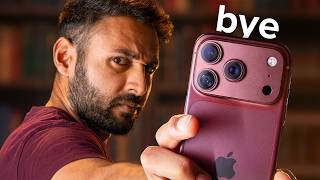
[01:15] the entire burgundy care package. All the official cases and straps that Apple's selling. But to be honest, compared to the vibrancy of that orange that they made last year, burgundy feels a little too sensible to my liking.
[01:31] More importantly though, the single boldest claim that Apple made on stage is that the iPhone 18 Pro Max has not just the largest battery ever on an iPhone, but also the largest increase in battery ever on an iPhone.
[01:43] So where do the new phones actually end up versus other iPhones? and also the competition with Samsung's S26 Ultra. So I used a combination of apps that I'd say are medium to high intensity, times how long it took for them to die,
[01:56] and, lomineck, I was not quite ready for this one. As expected, the base iPhone 17 and 17 Pro were the first to dip at under 9 hours. Samsung's S26 Ultra was a spare margin ahead at 10 hours on the dot.
[02:08] But then, what I'd never seen before is the smaller 18 Pro almost entirely matching the 17 Pro Max, which hit 10 hours 36, and more impressively for 18 pro max? Different ball game, in fact
[02:23] different stadium to be honest, with 12 hours and 32. So we're off to a very good start here, biggest jump indeed. And now they're drained, what about charging? So I connected each phone up to its respective ideal wall charger, because the iPhones and Samsung's use slightly different
[02:39] charging protocols and exactly 20... no, let me turn off the light one second... 20 minutes later, that was pretty good, we've got 58% and 63% for the latest iPhones, so it's good to see that they
[02:51] are solidly ahead of the 45% and 50% that last time got. Notice also how the smaller pros charge faster than the bigger ones because they not as large batteries The base iPhone 17 is somewhere in the middle but not a single iPhone surpasses Samsung S26 Ultra Apple kind of caught up but they not exactly leading the charge as it were
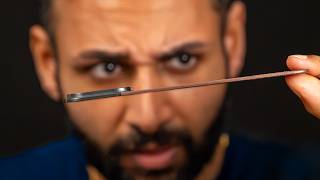
[03:11] And there's actually an even more important thing that we can use these chargers to test. Thermals. This is where things start to get a little bit odd, because this is an iPhone 16 Pro Max. It doesn't have a vapor chamber at all. This is a 17 Pro Max.
[03:23] It has a vapor chamber, but kind of looks like a strip going down the middle. The vapor chamber on the iPhone 18 Pro and Pro Max, though, occupies almost the entire breadth of the phone. So, to find out how much of a difference it makes, I started a 4K video recording on each
[03:38] while plugging them all in for an hour. This is about the most heat that any normal person is going to be generating. And here's what happened. Recorded on our new state-of-the-art thermal camera. The whiter the area, the hotter it is. The iPhone 16 Pro Max and the Samsung sort of trade glows as the hottest, but what I
[03:54] didn't expect to see is that the iPhone 18 Pro Max performed almost identically to the 17 Pro Max, and that the further the test went on, if anything, the hotter the body of the 18 Pro Max got, to the point where, by the end, it was the hottest. So I decided
[04:09] to run the exact same test again the next day, just to be sure, and we got the exact same result. Well, that's weird. There weren't a lot of new things announced for these 18 Pros, but one of the only major ones was this three times larger vapor chamber, so you'd
[04:22] You'd expect the 18 Pro to stay cold as a cucumber, right? Well, I just learned another test that goes a long way towards explaining why this is happening. I thought, well, if there's any other way to see if the cooling's doing anything, it's
[04:34] going to show up in performance. So I decided to put each device through 3DMark's extreme stress test. 20 minutes of M&A continuous loop of 4K graphics rendering. Is the phone's worth nightmare? I did this multiple times, and these were the best results that each firm achieved.
[04:49] And yes, the A-Team, with its new A20 Pro chip, absolutely murdered the other devices. Look at this top score, 9,024, which compares to Samsung in second place with 7,970,
[05:01] the iPhone 17 Pro at 5,911, and then the 16 Pro with 4,860. And the 18 Pro Max retains this very significant lead, even if you look at its lowest score during the test, 6,153.
[05:14] That handily beats out all the others. But look at the sales. The more the test goes on, just like you notice when you're using the cameras, if anything, the 18 Pro Max is getting the hottest out of all the phones.
[05:26] Why? Well, turns out, this is actually the vapor chamber doing its job. What it's not doing, clearly, is stopping the phone itself, the screen that you see here, the sides and the back, from heating up. But what it is doing, as you can tell by how this phone is able to maintain its incredibly high performance numbers, is getting heat away from the chip.
[05:44] So the outsides of the phone are getting warmer because it's redistributing the heat from its core more efficiently. Whereas on some phones, particularly the 16 Pro Max, which doesn't look very hot at all from the front, the heat isn't escaping, it's trapped inside.
[05:57] And this would also explain why every single time I got the phones all hot and bothered and then removed that strain, the 18 Pro Max is the fastest phone to cool down However if the gaming performance of the A20 Pro is the thing that I expected to be a little but has ended up a lot the AI side of things is kind of the
[06:15] opposite. Apple promised us two times the AI performance of the 17 Pro, and while running Geekventure's AI test, I can see a decent 30% or so increase. First of all, that's not 2x, and secondly, I wasn't able to feel even that performance gain in any day-to-day
[06:30] task. Like, let's make a Genmoji. Surprise but happy dinosaur who is riding a skateboard and looks like they're just about to fall over. Also they're wearing an astronaut helmet. Okay, so why isn't the 18 Pro Max not by far the quickest? What about photo clean up? I
[06:49] imported one of my favourite group shots and tried to remove the most handsome person from the image because it just wasn't there. Who does the 16 Pro Max actually finish first?
[07:02] And it's not like there's any difference in quality, the outputs look the same. I tried again using the fast clean up option, which is strictly always on device. The 18 did win this one, but then asking Siri to make me a shortcut, one of the main newly
[07:16] introduced iOS features, 18 Pro came squarely in last place. Now there do seem to be some third party apps where you can see clear benefits to the new like running Grid AI to generate a highly detailed high resolution image. This was about 1.8 times
[07:32] faster on 18 Pro versus 17 Pro and 2.5 times faster on 17 versus 16. But it's just a thing that at least right now this theoretical performance is not translating to the real life experience that most people are going to care about on their phones. Now before one of the big
[07:46] letdowns one completely random thing that I thought was cool is you know the dynamic island has gotten smaller on the 18 Pros right? Well it's pretty interesting how. So from the last they've taken the infrared camera from Face ID, the thing that fires out the dots onto your face,
[08:00] to figure out your 3D contours, and they've put that behind the screen and in the top left. But then to make sure that the IR can still travel through it, they've had to create gaps. So if you look over here, you can see that they've halved the number of pixels for the entire area in
[08:14] front of the camera. And then, to try and make sure that you can't tell, they've rearranged those pixels into a new structure, they've increased each one's brightness to make up for the fact that there's fewer of them, and also created this smooth gradient between the normal pixel
[08:26] arrangement and this alternative region, so there's no seam that looks jarring. It's very cool the thought that goes into it, and safe ID still works absolutely fine. The only annoying thing is that when the screen is off and you're looking from a certain angle, you can see
[08:39] it, and it annoys me. That said, if you were to ask Apple what's the one flagship feature of the 18 Pro's, Apple would tell you it's variable aperture. But while what it's doing is very impressive,
[08:52] what you're generally getting? Not so much. So as a general rule, when you're taking photos on a smartphone, the wider your aperture, the better. Because, well, let's take two shots on this 18 Pro. The first with the aperture set to its widest, f1.4.
[09:05] Second with the aperture set to narrowest, f4.0. Which of these looks better to you It the wide right Because a wide aperture creates so much more depth and character Now the one key exception to this is when you shooting multiple subjects at different depths Because let say one of your subjects is closer to the camera than the other then maybe
[09:23] you don't want one subject in focus and the other one blurred out. So one thing that I gotta say the i7-18 Pro does do rather intelligently is adapt this aperture to your situation. So notice it's pretty wide at f1.8. The whole time it's just me. It stays at f1.8 when someone else enters,
[09:38] because it knows that we're next to each other, so are both still in focus. But then the moment that I step in front of him, bam, aperture narrows all the way right down to f4.0. And that's meant that unlike the 17 Pro, which in this situation blurred him out,
[09:50] the 18 Pro got us both in focus. So this isn't a technically impressive tool, but the reason that I find it so underwhelming in practice is... I mean, first of all, I can genuinely say that never in my life
[10:02] have I taken a staggered group shot like this, unless I was specifically trying to blur whoever was in the background. But it's mostly the fact that I've noticed the phone spends the vast majority of its time fixed at f1.8. It opens up to its widest f1.4 when you're in low light, and it closes to f4.0 in those very specific group instances.
[10:19] The f1.8 is the default that it will constantly return to, which means that the hero feature of this device, the one in all the teasers, this whole extra layer of software and hardware complexity, all of it, is just going into calculating that, actually, yes, last year's setting was good.
[10:35] In fact, every iPhone since the 14 Pro has shipped with an f1.8 aperture right out of the box. That said, in the dark, this is cool. Not just because this is where you can see the real-time effects of the aperture blades opening and closing,
[10:51] it's because this is the only situation in which the aperture blades will automatically open to their widest, so you feel the effects of the extra light it can let in. Up against the 17 Pro Max and Samsung, I'd say the improvements range from a subtle brightening
[11:04] and slightly less noise to a pretty transformational, entirely new layer of detail, depending on how dark you go. And for reference, Samsung is pretty consistently bottom of the pile in these dark shots, whether it's the softness or just the skin tones, it's falling behind.
[11:18] So my point is not that variable aperture is bad, I just think that Apple could have had 96% of the benefits of it by just widening the aperture and scrapping the variable part. and in some cases that might have even resulted in better photos.
[11:31] It all comes back to what I said at the beginning. Often it's the simple upgrades that make the biggest difference. Like ESR's Zyklonar sponsor is now the one MagSafe perk I'd recommend for charging. It's got the same 25 watts of power as Apple's, but thanks to CryoBoost, which actively
[11:44] cools your phone, even if you're gaming at the same time, you just charge 28% faster while improving longevity. It's got a stronger magnet than Apple's, all while adding this surprisingly solid and surprisingly flexible kickstand. And if you're more of a wired person, it is very hard to
[11:59] beat the Xtend plug. Things tiny enough that I could literally carry in my sock. It still has the up to 60 watts of dynamic charging power to charge an 18 pro at max speed, or even a laptop. The cable built inside extends all the way to 95 centimeters, and then... I love this part.
[12:16] Retract. Link below for ESR.

⚡ Saved you 0h 12m reading this? Transcribe any YouTube video for free — no signup needed.