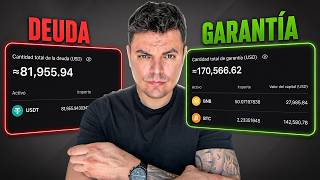

I'm $82K in Debt for Bitcoin
45sThe creator immediately reveals a shocking personal financial decision, sparking curiosity and debate.
▶ Play Clip"Delivers on the promise with a detailed breakdown of the strategy, risks, and practical steps, though some parts are repetitive."
The video discusses the strategy of taking on debt to buy Bitcoin, presenting both the theoretical reasoning and practical steps. The creator shares their personal experience of having $82,000 in debt used for Bitcoin purchases, evaluates the risks, and provides a step-by-step guide on how to execute such a strategy on Binance.
The creator has $82,000 in debt used to buy Bitcoin and will evaluate the strategy and risks.
Bitcoin is around $65,000, down 48% from its all-time high of $126,000, indicating a bear market.
Bitcoin cycles last about 4 years: 3 years bull, 1 year bear. Current cycle suggests we are in the bear phase.
Bitcoin has historically dropped 93% (2011), 87% (2013), 84% (2017), 77% (2022), and currently 53% (2026). The pattern shows decreasing drops.
For beginners, the DCA strategy (buying a fixed amount monthly) is recommended. The creator has a DCA portfolio buying $1,000 of Bitcoin monthly.
The creator uses debt to increase exposure to Bitcoin at what they believe is an undervalued price.
The creator maintains a conservative Loan-to-Value (LTV) ratio, never borrowing more than 50% of collateral value to avoid liquidation.
At 85% LTV, a warning is given; at 91%, liquidation occurs. The creator keeps LTV below 60% for safety.
The loan interest is around 3.92% variable, which is considered low but can fluctuate.
If Bitcoin reaches $150,000 in 3 years, after paying interest, the gain would be about 66%.
Risk that Bitcoin doesn't rise as expected, breaking the cycle pattern.
If Bitcoin falls significantly, the creator may be liquidated if they lack liquidity to add collateral.
Risk of the platform (e.g., Binance) having issues, mismanagement, or ceasing operations.
The stress of being in debt and watching Bitcoin fall can be psychologically challenging.
Steps: verify account, deposit collateral, go to Earn > Loans, select USDT, set collateral, borrow up to 78% but recommend 50%, repay via spot wallet.
Keep LTV below 70%, ideally below 60%, by paying off part of the loan or adding collateral when price drops.
The creator used this strategy successfully in 2020-2021 but got liquidated in 2022 due to FOMO and lack of liquidity.
The creator believes Bitcoin is near its bottom based on historical cycles and uses debt to increase exposure, but emphasizes the importance of managing risks and maintaining a conservative LTV. The strategy is not recommended for most people.
What is the current Bitcoin price and its drop from all-time high?
Bitcoin is around $65,000, down 48% from its all-time high of $126,000.
00:30
What is the typical Bitcoin cycle length and structure?
Bitcoin cycles last about 4 years: 3 years of bull market followed by 1 year of bear market.
00:42
What are the historical percentage drops of Bitcoin in bear markets?
2011: 93%, 2013: 87%, 2017: 84%, 2022: 77%, 2026: 53%.
02:02
What is the DCA strategy?
DCA (Dollar-Cost Averaging) is buying a fixed amount of an asset at regular intervals regardless of price.
03:29
What is LTV and what is the recommended maximum?
LTV (Loan-to-Value) is the ratio of the loan amount to the collateral value. The creator recommends not exceeding 50%.
04:49
At what LTV does liquidation occur?
Liquidation occurs when LTV reaches 91%.
05:32
What is the interest rate on the loan mentioned?
The interest rate is around 3.92% variable.
05:48
What is the hypothetical gain if Bitcoin reaches $150,000 in 3 years?
The gain would be approximately 66% after paying interest.
07:10
What are the four risks mentioned?
Thesis failure, liquidation, platform risk, and psychological risk.
07:23
What is the recommended LTV to keep a loan healthy?
Keep LTV below 60%.
11:38
Bitcoin's 48% Drop
Sets the context for the bear market and the rationale for buying the dip.
00:30Historical Drop Percentages
Shows a pattern of decreasing drops, supporting the thesis that the bottom may be near.
02:02Conservative LTV Principle
Emphasizes risk management by never borrowing more than 50% of collateral.
04:49Hypothetical 66% Gain
Illustrates the potential reward of the strategy in a best-case scenario.
07:10Past Liquidation Experience
Provides a real-world cautionary tale about the dangers of FOMO and over-leveraging.
12:04[00:01] reasoning behind going into debt to buy Bitcoin. Not only the theoretical part, but also the practical part. I currently have a debt of about $82,000 which I used to buy more Bitcoin. We're going to thoroughly evaluate this strategy and the
[00:16] risks involved in going into debt to buy Bitcoin. Let's begin. To give you some context about what we're doing, I want to show you the following. Currently, Bitcoin is around $65,000. It has fallen approximately
[00:30] 48% from its all-time high of 126,000 and its graph looks like this . In recent months it has done nothing but decline. Everything you see out there indicates that we are at
[00:42] or near the bottom of this bear market. To help you understand a little about what we 're doing, I'm going to show you the Bitcoin cycles, which are Bitcoin cycles of approximately 4 years. Bitcoin cycles usually
[00:55] consist of 3 years of bull market followed by a year of bear market, completing the 4-year cycle. In fact, this cycle that you see here is here, cycles of bull market and then continuing with a
[01:09] bear market. This other cycle that was repeated approximately also of 3 years of bear market, was this cycle that we look at here of approximately 3 years of bull market to then continue with one year of bear market. And then
[01:23] 2023, which lasted for approximately 3 years, from approximately 3 years, from approximately 2023 to 2026, and then continued with approximately one year of a
[01:36] bearish cycle, which is the stage we are currently in. And I believe it is I want to show you how much Bitcoin has fallen from these bull market peaks to the bottom each time it drops. What percentage falls in each fall?
[01:50] This will help us determine roughly where we are now and how much further it can fall. This is very relevant when applying for a loan. For example, when it fell in 2011, which here can't be
[02:02] appreciated because that was when Bitcoin was basically in its infancy. During that period, Bitcoin experienced a 93% drop. Then in 2013 Bitcoin had a drop from its all-time high to a low of 87%. Then, in 2017,
[02:18] Bitcoin had an 84% drop, and we do have a record of that drop, which is the one shown here. From this peak that reached about $20,000, when it fell around here to about 3,500 or 2,500, it was the 84% that you see here. Then, in the
[02:33] 2022 crash, it fell by 17%, which was this drop we had here when it reached $69,000 and then fell to about $15,500 or $16,000. And currently in the 2026 bear market, the maximum drop has been
[02:48] 53%. That was the drop it had from 126,000. I think it managed to drop to around $ 126,000. I think it managed to drop to around $ 58 or $59,000. out. But if we look at the pattern of what has fallen in each bearish cycle, you
[03:03] can see that the percentage that Bitcoin falls is decreasing each time. And the only thing we can base it on, then this drop could be between 53% as already happened or even 60%. Looking at
[03:17] history and how Bitcoin behaves in each cycle, I believe that at these time to enter and may be undervalued. Of course, the most advisable thing, especially if you're just starting out in the world of buying Bitcoin, is to
[03:29] use the DCA strategy, that is, buying a certain amount of money each month. Here I show you this other portfolio which is actually the most recommended, what I recommend you do. I started it about
[03:41] 10 months ago, and I actually started when Bitcoin was around 106,000, and from then on, every month, no matter what, on the first of each month I buy $1,000 worth of Bitcoin. No matter how much it's worth, I just make the purchases. So far
[03:53] , yes, we're down 17%, but I'm sure this portfolio will DCA strategy is what I would recommend you do, and by the way, here's a video about this strategy. But anyway, getting back to the
[04:06] main topic of this video, here we are using debt, leverage to why I'm doing this, I first want to give you a warning. In this . In fact, that strategy is probably not a good idea for
[04:22] most people. What you are about to see is my reasoning to show you is why I do do them. This video is simply for informational purposes, and one reason why I
[04:35] 'm taking on debt is to increase my exposure to Bitcoin now that I undervalued. Based on the current price of Bitcoin and considering good time to accumulate. Also, in the loans I'm making, I use a
[04:49] conservative LTB. LTB refers to the relationship between what you borrow and the value of your collateral. For example, in this debt I have, the loan in this debt I have, the loan I have is approximately 48%
[05:02] of what my collateral is worth, my debt is about $70,000, while the value of my collateral is about $ 144,000, more than double. In fact, when I take out a loan, I never ask for more than 50% of the value of my collateral. This is
[05:17] to avoid liquidations, because as you can see, at 85% they give me a warning that I could be liquidated, and when the value of my collateral approaches or reaches 91%, which in this case is if Bitcoin falls to $4,300, they
[05:32] would be losing all my collateral, and that would be quite catastrophic. always having available cash on hand. You should always have a way to pay off part of your debt or add more collateral in case the price drops
[05:48] unexpectedly. And another reason why I'm doing this is the cost of the loan. The interest I am paying on this loan is around 3.92%. Sure, this interest seems low to me, but it
[06:00] can also fluctuate. Since it's a variable interest rate, it might go up later, but it won't. It doesn't usually go up that much. Let's take a hypothetical example of the best-case scenario I'm considering. Let's say that today I took out
[06:12] a loan and bought a Bitcoin at the current price, say, $65,000, and let's say that I made this purchase with debt. I'm going to pay an interest of 3.92, goes up in the next few years and I end up paying an average interest of 5%. And let's say
[06:26] my goal is to sell that Bitcoin in the next 3 years, when it reaches roughly the previous all-time high , which was $15,000. Why in 3 years? Because theoretically, in the next 3 years we would be reaching the
[06:39] , I don't want Bitcoin to go up much , I just want it to reach its previous all-time high. With a debt of $65,000 at an interest rate of 5%, at the end of those 3 years I would be paying around $10,000 in interest. So
[06:55] if we add the $65,000 loan plus the $10,000 in interest, I would be paying a total of $75,000. Now imagine that Bitcoin has already reached $15,000 and at that point I decide to sell that Bitcoin. Of those $15,000 I would use
[07:10] $75,000 to pay off my debt plus interest and I would keep $50,000 in scenario would represent a gain of approximately 66% in these 3 years.
[07:23] But hey, it's not all sunshine and rainbows. Now I want to talk to you about the risks I first risk is that Bitcoin will not fulfill my thesis. Let's say that Bitcoin doesn't go up in the next 3 years, moves sideways, or
[07:38] these 4-year cycles simply break down for the worse. And that would lead me to the second risk, the risk of being liquidated. If Bitcoin falls significantly more than expected, say by as I have done in the past, I risk being liquidated,
[07:52] Bitcoin may fall more than anticipated. What if by that time I don't have the liquidity to pay part of the loan or add more collateral? At that point I would be selling my asset at these prices to cover the loan, which
[08:06] would be pretty bad for me. The third risk I'm taking is the far the largest and most reliable cryptocurrency platform, that doesn't make it exempt from having problems,
[08:18] mismanagement, changing its terms and conditions, or simply ceasing hope never happens , then my money goes with it too . And the fourth risk is the psychological risk. Here you have
[08:32] to ask yourself, being in debt like this , will you be able to sleep peacefully? You'll be able to sleep peacefully knowing that your money is on a platform they do. Also, if Bitcoin starts to fall drastically, reaching
[08:45] fall drastically, reaching 60, 50,000 or even 40 and liquidation price, will you be calm about that? It's a psychological stress that I've already experienced, and you should also take it into account. The
[08:58] point here is to weigh the benefits you'll get from taking on debt against the risks you 're running, and assess whether the potential reward is worth the risk you
[09:10] 're taking. If after everything I 've shown you, at some point you're considering and taking into account all the risks you're running, you would do it perform a transaction like this, the first thing you will need is a verified
[09:24] leave the official link in the description with exclusive rewards for new users. And if you'd like to see the step-by-step process on how to create an account, I'll leave a video for you above. Then I lower your
[09:37] spot wallet. Here you already need to have the cryptocurrency you want to leave as collateral. I have approximately $500 worth of Bitcoin here. If I want to have to go to this section that says earn and then to loans and here
[09:50] I select the cryptocurrency I want to borrow, which is usually done with USDT, which is the representation of the US dollar. And here's the collateral, that is, your guarantee, in this case it's going to be Bitcoin. Vinas
[10:04] can lend you up to 78% of what your collateral is worth, so out of my $500 they could lend me around $390, but remember, 78% is very close to 91%
[10:16] which is how they would liquidate you and we don't want that. So, with 500, the healthiest thing would be to use all my collateral and request a loan of only 250, which would be approximately 50% of what
[10:29] my collateral is worth. That's what I recommend if you want to do this request loan and the operation will be executed. That USDT that I borrowed will be spot account and I can use it to buy more Bitcoin or do whatever I want with it
[10:44] loan, I also need to have the USDT here in the spot wallet. I'll probably go back to the loans office and get my loans there. I press pay and here you enter the amount you wish to pay. You can pay it all at once or
[10:57] pay it little by little. It's up to you here. I can even apply this $500 to the debt I have here and simply press confirm. If you have more cryptocurrencies like Bitcoin stored in a wallet and you want to send it to
[11:10] Spot wallet, you can simply adjust the LTB right here and add more little, I give it in addition. That's basically it. Right now, this loan is in pretty good shape. Something I forgot to mention is that
[11:24] I normally never let this percentage exceed 70%. In other words, if Bitcoin starts to fall and this percentage starts to rise, approaching these levels, at that point I try to pay off part of the loan or add more
[11:38] collateral so that this percentage drops back down to these levels. For me, a healthy loan is one that keeps this percentage below 60%. And that's basically it. If you want to learn more about this loan product
[11:51] dedicated video that I'll leave up here for you . And well, to recap, I've already used this strategy of taking out loans a couple of times. It worked out quite well for me once. Around 2020, or approximately 2021, I used it to
[12:04] buy Bitcoin and it went quite well for me. Then I got carried away, I became obsessed, I really let myself be driven by FOMO and I used it around 2022. I used it with cryptocurrencies like Solana and I don't remember what
[12:17] other cryptos, but it was a really bad time because from that point Bitcoin fell by about 30-40%, but cryptocurrencies fell by 60-70% and of loan, nor did I have any more cryptocurrencies to add as collateral,
[12:32] so I ended up being liquidated and I ended up losing that money. This within reason, assuming all the risk in a proper way, because I think Bitcoin is near its bottom, based on what we've seen in
[12:46] Bitcoin cycles and how much Bitcoin falls, and I 'm also using it to buy more Bitcoin, I'm not buying junk out there that's going to disappear in a few months, and things have also changed because now if I need to add
[12:58] more liquidity or pay part of the loan, well, I have other ways to liquidated. So if you decide to start on Binance, I'll leave you the Also, if you have any questions about this topic, you can leave them in the
[13:11] to answer. And if you'd like to learn more about pods and all the products it has to offer, here's a playlist where platform. I'm signing off for today.



![How to Buy USDT on Binance P2P 2026 [Easy, Fast and Safe]](https://img.youtube.com/vi/ZmjPLzr6_IM/mqdefault.jpg)
⚡ Saved you 0h 13m reading this? Transcribe any YouTube video for free — no signup needed.