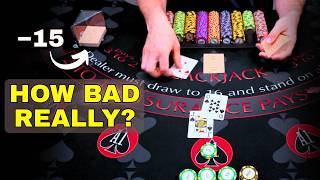

Starting at -16: The Worst Blackjack Count
44sThe dramatic setup of starting at a -16 count immediately grabs attention, promising a demonstration of severe disadvantage.
▶ Play Clip"The title asks a fair question and the video delivers a direct experiment — no clickbait tricks, just raw negative-count math."
This video demonstrates the consequences of playing blackjack with an extremely negative running count, starting at -16. Over three double-deck shoes, the player bets $50 a hand with no spread and ends up losing $700 of a $2,000 bankroll. It concludes by introducing back counting as a smarter alternative to avoid playing through such unfavorable counts.
The host sets up a double-deck game removing all four aces, kings, queens, and jacks, simulating a running count of -16. They use $50 minimum bets and no bet spread, with 40 green chips ($25 each, totaling $2,000).
In the first shoe, the count starts at -16 and, after playing through, the count recovers to +1. However, the player still loses money due to low cards causing busts and dealer 20s/21s.
The second shoe starts again at -16 but only reaches -8 by the end. Double-down opportunities (e.g., 11 vs. 6) fail repeatedly because the high cards aren't in the deck, leading to more losses.
The final shoe starts at -16 and ends at +2. Despite some wins, the player loses steadily. After three shoes, only 12 chips remain — a loss of 28 chips, or $700.
The host explains that in negative counts, hits often push you over 21 while the dealer makes strong totals. They introduce back counting — standing behind the table and waiting for a good count — as the recommended way to avoid these losses.
What was the starting running count in the experiment?
The experiment started at a running count of -16, representing the 16 high cards (A, K, Q, J) removed from the deck.
00:30
What was the minimum bet at the table?
The minimum bet used at the table was $50.
01:11
How many green chips did the player start with and how many were left?
The player started with 40 green chips (worth $25 each, totaling $2,000) and ended with 12 chips remaining.
12:15
How many chips were lost and what was the total dollar amount?
The player lost 28 green chips, which equated to a loss of $700.
12:30
Why are double-downs particularly bad in negative counts?
Because you don't get the big cards, your doubles (like 10 or 11 vs. 6) are much more likely to fail.
07:09
What is back counting?
Back counting is when you stand behind the table and wait for a good count before jumping in to play.
13:21
How did the count evolve over the three shoes?
Two of the three shoes went from -16 back to positive (finishing at +1 and +8, respectively), while the middle shoe only reached -8.
12:02
What makes hitting a 16 or similar hands especially dangerous in negative counts?
The dealer often ends with totals like 20 or 21, and hits or stands that would win at high counts just bust or fall short.
12:56
Back counting as a negative-count strategy
Provides a practical, actionable solution to avoid playing through negative counts and preserve bankroll.
13:21Quantified loss of $700 in three shoes
Concrete numbers show the brutal financial impact of playing through negative counts, making the risk vivid.
12:30Doubles fail without high cards
Explains why advantageous situations like doubling an 11 still lose money when the deck is low — a key nuance for counters.
09:29[00:01] are when you're playing advantage Blackjack. However, I got this comment from @CMarshall93 who asked me to kind of reverse engineer that video and do the opposite and show just how bad low counts are when you're playing and thus
[00:17] I think the best way to show this is going to be to take I have the ace, king, queen, and jack from our four suits here in a double deck. [music] cards. I'm going to throw them in the
[00:30] means it's kind of like we're starting at a running -16. >> [music] >> not good for the player. Right? So that said, I'm going to get the rest of these shuffled up. And as I
[00:44] you'll notice that [music] we have four piles of green chips. There's 10 in each >> [music] >> 10 black chips there. So that's $2,000 worth of chips and I think what we're going to see over three shoes of double
[00:59] deck is those [music] piles are going to start to dwindle. All right? So let's give the cards a cut. All right, cut off about half a deck of we're missing 16 cards. So that's probably a little bit more
[01:11] >> [music] >> Uh let's say we're playing at a $50 minimum table. Now, I'm not really going to use a bet spread [music] because it's of this. So we're probably not going to get past this first row into the second
[01:24] this kind of one spot of 50 as that's one way [music] is when it goes into the house's favor >> [music] >> even below a true one you might say,
[01:40] And I'm just using two chips here kind of $50 because blackjacks are easier to pay out that way if needed. Okay? So if you were counting with me um or counting up by yourself I should say you can start at minus 16 and let's try it. All
[01:57] counting I'm not going to count. I'm just going to call the game. But if you were counting minus 16 now it's minus 15, 14, minus 13. the count at the end if that's what
[02:10] hit still. All right, now you stay on a 15. A nine versus dealer's two. 19's going to stand. Dealer to stand. Dealer has a six, 10, and 20. So unfortunately,
[02:22] you lost both of those. All right. Next hand is a 16. That's a hit. 22 is one too many. Dealer would have had nine.
[02:37] All right. So you can see all these low cards coming out because our count is so negative. It's kind of a lot of what's left. Six is going to hit. left. Six is going to hit. Um 11 still a hit. Stand on 20. Dealer
[02:49] has 14. 15, 16, and 17. So there's a win.
[03:01] Okay. So you don't lose everything. Um 12 is a hit. 22's one too many. Um 12 is a hit. 22's one too many. Dealer would have had 15. >> [sighs] >> for the dealer
[03:16] 15 and 18.
[03:28] pile. Dealer would have had 19. um is a hit. You can stand on 18. Dealer has eight.
[03:42] You can stand on 18. Dealer has eight. Uh 13. Oof. 21. Weird is not winning much at all here, are we?
[03:55] 25 is too many. Dealer would have had 17 I think. Pair of fours versus dealer's eight is a hit. Uh 18. Oops. 18 versus dealer I should
[04:07] there. All right. And there is our cut card. So if you are interested um let's count this up and see kind of This should be the opposite of your count to get us back to zero.
[04:22] And it looks like we have one, two three, four, three, two, three, two, three, four, three, two, three, two, one, two, one, zero, one, two one, two, one, two, three two
[04:37] one, zero, D1. All right, so we actually did get above zero here. Uh this was minus one which means we need to end at a count of plus one. So the count went all the way from minus 16 back above zero
[04:50] um to plus one. Okay, I'm going to get these shuffled up except for those first these shuffled up except for those first 16 cards for our next round.
[05:03] just a little bit more than a half deck cut off. These 16 cards are going to go in the bottom of the discard tray. So if you're counting start at minus 16. Then I'll bet a $50 out there. All right, let's try it. 12 is going to hit. Hey,
[05:16] there you go. 21. Dealer had 19. So there's a win to start this one off. In fact, you can get a shoe that would be a whole win after playing through all
[05:28] be a whole win after playing through all of it. 18 will stand. Dealer has 10, 16 and too many. So like this we are up 100 bucks in this shoe already. But overall we are still down about 200.
[05:42] Pair of sevens split against a dealer's two. Double after split here. 16. Stand on 17. Dealer has 11. Oh, 21. So
[05:54] we're not up 200 and or down just 200 anymore. Down a little bit more than that. Another 50 out there. Nine versus Another 50 out there. Nine versus dealer's ace. Ah, blackjack.
[06:09] Another 50. 13 versus four is a stand. Seven 10, 15, 13 versus four is a stand. Seven 10, 15, and too many.
[06:25] use. They're a little slick. There you go. 20 can stand. Dealer has 12, 14 and too many. So you're winning a little bit more here in this
[06:38] in this shoe. No blackjack. 15 and a multi-card soft 18 is a hit still. Now
[06:50] a multi-card soft 18 is a hit still. Now you can stand on 19 but dealer has 20. This is a double. Ah, again dealer has 20.
[07:09] advantageous situations like a double down when you have an 11 those high cards in these really negative counts. 15 can in these really negative counts. 15 can stand against dealer's four. Six, 16
[07:22] stand against dealer's four. Six, 16 21. Oops. Last one for this round. Stand on 14. Dealer has nine. 10, 11, 12, and too
[07:35] 14. Dealer has nine. 10, 11, 12, and too many. that one. We are currently down looks like about 18 chips from where we that time again this should be the
[07:48] And zero, one two, one, two, three four, three, two, three, four, three, two, three, four, five six, seven, eight. All right. So this is
[08:04] plus eight. You should have finished at minus eight. So it really only went from minus 16 to minus eight that time. All right, I'll get these shuffled up for right, I'll get these shuffled up for our last round.
[08:21] round just a reminder our sponsor today is Casino Supply. I have a discount code for you that you can get 10% off use code A1BJ at checkout. Casino Supply has some of the best quality cards, chips, discard
[08:34] best quality cards, chips, discard trays, shoes, even custom felts if you like to order some of those or if you're into poker you can do custom poker felts and things like that. Get a nice uh chip set. I personally like these Monte Carlo
[08:46] chips um the best. So give them a a look at casinosupply.com. Use code A1BJ at checkout for 10% off your entire order. All right, again I'm going to take these 16 cards. We're going to throw those into the discard
[09:00] tray starting at minus 16. Minimum bet of $50. Let's go here. Stand on 18. Dealer has 17. So there's a win.
[09:16] six. Dealer has eight, 11 six. Dealer has eight, 11 and 17. So win one, lose one to start the round. Here's a double down opportunity. 10 versus six.
[09:29] Again, you just don't get those big cards. Um so dealer has 12 14 and 18. Yeah. So kind of an interesting conundrum there. That's why there are some deep cut deviations if
[09:44] are into those really negative ones but I would suggest it's not playing through about that at the end. Stand on 17. Dealer has 11 Dealer has 11 12 and 19.
[10:01] 11 12 and 20, sorry. Either way, you lost unfortunately. I think I said the wrong number. Uh 16 versus dealer's 10 and negative counts is a hit. Uh too many
[10:23] So, another loss there. Man, this one really see those piles going fast in Seven versus dealer's six is a hit. Stand on 17. Dealer has 13 and too many. Stand on 17. Dealer has 13 and too many. So, there's a win.
[10:43] 12 13 Uh Uh too many again. 14 can stand against dealer's five. Seven
[10:57] Seven and 18. So, you lost that one. and 18. So, you lost that one. Move those over. All right, 16's going to hit. 17 can stand now.
[11:13] 17 can stand now. Dealer also has 17. So, another push. And last one, 15 versus dealer's nine is a hit. Stand on 19. Can we end with a win? 14 15 16 17. Yes, there we go.
[11:30] All right, so before we count up the chips here, let's see if your count was correct. This should be the opposite of that. should be the opposite of that. We have D1 0 D1 0 D1 0 D1 0 1 2 1
[11:47] We have D1 0 D1 0 D1 0 D1 0 1 2 1 1 2 1 2 1 2 1 0 D1 D2 D1 and D2. So, interesting that also got positive. As this was minus two, your count should have been plus two.
[12:02] So, two of those rounds went all the way from minus 16 back positive, but that one that stayed really negative is also pretty big loss there. Okay, um that said let's check out our chip count. Remember
[12:15] we start with 40 of these green chips and we currently have and we currently have 12. So, that means that we lost 28 of those. That's uh that is not very good. That is
[12:30] 6 700 something. So, uh not the best there. In fact, this is dollars that we lost. Didn't have to tap into the blacks at all, the black chips
[12:44] into the blacks at all, the black chips I should say, but not very good. Now, counts. Um you just again on those double downs, so it's not going to be good for you there.
[12:56] Um on a lot of the hits and stands, it seems like you either have to hit and um you go over your total, whereas the dealer is more likely to make their totals with those low cards coming out. You would think you would too, but just
[13:09] the way that's what you stand on versus what you end up hitting uh it doesn't negative counts. So, how can we avoid this? You can do something called back counting. All right, that's where I'm not going to give it all away cuz I
[13:22] but you kind of stand behind the table and wait for a really good count then you can jump in. So, check out this video right here if you're interested in video right here if you're interested in how to back count.
⚡ Saved you 0h 13m reading this? Transcribe any YouTube video for free — no signup needed.