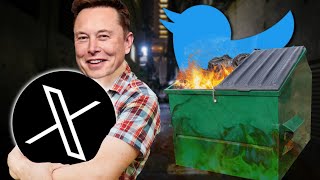

Is Twitter's rebrand to X the worst marketing move ever?
45sThe provocative question about a major brand rebrand sparks curiosity and debate.
▶ Play Clip"Delivers a thorough analysis with data and insights, but the title's promise of 'definitive' coverage is slightly oversold given the speculative nature."
The video analyzes the rebranding of Twitter to X, examining its current state, competition with Threads, and future prospects. It covers user data, creator monetization, live streaming, and the concept of outrage marketing, concluding that X is likely to dominate short-form content despite controversies.
Elon Musk rebranded Twitter to X, sparking debate about its future. The video aims to provide a definitive analysis of the platform's trajectory.
Elon bought Twitter in November 2022 and made numerous controversial decisions, including verified subscriptions, firing executives, laying off staff, and reversing bans on figures like Trump and Tate.
Threads launched in July 2023, gaining 100 million users in a month (faster than ChatGPT), but engagement dropped by at least 70% shortly after, making it feel like a dead platform.
Mario Narfall claims Twitter users peaked at 541 million, a 150-250% increase, but the creator doubts this, estimating a 20-30% increase. Other data shows monthly active users increased ~20% in late 2022, with minor declines in app usage.
Twitter reduced hate speech by shadow-banning content using AI detection, so offensive tweets don't surface. The creator believes this has been effective, though right-wing content is more visible now.
X pays creators a flat CPM of $0.001 per 1,000 impressions. Requirements: Twitter Blue, 50 million impressions in 3 months, and 500 followers. The creator earned $670 for 61 million impressions, calling it easy and viable.
Twitter's live streaming is being promoted heavily, and creators should syndicate their streams there. It's a temporary window for high discovery and monetization, similar to past platform features.
Outrage marketing involves deliberately provoking emotional responses to gain attention. The flashing X sign in SF generated massive media coverage, illustrating that all impressions are equal and drive engagement.
The creator predicts X will own short-form content due to Elon's speed, outrage marketing, and inability of competitors like Threads to keep up. He compares Elon's style to Trump's, noting a cult following may develop.
X is likely to succeed in the short-form space due to its rapid evolution, creator monetization, and outrage-driven attention, despite controversies. The platform's future looks strong, and now is a good time for creators to leverage it.
Threads' record growth and decline
Shows the volatility of social platforms and the challenge of sustaining user engagement.
01:12Shadow-banning as a hate speech solution
Reveals a technical approach to content moderation that has been effective, contrary to public perception.
10:03X's creator monetization model
Provides concrete numbers and requirements, making it actionable for creators.
16:14Outrage marketing as a strategy
Explains a powerful marketing principle that drives attention and engagement, applicable beyond Twitter.
26:50Prediction: X owns short-form
Offers a bold forecast based on speed and attention dynamics, useful for marketers and investors.
30:45[00:01] Twitter has rebranded to X. Is this the worst marketing move of all time? Where is it more appropriate to talk about this than on a marketing and social media channel? If you look at the popular news about X, then everyone will tell you it's doomed to fail, but what is the real
[00:15] truth of it? I wanted to make a video that definitively covers the future of Twitter now X, so everyone completely understands what's really happening and what's going on. There's a lot of nuance here, there's a lot of decisions that are being made that are just kind of partial information being shared on social media. There's a ton to cover, but
[00:30] By the end of this video, you will understand completely where this platform is going, what its future is, more than any other video. Let's get started right now. I'm excited. This is one of the craziest times in social media. It's been really crazy for our agency.
[00:42] I'm excited to kind of talk about some of the stuff that we've discovered. So to understand, before we get into, like, the marketing and the really big details and what's going on, you kind of understand how we got here. So that's section one. So Elon bought Twitter in November of 2022.
[00:56] It doesn't seem like that long ago, but it's had more updates than any social platform. There's just been so many updates. And to have a conversation about Twitter, we're going to also have to have a conversation about its chief competitor, which is Threads. Threads launched in July of 2023, which as of the time of this recording was just over a month ago.
[01:12] But since then has acquired 100 million users in just a month. That is faster than ChatGPT. That is actually faster than any app has ever onboarded users. And we're going to talk about Threads a little bit later. You have to keep it in mind in the context of this discussion, because it is the short-form competitor to Twitter.
[01:30] Mark Zuckerberg is even iconic in his challenge to Elon, or Elon's challenge to Mark to have a physical fight. Like, they're both rivals in business and rivals physically. It's just a crazy media thing.
[01:42] So, since then, it may not surprise you if you've been following news like this and you're watching a video like this, that Elon has made a few controversial decisions about Twitter, hasn't he? and there he has driven some of the craziest hate I think I've ever seen
[01:57] just outrage outrage some of the craziest things he's gone over so the the biggest decision that he made was Twitter changing verified and Twitter blue and that was the first thing he did to making Twitter blue a subscription service
[02:09] now you've got to pay to be a part of the verified crew and most verified beds if not all at this point are entirely gone some of the stuff you might have forgotten he fired all top executive, put on a new CEO, laid off well over half the staff, which ended up being
[02:25] fine. There were no real significant outages, but it was like a crazy decision. He also reversed bans on highly controversial figures. This includes people like Donald Trump, Andrew Tate, and Tucker Carlson.
[02:39] Names that on YouTube, I'm not even sure I can say, unless I get demonetized, we'll find out. And also put up a huge sign that blinded SF residents and made everybody mad. But, of course, the biggest one and the thing we're here to talk about today is the rebrand to X, which is otherwise called the Everything app.
[02:55] Keep that in mind because it's going to be important later. The Everything app. So that is just a small summary of what the hell is happening. I mean, this guy has made more and faster decisions than just about anyone on a platform this big.
[03:09] If you compare the amount of changes to X over the period of time that he has owned it, which is basically less than a year, and then you look at the entire platform's history under Jack Dorsey, the former CEO, there's a lot going on.
[03:25] And that's going to be really important for later. And that kind of brings us to, like, what is really happening at Twitter and Threads? And this is data that is hard to collect. I'm going to use our agency, Novo, which is going to help with some of this because we have insider information,
[03:38] but I'm also going to use a lot of resources. The first thing to understand, I think, is to start with threads, which is going to be the chief competitor. Because if you understand threads, you sort of understand where Twitter is going. People need short-form content.
[03:51] The ability to post 180, now you can post more, you can do a tweet longer within the tweet, but for the vast majority of Twitter, it's still this short-form culture. You need to have a platform that does that.
[04:03] So it's not like Instagram has its place, YouTube has its place for long-form video. So if anything is really going to disrupt Twitter, it's going to be Threads. So what's happening at Threads?
[04:15] Threads is dead, baby. Threads is dead. Why? I'm not too sure, but it's down in terms of its traffic by at least 70%. There are a lot of reports that say that engagement is down even more.
[04:30] And anecdotally, just using Threads over here at our agency and just how we interact with advertisers, we talk to a lot of agencies that run ads and do a lot of engagement and influencer marketing in these places.
[04:43] Threads just feels like a dead platform. It feels like there's very little going on. It feels like the people that are there are sort of the Elon haters slash like holdovers that would prefer a more brand-friendly experience.
[04:55] Now, even if the 100 million users is accurate, then, and down 70%, we still have to consider that, like, 30 million people may be logging in a month to use the platform. That's incredibly significant.
[05:08] But Threads has dropped off as fast as it grew. And I can only assume that this is, like, from a marketing standpoint, the assumption that Twitter, no one, like, really wants to be on Twitter.
[05:21] It's just the content on Twitter has gotten worse, I think. The feed has gotten worse since Elon acquired it. I've not only had that from advertisers we work with, but also from users and creators.
[05:34] There seems to be a huge decline in quality. I use Twitter every day, and my own experience of consuming it is also just like you get political stuff, right and left wing stuff, high school fights, Doomer stuff, war and all that.
[05:52] It just seems like they're really optimizing for engagement to get as many users engaged on the platform as possible. And if we're going to look at something that might affirm that, I think one of the hardest things to understand is what is the actual user base engagement on Twitter?
[06:10] You'll have a lot of people telling you that the engagement is going down, the user base is going down, and the platform is basically dying. And that was reinforced by thread starting, right? When thread started, everyone was like, Twitter is dead. Well, it doesn't seem like that, right?
[06:22] Because Threads is declining engagement vastly. I actually think that this reporting was as of last month, and now the data is even heavier. Like, some might be like 85%, 90% decrease in engagement.
[06:36] Like, crazy, crazy numbers for a social platform. I think that Threads is a very beta product. It has a long way to go to be able to compete with Twitter. They're going to keep trying to do it, and I think Meta is a good platform to own it,
[06:49] but I just think they're not even close. Let's look at some of the data on the actual users at Twitter and what's going on. To do this, we're going to go find this post by Mario Narfall.
[07:04] I think that's how you... Narfall? Now, I want to caveat that my experience with this dude, despite saying that he has no bias or echo chamber, he's notoriously an Elon shill.
[07:16] And almost everything he posts is bullish about Twitter. This was a dude that broke, like, the Twitter files about the U.S. government and everything. It's difficult to trust these numbers at face value.
[07:28] I'm going to read through them. We're going to understand them, and then I'm going to compare them to some more reliable sources. So according to Mario, and he would presumably have had insider information from the people at Twitter because he worked directly with them,
[07:41] the number of users peaked this month at 541 million. So that's five times the rate of this peak. that's a massive increase compared to the 237 million users the same time last year, of which 20% were bots.
[07:54] So Mario is telling us that the amount of total users on Twitter increased by over 100% in a year. This is a remarkable 150 to 250% increase. I don't believe this.
[08:06] This seems really unlikely. That's an insane amount of users. I do think that the amount of users overall has increased on Twitter. I just don't think it's by this much. It's really hard to believe, especially if you're considering that the bots and automated accounts have been reduced, as Mario's claiming here.
[08:25] So he's claiming that there is less bots but more real users. It's hard to determine what a bot is on Twitter, and it's, in most cases, I just don't believe this.
[08:39] I don't know by how much it has increased. I think it has increased. I would put that number closer to, like, maybe 20% to 30% and not, like, 150% to 250%. But I don't think – but that's notable, right, because I don't think the users are decreasing.
[08:53] I think they are increasing, just not by as much as Twitter and their kind of pundits are saying. Meanwhile, I always have seen more reliable numbers. I haven't, like, really seen the back end. It's just people like this kind of talking about it.
[09:06] So here the metrics that have been improved in all aspects including hate speech as demonstrated by a report Independent AI Sprinkler estimated daily English language hate speech to be 0 of all impressions compared to Twitter estimate of 0 for a period of January to May of 2023
[09:24] Now, so they're saying, so the reason they're saying this is because the classic criticism of Twitter has been this hate speech argument, which is basically saying, hey, Twitter has a lot of really hateful stuff on it. We don't want to advertise there.
[09:37] We don't want to be a part of it. There was a former Twitter employee by the name of Joel, I think, who posted that at the time of Elon's acquisition, hate speech was down.
[09:50] And Twitter solved this problem in an interesting way. There's a Joe Rogan podcast with Jack Dorsey, the former CEO of Twitter. A long time ago, they were discussing how the issues of hate speech and the issues of banning people was essentially untenable.
[10:03] You can't solve that problem. The way that Twitter actually managed to solve this problem was by effectively shadow-betting hate speech. So they were able to get good enough at AI detection of certain words and certain strings and characters
[10:16] that when hate speech does appear, that tweet just doesn't surface to anybody, even if that person has a lot of followers. So that has successfully reduced hate speech by an incredible amount on the platform.
[10:28] And I actually do believe this. I do think that hate speech is vastly less than it has been before. Now, I'm going to caveat that because there might be some people listening that are like, that doesn't make sense to me because I've read stuff on there that offends me.
[10:41] Yes, you probably have. And if you have read things on Twitter that have offended you in the recent six to 12 months, it's because the – you have to understand that the – I'm going to be careful about this.
[10:53] For everybody that's watching maybe for the first time and doesn't know Devin Nash, okay, I do not care about politics. I care about attention. I'm a marketer, okay? So I will market for either side. I don't care I'm mercenary. All I care about is how the attention comes in.
[11:08] Twitter was a very left-leaning platform with very left-leaning ideas for a long time under Jack Dorsey's tenure. So now there's a lot more right stuff that is coming up.
[11:20] So, for example, Tucker Carlson has a show on Twitter now that got something like, reportedly, on his Andrew Tate interview, got 70 million views. again what's a view like that sounds like so many views for for something like that maybe maybe like
[11:35] right might be up to like 100 million now according to like what twitter counts as a view or whatever you kind of have to be careful about that but the point is that that kind of thing is surfacing a lot more on twitter now so if you were if you're offended by right-wing ideas especially extreme
[11:49] right-wing ideas those are showing up right but that's not hate speech not by the definition of twitter users hate speech is stuff like um racist remarks or sex remarks things like that um all kinds of stuff that I can't even say on YouTube because it's also banned here.
[12:04] So I do believe that what they define as hate speech has reduced by at least this much, and I think that's generally a good thing. Great. Twitter announced that ad revenue sharing is live for creators. Great. Also, here's the future of X according to Mario and Twitter.
[12:18] It's soon to be the everything app. It will be a creator income generator. We're going to talk about that later. A one-stop financial app. We haven't seen anything like this, but supposedly you're going to be able to trade crypto here. an everything market where you can shop, trade, and hire.
[12:31] Again, nothing here. Entertainment, gaming, streaming, recreational features we have seen. Live streaming, we're going to talk about that in a little bit. And it will be shaped by you. And now the death of Meta's Twitter clone.
[12:43] Do you see what I mean by this guy having a little bit of bias? His profile has literally no bias. But my God, he is so pro-Twitter as much. I predicted the death of Meta's clone back when it was launched.
[12:55] It's a much faster death than I ever expected. Daily active users collapsed in the first week by 38%. That is true. The only important metric of mean deal users dropped by the first by a shocking 75%. The media has fallen silent, and so much for the Twitter cohort,
[13:07] because Meta's app died a premature death. Media mocks Elon's strategies, claim time and time again that Twitter is dead, ignored all indicators. Despite that, it is succeeding. So do you agree with my analysis? Well, do we?
[13:19] Let's keep going. So let's look at some other data for some of the Twitter usage reports. I like these guys. What's really going on? with Twitter, these guys say a couple of things.
[13:31] So what they're saying is that Twitter's monthly active users in the last three months of 2022 actually increased by about 20%. So you'll recall that I put that number at like 20%, 30%.
[13:46] I think that's probably right. Probably increased like 20%, 30% in 2023 since we're now like eight months in as well. So call that like 30%, 40%. It's probably fine. but that the app has decreased, app usage has decreased about 4% over each quarter,
[14:06] and the monthly active users, the number of active users, not total users, right? So total users might have increased, but the average monthly active users dropped by about 2%, which is negligible. The amount of app downloads declined by 4% over the quarter,
[14:21] and the average number of sessions per user per month declined by 2%. The average amount of time using the app fell by 2%. So the thing to take away from this, if you're a marketer, is not that it's failing, but really that it's just not changing.
[14:35] Like, these are not numbers that are, like, moving left or right in either way. One thing that this can't track is the engagement. So we don't really know, like, how engaging these platforms are. You can see Twitter.com here safely sitting at the number six most popular website.
[14:50] and there are quite a few that might surprise you here that are above it and it's just insane how much pornography gets impressions. If you really understand marketing, it's like crazy how many impressions are just on pornography.
[15:03] It's unreal. So it looks like the actual traffic and engagement is mostly unchanged. There might be more total users and so as a percentage, the engagement is up quite a bit
[15:18] because it's more total users. but in the meantime, the active users that are there are spending a little bit less time on the platform negligibly. I think this is a much more reliable data point than Mario stuff.
[15:32] Safe to say that we don't really know what's happening with the Twitter users yet. It's just too early to tell. By the end of 2023, we'll probably have had a WAP. But the platform's not dying.
[15:44] That's the one thing to take away. And the platform's not, like, exploding. So it just looks like it's just... A lot of people are in kind of a holding pattern. We're sort of waiting to see what Elon does with it, and we're kind of waiting to see what other stuff happens at threads.
[15:57] So here's a couple of other really big things that are going on, and then we're going to discuss what I think the future is. This one I just think is really, really crazy, and I encourage everybody to listen to this, especially because there's a lot of content creators that listen to me.
[16:14] X sent out millions in creator payments today. This is at the time of this recording on the 8th of August. I've only been active on X for about 75 days. I got almost $700. Here's how to make money posting X on three easy steps.
[16:26] Let's talk about the revenue model of X. They seem to be doing a flat CPM model, so that means they are paying per 1,000 impressions, which means no matter what, what your niche is, you'll get paid a flat rate of .001 cent per 1,000 impressions.
[16:41] Unlike YouTube, which pays CPMs based on niche, I got $670 for 61 million impressions. So let's talk about impressions for a second. This is going to be a really important section for anyone who's a content creator or anyone that's interested in this.
[16:54] An impression, as Twitter defines it, is actually an incredible amount of things. So this is going to be the creators getting paid section. We're going to find out if it's actually viable for creators to get paid and if this actually makes sense to build something like this on X and get monetized for it.
[17:10] An impression, as far as Twitter is concerned, is a profile visit, a view on your tweet, and or a view on a reply to a tweet.
[17:24] So this is a broad definition of impression. And initially, you might look at this and say, well, .001 cents is like almost nothing per 1,000 impressions.
[17:36] And this guy got $700 on 61 million impressions. So it must be pretty hard to get 61 million impressions, right? Because, like, if you think about 61 million views on YouTube, that's almost impossible, right?
[17:48] And here's where I want to really correct that thinking. Impressions are really different from views. An impression doesn't mean that anybody engaged with something at all. It doesn't mean that they replied to your tweet. It doesn't mean anything like that. It just means that they viewed it.
[18:01] So, for example, even for me, and I am not by any means a big content creator or a consistent person on Twitter or anything. I don't even do content creation full time because I run my agency. you can look at like a tweet like this and it shows you that just on this tweet here I got 1 million impressions that I posted like last month about Twitch And I have several of these like even this tweet here where it just me going to Diablo 4 which ended up being a horrible mistake by the way that I don recommend got 10 impressions So it way way easier 176
[18:32] impressions here. It's way, way easier to get impressions on a platform like Twitter than it is to get views on a platform like YouTube or stream viewers on a platform like Twitch. It's actually incredibly easy.
[18:44] And if you're posting consistent viral content, like he notes here, where this guy just basically posts memes, it's the most viral types of content that you post random funny memes, you get over 100 million impressions a day. That's $1,000 a day from posting memes.
[18:57] This account is 1.5 years old. If you're just sharing viral stuff, you could easily hit the impression threshold to get paid, which is $15 million a month. These are the requirements. You have to have Twitter Blue, which means you've got to pay $8 a month or whatever it is, $12 a month.
[19:11] I don't know. Have 50 million impressions in the last three months, which equates to 5 million impressions per month, and you have to have 500 followers. Pretty low requirements, way, way lower requirements than YouTube. A lot of people are just going to buy those 500 followers
[19:24] and then start farming impressions, just like new accounts, things like that. I would recommend you do it organically, but there's a lot of things that people are going to do. Those are just what you've got to do. It is incredibly easy to get 50 million impressions in three months on this platform.
[19:38] If you are just posting consistent, I think the strategy would be like you're posting two pretty consistent thoughts per day, and maybe you're even doing threads because the benefit of this is if you do, let's say, three tweets in one thread.
[19:51] So I often have these tweets I do where I'll just, like, post, like, pages and pages of stuff. This is something that you want to do now. Like, let's go here, for example, and I'll often say that's, like, the one I don't actually have a thread on.
[20:05] So, yeah, here we go. So I will often post, like, multiple different threads. Each one of these individually serves as an opportunity to get impressions.
[20:17] So if you post, like, eight or nine, one tweet that's, like, eight or nine posts, every single one of those is an independent opportunity to get impressions and get monetized. I think it's actually pretty easy to do this, and I think that this is pretty incredible for content creators.
[20:29] In fact, I would go so far to say right now that if you are a content creator, Twitter short form should be a part of your strategy. in addition to the two best platforms to make money on and the two best platforms to garner views on
[20:41] are YouTube number one. YouTube still outclasses Twitter by a huge margin, and Twitter is probably number two. I don't think there's a better platform than Twitter as the number two to both get paid and to get exposure,
[20:53] which is pretty crazy. Now, there's no mistake that this is happening because Elon has been following the rulebook of YouTube almost to a T, identifying that they need to pay creators to make stuff happen,
[21:06] and they're absolutely correct on that. Creators are going to be bringing more content to Twitter because of this system once people start realizing that you can make real money off this. You can make real money off this. I know several people.
[21:18] Now, I'm in the agency world, so keep in mind that I have a bias of people that are content creators full-time or are companies that are doing this. I know several people making $4,000 or $5,000 a month off of Twitter right now. I think it's very easy to do.
[21:31] I think you can do it with two to five tweets a day, strategically planned out, and you're not going to have too much problems doing it. It's pretty incredible. So this thing right here, I think, is the first really positive thing you can think about with Twitter
[21:43] is that creators can get paid. The likelihood that you're going to get paid on a platform like Twitch or Instagram through sponsorships or something like that or even TikTok with their creator monetization is just so low.
[21:55] The reason why this is so powerful is because you have to understand what an impression is on Twitter. If you understand how easy impressions are to get on Twitter, that it includes your profile business, includes everything that's ever been viewed. That is why it's so easy to do this.
[22:08] Now, will Twitter be able to do this? I mean, like, definitely? I don't know. Like, will they run out of money to do this because they're already bleeding? That's, like, a good question. But get it well taught. Like, oftentimes on these platforms, there's, like, a one- or two-year window
[22:22] where you go on, you make a ton of bread, and then you get out. That happened with Facebook. It's happened with Mixer. It happened with a ton of different places. Because you have one with Twitch, the live stream platform, where you could get a contract pretty quick if you were anybody for a while and get paid to stream there.
[22:36] And now that's totally gone, right? So there are these opportunities in the marketing space. It's one of the reasons why I maintain this YouTube channel is because I like to talk about these, where there's probably a short time window where you're really going to benefit
[22:48] if you jump on. And it seems like Twitter is kind of in that window right now. But that's not all. There's also some really interesting stuff going on about live streaming. So over here, we can check out this weird tweet where live video works reasonably well.
[23:03] Tap this button and look at the camera when you post. And our favorite content creator on Twitch, XQC, did a shower stream, said it's a little bit scuffed but seems okay. Engagement rate seems very good and accessible.
[23:16] I'm going to tell you something right now that you will thank me for if you listen to me and your content creator. The live streaming on Twitter, 100%, you should syndicate all of your live streaming content to Twitter right now. Right now.
[23:28] And that is to say that even if you are a Twitch streamer right now, Twitch has not updated its terms of service to include not being able to simulcast to Twitter, meaning that you can simulcast to Twitter at the same time that you're on Twitch.
[23:41] It's a platform that allows you to do that. As a partner, you may still be restricted, so you have to check your contracts for that. It kind of depends on the contract. Some are okay and some are not to multi-stream. But think about this. Whenever a platform introduces a new feature,
[23:55] that feature is going to be served at the top of everything. So live shares for the next, I don't know how long it's going to be, maybe three months, maybe six months, on Twitter are going to get a ton of discovery.
[24:08] I mean an insane amount of discovery. They're going to put it at the top of everybody's feed. You have seen this happen. If you're a marketer, you've seen this happen over and over again. Think about when YouTube released community posts. For a while, you could literally build entire channels on community posts because they were just getting served everywhere.
[24:22] Community posts are still incredibly powerful, right? Think about Instagram Shorts, Instagram Reels, TikTok, right? Like, as soon as these platforms come out with a new feature, you want to be on this. I think live streaming on Twitter, especially considering that all of your impressions are going to automatically be monetized, is an insane opportunity.
[24:40] And it's going to, I don't know how long it's going to be an opportunity for, but it's going to be busted. It's really, really powerful. And now, just recently, on CoinMarketCap, we also see that Twitter has announced an exchange. So this seems to be along the lines of what Mario was talking about,
[24:52] that they are looking for a financial data company to build a trading platform within the app. So it really does seem like Elon is going to make this the everything app, like you said. So right now is the time of this recording. We've got live streaming, we've got creator monetization,
[25:05] and we've got a platform with really, really high engagement. So as a marketer, when it comes to attention, that is exciting to me. and now we're going to talk about what we think the actual future of Twitter is, where we think X is going, and what's going to happen.
[25:18] But before that, we're doing the shout-out. It's the secret call-out. That's right. It's 2520. 2520. You post a comment saying 2520. I'm still here. Thank you, guys. These are long videos, but I try to make them informative and educational.
[25:31] If you appreciate this video, thank you so much for leaving a comment, for liking the video, for subscribing to this channel. We regularly have really in-depth stuff like this. I'm Devin Nash. I run a company called Novo that takes care of brands.
[25:43] We do influencer marketing for brands. So if you're a brand that's looking for influencer marketing, that might be us. We contact us, or you can contact me at Novo. Novo.tv is our website. Also, if you like this channel and you want to support it, you don't have to do anything.
[25:56] We don't take sponsorships on this channel. But what we do do is I have a Patreon. My Patreon has over 90 videos. I think it's over 100 videos now. 30 minutes long teaching marketing and business, how I built several multimillion dollar businesses,
[26:08] how you can too. Sounds like kind of coursey, like I'm selling you something, but it's five bucks and you get access to all 90 videos. Check out the patreon.com slash Devin Nash. You may not even want the videos. You may just want to support the channel.
[26:21] That's the best way to do it. I get 90% of the income back from that, 92% actually. So patreon.com slash Devin Nash and Novo are the two things I have to tell you about. So 2520, thank you everybody for being here and for watching this video. Let's get into the conclusion and kind of how we think about what's going on and what's going to happen.
[26:38] So I want you to understand something really important, and that's what's called outrage marketing. Outrage marketing is a fascinating idea. I'm going to tell you about outrage marketing in one single image.
[26:50] Ready? Here we go. This is the image. Okay? So if you're just listening to this video, which some of you do, some of you guys play the podcast game, I'm looking at a giant flashing X sign on top of a San Francisco building
[27:03] that Elon decided to put up here without any building inspectors or any permits. And what ended up happening? Well, Business Insider reports that the flashing sign at Twitter ended up resulting in about $4,400 of fines,
[27:15] which the landlord paid. But I want you to think about the amount of impressions, the amount of attention that this got. Let go look at like this article from India Today okay Elon Musk shares video of X logo on top of Twitter headquarters Internet reacts Okay the next most popular article is police 14 days Supreme Court asked Bannifer for detail
[27:40] Like, railway protection force in Mumbai on a train. This news got to India, no problem, right? Like, the amount of impressions, you probably heard about this. The amount of impressions and the amount of attention that this got is outrageous.
[27:57] And that is what outrage marketing is. Outrage marketing is the... We just saw this too. On Twitch, you probably heard about this story with Kai Sennett, where he basically wanted to give away like a PS5 and some iPhones, I think.
[28:10] And he went out into Union Square, and there was a huge riot. There was over 5,000 people there. The freaking SWAT team showed up. The NYPD showed up. They had to call people in for overtime. It's millions of dollars in damage. It was an insane story.
[28:22] I almost did a video on it. This is absolutely insane. and this is the same thing so what did it cost Kai to do this probably I think you know you would call it a hundred thousand dollars in fine let's go crazy okay and then like some prices of iPhones and whatever else okay and what ended up happening I mean tens of millions of dollars in impressions
[28:39] I mean everybody knows who this guy is now this is what is called outrage marketing you are deliberately marketing in a way that instills a response an emotional response in someone Could be good response, like, oh my God, that's so funny.
[28:54] He put that up there, I bet it's pissing everybody off. Could be a bad response, like, this guy is so inconsiderate, stupid tech billionaire, right? What people don't realize, and this is one of the most important things that I can teach anybody about marketing,
[29:06] is that impressions are all equal. Impressions make people think about something. It makes people think about a platform like Twitter. And compare that to threads, you hear less and less about threads right now. Over the last week, think about how many times you've heard about threads.
[29:19] And then when you do hear about it, you're probably hearing about engagement lowering, that it fails, that it's lowering the amount of users, that it's not going anywhere. Compare that to how many times you hear about X. Elon understands outrage marketing.
[29:33] He understands it better than almost anyone. I say almost anyone because if I were to compare this to anybody, I would compare his marketing style to Donald Trump. And I think this is the most important and most powerful form of marketing in the world.
[29:47] Now, I'm going to caveat this. You may not like this. And in fact, I don't like outrage marketing a lot of times and the people that do it. We are just talking in a neutral sense about what outrage marketing is and why it works.
[29:59] You've got to divorce the ideas you have about it. You may hate Elon. You're watching this video. You may hate Elon. You may hate Trump, right? But you cannot deny the amount of impressions that they are able to garner from just pure outrage marketing by saying something so controversial or doing something so controversial by doubling down their masters of engagement.
[30:18] And you can't change human nature. Human nature is always going to go towards the drama, towards some of the negative. You're always going to feel a certain way, and you're going to respond to things that you feel that you have an emotional response to,
[30:31] more so than you're going to respond to other stuff. You may think that human beings are higher life forms. You may aspire and desire that human beings are higher life forms. Time and time again, they are not. This has been the way that marketing has been for hundreds of years.
[30:45] So, impressions all being equal, the conclusion really is, in my opinion, that Twitter probably owns short form in the future. And Elon continues to get massive media exposure.
[30:57] He knows how to do this. Did it for Tesla. Did it for SpaceX. The platform is evolving faster than anyone else. It's going way faster than Instagram, way faster than TikTok, way faster than YouTube even.
[31:09] And the news is following Twitter. News is following X. Everybody is talking about it. Nothing beats human nature, right? The impressions will keep going to Twitter, and that means the ads will keep going to Twitter, and the money will keep going to Twitter. There are going to be tons of people, and there are a million Reddit threads every day
[31:24] about how stupid Elon is, about he's the world's dumbest person, go on and on and on. Doesn't matter. Getting the engagement, getting the ads, and thus getting the money. That's all it is to it, man. Like, ads and impressions run the world.
[31:36] That's why I'm in the business I'm in. That's why I'm so interested in this. I just think it's fascinating. I think the human psychology is fascinating that there is so much negative hate towards X on Twitter, and despite that, the platform is soaring. And this, again, is so similar to the 2016 election in America, which was – there was so much vitriol towards Donald, and that dude was just steamrolling because he would double down on anything and nothing stuck because he just kept doubling down and outraging as many people as possible.
[32:04] it galvanizes and I bet you just pay attention to this I think a similar thing will happen with Elon where a cult following of Elon people will develop like right now it's like super cool to hate on Elon and I think what will happen
[32:16] is like a cult following of Elon it's almost already started happening will start to develop where Elon just does such crazy stuff that people are like yeah like yeah double down like who cares hell yeah bring that sink in there I think that'll happen more
[32:28] and I think that there will be like more people that are just like dedicated to that idea but like for the rest of the people that are, like, not going to join a camp or whatever, I just don't know where else you go. Like, I don't think you go to threads. I think that it's too brand
[32:40] safe, which is crazy me saying that, right? Like, I'm the brand guy. Like, we represent brands at Novo, and I'm always concerned with brand safety. But I just think this is where the platform ends up. Like, Twitter probably owns it because there's nowhere else to go, and you can't stop watching the dumpster fire. Let me tell you a story. Okay, I need to close
[32:56] out this video. I took Twitter off my phone about two months ago for 30 days. I'm like, this platform, the content had drastically declined at that time. It's not better now, but it's drastically declined. I'm just watching like fight videos to feel horrible about myself,
[33:10] the world's ending, blah, blah, blah. Take the platform off my phone. 30 days later, my moratorium is up and I feel better. My psychology is better. I'm a healthier person. I'm happier. You know what I do? I install that app back on my phone and I'm like, why? Right?
[33:26] I can't stop watching the dumpster fire. It's beautiful. Okay. Like the sign, it's beautiful. the flashing sign draws me in to this absolute train wreck that is this platform and everything
[33:39] that's going on with it. I can't stop watching it, and I don't think other people can either. So I just think it's going to succeed by virtue of its outrage, just the same as a lot of people that use outrage marketing consistently can do, and some of the most popular influencers in the
[33:54] world are consistently using outrage marketing because no matter what, you will have this emotional response to Twitter, for better or worse. So I don't know if anything can stop this platform. I just think it's going to be the place that owns short-form content in the future. And I do think
[34:08] that Elon is just willing to do more faster. He's willing to break things. He's willing to break things faster than anybody else. He's not stopped by corporate bureaucracy. And so he's just going to keep implementing stuff, lots of which is going to be half-finished, broken, janky,
[34:24] threw over people, piss off everybody. And it's not going to matter. It's just going to move so fast that he ends up on top. It's crazy to see because it's such a wild way of doing marketing and a wild way of running the business. But he has shown that you don't need these bloated
[34:40] thousands of people in a company, random PMs and middle managers who don't code and don't do the work. I just, I'm reminded of something that Obama said, which is just learn how to get stuff done.
[34:55] I'm reading a tweet right now. What I mean by that is I've seen every level of people who are very good at describing problems, people who are very sophisticated in explaining why something went wrong or something can't get fixed, but what I'm always looking for, no matter how small or big the problem is,
[35:08] somebody who says, let me take care of that. If you project an attitude of whatever it is that's needed, I can handle it, I can do it, whoever is running that organization will notice. I feel like that is such an important quote for life, and it's what Elon has done with Twitter.
[35:21] He has reduced the staff to the people who just get stuff done. and has shown that you can run the organization based off that. Likewise, I think he is moving so fast and getting so many things done that nobody can compete.
[35:35] And just other stuff like threads is just going to be too slow. It's just the teams are too big. It's similar to why Facebook couldn't compete with, like, Twitch, and Twitch really can't compete with anyone because there hasn't been, like, a live stream. So many corporations, especially in, like, the California area,
[35:48] are just so bloated. So that's what I think. I think that Twitter is going to own the future of short form, and I'm here for it. I really think that at this time, it's a great time to be a creator on the platform and make money. If I think that's different, then I'm going to make a video and I'm going to tell you about it.
[36:02] But for now, I think that's it. Hey, do you agree with me? Do you think that I'm an Elon sympathizer and shill and I'm just here like Mario just trying to prop up the platform? Or maybe I have some back-end deal or something. I spoiler alert, I don't.
[36:15] Wish I did. What do you think? Post a comment in the comment section down below and let me know what you think. I do read them, even if it drives me insane sometimes. Actually, most of you are really nice. and I really appreciate that. Thank you guys all for coming out for my video,
[36:27] and check out discord.gg slash Devin if you're still here. Discord.gg slash Devin is the sort of discussion place we have for issues like this. Tons of really active channels every day talking about stuff like this, and I'm there every day.
[36:40] So I'll see you guys later. Thank you very much for supporting this video. Until next time, bye.
⚡ Saved you 0h 36m reading this? Transcribe any YouTube video for free — no signup needed.