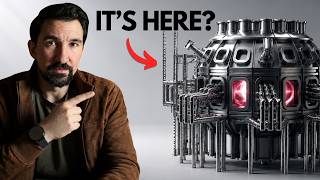

Fusion plant applies to US grid for first time
45sThe historic milestone of a fusion company filing for grid connection, despite not yet achieving practical fusion, creates immediate intrigue and debate.
▶ Play Clip"Title accurately reflects the historic filing; video delivers on explaining the breakthrough and context."
Commonwealth Fusion Systems (CFS) has filed the first-ever interconnection request to connect a fusion reactor to the US power grid, targeting 400 MW in Virginia by the early 2030s. The key breakthrough is a high-temperature superconducting magnet (YBCO) that achieved 20 Tesla, enabling a much smaller and potentially economical reactor design. While fusion has been perpetually 20 years away, this filing suggests a concrete timeline may finally be emerging.
On April 28, 2026, CFS became the first fusion company to apply for an interconnection slot to connect a fusion reactor to the US power grid. The proposed plant, ARK, aims to deliver 400 MW to Chesterfield County, Virginia.
Fusion requires three conditions simultaneously: plasma temperature of 100-150 million °C, sufficient density (via magnetic confinement), and long confinement time. Lawson's triple product (temperature × density × confinement time) defines the threshold for net energy gain.
Since the 1960s, the achieved triple product has increased by three orders of magnitude. The National Ignition Facility (NIF) has crossed the barrier multiple times, but with low wall-plug efficiency (under 1%).
In December 2022, NIF achieved net energy gain at the plasma (3.15 MJ out from 2.05 MJ laser input), but the lasers required 400 MJ from the grid, resulting in under 1% wall-plug efficiency.
Fusion power output scales as the fourth power of the magnetic field. Doubling the field yields 16× output; tripling yields 81×. This makes high-field magnets the 'silver bullet' for compact, economical fusion.
For 60 years, conventional superconductors (niobium-titanium) capped magnetic fields at 12-13 Tesla. To increase power, reactors had to be larger, leading to projects like ITER (€20B+, 23,000 tons, 840 m³ plasma).
In September 2021, MIT and CFS tested a high-temperature superconducting magnet (YBCO) that reached 20 Tesla, a world record. YBCO can superconduct up to 90 K, allowing much higher current before quenching.
The 20 Tesla field enables fusion performance equivalent to ITER in a machine 40× smaller (20 m³ plasma vs. 840 m³). This makes the reactor cheaper, faster to build, and suitable for volume manufacturing.
In September 2025, the SPARC toroidal field magnet was independently validated by a DOE review panel. First plasma is targeted for 2026, net energy gain (Q>1) for 2027. The first of 18 coils was completed in January 2026.
In April 2026, CFS filed an interconnection request with PJM for the ARK reactor. Google and others have signed offtake agreements. The interconnection study takes 4-6 years, targeting grid power by early 2030s.
CFS CEO Bob Mumgaard states fusion is now an engineering problem, not a science problem. The magnet was destructively tested to know its limits, trading money for fast learning.
Fusion has moved from 'mythic tech' (unknowable timeline) to 'deep tech' (knowable challenges with scopes and timelines). Remaining challenges (tritium, neutron damage, remote maintenance) are hard but no longer mythic.
For the first time, fusion has a concrete regulatory filing and a plausible path to grid connection. While challenges remain, the YBCO magnet breakthrough has transformed fusion from a perpetually distant dream into an engineering problem with a timeline.
What is Lawson's triple product?
The product of plasma temperature, density, and confinement time; the threshold for net energy gain in fusion.
01:30
What temperature must fusion plasma reach?
100-150 million °C, about 10 times hotter than the core of the sun.
01:30
What was the wall-plug efficiency of NIF's 2022 net energy gain?
Under 1% (400 MJ input for 2.05 MJ laser light).
05:30
How does fusion power scale with magnetic field?
As the fourth power of the magnetic field (doubling field gives 16× power).
07:00
What was the historical ceiling for conventional superconducting magnets?
12-13 Tesla, using niobium-titanium alloys.
09:00
What material did CFS use to achieve 20 Tesla?
Yttrium Barium Copper Oxide (YBCO), a high-temperature superconductor.
11:00
How much smaller is SPARC's plasma volume compared to ITER?
40 times smaller (20 m³ vs. 840 m³).
13:00
When did CFS file the interconnection request for ARK?
April 2026.
17:00
What is the target year for first plasma of SPARC?
2026.
15:00
What does Bob Mumgaard say is the key difference between science and engineering problems?
Science problems may have no solution (mother nature says no), but engineering problems have a pathway forward.
19:00
Historic Filing Announcement
First time a fusion company has applied to connect to the grid, marking a potential turning point.
20 Tesla Magnet Test
World record magnet test that could shrink fusion reactors 40x, making them economically viable.
11:00Fusion is Now an Engineering Problem
Bob Mumgaard's statement that fusion has moved from science to engineering, implying a solvable timeline.
19:00[00:00] This is a copy of a set of documents that has never existed before. On the 28th of April of 2026, Commonwealth Fusion Systems became the first fusion company in history to apply for an interconnection slot to connect a fusion reactor to the US power grid. The proposed plant, the fourline power station, is scheduled to deliver 400 megawatt to Chesterfield County, Virginia, currently the fastest growing electricity load region in the country, courtesy of the data center boom.
[00:24] The catch is that they haven't actually made Fusion work yet. not in a way that actually matters. So either this is the most premature regulatory filing in the history of energy or it's the moment that fusion stops being a punchline and starts becoming a real energy contender. >> Nuclear power. >> That sounds pretty bullish to know whether it's exciting bullish or totally unhinged bullish. I want to talk about what it took to get us to this
[00:48] point where this paperwork is even possible. So let's start with the easy stuff. Nuclear fusion. Homer, scientific research can solve anything except with fusion. >> Fusion is the reaction that powers the sun. It works because the sun is heavy enough that gravity can crush hydrogen plasma into a tight enough ball that the nuclei collide, fuse together, and release huge amounts of energy. There are three main problems that keep that process a hard challenge on Earth seemingly
[01:12] perpetually 20 years away. The first is that on Earth, we don't have the luxury of the crushing gravity of the sun, so we have to brute force it. In 1955, John Lawson gave us the clearest outline of this challenge called the triple product problem. To achieve fusion, you need three things all to be true at the same time. The plasma has to be hot, somewhere between 100 and 150 million° C. That's about 10 times hotter than
[01:37] the core of the sun. Because the less gravity you've got squeezing the fuel, the more temperature you need to make up for it. The plasma also has to be dense enough that the nuclei actually bump into each other. Again, where the sun gave us that one for free, we typically turn to superconducting magnets to squeeze the plasma together. And finally, it has to stay there long enough for those collisions to happen faster than the whole thing
[02:01] falls apart, called confinement time. Multiply those three numbers together, temperature, density, and confinement time, and you get what's called Lorson's triple product. That's the line that every fusion machine ever built has been trying to cross. Most of them can clear two or three, but very few have cleared all three at the same time. And fun fact, this work by Lawson was produced in 1955 for the Atomic Energy Authority and was almost immediately classified because people believed
[02:25] that the math was too pessimistic to publish. They conceded 2 years later declassifying the paper and the equation has been governing every single fusion program on Earth ever since. That said, for all of the slow grind, the triple product that fusion machines actually achieve has gone up by three orders of magnitude since the 1960s. Now, that's definitely not Mo's law, but considering that we started with that is impossible, let's not talk about it. That's pretty good
[02:49] progress. And now groups like the National Ignition Facility have shown multiple times that the barrier can be crossed and fusion can be achieved. But that brings us to our second problem. Just how much energy went into actually achieving it? I'll answer that. But first, I have to thank today's sponsor, Short Form. Every video on this channel starts broadly the same way. Me somewhere between a stack of papers and a half-finished coffee trying to work out what
[03:13] is actually true and what's just noise. And Short Form is genuinely one of the tools I lean on to do that. Short Form is the world's largest library of expert written guides. Basically, a smart structured breakdown of the best books, papers, and ideas designed to actually teach you something rather than just summarize it. They cover science, technology, and psychology, and a lot else. And a new guide drops every week with subscribers actually getting to vote on
[03:37] what gets covered next, which is a nice change from being shouted out by an algorithm. They have expanded well beyond just books. There are article guides, podcast summaries, master guides that synthesize entire fields, and the kind of thing I reach for when I'm trying to get from I've heard of this to I actually understand the mechanism in just one afternoon. There's also a browser extension that will summarize articles, emails, and even YouTube videos with one click,
[04:01] which has quietly become the thing I use most. If you're interested, go to shortform.com/dbam. get a free trial and $50 off the annual plan. Thank you to Short Form for supporting the channel. Now, back to the video. This is where a lot of the public confusion and maybe distrust actually lives. In December of 2022, the National Ignition Facility, which uses a laser array to initiate fusion, fired 2.05 megajou of laser light at a pellet of hydrogen
[04:26] and got 3.15 megaj of fusion energy out. That is net energy gain. And every front page in every newspaper ran this breakthrough. The bit the front pages didn't necessarily so clearly run which we talked about on this channel before when it happened was that N's lasers needed roughly 400 megajou of electricity from the wall socket to produce these 2 megajou of laser power. This means that the wall plug efficiency was under 1% which as the story
[04:50] was slowly better explained left a bad taste in people's mouths that made it seem much more like we had made a very complicated toaster oven. not a method of actual unlimited energy generation that we were promised. So the obvious question is can we actually make fusion power useful? And what's the actual path to fusion that means that we could plug it into the power grid? Roughly there are two options. One is what the NF does. Blast
[05:14] a pellet of fuel with the most powerful lasers on Earth to make the fuel implode faster than it explodes and get fusion in a millionth of a second, a process called inertial confinement. The other is what programs like Eater or Spark, which is run by Commonwealth, and what basically every other serious commercial player is building, which is magnetic confinement. In magnetic confinement, the plasma is held in midair by enormous magnetic fields, twisted around the inside of
[05:38] a donut-shaped chamber called a tokamac. No physical container could survive a 150 million°. So, the magnets do a lot of work here. They squeeze the plasma to increase its density and they hold its shape and keep it from touching the walls so that the whole reactor doesn't instantaneously melt down. And specific to our question of how do you actually get more energy out than you put in? Energy gain in magnetic confinement is particularly promising. And that's
[06:02] because fusion power output scales as the fourth power of the magnetic field. So if we can double the power of our magnets, you get 16 times the output power from the same volume of plasma. If you triple it, you get 81 times the output. That is by a long way the closest thing to a silver bullet in fusion physics that we will ever find. Find a way to push the magnetic field higher and you get exponentially
[06:26] greater energy gap. This is why a very major component of the fusion industry has spent six decades chasing one number. That one number is the field strength of those magnets. Which brings us to a problem. For most of recent human history, magnet strength has had a ceiling. The same ceiling basically for 60 years. The magnets used to create these ultra high field strengths in fusion are superconducting electromagnets. That means they use superconducting coiled wires around a
[06:50] former then cool them to cryogenic temperatures. So their windings can carry current with zero electrical resistance. However, these wires have a sweet spot. And if you push too much current through them or let the field around them climb too high, the superconductivity collapses. The alloys that Fusion has had access to since about the 1960s, mostly nobbium titanium, hit that magnetic field edge at a window of about 12 to 13 Tesla. If you go any higher, then
[07:15] the resistance suddenly snaps back into effect and the coil dumps all of its energy as heat in a few milliseconds and you've got what engineers politely call a quench and what everyone else calls a loud, traumatizing self-destruction, which generally is to be avoided. So if your field is capped, the only dial left to turn is volume. Because the bigger you can make your reactor or your plasma, the more fusion power you can get out. This is
[07:39] why the field's flagship project ended up the size of a small office building €840 m of plasma contained in 23,000 tons of a machine. But annoyingly, there is a slight caveat. Eater originally was going to cost 5 billion and produce first plasma in 2020. Current estimates however put it at over 20 billion euros with first plasma scheduled for 2033 with four dutarium tritium operations scheduled for 2039. This flagship like many flagships in the world of nuclear
[08:03] is decades late and four times over budget. The good news is Eater will probably work. The science is going to do genuinely useful things. But even if it works perfectly, this isn't a commercial machine and was never intended to be. It is purely for research and its costs now mean that it could never deliver grid usable energy at a reasonable price despite being one of our biggest bets in the space. And that is kind of where
[08:27] we got stuck. Either big plants with economics that scale out of control or small plants with less advantageous physics. That's where we've been for about 60 years until something changed that ceiling itself. I juiced it up a little. In September of 2021, just before sunrise, a team at MIT and Commonwealth Fusion Systems tested a new kind of magnet. Instead of the conventional low temperature superconductors Fusion had used since the 60s, they wound their coil with high
[08:51] temperature superconducting tape called Yitrium Barryium copper oxide or YBCO. This is part of a family of materials called Rebco or rare earth barryium copper oxides. And why it's interesting is because the old superconductors, things like nobbium tin or nobium titanium, which is what it uses, only superconduct below about 4 Kelvin, basically the temperature of liquid helium. Rebco superconductors though can superconduct up to about 90 Kelvin, warm enough that you can cool it with liquid nitrogen instead.
[09:15] Now, in practice, fusion magnets still run Rebco much colder than that, about 20 Kelvin, and that allows them to push the current limits much higher. But that headroom is important. It allows you to pump vastly much more current through before your superc conductivity collapses. The disadvantage of using this material is that it is typically a brittle ceramic and it can't be drawn into a round wire. So instead, it's deposited into flat metallic tape and the coil
[09:39] is wound from stacked layers of that tape. On that morning, in their very first test, the MIT team called this stacked magnetic coil to about 20 Kelvin, ramped it up, and hit 20 Tesla, a world record. And because fusion power scales with the fourth power of the magnetic field, the 20 Tesla on the spark design could give fusion performance equivalent to Eater, but on a machine that is 40 times smaller. The plasma volume in the spark
[10:04] reactor will be just 20 cubic m compared to EA's 840. This was the equivalent to the fusion field small modular reactor moment. And small volumes are interesting because they are cheap, faster to build, and they're replicable in series. The kind of thing that you can put into a production line and actually unlock volume manufacturing. That meant that for the very first time, Fusion started to have a technoeconomic model that an economics committee or an investor could
[10:28] actually recognize. But how do you get from a magnet on a test bench to a power station with a postcode? The answer is very slowly, methodically, and with a Department of Energy review panel parked over your shoulder. It can only be safely contained in a magnetic field. >> In September of 2025, 4 years after the original 20 Tesla test, the spark scale tooidal field magnet was independently validated by a DOE review panel. And I appreciate that
[10:52] that sentence sounds just about as exciting as a bureaucratic tickbox exercise, but it means that CFS and MIT aren't just plucking numbers out of thin air, and that this is now a validated result that starts to look like it might actually be possible. And that starts to peique the interest of grid operators and utility companies that can't not only afford to ignore it, but also think ahead on 10 to 20year time scales, which we'll come back
[11:16] to in a second. Now, this year in January of 2026, the first of 18 toidal field coils for the spark reactor was completed. A TOKAC needs 18 of these coils, and each one is wound from the same Repco tape. So, CFS at this point still had 17 to go, but all indications are they are making good progress. Once this is complete, their timeline from here is aggressive. First plasma, the moment that the machine switches on and
[11:40] produces a plasma at all, is targeted for later this year, 2026. Net energy gain, a Q greater than one at the plasma, is targeted for next year, 2027. It is worth pointing out here that these are very ambitious. Historically, every new fusion machine in history has needed somewhere between 10 to 15 years after first plasma to reach peak performance. This is an ambitious timeline. >> I haven't even begun to peak. And when I do peak, you'll
[12:04] know. >> Beyond Spark, there is ARK, the first commercial reactor from Commonwealth and the one that is causing the current commotion. Last month, in April of 2026, Commonwealth filed an interconnection request with PJM, the grid operator that runs the largest wholesale electricity market in the United States, serving 67 million people across 13 states. And they asked them, for the very first time in history, to plug a fusion reactor into the grid. Now, ARK hasn't even been
[12:28] started yet, but the filing aims to connect it into Virginia's data center corridor with Google and any already signing offtake agreements, which are legally binding long-term contracts between an energy producer and a customer, the Offtaker, to purchase or sell a significant proportion of the project's future output. This interconnection study by PJM is scheduled to take four to 6 years to complete. And the reason that Commonwealth are filing this paperwork now is because they believe by the
[12:53] early 2030s we will have deliverable fusion energy that can be supplied to the grid. Which sounds like a great and optimistic story. But do we believe it? How do we know that these magnets are in fact the last breakthrough that was needed and now finally we can realize fusion power? Or are we in a position much like we have been many times before with fusion that some promising breakthrough still has left us another frustrating 20 years
[13:17] away? Well, to find out, I thought I'd just call up Commonwealth and ask. >> Really important for people to know that fusion is not a science project anymore. The first mission of Spark from day one is going to be sprinting to getting to Q greater than one. So, the whole operations plan and the commissioning and all the turnon is based off of getting to that point as fast as possible. sort of like a that's a qualitative
[13:41] difference between us and a lot of the other machines that have turned on is those machines really did have a big science component first where they did a whole bunch of you know things that we actually very useful right there's a whole bunch of the knowledge that we are built off of on as the tokamac principle is because we had all these devices that came before us and did all those preparatory science work and so that
[14:05] science has been done now and now it's really about engineering um but the difference between a science science problem and an engineering problem. You know, if you have a science problem, sometimes the answer might be like mother nature says no. Uh and there's no pathway forward and then well, you're out of luck. But with an engineering problem, there's so many examples. You look back in history of people saying like, oh, that will be impossible. We talked
[14:29] about airplanes before, right? For thousands of years, like people didn't even conceive of being able to fly. And then for hundreds of years, you know, when early people were trying it, people said, "Oh, that's impossible. We'll never be able to do it." And now we fly around the world all the time. That's the type of class of problem that Fusion is in right now. And a demonstration that we had in 2021 that was a really critical
[14:53] validation that the technology actually worked. You know, we actually took that magnet and even destructively tested it. So, we really really know what the magnets could do, you know, because we we pushed it all the way past failure. And we did that knowingly. It wasn't like, you know, we just like sort of like oops, pressed the wrong button. Like we had a very dedicated test campaign to say, you know, we got to the level of 20
[15:18] Tesla, which is what you need to operate the device, but then we said, okay, let's start, you know, probing and pushing and seeing if we can exceed the parameters in different areas to expand the space what we really know this thing can do. It's kind of like, you know, crash testing a car. You you don't ever plan on purposefully crashing a car, but you'd really like to know what happens, you know, if you did that. It's
[15:42] enabled by ultimately having different funders that are that are able to tolerate more risk. And so like you know I came from academia too and did you know working in grad school on magnets and there was no way that if I was being funded to you know to build a magnet that they would let me just destructively test it afterwards to push the limits. There would have been you know a much longer campaign to you know
[16:06] to to maybe eventually do that but do that over the course of years. And we said, we want results really, really fast. And our investors were okay with us putting, you know, this test article that was several million dollars at risk to be able to learn really fast. And so it's, you know, it's sort of this idea of of trading money for fast learning. And we're very fortunate to have funders who agree with that risk profile
[16:30] and say, "Hey, we're willing to pay a little bit extra so that we can go really, really fast." So, it's a really exciting time to be working on it and I think it's coming. You know, if there's one thing that people could take away is that it's coming a lot sooner than you think. From my side, I see this as a meaningful positive movement towards fusion. But I also have to give some real context about how
[16:54] difficult it is to judge our distance away from realizing it. This is how broadly I like to think about technologies, particularly in the work that I do outside of YouTube. Most things to me fit into one of three categories. The first is shallow tech. The kind of thing that you can prototype in a weekend or afternoon, an app, a platform, a 14th way to deliver food to your door. Useful and sometimes very lucrative, but in my
[17:18] view, not the stuff that necessarily changes the world in a way that I am that excited for. The next layer down, where I spend a lot of my time, is called deep tech. Built directly on fundamental scientific breakthroughs. Things like lithium-ion batteries, crisper or gene editing, and mRNA vaccines. These things inherently have much longer timelines to realize them involve very hard science and probably a lot of failed projects and prototypes. When I'm not on YouTube, I
[17:42] build companies in this space and I also separately run a venture capital fund that invests here. As a consequence, what I have to think about a lot and I'm not sure many deep tech investors necessarily do this is that there is a bottom to this category. And that's important for me to think about because generally when people and institutions are trusting me to spend their money and make good picks, they want to be still alive and
[18:07] around when these picks actually make a return. So there is an impetus to make sure that we are backing things that can traverse some sort of difficult trajectory across a knowable time scale. The alternative obviously is that we are throwing money down a bottomless pit and we never know when something good will come as a result of it. If you don't have clarity on that, then you are in a category below called mythic tech. Mythic tech
[18:31] is a set of technologies that will obviously be solved at some point between now and the heat death of the universe, but where nobody, including oftentimes the people building the things, can tell you exactly when. Fusion has been sitting in this category for 60 years. And the defining feature of it isn't difficulty. It's that the timeline is largely unknowable. We have a lot of famous technology examples that made this jump. Crisper, the ability to edit genes,
[18:55] was discovered in 1987, but it looked structurally impossible to reproduce in humans, and it fell firmly in the mythic tech territory. It took until 2012 when DNA and Sharpentia showed that the bacterial immune mechanism could be repurposed as a programmable gene editor with the creation of crisper cast 9. At that point, suddenly there was a traversible innovation timeline that could generate real products. With the first treatment being casi, a single dose gene therapy for cickle cell
[19:19] disease approved by the FDA in December of 2023. This disease has shaped human history for thousands of years. Now potentially, it has been cured with one single infusion. Just 11 years from paper and discovery to product, which brings us back to fusion. For 60 years, fusion has had every defining feature of mythic tech. The physics has been settled since the 1950s. We've known what conditions a plasma needs to hit to release more energy than you put
[19:43] in. The question is, are these magnets the last milestone that give fusion its deep tech moment? There are absolutely still challenges to tackle. From tritium production to neutron damage to remote maintenance and closing the fuel cycle, these are all real and they are all hard and they will take years, but none of them are mythic anymore. They all have scopes and costs and timelines. For 60 years, fusion has been the technology that has always been 20
[20:07] years away. In April of 2026, for the first time, somebody filed paperwork that suggests that that might not be true anymore. Guys, thank you so much for watching the video. If you would like to see the full interview I did with Commonwealth, I will leave it over on the YouTube members and Patreon sections. Thank you as always for supporting us. I'll see you next time. Goodbye. >> Know the old saying, out with the old, in with
[20:31] the nucleus.
⚡ Saved you 0h 20m reading this? Transcribe any YouTube video for free — no signup needed.