
Overwhelmed by Jazz? Start Here
45sRelatable pain point for beginners hooks viewers immediately.
▶ Play Clip"The title promises a simple explanation for a typically complex subject, and the video delivers by breaking down the 2-5-1 progression, scales, chord tones, and melodic resolution in an accessible way."
This video provides a beginner-friendly, step-by-step approach to jazz improvisation. It demystifies the process by focusing on the essential components: understanding chord progressions, scales, chord tones, and the concept of resolving melodic lines to chord tones.
The video addresses common feelings of being overwhelmed and unsure where to start with jazz improvisation.
The most common chord progression in jazz is introduced: D Minor 7 → G7 → C Major 7, known as a '2-5-1' in the key of C major.
All three chords (Dm7, G7, Cmaj7) share notes from the C major scale, so playing that scale is the simplest way to get 'right notes' over the progression.
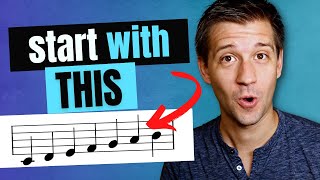
To better differentiate the chords, play the C major scale but start and end on the root of each chord: D (Dorian for Dm7), G (Mixolydian for G7), and C (Ionian for Cmaj7).
The most important notes for improvising are the chord tones (root, 3rd, 5th, 7th). Using just these makes the chord changes 'pop out' in a solo.
Jazz musicians don't just use the major scale; they effectively use the chromatic scale, meaning any note is available. The key is how they resolve those notes.
The secret of jazz is not playing scales but creating melodic lines that resolve to chord tones (especially the 3rd and 7th) using half-steps or 'enclosures'.
An actual jazz lick is broken down, identifying which notes are chord tones and which are chromatic passing/resolution tones, showing the principle in action.
To start creating your own lines, practice composing with these principles and, crucially, learn licks and solos from great jazz musicians by ear.
Jazz improvisation isn't about random notes or just scale patterns. It's about understanding the underlying chord tones and using chromatic and diatonic notes to create melodic resolutions, ultimately making the chord changes come alive in your solos.
What is the most common chord progression in jazz called?
The 2-5-1 (two-five-one) chord progression.
0:48
In the key of C, what are the chords in a 2-5-1 progression?
D Minor 7 (ii), G7 (V), C Major 7 (I).
0:29
What is the parent key center for D Minor 7, G7, and C Major 7?
C Major.
1:43
What is the formula for a minor seventh chord?
Root, flat 3, 5, flat 7.
6:25
What is the formula for a dominant seventh chord?
Root, 3, 5, flat 7.
6:28
What is an 'enclosure' in jazz improvisation?
Approaching a target note (usually a chord tone) from a half step above and a half step below.
12:09
The real jazz scale is the chromatic scale
This reframes the entire approach: any note is available, and it's how you resolve it that matters.
8:06Resolve to chord tones, don't just play scales
Switching the goal from playing the correct scale to crafting melodic resolutions is a key insight that transforms improvisation.
9:44Chord tones are the most important notes
Prioritizing chord tones (especially the 3rd and 7th) is the structural foundation of a coherent jazz solo.
6:02Learn jazz as a language by ear
Emphasizes that true fluency comes from listening and imitating (transcribing), not just theoretical knowledge.
16:33[00:00] If you've ever felt overwhelmed by Jazz
[00:03] started today I'm going to show you exactly how
[00:08] the right direction coming up okay so if you're
[00:14] sidelines on getting into jazz it can seem
[00:18] complicated so what I want to do for you today is
[00:24] essential building blocks that will help you start
[00:29] look at this chord progression which is D Minor 7
[00:48] in the key of C major okay a two five one
[00:57] entirely understand what that means right
[01:02] is the most common chord progression that will
[01:07] the vehicles in which Jazz musicians use to
[01:14] progression you need to master so we're going to
[01:20] two five one because this is going to get you
[01:26] general so the natural first question is what
[01:35] to make things really simple what you do need
[01:43] the same notes that are within C Major seven so C
[01:50] and the parent key Center has a scale and in this
[01:59] and a lot of us know our major scales pretty
[02:08] very simple way for you to understand just
[02:13] of what notes we can choose over this chord
[02:18] ng7 all share notes within the c major scale
[02:25] play the c major scale over top of the 251 chord
[02:37] okay now listening to that obviously
[02:44] right the G7
[02:51] and then of course the C Major seven those are
[02:58] nothing that's actually wrong however listening to
[03:05] changes come out and something that you understand
[03:09] jazz musicians sound so great is they're able to
[03:17] differentiate a little bit let's go on to the next
[03:23] call the modes of the major scale and in this
[03:30] G7 is mixolydian and then for C Major seven is
[03:37] don't worry about that because it's very simple
[03:45] notes as the c major scale so all we're going
[03:51] C major scale but starting on the D note over top
[03:59] okay so it's the c major scale starting and
[04:09] it's just a fancy name for the second mode of the
[04:16] major scale on the second tone all right and then
[04:21] going to start and end on the fifth tone of the
[04:30] okay and then ionian is really just a
[04:38] major scale so the c major scale
[04:47] their perspective root of each chord
[04:58] so already immediately we have
[05:02] can actually hear the chords a little bit better
[05:05] coming out and differentiating each other
[05:15] c major scale and another thing to notice is
[05:21] and that's because eighth notes is a really
[05:26] so we want to get really good at playing swung
[05:31] course because that is very common for us to see
[05:37] is that this still isn't the best solution for
[05:44] seven the G7 and the C Major seven it's still
[05:52] so what we have to start doing when we're given
[05:57] start breaking it down a little bit for further
[06:02] important notes and the most important notes are
[06:09] so in our case D minor seven and then g seven
[06:18] that's a Major Seventh right and the formula
[06:25] flat three five flat seven and for the
[06:34] flat seven and for the major seven it's root third
[06:43] doing to get these chord tones is simply looking
[06:51] is every other note in this scale and that is
[07:00] other note in the scale is the chord tones the
[07:05] when we're playing just the chord tones over top
[07:10] so I want to emphasize one more time chord tones
[07:23] tones first before I talk about scales in general
[07:30] it's not that we don't want to know what the
[07:34] us get the chord tones and also it does give us
[07:38] like what other notes can we play outside of the
[07:43] important to the chord so we want to really
[07:48] in the case of this two five one now here's the
[07:53] far that this doesn't really sound sound like
[07:59] couple of Secrets and the first secret is that
[08:06] not even close in fact the scale that they're
[08:13] might sound controversial at first especially if
[08:19] with me really quick essentially a chromatic
[08:25] in western music that you can play in this case
[08:30] sharp D D sharp E F F sharp G G sharp a a sharp
[08:43] we're gonna play the chromatic scale over top
[08:52] so if you're really paying attention here
[08:57] said you can play any note that you want over top
[09:05] and it really can be in fact this is what kind
[09:11] to Jazz sometimes they think that it's just random
[09:17] like we just played here however like I said
[09:23] second secret is they do not play the chromatic
[09:29] major scale like a scale instead we go back to
[09:36] third and the seventh of each chord and instead
[09:44] and that question is how can I use notes that
[09:52] how do I find the right notes that can resolve
[09:57] the chord tones are structural they'll make the
[10:03] scale and every single note in between and the
[10:10] actually have however when we stop thinking about
[10:16] think of what notes can we use to resolve to chord
[10:21] better understand this let's use an example of how
[10:29] what we'll do first is we'll look at resolving to
[10:36] for D Minor is f the third for G7 is B natural
[10:45] I want to resolve to those and a simple way we can
[10:52] of and resolving by a half step to that third
[10:58] technically the key is we're trying to resolve it
[11:04] to resolve to the third let's just say we start
[11:10] scale or the D Dorian mode and arrive to that F
[11:17] could do it now taking a look at the G7 let's move
[11:23] time what we're going to do is use a note from the
[11:29] to go a sharp to B is the third okay and then
[11:36] the e natural which is the third but we're going
[11:40] with a D sharp so if we're going to play this line
[11:54] oh but this is a legitimate starting place for
[11:59] are doing again how are we resolving to those
[12:04] the major scale so let's look at another way
[12:09] in this particular case what we're going to do
[12:15] each chord but what we're going to do instead
[12:22] a half Step Above So if we're encircling the
[12:30] natural F sharp which is above and Pitch to F
[12:39] F sharp is not in the c major scale it is from
[12:44] movement and then let's do the same thing on the
[12:52] and then on the c major we have
[12:57] an E flat an F natural to an e natural okay
[13:04] is called enclosure we call it an enclosure
[13:09] and below our Target note which is again
[13:15] now there's many other ways to approach a Target
[13:26] to just use the third and indeed sometimes
[13:32] ninth as we would call it and you can use more
[13:39] Jazz musicians really become an expert is they
[13:45] to these chord tones so take a listen to this
[13:56] okay and here it is slowly
[14:07] let's identify where the chord tones are so in
[14:12] seven we have an F natural okay the F natural is
[14:21] we have a d natural which is of course the root
[14:28] seven and then on the G7 we have a B natural which
[14:35] have another B natural we have G which is the root
[14:44] the flat seven and then over the C Major seven we
[14:51] a g natural which is the fifth so every other note
[14:59] we're using to resolve to the chord tone so over
[15:05] okay so that g natural again is a note from the c
[15:14] chromatic scale which resolves to the F natural
[15:23] fifth then we go to an e natural which is part
[15:33] note which is the root to a c which is the flat
[15:41] resolving to be natural now we're on our G7
[15:47] tones so we go B natural g b to G which is
[15:57] out playing chord tones now we're gonna do
[16:03] a flat and then chord tones G to F that's
[16:11] the C Major seven with a third that's the
[16:18] so the next natural question is how do I start
[16:28] the notes that you can use and you understand that
[16:33] can start experimenting and composing your own
[16:39] also it's really important that you learn the Jazz
[16:45] great jazz musicians that you love only if you've
[16:50] understand it so I have a video on the screen
[16:55] by ear I give you very simple steps on how to do
[16:59] ahead and click that video on the screen right now
[17:03] that like button make sure you subscribe to the
⚡ Saved you 0h 17m reading this? Transcribe any YouTube video for free — no signup needed.