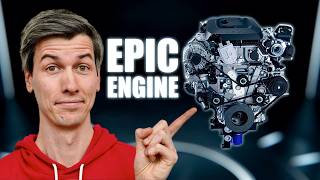

Jeep's F1 Engine Tech?!
44sSurprising that Jeep, not a luxury brand, brings Formula 1 technology to mainstream engines.
▶ Play Clip"Delivers a thorough technical breakdown of an impressive engine—exceeds expectations for a mainstream video."
The video explores Jeep's new Hurricane 4 engine, a 2-liter turbocharged inline-four that uses turbulent jet ignition (TJI) technology derived from Formula 1. It produces 324 horsepower and 332 lb-ft of torque while achieving up to 40.5% thermal efficiency, outperforming many larger engines. The presenter explains the technical details, including the pre-chamber design, Miller cycle, dual injection, and variable geometry turbo.
Jeep's Hurricane 4 is a 2-liter turbocharged inline-four with passive pre-chamber turbulent jet ignition, two spark plugs per cylinder, Miller cycle, plasma spray cylinder liners, dual fuel injection, electric cam phasing, and variable geometry turbo with up to 35 psi boost.
Jeep is the first company to bring modern F1 engine technology (TJI) to mainstream pricing, following Maserati's MC20 Nettuno engine.
During compression, air-fuel mixture enters the pre-chamber. The spark plug ignites it, shooting turbulent jets into the main chamber for fast, complete combustion, reducing knock and increasing power and efficiency.
324 hp, 332 lb-ft torque, 12:1 compression ratio (high for turbo), 35 psi max boost (gauge pressure).
Eight 1-mm radial holes and one 0.5-mm center hole. Holes are angled to avoid piston melting; center hole is smaller because it is closer to the piston.
Pre-chamber holes avoid carbon buildup due to fuel cleaning during compression and extremely high temperatures that burn off deposits.
The engine uses early intake valve closing to increase expansion ratio and reduce pumping losses, especially at low loads.
Brake specific fuel consumption (BSFC) is about 211.5 g/kWh at 100 kW, translating to 40.5% thermal efficiency. This is very high for a gasoline engine.
The Hurricane 4 uses 10% less fuel and makes 20% more power than Jeep's previous 2-liter turbo, and outperforms the 3.6L V6 in power, torque, fuel economy, and acceleration.
Two spark plugs: pre-chamber plug always fires, main chamber plug fires at low loads for consistency and catalyst heating, but is disabled at high loads to prevent damage. Dual injection: port injection at low loads for quiet operation, direct injection at high loads for knock suppression.
The turbo uses variable vanes to control boost, reducing lag. A wastegate is only used for catalyst heating. Max boost of 35 psi is only needed at high altitude or high temperatures to maintain torque.
The Hurricane 4 produces 70% more power than the old 4.0L inline-six (190 hp) and nearly 100 hp more than the 4.7L V8 (235 hp) from early 2000s Jeeps.
Jeep's Hurricane 4 demonstrates that advanced F1-derived technologies can be applied to mass-market engines, achieving remarkable efficiency and power. It sets a new benchmark for mainstream four-cylinder engines.
What is the peak boost pressure of Jeep's Hurricane 4 engine?
35 psi (gauge pressure).
02:36
What is the thermal efficiency of the Hurricane 4 engine at 100 kW?
Approximately 40.5%.
09:39
How many holes does the pre-chamber have and what are their sizes?
Eight radial holes (1 mm) and one central hole (0.5 mm).
03:04
Why is the center hole of the pre-chamber smaller than the radial holes?
To prevent the jet from melting the piston, as the center hole is closer to the piston.
03:45
What are the two methods to prevent pre-chamber hole clogging?
Fuel cleaning during compression and extremely high temperatures that burn off deposits.
04:11
What is the compression ratio of the Hurricane 4 engine?
12:1.
02:36
At high torque scenarios, why is the main chamber spark plug not used?
Because the high heat and pressure would damage the plug, and the pre-chamber alone provides complete combustion.
13:05
What is the benefit of using port injection at idle?
It runs quieter because the high-pressure direct injection pump is not needed.
14:39
How does the variable geometry turbo help at low RPM?
The vanes close to increase exhaust velocity, spooling the turbo quickly.
15:34
How does the Hurricane 4 compare to the previous Jeep 2-liter turbo?
It uses 10% less fuel and makes 20% more power.
10:23
Efficiency Focus
Explains that 40.5% thermal efficiency is exceptional for a gasoline engine and highlights the engine's core innovation.
07:40Real-World Improvements
Quantifies the improvements over previous Jeep engines, making the technology's benefits concrete.
10:23Variable Geometry Turbo History
Notes that this tech first appeared in a Porsche 911 Turbo in 2006 and is now in a mass-market engine.
15:20Historical Performance Leap
Shows a 70% power increase over the old 4.0L inline-six, emphasizing the engine's advancement.
18:00[00:02] four-cylinder engines ever just launched. This engine has a passive pre-chamber with turbulent jet ignition, just like what is done in Formula 1. So, it can make boatloads of power without using much fuel. It uses two spark plugs
[00:19] per cylinder. It's running the Miller cycle. It uses plasma spray cylinder liners, dual fuel injection, electric cam phasing, and a variable geometry cam phasing, and a variable geometry turbo with up to 35 psi of boost
[00:33] pressure. Oh, and it's made by Jeep. Yep, the first company making modern F1 Yep, the first company making modern F1 engine tech mainstream is Jeep. I did not have that on my bingo card, but maybe I should have considering Maserati
[00:49] in the same Stellantis family as Jeep introduced this tech to production cars with the MC20's Nettuno engine. But, it is Jeep that will bring this tech to mainstream pricing. Now, at this exact moment, history nerds are furiously
[01:03] typing. Um Jason, Honda was making pre-chamber engines in the 1970s. Go on, pre-chamber engines in the 1970s. Go on, get it out. Get it out. Okay. This is quite different. We're moving
[01:19] on. All right. So, I had a fascinating chat with Jeep's engineering to learn all about this Hurricane 4 engine. And so, we're going to dive deep into understanding how it works, starting with a quick review of how turbulent jet
[01:32] ignition works. All right. So, like any four-stroke gasoline engine, we start things off with our intake stroke, pulling in air and fuel. In this case, we are using port injection as well as direct injection for the fuel. Then, we
[01:44] of course have our compression stroke. So, we compress that air and fuel. Some of that air and fuel goes within this little pre-chamber, which Jeep was kind enough to send me one to check out. And so then, we have our power stroke. So,
[01:56] our spark plug within this pre-chamber ignites the air and fuel mixture within that, which shoots out these turbulent jets as that combustion occurs, that pour out into the main chamber. And so, as these turbulent jets shoot out into
[02:09] the main chamber, you have very fast, very complete combustion. This reduces the likelihood of knock, and because of that, you get more power, and you get better efficiency. So, looking at the specifications of Jeep's engine here,
[02:22] the Hurricane 4, this is a 2-liter inline four turbocharged engine. It's inline four turbocharged engine. It's producing 324 horsepower and 332 pound-feet of torque. It is using a variable geometry turbo, and it has a
[02:36] max boost pressure of 35 PSI. Yes, that is gauge pressure. Yes, it is bonkers high. And it is using a 12:1 compression ratio, which is quite high for a turbocharged engine. Now, when you start to think about designing this little
[02:51] variables that come into play. So, you have to think about the surface area to volume ratio. You have to think about the number of holes. In this case, there are eight radial holes and one central hole. You also have to think about the
[03:04] diameter of these holes. So, in this case, Jeep is using about 1-mm holes for the radial ones, and then the one in the center is about half a millimeter. Now, Well, you need to think about the energy of these jets, the energy that's going
[03:18] to come pouring out of these jets. So, if it was too high, if it was too much was pointed directly at your piston, you could literally melt that piston. So, design. You have to think about the angle that you have and the size of
[03:31] you're not going to have quite as much energy, it's restricted. Or if you go much energy, you have too much space, center spot of where do we get this to ensure that we have the ideal combustion
[03:45] characteristics we're looking for. Now, as far as why the center hole is smaller than the radial holes on the pre-chamber, we're looking at the distance that that flame has to travel, right? So, if your piston is right
[03:58] want a really strong jet just blasting right into it. So, you use a smaller and then where you have a further distance to travel in the main chamber, then these radial holes are larger, so
[04:11] they have more energy in those jets. Now, you might wonder, how do they ensure these pre-chamber holes don't clog up with carbon deposits? Two comments. First, remember every time we have our compression stroke, we're
[04:23] pressing air and fuel back into this pre-chamber. So, you can benefit from the fuel's cleaning properties as it goes into the pre-chamber. But second, and more importantly, the temperatures in this pre-chamber get so hot, you
[04:35] literally just burn everything off of it. So, it's something you are designing for, but ultimately something Jeep says is not an issue. This portion of the video is sponsored by Motive, who sent me their AI Dash Cam Plus. This advanced
[04:50] dash cam is designed as a safety and operations aid, packed with useful features for use in fleets. For example, two front-facing cameras provide stereo vision. This enables precise forward collision warnings. The front zoom lens
[05:05] supports automated license plate recognition, capturing evidence in the event of a hit-and-run. Sensor fusion combines sensor data to record important events. Say it hears the sound of broken glass, it knows to record in case of a
[05:20] vehicle break-in. And it can provide prompts to the driver to help save on costs. For example, if the engine is unnecessarily idling. And helping enable all of this is a powerful processor that can handle over 30 precise AI models
[05:34] simultaneously, ensuring critical moments are captured accurately in real time with minimal latency. To learn more, check out gomotive.com/dashcam, description. Now, this engine is running the Miller cycle and it is doing so by
[05:50] closing the intake valve early. So, what does that mean? Well, as the piston is on its way down during the intake stroke, you are closing that intake valve before the piston reaches bottom dead center. So, you're closing that
[06:03] intake valve early and then the piston is still traveling downward. Why do you do this? Well, one of the ways is it increases your expansion ratio
[06:15] thing that it does is it reduces your pumping losses. So, let's look at a low load example. Let's say we're at partial throttle, we're trying to make a little bit of power, and so during this, we're going to have a short cam duration. This
[06:28] is Miller cycle all the time on this engine. It is always running early variable cam timing, but it's always going to be closing that intake valve early. Now, what happens is you close it early and so that means you have a less
[06:42] you have less time to fill up that your throttle a little bit more in order to get sufficient air in it. So, the more you open the throttle, that reduces your pumping losses. So, you're forcing
[06:56] throttle than it normally would have to, and in doing so, that improves pumping losses. Amazing. Now, by running the Miller cycle in combination with TJI, compression ratio. Again, 12 to 1 for a turbocharged engine is quite high,
[07:11] especially considering how much power this is making, and overall that high compression ratio means we get better efficiency. And that really gets into the heart of why this engine is so impressive. It isn't simply because it
[07:24] makes a lot of power. And don't get me wrong, 324 horsepower is a lot for a mainstream mass-market 2-liter. But, there are some niche 2-liters out there making more power. What makes Jeep's engine so impressive is not only does it
[07:40] make a boatload of power, but it does so very efficiently. And so this brings up very efficiently. And so this brings up BSFC or brake specific fuel consumption. All right, so brake specific fuel consumption is a ratio of how much fuel
[07:55] do you have going in versus how much power is coming out. So the lower the number the better because that means you're making more power with less fuel. So brake specific fuel consumption here you have the math if you're curious
[08:07] where the units come from. You have your mass flow rate over your brake horsepower. That's grams per hour over kilowatts or grams per kilowatt hour. So we're looking at a graph here of our brake specific fuel consumption versus
[08:19] how much power our engine is making. And so this is like a big scatter plot, say if this engine is making 100 kilowatts of power, what is its then you would get a little point on this plot right here. And so if you do
[08:33] there or a lot of the mainstream four cylinders out there which Jeep did and they provided this plot, you can get this range that you can see these four cylinders tend to fall within as far as their brake specific fuel consumption
[08:46] And what's really impressive about Jeep's engine is that it basically just traces the bottom line of this plot. So it means it's as efficient as possible compared to today's modern engines in terms of efficiency for making a certain
[09:01] amount of power. All right, let's look at this plot and just grab an example to get a bit of a better understanding of it. So let's say we want to understand what our brake specific fuel consumption is when our engine is producing 100
[09:13] right here and that's our point. And so that gives us based on this plot that Jeep provided about 211.5 grams per kilowatt hour as far as our brake specific fuel consumption. So how do we convert this into thermal
[09:27] efficiency so we can understand what that number means. How efficient is this engine really? Well, efficiency power out divided by the energy that you're putting in, the rate at which you're putting in energy, or one over our brake
[09:39] the lower heating value. We do the math right there, and that gives us an efficiency thermal efficiency for this engine while producing 100 kilowatts of power of about 40.5%. Now, there are a couple of assumptions
[09:53] accurate, and then assuming the lower heating value of gasoline mixed with a 10% ethanol is about 42 megajoules per kilogram, but this number right here, 40.5% is very, very, very good for a gasoline
[10:09] engine. It is incredibly efficient for a gasoline engine. And just to further reiterate how impressive what this engine is doing is, it's using 10% less engine is doing is, it's using 10% less fuel while making 20% more power than
[10:23] Jeep's 2-liter turbo they're currently using in the Wrangler. And versus the Jeep Grand Cherokee using the 3.6-liter V6 engine, this has more power, more torque, better fuel economy rating across the board, and it's about a full
[10:38] second quicker zero to 60. It's just better. Okay, so now let's move on to why it has dual spark plugs as well as dual fuel injectors, starting with the plugs. All right, so let's get an understanding of the overall layout. If
[10:51] you were to shrink yourself down and stand on top of this piston and look up course your two intake valves, your two exhaust valves, then there in the center you would see the pre-chamber, and of course housed within this pre-chamber is
[11:04] another spark plug that is firing for the main chamber. Then you have a direct injection here on the left, and you also have port injection. So, two fuel injectors, two spark plugs, why do you use two spark plugs? Well, a couple of
[11:19] rules here. We're going to look at a plot of torque versus engine rpm and see but a couple rules. First of all, the pre-chamber spark plug is always firing. Second of all, you always want some stagger between when you fire one plug
[11:34] because you want to have some leading form of combustion. You want to have something predictable. You want to, you know, choose what mechanism do I have that is igniting this air-fuel mixture. You're not firing both at the same time
[11:46] you're always going to have the pre-chamber firing, but when it fires differs and you want to make sure that these fire at different times. So, let's work in some of the scenarios. If we're at a low load here and, you know,
[11:59] various engine RPM or you're heating up your catalyst, for example, well, then you're going to have the main chamber lead. And so, at these low loads, you don't have a ton of air and fuel in this mixture, right? In this chamber that's
[12:11] all mixed up. So, and it could be inconsistent and you're relying on that mixture getting inside of this tiny little pre-chamber and then hoping that you have consistent combustion. So, because of that, you just use the main
[12:23] chamber spark plug to fire it, then shortly after you fire the pre-chamber spark plug. That gives you better consistency, better catalyst heating, emissions aspect of the consistency of that pre-chamber firing. Now, as you
[12:37] start to get into higher loads, then you start to have plenty of air and fuel this pre-chamber, so it's no worries, and then you have the pre-chamber leading and then shortly after you have that main spark plug for the main
[12:50] mechanism for igniting the mixture, of course, in that scenario is the pre-chamber rather than the main chamber plug, which we had at lower loads. And scenario. So, when you're trying to make as much torque as possible, you're just
[13:05] pre-chamber to ignite that air-fuel mixture. You are not using that main plug at all. So, why? Well, there's a couple of reasons for this. Remember, one thing that we always have to do is have some delay between when one spark
[13:19] plug fires and when the other fires. But, at these really high torque scenarios, we're having this air-fuel mixture ignite very quickly. And so if you have just a small delay, well it means you've already got really high
[13:32] heat and really high pressure within the cylinder and then this spark plug is firing against that really high heat and really high pressure. And so because of that, it actually reduces the life of that plug. It's not a great scenario to
[13:45] have that plug igniting. And so there's minimal benefit first of all because the igniting all of that air and fuel mixture and then second of all, you can damage your main plug if you have it igniting in these really high temps and
[13:58] really high pressures. So, no reason to use it in that scenario, so it is just pre-chamber. All right, moving on to port and direct injection? So, we're going to look at a similar plot here of
[14:11] torque versus engine rpm and just work through some of the scenarios. When you to heat up your cat, that's the most going to be having late combustion and in doing so, direct injection gives you
[14:24] they're going to be using more direct injection, less port fuel injection. Then once your engine is warmed up and you're just idling or at very low loads, with port fuel injection. Port fuel injection is at a much lower pressure.
[14:39] As a result, you don't have to hear that direct injection pump and so the engine runs much quieter. So, when you're just sitting there idling at a stoplight or at a stop sign, whatever it may be, the engine will be really quiet while using
[14:51] into your highest loads, you start to become more dependent on direct fuel injection. And that's because direct injection improves the knock characteristics of combustion and so you can have more power and more power at
[15:05] greater efficiency. So, there's a lot of innovative technology used on this engine and on the subject of innovation, Porsche launched a new 911 Turbo in 2006, which was the first time a gasoline production car used variable
[15:20] geometry turbos. And now, 20 years later, we get to see that tech make its way down into mass market engines. How cool is that? All right, so a quick review of how variable geometry turbos work. So, within the exhaust portion of
[15:34] the turbocharger, you have these vanes, and these vanes can open or close. And so, as you close them up, you're creating restriction. And so, by doing so, you're speeding up those exhaust gases, and thus you're going to spool up
[15:47] that turbocharger very quickly as the exhaust velocity is very high. Now, that is at the cost of reducing your exhaust flow. So, if you want to reduce the restriction in the exhaust, you open up these vanes. And so, then it acts much
[15:59] like a large turbo, rather than acting like a small turbo. And so, in this case, you have less energy going into spooling up that turbocharger. And in fact, you can use variable geometry turbos. I did not know this. You can use
[16:12] them without wastegates, because you can essentially just use the direction that the vanes point towards in order to determine how much boost you set. So, you don't have to rely on a wastegate to bleed off excess pressure. They still do
[16:24] use a wastegate in this scenario on the Jeep engine, but it is purely for heating up the catalytic converter. So, when you just start off the engine, you bypass [clears throat] your turbo essentially, and have that exhaust just
[16:37] rather than putting energy into the turbo. So, there is a wastegate, but you don't need it at these high loads. And those cases, you just open up the vanes fully, you're basically just going to have so much exhaust flow that you're
[16:51] restricting the speed of that turbo, and thus your boost comes down. Now, I mentioned this engine has a peak boost pressure of 35 psi, which, yes, is bonkers high. But, there's some context that you need here, because that is the
[17:06] peak pressure that the engine will ever see. That is going to be very, very rare running with that much boost. First of all, because you're not always flooring it, but second of all, let's say you're at sea level and it's cool ambient
[17:19] temperatures, you don't need 35 PSI of boost to make that 332 pound-feet of higher elevations where the air is thinner, or as temperatures really climb
[17:31] oxygen going into the engine, well, then you can compensate with this engine by increasing the boost, and by increasing the boost, you make more power. So, at sea level, cold temperatures, no, you're not going to be hitting 35 PSI. That is
[17:45] the peak in scenarios where it can't otherwise make the desired torque output. Now, I just want to close out with a fun anecdote, because when I was in college, one of my roommates had a Jeep Cherokee XJ, which had a 4-liter
[18:00] Jeep Cherokee XJ, which had a 4-liter inline six-cylinder engine that made 190 horsepower. And here we are with an engine half that size making 70% more power. I mean, this is quite cool. Another example, my other roommate, I
[18:15] guess they just like Jeeps, my other roommate had a Jeep Grand Cherokee, roommate had a Jeep Grand Cherokee, which had the 4.7 liter V8 engine. A V8 engine which was making 235
[18:27] horsepower. So, this four-cylinder is making nearly 100 horsepower more than the Jeep Grand Cherokee back in the early 2000s with the 4.7 liter V8. Unreal. And for those wondering, yes, this new engine has the structural
[18:42] enhancements to handle the additional power. And worth mentioning, even though this is making a lot of power per liter, it's still significantly lower power per liter than its relative in the Maserati MC20, which is also using TJI. The Jeep
[18:58] engine is focusing on efficiency as much as it is focusing on power, and it does a great job at both. Crazy, crazy. If you have any questions or comments, feel free to leave them below. Thanks for watching.



⚡ Saved you 0h 19m reading this? Transcribe any YouTube video for free — no signup needed.