
Inside the Whale: The Horrifying Set
45sThe bizarre premise and description of a slimy, claustrophobic whale stomach set will intrigue viewers.
▶ Play Clip"The title promises an inside look at the film, and the interview delivers, though it's padded with typical promotional banter."
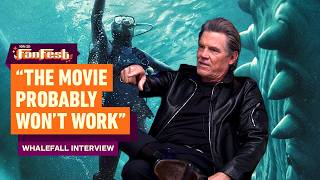
In this interview, IGN's Akeem Lawanson sits down with the cast and creative team behind the film 'Whale Fall,' including stars Josh Bolin and Austin Abrams, author and co-writer Daniel Krauss, and director and co-writer Brian Duffield. The conversation covers the challenges of filming inside a whale set, the research behind the film's unique setting, and the emotional father-son dynamics at the heart of the story.
The interview features Josh Bolin, Austin Abrams, author Daniel Krauss, and director Brian Duffield discussing the film 'Whale Fall.'
Austin Abrams describes the 360-degree set built for the whale interior, filled with slime and extremely slippery, creating a claustrophobic atmosphere.
Brian Duffield and the team watched autopsies of beached sperm whales and endoscopies of beluga whales and dolphins to recreate the whale's insides accurately.
Austin Abrams explains the intensity of acting inside the whale, with crew members squishing the set to simulate movement, making the experience feel intense and claustrophobic.
Josh Bolin discusses the personal reticence between him and Austin Abrams, which translated into the film's father-son relationship, enhancing the authenticity of their scenes.
Daniel Krauss and Brian Duffield explain the challenge of adapting the book's internal voice into an external visual narrative, reducing 100+ flashbacks to about five or six key scenes.
Brian Duffield emphasizes the importance of casting and giving actors room to explore, allowing for a more authentic and uncomfortable performance.
The team hopes audiences leave reflecting on their family roles, with Daniel Krauss noting the book's themes of truth and mercy, and the possibility of forgiveness.
Daniel Krauss reveals that some scenes between the father and son are almost verbatim from his own life, making the film deeply personal and emotionally resonant.
The interview highlights the creative and emotional challenges of bringing 'Whale Fall' to life, emphasizing the film's unique setting and its profound exploration of family, forgiveness, and the human condition.
Graphic Research for Whale Set
Reveals the extreme lengths the team went to for authenticity, watching graphic autopsies and endoscopies.
01:31Adapting Internal Monologue to Visual Storytelling
Highlights the creative challenge of translating a book's internal voice into an external film narrative.
05:16Themes of Truth and Mercy
Provides a clear thematic framework for the film, emphasizing forgiveness and family.
09:30Autobiographical Scenes
Daniel Krauss reveals that some scenes are verbatim from his life, adding a layer of personal authenticity.
10:12[00:00] This movie probably won't work. 80% of it takes place inside of a whale. Whale, whale, whale. We're talking about Whale Fall in theaters October 16th.
[00:14] And to do that with me are the stars of the movie, Josh Bolin, Austin Abrams. Thank you so much for joining me. We have the author of the book that it's based on, and the co-writer for the movie, Daniel Krauss. And we have the director and also co-writer for the movie,
[00:28] Brian Duffield. Hey, how you doing? Great. I want to ask first about filming scenes inside of a whale. I'm going to toss it to you, Austin. What was it like? No, I was there.
[00:40] What was it like to be inside of a whale? The set was pretty crazy. Yeah. Yeah, Brian wanted to go about it in the way of building full 360-degree sets,
[00:55] you know, not like just a little bit or half, you know, with a full experience. It was pretty crazy. And what Austin has written out is that it's horrible in there.
[01:07] It was filled with this, like, a meeknessy slime, and it's extremely slippery, and pretty claustrophobic, which all lines up really with a real whale stomach. Yeah.
[01:19] Yeah, that also leads me to ask, What kind of research did you do to recreate the insides of a whale? Do you really know what's inside of a whale? And how did that manifest when you were shooting and making the set?
[01:31] We would watch autopsies of beached sperm whales. And there's a bunch of endoscopies of beluga whales and dolphins that we would watch. And then talk to the experts and see how much of that we could use and how much it would be different than a sperm whale.
[01:49] But, yeah, it was a real weird time in my life where most everything I was watching was very graphic. I just got these autopsies, and my wife was walking around, and I closed my laptop. And she was just like, she knew I wasn't watching porn, so she said,
[02:02] just another autopsy. I'm like, yes, it's my job. It's worse, actually. Yeah, so that claustrophobic feeling is such a key part of the movie.
[02:14] So when you're in there, what are you feeling? What are you thinking? and how intense is that to be in those scenes and act that out? You know, there's all these guys outside of it working, kind of like squishing it to, like, give the effect of it
[02:28] kind of, like, a bit moving and stuff like that. There'll be times where it's like they're all squashing down on you, you know? So, yeah, I mean, it can feel a little bit kind of intense.
[02:42] It's kind of crazy. It's almost like you had your own weird personal ride built for you or something like that. You know what I mean? That never ends. Yeah.
[02:54] Yeah you do the first stomach and then you go to the second one that really extra gooey and then you go up the throat and just yeah it was uh it was it was crazy yeah really crazy so josh i want to ask you about like playing that role and bouncing off of austin
[03:11] when you are doing these scenes and having building that father-son dynamic what was that like it was already just a feeling of discomfort there was always a there is i don't like reticence you know i'm like somebody who gets right in your face and i want to know you and whatever and
[03:26] And there was more reticence on this end, and whether it was reticence because of nervousness around the film, because he's going to be in the film and he's going to have to be there the whole time while I'm just showing up for three weeks and doing my scenes back to back.
[03:40] But the closer we tried to get, the further away we got. And that wasn't just, you know, in the movie. It was personally. I think what we did personally truly lent to the movie,
[03:52] and when I finally saw it, I was really pleased. Yeah. uncomfortably pleased. How has this differed from your other roles? More experimental. I think this role was why I was so taken by when I read his book and I was in Italy doing
[04:05] Ridley's movie and I read the book and I put it to my chest and I wrapped my arms and I just sobbed and I still don't know exactly why. I think I know but why I cried that hard
[04:18] and was so taken by the book and then I was taken by the script and then I was already in once I read the book was like, you know, for thick or thin, whether this movie probably won't work. 80% of it takes place inside of a whale.
[04:32] You know what I mean? And then when you watch it and it works and you're so happy that there's this like invisible tentacle with the people that I've talked to that have seen it that just grabs them, grabs their heart, and it won't let go.
[04:44] So I've had people that have seen it and call me three weeks later and say, I still can't stop thinking about this movie. Yeah, it's kind of like the concept of the whale following kind of lures you in, and then you realize that it's so much deeper than that.
[04:59] And so I want to talk to you guys about how you kind of recreated sort of the chaotic nature of the book, where it's bouncing between flashbacks and the main character stuck in the whale. And so recreating that on screen, what was your guys' dynamic like to make sure that that came across in the movie?
[05:16] I think the two biggest changes probably in the book is just that the book is so internal. It's really in Jay's inner voice, and obviously our movie is very external,
[05:28] and there's no inner monologue going. So figuring out all the information that he's thinking about, how do we do that visually, and a lot of times without dialogue, was an interesting writing challenge. And then I think the second big change was there's probably 100-plus little flashbacks in the novel.
[05:46] And then for us, it's such a tense experience. How do we deploy these scenes with myth kind of throughout, knowing we won't have 100, we'll probably have like five or six. And so it was really fun figuring out how to use those scenes
[05:59] to both illuminate where in the present timeline where Austin character is going through and why he would be thinking of them and then what else later on in the movie he taking from those exact same scenes Yeah the biggest challenge is always the pouring mitt you know
[06:14] What happens in the whale happens in the whale. So that part ports over like really cleanly. And so the rest of it is when's the pouring mitt? How do you do it so it hooks in with Austin's
[06:26] character and gives you the next bit of information that Josh's character needs to impart. For all of you guys working together on this, what kind of conversations did you all have
[06:38] to make sure that you were nailing the right tone and making sure that every scene was exactly what you wanted to be, whether you envisioned it from the book to the screen or you asked the director? Yeah, I'm a real tone nut.
[06:52] Like, that's definitely one of the things I'm most passionate about in terms of writing and directing. But, I mean, I think, too, so much of that is you just cast right, I think. And, you know, having these few guys that are coming to the table with ideas
[07:09] and, like, hopefully, like I said, like, giving them room to find it so that they don't feel like dolls and I'm just moving around and, you know, telling them to say the line and leave kind of thing. But, like, really having them feel, you know, like I think to what Josh was saying earlier,
[07:24] like, that they can kind of get into the weeds a little bit and that it can be uncomfortable. We were saying the other day, like we weren't really talking about other movies. We were just talking about our own experiences as, you know, Josh and I as fathers and Elvis as sons.
[07:38] And I think there's just little bits of all those relationships kind of in the movie. But I remember talking with you a lot about, you know, when his character's with his family, there's a performance that he's kind of putting on,
[07:50] whether it's trying to let his parents or his mom know that he's not doing as badly as he feels like he's doing, or with his dad. He doesn't really want to be there. He's trying to engage. So playing up that aspect of it with him outside the whale,
[08:03] and then when he's inside the whale, there's no performance. It's less like there's no one who can judge you or think you're cool. You're raw. Selfish, I think, for him is a really challenging feat where he's in that setting for an hour in the movie,
[08:16] but that's him in that uncomfortable setting for two months having to be at that I'm-about-to-die tension level and still finding those values and everything
[08:28] to kind of not make it just a monotonous screaming. Yeah. One thing that you guys want people to take away from this movie when they go see it. Start with you. I remember finishing the book, not dissimilar to what Josh was saying,
[08:42] and just thinking about fathers and sons and those two characters in particular, and then like 30 minutes later thinking about the whale, which is for you know this story is such a bizarre magic trick that I think the
[08:57] most extraordinary kind of story ever but it's such a relatable and emotional thing I just remember every day on the movie I was trying to replicate that feeling of how I felt finishing the book where wanting people to leave looking at their families looking at themselves and then kind of sitting in this later being like oh there some crazy visual effects in that
[09:17] I think what Daniel did such a great job of, of really getting something that really gets its, you know, tentacles into you and really makes you think about your role in the family differently.
[09:30] Well, you know, the book is divided into two sections, right? It's got the first section called truth and the second section was called mercy. And I think that carries over to this film where, you know, what we do to each other,
[09:44] even as loved ones, can be harmful and painful. And that's truth. That stuff, what happens, happens. And then the question of the book and movie is, can you arrive at a place of mercy?
[10:00] You know, can you look at your father who wasn't there for you, your son who wasn't there for the father, and at some point can you get to a point of just forgiveness,
[10:12] even if they don't deserve it. Oddly enough, when I think about the movie, I think about the scenes between these two, because there's so many of those scenes that are autobiographical. Obviously, I was never swallowed by a whale.
[10:24] That's fiction. But there's scenes between those two that are almost verbatim from my life, and there's a scene with you two on the driveway and you're talking about how you thought he was hanging out with you and you're hanging out with your friends.
[10:36] And I think about that scene as filmed by these three every day. Yes, sir, too. I work there for that day. I work there for that day. But I think about that scene every day
[10:48] because it's so painful to me to see it, but there's like a release to see it acted out by these two. I remember that day, too, was funny because a lot of crew members, That was the day. I think we were coming up to both you and I,
[11:02] and we were just kind of being like, this really reminds me of this one time. It was really... I remember it. It was such an uncomfortable scene. But you can also tell, I think, in that scene, that they really do love each other, and they're just kind of bouncing off each other a little bit.
[11:14] Like, Mitch is so excited to hang out with his son, and then kind of just gets a little heartbroken that his son would rather do something that he considers silly as opposed to hanging out with him. And, yeah, it was just a funny day.
[11:26] I just remember repeatedly people being like, I had this one time with my dad or one time my son. And I was like, oh, we really kind of grew up together. That was the biggest thing. I mean, the differences between these two is when he's hurt, he implodes.
[11:39] When he's hurt, he hurts others. So it wasn't even in the script, but we kind of came up with the thing of going down to his friend and like being sarcastic with your friend. Yeah. Of wanting to somehow manifest that pain.
[11:53] Yeah. Outshot on the Outshot thank you so much for joining us thank you Josh Austin Daniel Brian thank you so much for joining us and once again
[12:05] sweepers arise whale fall in theaters October 15th for more on the world of entertainment and games be sure to stick with IGN Santa
⚡ Saved you 0h 12m reading this? Transcribe any YouTube video for free — no signup needed.