
AI Summary
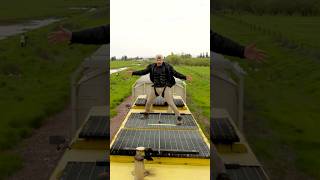
This video explains the physics behind why a person lands in the same spot when jumping inside a moving train, but not when jumping on top. Using a small-scale test with Lego figures in water and an analogy to air as a fluid, the presenter illustrates the role of air resistance in relative motion.
Chapters
The video begins by asking why landing inside a moving train differs from jumping on top.
A test with two Lego figures in water shows that the enclosed figure stays in place while the exposed one is pushed back.
The exposed figure moves through still water, experiencing resistance; the enclosed figure moves with the water, avoiding pushback.
Air behaves like water—inside the train, air moves with you; outside, it rushes past and pushes you back when you jump.
On top of the train, jumping means colliding with trillions of oncoming air molecules, causing you to land in a different spot.
The key factor is air resistance: inside the train, the air is stationary relative to you, while on top, the moving air pushes you backward, altering your landing position.
Study Flashcards (4)
Why do you land in the same spot when jumping inside a moving train?
easy
Click to reveal answer
Why do you land in the same spot when jumping inside a moving train?
Because the air inside the train moves with you, offering no resistance, so you land in the same spot.
00:39
What happens when you jump on top of a moving train?
easy
Click to reveal answer
What happens when you jump on top of a moving train?
You are pushed backward by rushing air molecules, causing you to land in a different spot.
00:54
In the small-scale test, what was used to demonstrate the concept?
easy
Click to reveal answer
In the small-scale test, what was used to demonstrate the concept?
Two Lego figures in water; one enclosed in a container, one exposed.
00:14
Why is air considered a fluid in this context?
easy
Click to reveal answer
Why is air considered a fluid in this context?
Air, like water, is a fluid that can push against objects moving through it.
00:39
💡 Key Takeaways
Water Resistance Analogy
Provides an intuitive understanding of how a surrounding medium affects motion.
00:26Air as a Fluid
Key conceptual leap: air behaves like water, explaining the difference in outcomes.
00:39Full Transcript
[00:00] Why do you land in the same spot if you jump inside the train, but not if you jump on top of a train? - But first, let's see if we can glean any clues from this small scale test with two Lego guys, but
[00:14] Here we go. Now because this test was in water, you intuitively sort of had a sense the top guy would
[00:26] Well yeah, cause the top guy would have to travel through all that still water and that would push Whereas inside the train car, he's enclosed, so everything in that car, including the water is
[00:39] And just like water, air is also a fluid. And that's why inside the train when I jump, I get no pushback from all my air molecule neighbors But on top of the train, it's a whole different story.
[00:54] I'm continuously bonking into a mad rush of trillions of air molecules every second as I whiz by. So if I jump now, it makes total sense why they would push me back and I would land in a whole different spot.