
AI Summary
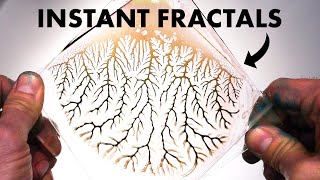
Viscous fingering, or Saffman-Taylor instability, occurs when a less viscous fluid pushes into a more viscous one, creating branching fractal patterns. This phenomenon appears in everyday situations, like pulling apart two plates with liquid in between, and has significant implications for carbon sequestration and oil extraction.
Chapters
Viscous fingering occurs when two surfaces with liquid in between are pulled apart, creating fractal patterns. The phenomenon is also known as the Saffman-Taylor instability.
Controlling viscous fingering could help reduce atmospheric CO2 by improving carbon sequestration, or conversely, increase CO2 in oil recovery processes.
A Hele-Shaw cell uses two flat plates with a small gap; injecting a thin fluid into a thick one produces fingering patterns. Examples include air into water, water into oil, and corn syrup into air.
The instability occurs because pushing a less viscous (thin) fluid into a more viscous (thick) fluid creates a pressure gradient, causing perturbations to grow into fingers.
A simple experiment: put a puddle of school glue, add a drop of food coloring and dish soap, and observe branching patterns driven by surface tension differences.
Viscous fingering is inefficient for sweeping thick fluids from porous media, affecting carbon dioxide storage and crude oil extraction. Researchers aim to disrupt it.
Viscous fingering reveals how fluid viscosity differences create beautiful fractal patterns, with practical consequences for environmental and energy technologies.
Mentioned in this Video
Study Flashcards (6)
What is the proper name for viscous fingering?
easy
Click to reveal answer
What is the proper name for viscous fingering?
Saffman-Taylor instability
05:39
What condition causes viscous fingering?
easy
Click to reveal answer
What condition causes viscous fingering?
Pushing a less viscous (thin) fluid into a more viscous (thick) fluid.
05:52
Why does viscous fingering occur?
medium
Click to reveal answer
Why does viscous fingering occur?
Pressure gradient and energy minimization: the thin fluid advances faster where it protrudes, and it is energetically easier to push aside the thick fluid.
07:37
What is a Hele-Shaw cell?
easy
Click to reveal answer
What is a Hele-Shaw cell?
Two flat plates separated by a small gap, with a hole to inject one fluid into another.
02:29
How does viscous fingering affect carbon sequestration?
medium
Click to reveal answer
How does viscous fingering affect carbon sequestration?
It causes inefficient sweeping of water from porous rocks, reducing the space available for CO2 storage.
11:15
What role does surface tension play in viscous fingering?
medium
Click to reveal answer
What role does surface tension play in viscous fingering?
Surface tension opposes the formation of fingers below a certain size, dictating finger thickness.
10:07
💡 Key Takeaways
Saffman-Taylor Instability
Defines the scientific term for viscous fingering, providing a foundation for understanding the phenomenon.
05:39Pressure Gradient Mechanism
Explains how pressure differences drive the growth of fingers, a key physical principle.
07:37At-Home Glue Experiment
Demonstrates the concept with everyday materials, making science accessible.
09:28Real-World Impact
Connects the phenomenon to carbon capture and oil recovery, showing practical relevance.
11:01Full Transcript
[00:11] the end of this video, it might be yours, too, because they're really cool. viscous fingering fractal yourself without even realizing it. Because if you've ever pulled two surfaces apart that had some kind of liquid in between,
[00:26] chances are you made a fractal. But why do these fingers form? And why do these fingers have fingers of their own? And why do those fingers have fingers? It's fingers all the way down in this episode of
[00:39] you know, Steve puts two pieces of clear acrylic together with liquid in between. Also, viscous fingering is weirdly important, like preventing viscous fingering might help us to reduce the amount of carbon
[00:53] dioxide in the atmosphere, but it might also help us to add more carbon dioxide mixed bag. But anyway, there are a few different ways to make viscous fingers. Prying apart two flat sheets is just one of them. It even works just with water,
[01:07] it's quite nice to just see this ephemeral branching pattern sweep across the plate. You can get something more permanent with honey or glycerol, but actually, PVA glue seems to work really well. You might call it Elmer's glue.
[01:21] But look, if I put it on this black acrylic plate, how cool is that? But you know, my preference is always to backlight transparent liquids. So, here's some clear PVA glue dyed blue. I mean, look at that. How cool is that? I
[01:34] cut these sheets into a butterfly shape. It was a challenge to get the pattern to emerge symmetrically, so I thought about cutting a channel down the center of the butterfly to encourage the fractal to grow from there, like a seed. But
[01:48] because I have to pry the butterfly open from the corner of a wing, I decided to cut grooves down the wings instead, but it didn't really work. Maybe I need to it didn't really work. Maybe I need to try it on a shape where I pry from the
[02:03] same place that I would place the guide groove. But anyway, viscous fingering is an interaction at the boundary between two fluids. The two fluids in this case being PVA glue, obviously. But the other
[02:16] fluid is air. The air is penetrating into the PVA glue in this branching fingering pattern. So, when you pull the plates apart, it's atmospheric pressure that's forcing the air into the glue. But that's not the only way to do it.
[02:29] a Hele-Shaw cell, which is just two flat plates separated by Well, in this case, put a hole in the middle of one of the plates, so you can force the second fluid into the first fluid via the hole. So, this is pushing air into water. This
[02:44] is what you get when you push water into oil.
[03:22] in from the middle. You can push it from the edge as well. This is water versus Well, breath, for example. That was so cool. Should I try it again?
[03:37] Yeah. How amazing. Just for comparison, what do we get if we flip those pairs of fluids? Well, this is water into air. This is oil into water. This is corn syrup into air. Basically, if you flip the fluids, well,
[03:51] it's just a convoluted way of making a circle. And why is that? I'll get to the explanation in a second, but look, I left this one on the side and it ended up drying out, which is cool cuz it's now a permanent pattern. I mean, you
[04:03] couldn't you? Though if I was going to do that, I'd need an e-commerce website. that, is it? Cuz you've also got to do like project management, accounting. The truth is, a business like that has a lot of moving parts.
[04:17] Wouldn't it be amazing if there was a solution out there that just took care of all of it? Like the sponsor of this video, Odoo. Odoo is a website builder much more than that. It's an all-in-one tool that gives entrepreneurs a whole
[04:30] management of their business, like invoicing, accounting, project management, inventory, and of course, e-commerce and websites. And the great thing is, the first app is free for life with unlimited hosting and unlimited
[04:42] e-commerce. And if that's all you want to use it for, then that's free forever, name for 1 year. Then if you want to access additional applications on top, it starts at $19.90 a month. But let's look at the e-commerce builder because
[04:57] it's really easy. It's four steps to define the business, and then Odoo your website from the information you content, and everything's automatically laid out nicely, whether it's on a
[05:09] mobile or desktop. Adding products is just as easy. And then there's a few bits of business info like bank account details, shipping method, payment provider, and that's it. You can start selling. The additional apps are all
[05:22] other, so you don't need to set up any automations between, like, sales and stock control, or whatever. The automations are automatic, interested in, I'd love you to use my URL so that they know I sent you. It's
[05:39] in the description there, so check out Odoo today. The proper name for this behavior is Saffman-Taylor instability. It's an instability because a smooth boundary between the two fluids is unstable. It will tend to spontaneously
[05:52] become unsmooth. And the reason it's called viscous fingering is because the instability only appears when you try to push a less viscous fluid into a more viscous fluid. I'm just going to say thin and thick from now on instead of
[06:04] less viscous and more viscous. But anyway, that's why all of these tests created a fractal pattern, but the reverse of those tests didn't. It only the thicker fluid. Informally speaking,
[06:17] viscosity is just a measure of how much a fluid resists being moved. So, imagine we've got a long Hele-Shaw cell like this. This is the thick fluid that we're trying to push along the cell using this thin fluid. Now, that requires some
[06:31] effort because the fluids are viscous. They don't want to move. And that effect is enhanced by how thin the Hele-Shaw cell is. These viscous fluids are sticking to the plates of the Hele-Shaw cell and being dragged past by the flow
[06:45] of the fluids. So, all the way along as the fluid is moving through the cell, energy is being lost as friction against the plates. That means you have a pressure drop. You have high pressure here to fight all that viscous
[06:58] resistance. And most of the energy is spent by the end, so the pressure here is small. There's a pressure gradient. geography anyway. Fluid flows from regions of high pressure to low
[07:11] notice that this is different to the assertion that I made in my video about hose instability. In that video, I confidently stated that the pressure fire hose, but of course it does because of viscosity. But anyway, there are a
[07:25] few other issues with that video, and at some point I'll make a follow-up. But there are corrections now in the card and description of that video. Back to the viscous fingering. For simplicity, let's assume that the thin fluid is air,
[07:37] and let's assume that it has basically no viscosity. In other words, there's no friction between the air and the two plates of the Hele-Shaw cell. In that case, we know that the pressure in the region taken up by air inside the
[07:50] Hele-Shaw cell is everywhere the same. But, the pressure inside the thick fluid still has that gradient in the direction that it's being pushed. In other words, the pressure just inside the viscous fluid is the same as the pressure in all
[08:02] of the air inside the Hele-Shaw cell, but that pressure goes down as you go in happens when we introduce a perturbation into the boundary between the two fluids. Well, this point here is a little further forward into the viscous
[08:16] fluid region. So, we know that the pressure here is slightly less compared to air pressure. So, the air is going to push this part of the boundary forwards more rapidly than everywhere else. And so, the bulge grows. And as the air
[08:31] advances in that region, the pressure difference only gets greater. And so, it speeds up. As the front bulges outwards, the advancing front of the finger becomes actually quite flat. At which point any new slight perturbation that
[08:46] appears will start to advance faster than the surrounding. And so, the finger there might be a nicer way to think about it, which is in terms of energy. The system is trying to push the thin fluid forwards. And what's the easiest
[09:01] way to do that? Well, if the boundary between the two fluids remains flat, then to push the thin fluid forwards, you have to push all of the thick fluid forwards as well, which really resists being pushed. Wouldn't it be simpler to
[09:15] just push the thick fluid to one side and advance through the gap? In other words, the thin fluid does the energetically more favorable thing. fingering. This one's nice because you can do it at home. You don't need to
[09:28] build anything. You make a little puddle of that school glue, add a drop of food soap. That's cool, isn't it? Look at those branching patterns. I'm not sure that strictly speaking this is an example of
[09:42] Saffman-Taylor instability because well, it's not happening in a Hele-Shaw cell, and you don't have one fluid being pushed into the other fluid. Instead, movement is driven by a difference in surface tension. This is like how you
[09:54] can make pepper spread out on the surface of water by adding a drop of dish soap. But, I believe the fingering pattern is still down to a difference in viscosity. The glue is much thicker than the dish soap food dye combo. that the
[10:07] fingers here are much thinner than the fingers we were getting in the Hele-Shaw cell. That's because finger size is dictated by surface tension. Surface tension opposes the formation of fingers below a certain size. And so, because
[10:19] tension in this example, we should just wanted to show you a clip from a video I made a while back about ink-powered leaf boats. The reason the leaf moves forwards is probably down to
[10:33] surface tension, again like the pepper thing. video I tried using the different ingredients in Biro ink separately to see what happens. The main solvent in Biro is phenoxyethanol. And on its own, when you put it on water, it does this
[10:48] mad thing. How cool is that? There seems to be a fingering pattern there, but it's incredibly short-lived. I wonder if this is driven by a difference in viscosity as well. But, I digress. The reason we see the viscous fingering
[11:01] pattern in a Hele-Shaw cell is because the plates of the Hele-Shaw cell provide lots of friction. But, that's not the only way you can do it. You can achieve only way you can do it. You can achieve high friction in a porous 3D medium as
[11:15] well. You might know that scientists are working on a way to pump carbon dioxide working on a way to pump carbon dioxide into porous rocks as a way to reduce you do that, you're displacing the water from the porous rocks. And carbon
[11:29] from the porous rocks. And carbon dioxide is thinner than water. So, when you attempt it, you end up with a fingering pattern. And unfortunately, viscous fingering is a really inefficient way to sweep the thick fluid
[11:42] from the porous media, which means you more quickly run out of space to put the thin fluid, in this case carbon dioxide. On the flip side, if you want to extract On the flip side, if you want to extract crude oil from porous rock by pushing
[11:54] air or water into it, viscous fingering means you're going to have a bad time. So, scientists are trying to figure out ways to disrupt viscous fingering for literally a whole spectrum of reasons. I'm interested in trying other
[12:08] butterfly, but where the symmetry promoting channel lines up with the pry direction. If you've got any ideas for that, let me know in the comments. In the meantime, the algorithm thinks you'll enjoy this video next.